2. Solving One-Step Equations with Rational Coefficients
Sign In
An error ocurred, try again later!
Chapter 6
2.
Solving One-Step Equations with Rational Coefficients
This lesson explores the methods for solving one-step equations where the coefficients are rational numbers. It emphasizes the importance of using the Multiplication Property of equality and the Division Property of Equality to find the solution. These techniques are not just theoretical; they have practical applications too. For example, they can be used in financial calculations, engineering problems, and various other fields that require precise mathematical reasoning. The goal is to make learners proficient in solving such equations, whether they are high school students preparing for advanced algebra or professionals needing these skills for their work.
Show less Show more expand_more 


Lesson Settings & Tools
| | 12 Theory slides |
| | 11 Exercises - Grade E - A |
| | Each lesson is meant to take 1-2 classroom sessions |
Solving One-Step Equations with Rational Coefficients
Slide of 12
Real-life situations modeled by an equation include a coefficient of the variable which can be a rational number. Both sides of the equation are multiplied or divided by a number to isolate the variable. This lesson begins its focus on solving equations involving multiplication and division. Then, the focus shifts to how to write these equations when modeling real-life problems.
Catch-Up and Review
Here are a few recommended readings before getting started with this lesson.
Challenge
Share
Report error
A Vinyl Record Collection
Diego is going through some old stuff in storage. He discovers an entire rack of vinyls! There are 200 in total and they belong to his dad. Diego asks his father how long this collection took to gather.

a Write an equation in terms of m that represents the situation.
{"type":"text","form":{"type":"math","options":{"comparison":"1","nofractofloat":false,"keypad":{"simple":false,"useShortLog":false,"variables":["m"],"constants":[]},"rendered":false},"text":" "},"formTextBefore":null,"formTextAfter":null,"answer":{"text":["10m=200","200=10m","10=200\/m","200\/m=10","m=200\/10","200\/10=m"]}}
b Solve the equation to find the time it took Diego's father to gather his collection of records.
{"type":"text","form":{"type":"math","options":{"comparison":"1","nofractofloat":false,"keypad":{"simple":true,"useShortLog":false,"variables":[],"constants":[]},"rendered":false},"text":" "},"formTextBefore":null,"formTextAfter":"months","answer":{"text":["20"]}}
Discussion
Share
Report error
Multiplication Property of Equality
Multiplication and division are inverse operations. They can be used to solve equations by the following properties of equality.
Rule
Share
Report error
Multiplication Property of Equality
Given an equation, multiplying each side of the equation by the same number yields an equivalent equation. Let a, b, and c be real numbers.
If a = b, then a * c = b * c.
The Multiplication Property of Equality is an axiom, so it does not need a proof. This property is one of the Properties of Equality that can be used when solving equations. Consider the following example. x÷4&=2 x÷4 * 4&=2 * 4 x&=8
Here, by multiplying both sides of the equation by 4, the variable x was isolated and the solution of the equation was found.Discussion
Share
Report error
Division Property of Equality
Dividing each side of an equation by the same nonzero number yields an equivalent equation. Let a, b, and c be real numbers.
If a = b and c≠ 0, then a ÷ c = b ÷ c.
The Division Property of Equality is an axiom, so it does not need a proof to be accepted as true. This property is one of the Properties of Equality that can be used when solving equations. 5x&=10 5x ÷ 5&=10 ÷ 5 x&=2
As can be observed, by dividing both sides of the equation by 5, the variable x was isolated and the solution of the equation was found.Example
Share
Report error
Vinyl Collection Stored in Boxes
a Diego's father stored his vinyl collection in five boxes. Each box contains the same number of records and, in total, there are 200 vinyl records in the collection. This situation can be represented by an equation.
{"type":"text","form":{"type":"math","options":{"comparison":"1","nofractofloat":false,"keypad":{"simple":true,"useShortLog":false,"variables":["x"],"constants":["PI"]},"rendered":false},"text":" "},"formTextBefore":"b =","formTextAfter":null,"answer":{"text":["40"]}}
b Diego's grandfather also found some records.
 Diego wants to put an equal number of those records grandpa found into each of the five boxes. He notices that he would have to put seven records into each box to do that. The following equation represents the situation.
{"type":"text","form":{"type":"math","options":{"comparison":"1","nofractofloat":false,"keypad":{"simple":true,"useShortLog":false,"variables":["x"],"constants":["PI"]},"rendered":false},"text":" "},"formTextBefore":"r =","formTextAfter":null,"answer":{"text":["35"]}}
Hint
a Use the Division Property of Equality.
b Use the Multiplication Property of Equality.
Solution
a When solving equations in one variable, the variable is isolated on one side of the equation. This can be done by using inverse operations because inverse operations undo each other. Consider the given equation.
5b=200
DivEqn
.LHS /5.=.RHS /5.
5b/5 = 200/5
CrossCommonFac
Cross out common factors
5b/5 = 200/5
SimpQuot
Simplify quotient
b = 200/5
CalcQuot
Calculate quotient
b = 40
b Recall that the variable is isolated on one side when solving equations in one variable. Inverse operations play a role in isolating the variable because they
undoeach other. Consider the given equation.
r/5 = 7
MultEqn
LHS * 5=RHS* 5
r/5 * 5 = 7* 5
FracMultDenomToNumber
a/5* 5 = a
r = 7* 5
Multiply
Multiply
r = 35

Discussion
Share
Report error
Solving Equations With Rational Coefficients
The Multiplication Property of Equality can be used instead of the Division Property of Equality anytime when solving an equation with a coefficient that is a rational number. Consider an equation in the form abx = c. a/bx = c The coefficient ab is a fraction. For that reason, the equation can be solved by multiplying both sides by the reciprocal of ab. As an example, consider the following equation. 3/5 x = 6 The coefficient next to the variable is 35. Interchange the numerator and denominator to find its reciprocal. The reciprocal of 35 is 53, so the equation can be solved by multiplying both sides by 53.
3/5x = 6
MultEqn
LHS * 5/3=RHS* 5/3
3/5x * 5/3 = 6 * 5/3
▼
Simplify
CommutativePropMult
Commutative Property of Multiplication
x * 3/5 * 5/3 = 6 * 5/3
MultFracByInverse
a/b* b/a=1
x * 1 = 6 * 5/3
MultByOne
a * 1=a
x = 6* 5/3
MoveLeftFacToNum
a*b/c= a* b/c
x = 6* 5/3
Multiply
Multiply
x = 30/3
CalcQuot
Calculate quotient
x = 10
Example
Share
Report error
Vinyl Records, Rotations, and Song Length
Diego finds himself wondering about the speed at which a record rotates. His father tells Diego that the record rotates 190 times while playing a song on the album. Diego later reads online that a record rotates 59 of a full rotation every second it plays.

{"type":"text","form":{"type":"math","options":{"comparison":"1","nofractofloat":false,"keypad":{"simple":true,"useShortLog":false,"variables":["x"],"constants":["PI"]},"rendered":false},"text":" "},"formTextBefore":"t =","formTextAfter":null,"answer":{"text":["342"]}}
Hint
Identify the coefficient of the variable. Multiply both sides of the equation by the reciprocal of the coefficient.
Solution
Consider the given equation.
5/9 t = 190
Here, the variable is t and its coefficient is the fraction 59. Since it is a fraction, isolate the variable by multiplying both sides of the equation by the reciprocal of that fraction. Recall that the reciprocal of a fraction is found by interchanging the numerator and denominator. The reciprocal of 59 is 95. Now, multiply the equation by 95.
The solution to the equation is t = 342, which means that the song lasts 342 seconds.
5/9t = 190
MultEqn
LHS * 9/5=RHS* 9/5
5/9t*9/5= 190*9/5
▼
Simplify
CommutativePropMult
Commutative Property of Multiplication
t* 5/9*9/5= 190*9/5
MultFracByInverse
a/b* b/a=1
t* 1= 190*9/5
MultByOne
a * 1=a
t = 190*9/5
MoveLeftFacToNum
a*b/c= a* b/c
t = 190*9/5
Multiply
Multiply
t = 1710/5
CalcQuot
Calculate quotient
t = 342
Pop Quiz
Share
Report error
Solving Equations
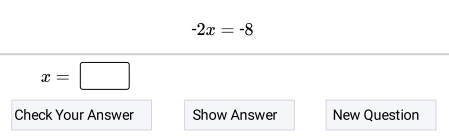
Solve the equations using the Multiplication Property of Equality or the Division Property of Equality. If necessary, round answers to two decimal places.
Discussion
Share
Report error
Writing Equations
Many real-life situations can be algebraically modeled by equations. These equations can involve a variable that represents an unknown quantity. Consider modeling the following situation.
|
Diego categorizes his father's record collection by genre. He finds out that there are 8 different genres, each with the same number of records. The collection contains 200 records. How many records are there in each genre? |
8x = 200
DivEqn
.LHS /8.=.RHS /8.
8x/8 = 200/8
CrossCommonFac
Cross out common factors
8x/8 = 200/8
SimpQuot
Simplify quotient
x = 200/8
CalcQuot
Calculate quotient
x=25
Example
Share
Report error
Earning to Fix the Turntable
Diego's father's old turntable is broken. Diego is so eager to listen to the records that he decides to make some money to buy the replacement parts. The parts that Diego needs to buy costs $96. Diego's neighbor offers him $8 per walk to walk her dog.

a Write an equation for the number x of times Diego has to walk his neighbor's dog to earn enough money to buy the parts he needs.
{"type":"text","form":{"type":"math","options":{"comparison":"1","nofractofloat":false,"keypad":{"simple":false,"useShortLog":false,"variables":["x"],"constants":[]},"rendered":false},"text":" "},"formTextBefore":null,"formTextAfter":null,"answer":{"text":["8x = 96","96 = 8x","96\/x = 8","8= 96\/x","x = 96\/8","96\/8 = x"]}}
b Solve the equation.
{"type":"text","form":{"type":"math","options":{"comparison":"1","nofractofloat":false,"keypad":{"simple":false,"useShortLog":false,"variables":[],"constants":[]},"rendered":false},"text":" "},"formTextBefore":"x =","formTextAfter":null,"answer":{"text":["12"]}}
c Which of the following is a true statement?
{"type":"choice","form":{"alts":["Diego needs to walk the dog exactly 12 times.","Diego needs to walk the dog more than 12 times.","Diego needs to walk the dog less than 12 times."],"noSort":false},"formTextBefore":"","formTextAfter":"","answer":0}
Hint
a Assign the variable to the unknown quantity.
b Use the Properties of Equality to solve the equation written in Part A.
c What does the variable represent?
Solution
a The number of times Diego has to walk the dog is represented by the variable x. Diego gets $ 8 per walk, so the total amount he earns is equal to 8 x. He wants to save $96, so the amount earned should be equal to $ 96. By combining all this information, an equation can be written as follows.
8 x = 96 This equation models the given situation.
b Solving an equation in one variable means isolating the variable on one side.
8x = 96
DivEqn
.LHS /8.=.RHS /8.
8x/8 = 96/8
CrossCommonFac
Cross out common factors
8x/8 = 96/8
SimpQuot
Simplify quotient
x = 96/8
CalcQuot
Calculate quotient
x = 12
c The variable x in the equation from Part A represents the number of times Diego needs to walk his neighbor's dog to earn enough money for the parts he needs to repair the broken turntable. The calculations show that x = 12. This means that Diego needs to walk the dog exactly 12 times to earn enough.
x = 12 ⇓ Diego needs to walk the dog12times.
Example
Share
Report error
Job Well Done
The dog Diego walked loved him so much — just look at the two of them!  His neighbor, the dog owner, was so impressed that affter 12 walks, she decided to pay Diego handsomely. Diego received $10 for each walk.
a Write an equation for the amount t of money Diego got in total.
{"type":"text","form":{"type":"math","options":{"comparison":"1","nofractofloat":false,"keypad":{"simple":false,"useShortLog":false,"variables":["t"],"constants":[]},"rendered":false},"text":" "},"formTextBefore":null,"formTextAfter":null,"answer":{"text":["12*10 = t","t = 12*10","t\/10 = 12","12= t\/10","10 = t\/12","t\/12 = 10"]}}
b Solve the equation.
{"type":"text","form":{"type":"math","options":{"comparison":"1","nofractofloat":false,"keypad":{"simple":true,"useShortLog":false,"variables":[],"constants":[]},"rendered":false},"text":" "},"formTextBefore":"t =","formTextAfter":null,"answer":{"text":["120"]}}
c Which of the following is a true statement?
{"type":"choice","form":{"alts":["Diego got less than $120.","Diego got more than $120.","Diego got exactly $120."],"noSort":false},"formTextBefore":"","formTextAfter":"","answer":2}
Hint
a Assign the variable to the unknown quantity.
b Use the Properties of Equality to solve the equation written in Part A.
c What does the variable represent?
Solution
a The total amount of money Diego got for walking the dog is represented by the variable t. Diego walked the dog 12 times, so the amount he earned for one walk is t 12. The neighbor paid Diego $ 10 per walk, so the amount earned for one walk should be equal to 10. Now, an equation can be written.
t/12 = 10 Note that different equations, equivalent to this one, can also be used to model this situation. An example of such an equation is t = 12 * 10.
b Isolate the variable t on one side to solve the equation.
t/12 = 10
MultEqn
LHS * 12=RHS* 12
t/12 * 12 = 10 * 12
FracMultDenomToNumber
a/12* 12 = a
t = 10 * 12
Multiply
Multiply
t = 120
c The variable t in the equation from Part A represents the total amount of money Diego earned walking his neighbor's dog. The calculations show that t = 120. This means that Diego earned exactly $120. t = 120 ⇒ Diego earned$120.
It is safe to say that Diego earned enough to fix the turntable. Play that jam! 
Closure
Share
Report error
How Long Did It Take To Compile the Collection?
The challenge presented at the beginning of the lesson can be solved by writing an equation that models the situation and then solving the equation. It stated that Diego's father collected 200 vinyl records and bought 10 records every month.

a Write an equation in terms of m that represents the situation.
{"type":"text","form":{"type":"math","options":{"comparison":"1","nofractofloat":false,"keypad":{"simple":false,"useShortLog":false,"variables":["m"],"constants":[]},"rendered":false},"text":" "},"formTextBefore":null,"formTextAfter":null,"answer":{"text":["10m=200","200=10m","10=200\/m","200\/m=10","m=200\/10","200\/10=m"]}}
b Solve the equation to find the time it took Diego's father to gather his collection of records.
{"type":"text","form":{"type":"math","options":{"comparison":"1","nofractofloat":false,"keypad":{"simple":true,"useShortLog":false,"variables":[],"constants":[]},"rendered":false},"text":" "},"formTextBefore":null,"formTextAfter":"months","answer":{"text":["20"]}}
Hint
a Assign a variable to the number of months.
b Use the Division Property of Equality.
Solution
a When modeling a real-life situation with an equation, the first step is to assign a variable to the unknown quantity. In this case, the unknown quantity is the number of months it took Diego's father to gather his collection, so let it be m.
Number of Months: m Diego's father bought 10 records every month. Then, the number of records Diego's father collected in m months is 10 m. There are 200 records in the collection, so 10 m must be equal to 200. 10 m = 200 Diego figured out the equation!
b The m-variable must be isolated to solve the equation. In this case, m is multiplied by 10. Divide both sides of the equation by 10 to isolate m. Recall that dividing both sides by the same number does not change the solution to the equation because of the Division Property of Equality.
10m = 200
DivEqn
.LHS /10.=.RHS /10.
10m/10 = 200/10
FracMultDenomToNumber
a/10* 10 = a
m = 200/10
CalcQuot
Calculate quotient
m=20
Extra
Equations With Decimal CoefficientsOn a final note, consider an equation where the coefficient is a decimal.
1.6x = 12
Equations where the coefficient is a decimal can be solved the same way as equations where the coefficient is an integer or a fraction. In this case, this means dividing both sides of the equation by the coefficient 1.6.
Similarly, when solving equations where the variable is divided by a decimal, or a decimal is added or subtracted from the variable, we use the same methods we would when solving an equation with integers or fractions.
1.6x = 12
DivEqn
.LHS /1.6.=.RHS /1.6.
1.6x/1.6 = 12/1.6
FracMultDenomToNumber
a/1.6* 1.6 = a
x = 12/1.6
CalcQuot
Calculate quotient
x = 7.5
Solving One-Step Equations with Rational Coefficients
Exercise 1.1
Translate the given sentences into equations.
{"type":"text","form":{"type":"math","options":{"comparison":"1","nofractofloat":false,"keypad":{"simple":false,"useShortLog":false,"variables":["k"],"constants":[]},"rendered":false},"text":" "},"formTextBefore":null,"formTextAfter":null,"answer":{"text":["7k=12","12=7k"]}}
{"type":"text","form":{"type":"math","options":{"comparison":"1","nofractofloat":false,"keypad":{"simple":false,"useShortLog":false,"variables":["x"],"constants":[]},"rendered":false},"text":" "},"formTextBefore":null,"formTextAfter":null,"answer":{"text":["41=1.5x"]}}
{"type":"text","form":{"type":"math","options":{"comparison":"1","nofractofloat":false,"keypad":{"simple":false,"useShortLog":false,"variables":["n"],"constants":[]},"rendered":false},"text":" "},"formTextBefore":null,"formTextAfter":null,"answer":{"text":["5n = 22"]}}
security
report
code
security
report
code
We have been given a sentence and we want to translate it into an equation.
Seven times k is equal to twelve.
Every equation has an equals sign and values or expressions on either side of it. Key phrases, such as is,
is equal to,
and equals
tell us about the placement of the equals sign. Let's look for such a keyword in the given sentence and replace it with the equals sign.
Seven timesk is equal to twelve.
⇕
Seven timesk = twelve.
On the left-hand side we have another keyword times.
This word tells us the operation that will be used in our equation, which is multiplication.
Seven times k
7 * k
On the right-hand side, we have the number twelve. Putting these sides together, we have a complete equation.
7 * k = 12
We want to translate the given sentence into an equation.
Forty-one is one and a half times x.
Like every equation, our equation will have an equals sign and values or expressions on either side of it. Key phrases, like is,
is equal to,
and equals
tell us where the equals sign should be placed.
Forty-one is one and a half timesx.
⇕
Forty-one = one and a half timesx.
The left-hand side is the number forty-one. On the right-hand side, we have the keyword times.
This means that we will use multiplication in our equation.
one and a half times x
1.5 * x
Putting the two sides together, we have a complete equation.
41 = 1.5 * x
Let's translate the given sentence into an equation.
The product of n and 5 equals 22.
Like all equations, ours will have an equals sign and values or expressions on either side of it. Key phrases, for example is,
is equal to,
and equals
tell us where to put the equals sign.
The product ofnand5 equals 22.
⇕
The product ofnand5 = 22.
On the left-hand side we have the keyword product.
This word tells us that multiplication will be used in our equation.
The product of n and 5
n * 5
On the right-hand side, we have the number 22. Putting these sides together, we have a complete equation.
n * 5 = 22
security
report
code
Translate the given sentences into equations.
{"type":"text","form":{"type":"math","options":{"comparison":"1","nofractofloat":false,"keypad":{"simple":false,"useShortLog":false,"variables":["k"],"constants":[]},"rendered":false},"text":" "},"formTextBefore":null,"formTextAfter":null,"answer":{"text":["k\/8=4","4=k\/4"]}}
{"type":"text","form":{"type":"math","options":{"comparison":"1","nofractofloat":false,"keypad":{"simple":false,"useShortLog":false,"variables":["v"],"constants":[]},"rendered":false},"text":" "},"formTextBefore":null,"formTextAfter":null,"answer":{"text":["14=v\/5","v\/5=14"]}}
{"type":"text","form":{"type":"math","options":{"comparison":"1","nofractofloat":false,"keypad":{"simple":false,"useShortLog":false,"variables":["p"],"constants":[]},"rendered":false},"text":" "},"formTextBefore":null,"formTextAfter":null,"answer":{"text":["p\/2 = 14","14=p\/2"]}}
security
report
code
security
report
code
We are given the following sentence and we want to translate it into an equation.
The number k divided by eight is equal to four.
Every equation has an equals sign and values or expressions on either side of it. Key phrases, such as is,
is equal to,
and equals
helps us determine where to put the equal sign.
The numberk divided by eight is equal to four.
⇕
The numberk divided by eight = four.
On the left-hand side we have the key phrase divided by.
This tells us the operation that will be used in our equation, which is division.
The numberk divided by eight
k ÷ 8
On the right-hand side, we have the number four. Putting these sides together, we have a complete equation.
k ÷ 8 = 4
We want to translate the given sentence into an equation.
Fourteen is v divided by five.
Like every equation, our equation will have an equals sign and values or expressions on either side of it. Key phrases, like is,
is equal to,
and equals
tell us where the equals sign should be placed.
Fourteen is vdivided by five.
⇕
Fourteen = vdivided by five.
The left-hand side is the number fourteen. On the right-hand side, we have the key phrase divided by.
This means that we will use division in our equation.
v divided by five
v ÷ 5
Putting the two sides together, we have a complete equation.
14 = v ÷ 5
Let's translate the given sentence into an equation.
The quotient of p and 2 equals 13.
Like all equations, ours will have an equals sign and values or expressions on either side of it. Key phrases, for example is,
is equal to,
and equals
tell us where to put the equals sign.
The quotient ofpand2 equals 13.
⇕
The quotient ofpand2 = 13.
On the left-hand side we have the keyword quotient.
This tells us that division will be used in our equation.
The quotient of p and 2
p ÷ 2
On the right-hand side, we have the number 13. Putting these sides together, we have a complete equation.
p ÷ 2 = 13
security
report
code
Solve the given equations.
{"type":"text","form":{"type":"math","options":{"comparison":"1","nofractofloat":false,"keypad":{"simple":true,"useShortLog":false,"variables":["x"],"constants":["PI"]},"rendered":false},"text":" "},"formTextBefore":"x =","formTextAfter":null,"answer":{"text":["6"]}}
{"type":"text","form":{"type":"math","options":{"comparison":"1","nofractofloat":false,"keypad":{"simple":true,"useShortLog":false,"variables":["x"],"constants":["PI"]},"rendered":false},"text":" "},"formTextBefore":"u =","formTextAfter":null,"answer":{"text":["-4"]}}
{"type":"text","form":{"type":"math","options":{"comparison":"1","nofractofloat":false,"keypad":{"simple":true,"useShortLog":false,"variables":["x"],"constants":["PI"]},"rendered":false},"text":" "},"formTextBefore":"r =","formTextAfter":null,"answer":{"text":["-3\/7"]}}
security
report
code
security
report
code
We have to isolate the variable x on one side to solve the given equation. 4x = 24 In this equation, x is multiplied by 4. To undo this multiplication, we need to divide both sides by 4 because multiplication and division are inverse operations. We can perform this division because of the Division Property of Equality. Let's do it!
Our calculations show that the solution to the given equation is x=6. To check that this solution is correct, let's substitute x=6 into the original equation and simplify.
The left-hand side and right-hand side are equal, so x=6 is the correct solution.
For this equation, we need to isolate u on one side. -2 u = 8 Here, the variable u is multiplied by - 2. Dividing by - 2 is the inverse of multiplying by - 2. Let's use the Division Property of Equality to divide both sides of the equation by - 2. This will isolate u.
The solution to the given equation is u=- 4. Finally, we substitute u=- 4 into the original equation and check if our answer is correct.
Substituting u=- 4 resulted in a true statement. We can conclude that u=- 4 is the correct solution.
This time, we will isolate the variable r to solve the equation. 7r = - 3 We can see that r is multiplied by 7. We will use the Division Property of Equality to divide both sides of the equation by 7. This will undo multiplying by 7 and isolate r.
The solution to the given equation is r=- 37. Now, let's verify that our answer is correct. We will substitute r=- 37 into the original equation and simplify to check that our answer is correct.
This statement is true, so r=- 37 is the correct solution.
security
report
code
Solve the given equations.
{"type":"text","form":{"type":"math","options":{"comparison":"1","nofractofloat":false,"keypad":{"simple":true,"useShortLog":false,"variables":["x"],"constants":["PI"]},"rendered":false},"text":" "},"formTextBefore":"a =","formTextAfter":null,"answer":{"text":["36"]}}
{"type":"text","form":{"type":"math","options":{"comparison":"1","nofractofloat":false,"keypad":{"simple":true,"useShortLog":false,"variables":["x"],"constants":["PI"]},"rendered":false},"text":" "},"formTextBefore":"p =","formTextAfter":null,"answer":{"text":["20"]}}
{"type":"text","form":{"type":"math","options":{"comparison":"1","nofractofloat":false,"keypad":{"simple":true,"useShortLog":false,"variables":["x"],"constants":["PI"]},"rendered":false},"text":" "},"formTextBefore":"h =","formTextAfter":null,"answer":{"text":["-28"]}}
security
report
code
security
report
code
We have to isolate the variable a on one side to solve the given equation. a ÷ 4 = 9 In this equation, the variable a is divided by 4. Since the inverse of dividing by 4 is multiplying by 4, we will multiply both sides of the equation by 4. The operations will undo each other and the variable is isolated. Let's use the Multiplication Property of Equality to do what we just said.
Our calculations show that the solution to the given equation is a=36. To check that this solution is correct, we will substitute 36 for x into the original equation and simplify.
The left-hand side and right-hand side are equal. This means that a=36 is the correct solution.
Let's solve this equation. 5 = p/4 We need to isolate the variable p on one side to find its solution. We see that p is divided by 4. In this case, we can eliminate the denominator of the fraction by multiplying both sides of the equation by 4. Recall that we are allowed to do so by the Multiplication Property of Equality.
The solution to the given equation is p=20. We can substitute 20 for p into the original equation and simplify to check that our answer is correct.
This statement is true, so p=20 is the correct solution.
We will solve the given equation. We need to isolate the variable h on one side. h/- 4 = 7 In this equation, h is divided by - 4. Again, we will use the Multiplication Property of Equality. If we multiply both sides of the equation by - 4, the variable h will be isolated. This is because multiplying by - 4 is the inverse of dividing by - 4.
The solution to the given equation is h=- 28. Now, let's verify that our answer is correct. We will substitute h=- 28 into the original equation and simplify to check that our answer is correct.
This statement is true, so h=- 28 is the correct solution.
security
report
code
Solve the given equations using reciprocals. Check your answers.
{"type":"text","form":{"type":"math","options":{"comparison":"1","nofractofloat":false,"keypad":{"simple":true,"useShortLog":false,"variables":["x"],"constants":["PI"]},"rendered":false},"text":" "},"formTextBefore":"q =","formTextAfter":null,"answer":{"text":["24"]}}
{"type":"text","form":{"type":"math","options":{"comparison":"1","nofractofloat":false,"keypad":{"simple":true,"useShortLog":false,"variables":["x"],"constants":["PI"]},"rendered":false},"text":" "},"formTextBefore":"k =","formTextAfter":null,"answer":{"text":["-16"]}}
{"type":"text","form":{"type":"math","options":{"comparison":"1","nofractofloat":false,"keypad":{"simple":true,"useShortLog":false,"variables":["x"],"constants":["PI"]},"rendered":false},"text":" "},"formTextBefore":"g =","formTextAfter":null,"answer":{"text":["-21"]}}
security
report
code
security
report
code
Let's take a look at the given equation. 2/3q = 16 We will isolate the variable q on one side to solve this equation. We see that q is multiplied by a fraction, 23. In other words, the coefficient of the variable is 23. In this case, we can isolate q by multiplying both sides of the equation by the reciprocal of the coefficient. Recall that the reciprocal of a fraction is found by interchanging the numerator and denominator. Fraction & Reciprocal 2/3 & 3/2 Let's multiply both sides by 32. We are allowed to do it by the Multiplication Property of Equality.
Our calculations show that the solution to the given equation is q=24. To check that this solution is correct, let's substitute 24 for q into the original equation and simplify.
The left-hand side and right-hand side are equal, so q=24 is the correct solution.
Let's now solve this equation. - 5/8k = 10 We will isolate k on one side. Here, the variable k is multiplied by - 58. This is a fraction, so we will multiply both sides of the equation by its reciprocal. Fraction & Reciprocal - 5/8 & - 8/5 Let's multiply the equation by the reciprocal.
The solution to the given equation is k=- 16. We can substitute - 16 for k into the original equation and simplify to check that our answer is correct.
This statement is true, so k=- 16 is the correct solution.
Finally, we will solve the following equation. 4/7g = - 12 We need to isolate the variable. We can do it by multiplying both sides of the equation by the reciprocal of the coefficient. The reciprocal of the coefficient 47 is 74. Fraction & Reciprocal 4/7 & 7/4 Let's solve the equation!
The solution to this equation is g=- 21. Now, let's verify that our answer is correct. We will substitute -21 for g in the original equation and simplify to check that our answer is correct.
This statement is true, so g=-21 is the correct solution.
security
report
code
Solving One-Step Equations with Rational Coefficients
Recommended exercises
To get personalized recommended exercises, please login first.
Loading content
≤
>
■2
■▢
e▢
7
8
9
×
÷■1
=
=
√▢
▢√
∫▢▢
4
5
6
+
−
≤
<
log
ln
log▢
1
2
3
()
∣
sin
cos
tan
0
.
π
x
y
Loading content