7. Rigid Motion and Congruence
Sign In
An error ocurred, try again later!
Chapter 1
7.
Rigid Motion and Congruence
Explore the concept of rigid motions and their relationship with congruent figures. Rigid motions, which include transformations like translations, rotations, and reflections, play a pivotal role in understanding the congruence of geometric shapes. When two figures can be mapped onto each other using only rigid motions, they are deemed congruent. This lesson emphasizes the significance of understanding these transformations, especially when determining the congruence of complex geometric figures. Real-world examples, such as determining the congruence of logos or analyzing the properties of various polygons, further illustrate the practical applications of these concepts. The lesson also touches upon the importance of sequence in rigid motions and how different sequences can lead to varied results. Overall, the lesson provides a comprehensive insight into the relationship between rigid motions and congruence in geometry.
Show less Show more expand_more 


Lesson Settings & Tools
| | 11 Theory slides |
| | 6 Exercises - Grade E - A |
| | Each lesson is meant to take 1-2 classroom sessions |
Rigid Motion and Congruence
Slide of 11
A method used to determine whether two segments or angles are congruent is to find and compare their measures. Additionally, their congruence can be determined through the use of rigid motions. Engage with this lesson to learn how this is done.
Catch-Up and Review
Here are a few recommended readings before getting started with this lesson.
Challenge
Share
Report error
Identifying Congruent Figures
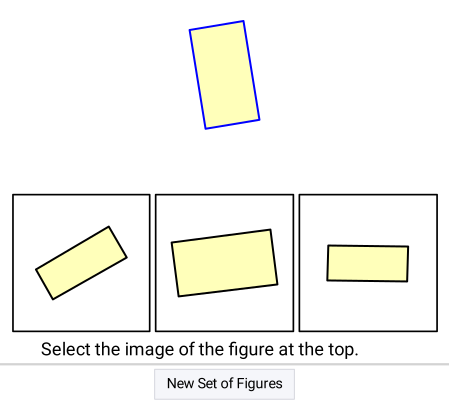
In the following applet, four figures are shown. One of the three figures at the bottom is the result of applying a rigid motion or a sequence of rigid motions to the upper figure. Match the preimage with its image.
Discussion
Share
Report error
Congruence and Rigid Motions
When working with the different types of rigid motions, it was used that they map a segment into another segment. To verify that this is true, consider a segment AB and any rigid motion. Let C be the image of A and D the image of B.
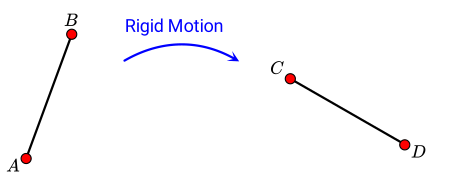
Because rigid motions preserve distances, CD is equal to AB. Now, to check that every point of AB was actually mapped onto CD, consider a point P on AB different from the endpoints. Let Q be the image of P under the rigid motion.
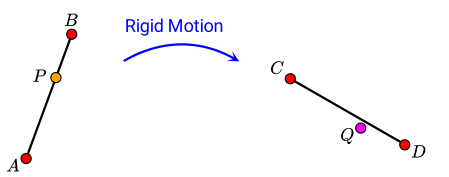
CQ=AP & (I) QD=PB & (II)
▼
Solve by elimination
SysEqnAdd
(I): Add II
CQ+ QD=AP+ PB QD=PB
(I): Segment Addition Postulate
CQ+QD=AB QD=PB
Substitute
(I): AB= CD
CQ+QD= CD ✓ QD=PB
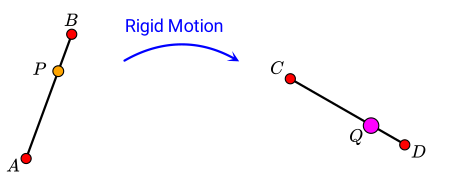
Rigid motions map n-sided polygons onto n-sided polygons.
Example
Share
Report error
Congruence in Circles
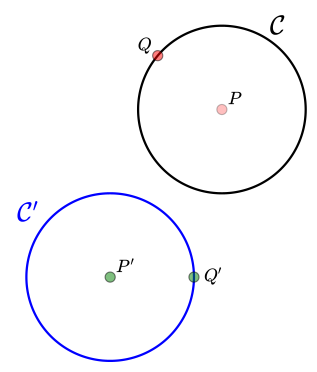
Consider a rigid motion and a circle C.
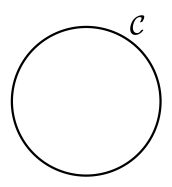
a If the center and the radius of C are known, how can the image be found?
b If the center and a point on C are given, how can the image be found?
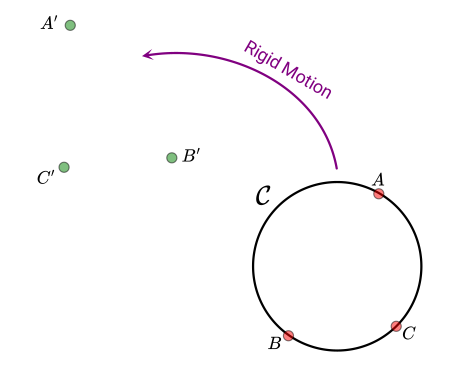
c If three points on C are given, how can the image be found?
Answer
a The image of C is the circle centered at the image of the center of C and the same radius as C.
b The image of C is the circle centered at the image of the center of C that passes through the image of the given point.
c The image of C is the circle that passes through the images of the three given points.
Hint
a Use the fact that rigid motions preserve distances.
b With the image of the center and the image of the given point, the image circle can be drawn.
c Consider the segments connecting the images of the given points. Then, draw their perpendicular bisectors. These lines intersect at the center of the circle.
Solution
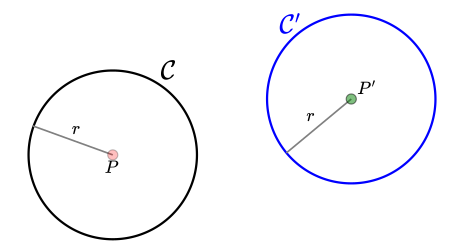
a The first step is to find the image of the center of C under the rigid motion.
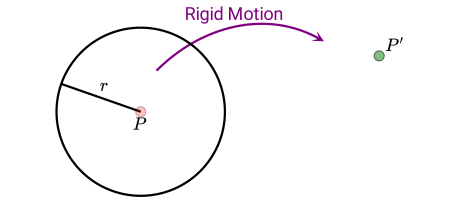
Since rigid motions preserve distances, the image of C is a circle whose radius is equal to the radius of C. Therefore, C' is the circle centered at P' and radius r.
b As in Part A, start by finding the image of the center of C and the image of the given point.
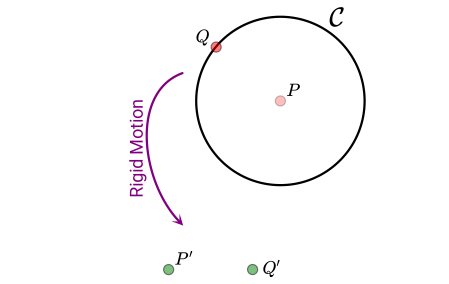
The image of C is a circle centered at P' with radius PQ. Since PQ and P'Q' are equal, C' is the circle centered at P' passing through point Q'.
c Once more, start by finding the images of the three given points.
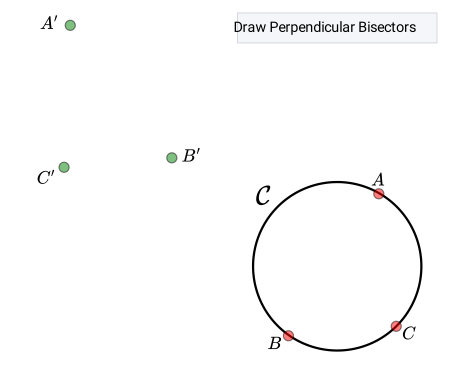
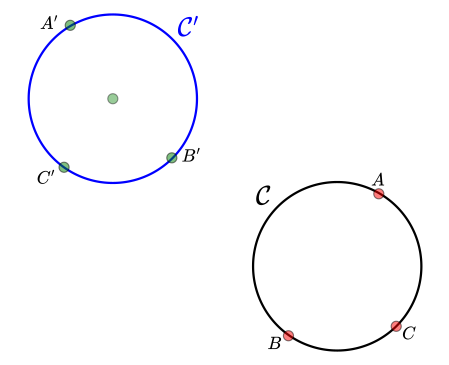
Discussion
Share
Report error
Using Rigid Motions to Determine Congruence
Since rigid motions map segments into congruent segments and angles into congruent angles, rigid motions can be used to define when a pair of geometric figures are congruent.
Concept
Share
Report error
Congruent Figures
Two figures are congruent figures if there is a rigid motion or sequence of rigid motions that maps one of the figures onto the other. As a result, congruent figures have the same size and shape. To denote algebraically that two figures are congruent, the symbol 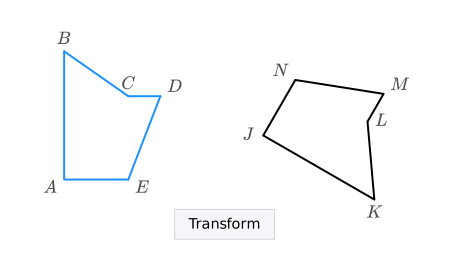 When stating that two polygons are congruent, the corresponding vertices must be listed in the same order. For the polygons above, two of the possible congruence statements can be written as follows.
≅is used.
ABCDE ≅ JKLMN or CDEAB ≅ LMNJK
Example
Share
Report error
Determining if Figures are Congruent
Emily and her family are spending the weekend at a lake house. On Saturday afternoon, Emily begins to work on her geometry homework that asks her to determine if the following pair of polygons are congruent.
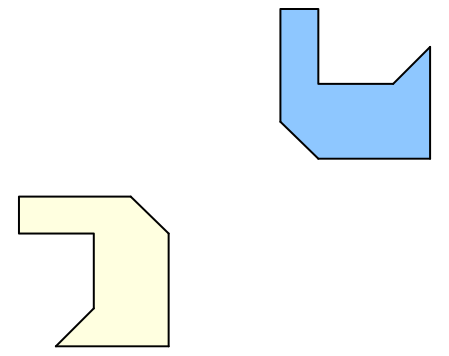
Unfortunately, Emily left her ruler and protractor at her house and only brought a pencil and a piece of tracing paper.
a How can Emily do the homework?
b Are the polygons congruent?
{"type":"choice","form":{"alts":["Yes","No","It cannot be determined"],"noSort":true},"formTextBefore":"","formTextAfter":"","answer":0}
Answer
a Emily can use the definition of congruent figures in terms of rigid motions. She can draw one of the polygons on the tracing paper and use it to perform different rigid motions on it and try to match both polygons.
b Yes, by applying a sequence of rigid motions, one polygon can be mapped onto the other.
Hint
a Use the definition of congruent figures in terms of rigid motions, and remember how to perform rigid motions using paper. Start by translating one polygon in order to match a pair of corresponding vertices.
b After applying some rigid motions, if the two figures match perfectly, then they are congruent.
Solution
a Since Emily has no ruler and protractor, she cannot compare the figures' side lengths or angle measures. However, she can check if the polygons are congruent using rigid motions. By using paper and pencil she can perform rigid motions on the figures. The first step is to identify possible corresponding parts.
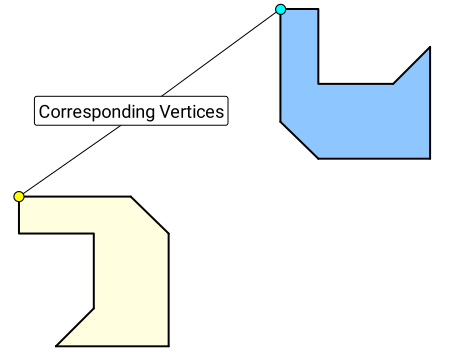
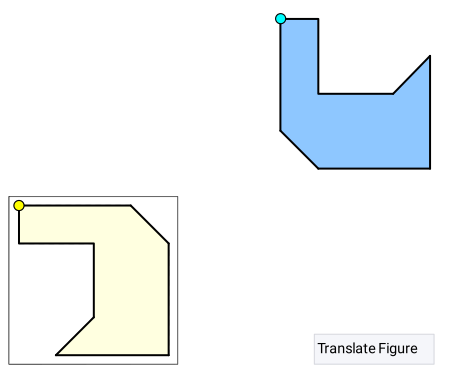
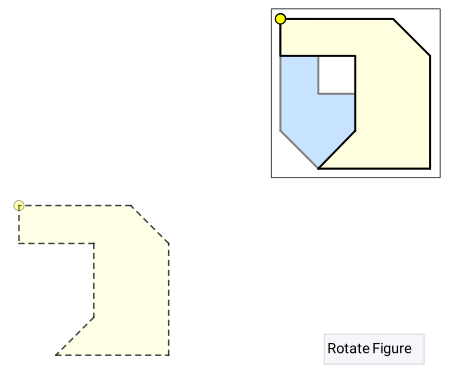
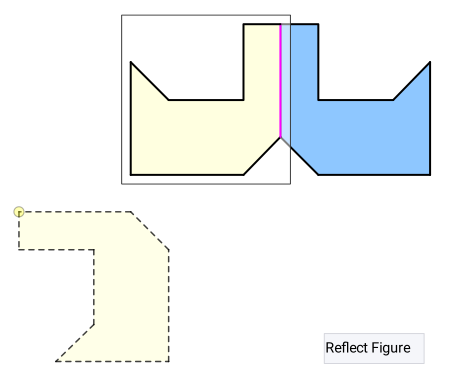
b Since the two polygons matched perfectly and only rigid motions were applied, it can be concluded that the polygons are congruent.
Discussion
Share
Report error
Figures That Are Not Congruent
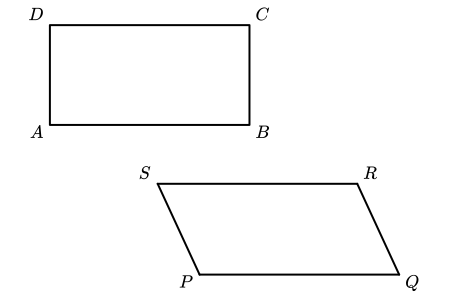
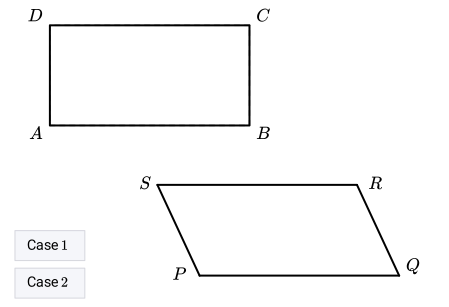
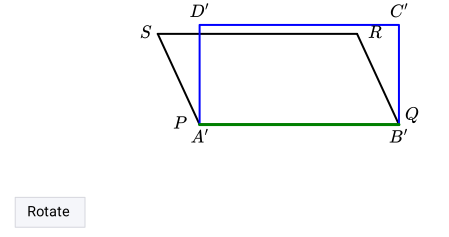
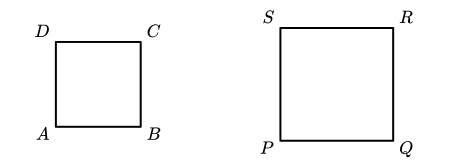
When two figures are not congruent, no sequence of rigid motions maps one figure onto the other. Even so, it is possible that a rigid motion maps certain parts of the preimage onto their corresponding parts, but not all. For example, consider the following pair of quadrilaterals.
Example
Share
Report error
Determining Congruence Using a Sequence of Transformations
Consider the following pair of quadrilaterals ABCD and PQRS in the coordinate plane.
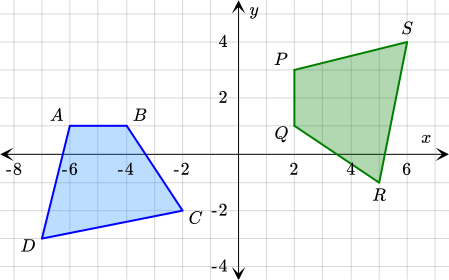
Furthermore, consider the following sequences of transformations.
- S_1: Translation along v=⟨ 3, 1⟩ followed by a 90^(∘) clockwise rotation about the origin.
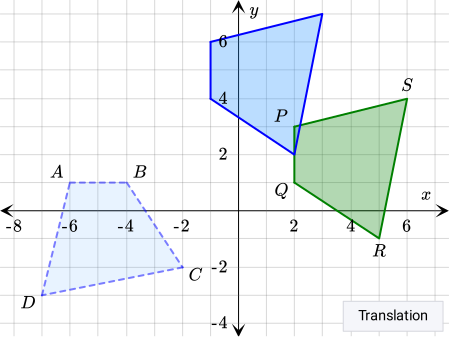
- S_2: Glide reflection defined by the line y=- x and v=⟨ 3,-3⟩.
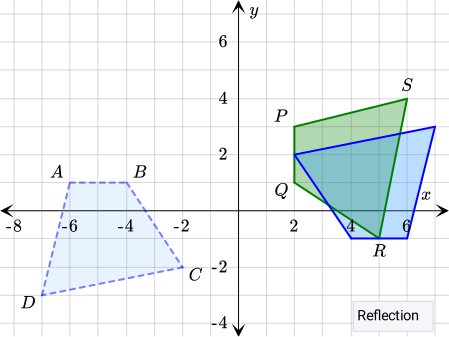
- S_3: 180^(∘) rotation about the origin followed by a reflection across y=x.
{"type":"choice","form":{"alts":["Yes","No"],"noSort":true},"formTextBefore":"","formTextAfter":"","answer":0}
{"type":"multichoice","form":{"alts":["S_1","S_2","S_3","None"],"noSort":true},"formTextBefore":"","formTextAfter":"","answer":[1]}
Hint
Use the orientation of both quadrilaterals to discard one of the sequences. Then, apply the remaining sequences to ABCD, one at a time, to find the image. Compare the image to PQRS.
Solution
To determine if any of the given sequences maps ABCD onto PQRS, apply them to ABCD, one at a time, and compare each resulting image to PQRS.
Sequence 1
At first glance, it seems like the two quadrilaterals have opposite orientations. If this is true, the first sequence cannot map ABCD onto PQRS because both translations and rotations maintain the orientation. To verify it, apply the sequence to ABCD.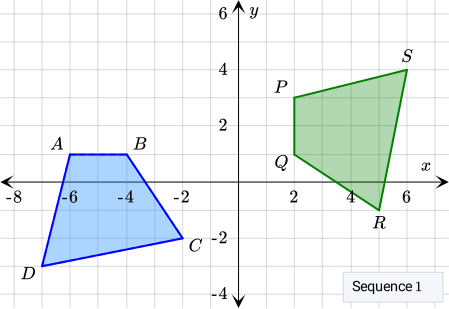
Sequence 2
A glide reflection is the composition of a reflection and a translation performed in any order. Since a reflection is involved, this sequence is a good candidate. To apply it to ABCD, start with the reflection.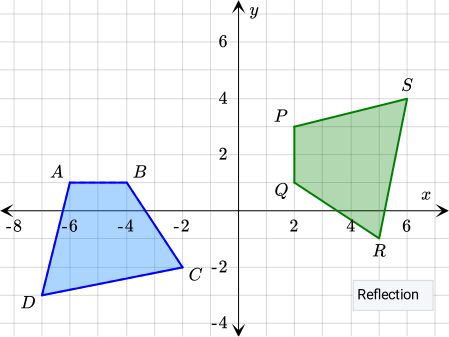
Sequence 3
Like the previous sequence, this third sequence also involves a reflection and thus it is a good candidate. Here, the rotation is applied first. Since it is a 180^(∘) rotation, the direction of the rotation will not affect the resulting image.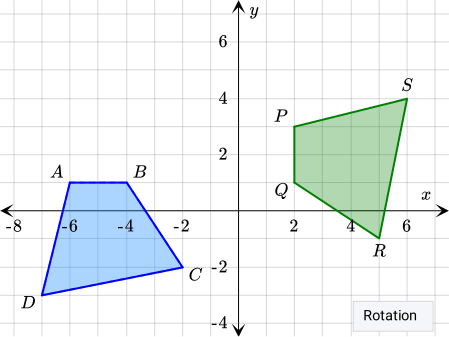
Pop Quiz
Share
Report error
Practice Identifying Congruent Figures
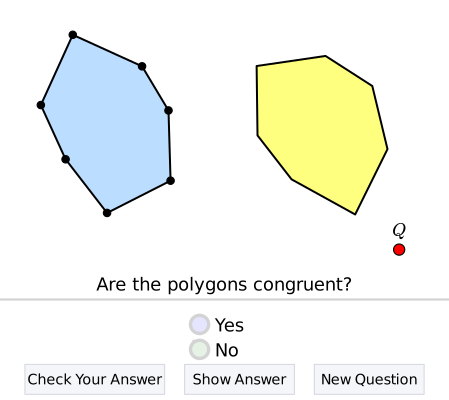
In the following applet, the left-hand side polygon can be translated and rotated.
- To translate the polygon, click on it and slide.
- To rotate the polygon about Q, click on any vertex of the polygon and rotate.
By applying these rigid motions, determine whether the given pair of polygons are congruent.
Illustration
Share
Report error
Similar but Not Congruent
Because of copyright, in marketing, two different companies cannot have the same name or logo. Here, knowing how to determine if two figures are congruent is useful in dealing with intellectual property. Sometimes lesser-known brands use logos almost congruent to those of well-known brands. The intention is to receive instant recognition. For instance, consider the well-known logo of MathLeaks and the logo of a startup company called MathLovers.

Closure
Share
Report error
Congruence in Real Life
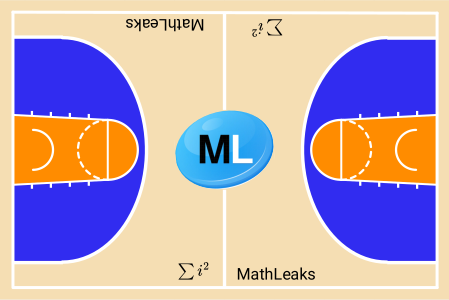
Congruent figures are everywhere in daily life. For example, the figures formed by lines on one half of a basketball court are congruent to the figures formed on the other half. However, verifying this congruence through rigid motions is a difficult thing to do, given the circumstance of not being able to see the rigid motions occur.
Rigid Motion and Congruence
Exercise 3.1
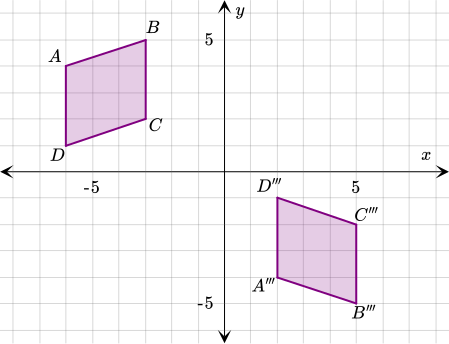
The quadrilateral ABCD has undergone a sequence of rigid motions mapping it onto A'''B'''C'''D'''.
{"type":"multichoice","form":{"alts":["Rotation of 90^(∘)","Rotation of 180^(∘)","Rotation of 270^(∘)","Reflection in x=0","Reflection in y=0","Reflection in y=x"],"noSort":true},"formTextBefore":"","formTextAfter":"","answer":[1,3]}
security
report
code
security
report
code
Let's begin by performing the first transformation. It is a translation of 8 units to the right.
Examining the diagram, we can decipher that A'B'C'D' is a reflection of the final image A'''B'''C'''D''' in the x-axis. Recall the formula for reflecting something in the x-axis. Reflection in thex-axis (x,y) → (x,- y) The reflection in the x-axis changes the sign of the y-coordinate. We need to replicate a reflection in the x-axis using a combination of transformations, one rotation and one reflection. Let's have a look at some rules for rotating something counterclockwise about the origin.
| Rotation | Rule |
|---|---|
| 90^(∘) | (x,y) → (- y,x) |
| 180^(∘) | (x,y) → (- x,- y) |
| 270^(∘) | (x,y) → (y,- x) |
We can see that a rotation of 180^(∘) changes the y-coordinate in the desired way. Therefore, let's perform this rotation.
Now we see that we need to perform a reflection in the y-axis, or x=0, to make A''B''C''D'' map onto A'''B'''C'''D'''.
Therefore, the transformations that are missing are a rotation of 180^(∘) counterclockwise about the origin and a reflection in x=0.
security
report
code
Rigid Motion and Congruence
Recommended exercises
To get personalized recommended exercises, please login first.
Loading content
≤
>
■2
■▢
e▢
7
8
9
×
÷■1
=
=
√▢
▢√
∫▢▢
4
5
6
+
−
≤
<
log
ln
log▢
1
2
3
()
∣
sin
cos
tan
0
.
π
x
y
Loading content