{{ tocSubheader }}
{{ 'ml-label-loading-course' | message }}
An error ocurred, try again later!
Chapter {{ article.chapter.number }}
{{ article.number }}.
{{ article.displayTitle }}
{{ article.intro.summary }}
Show less Show more expand_more Lesson Settings & Tools
| | {{ 'ml-lesson-number-slides' | message : article.intro.bblockCount }} |
| | {{ 'ml-lesson-number-exercises' | message : article.intro.exerciseCount }} |
| | {{ 'ml-lesson-time-estimation' | message }} |
Angles can be measured not only by degrees but also by radians. In this lesson, the concept of radian measure will be introduced. Additionally, the formulas related to arc length will be derived and exercised.
Catch-Up and Review
Here are a few recommended readings before getting started with this lesson.
Try your knowledge on these topics.
a Calculate the circumference of the given circle.
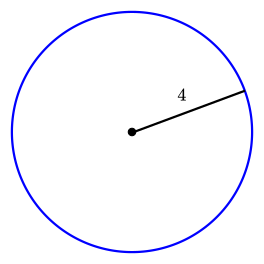
Round the answer to the closest integer.
{"type":"text","form":{"type":"math","options":{"comparison":"1","nofractofloat":false,"keypad":{"simple":true,"useShortLog":false,"variables":[],"constants":[]},"rendered":false},"text":"<span class=\"katex\"><span class=\"katex-html\" aria-hidden=\"true\"><\/span><\/span>"},"formTextBefore":"<span class=\"katex\"><span class=\"katex-html\" aria-hidden=\"true\"><span class=\"base\"><span class=\"strut\" style=\"height:0.68333em;vertical-align:0em;\"><\/span><span class=\"mord mathdefault\" style=\"margin-right:0.07153em;\">C<\/span><span class=\"mspace\" style=\"margin-right:0.2777777777777778em;\"><\/span><span class=\"mrel\">=<\/span><\/span><\/span><\/span>","formTextAfter":null,"answer":{"text":["25"]}}
b Find the measure of arc AB.
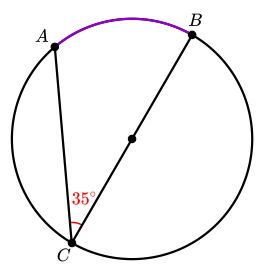
{"type":"text","form":{"type":"math","options":{"comparison":"1","nofractofloat":false,"keypad":{"simple":true,"useShortLog":false,"variables":[],"constants":[]},"rendered":false},"text":"<span class=\"katex\"><span class=\"katex-html\" aria-hidden=\"true\"><\/span><\/span>"},"formTextBefore":"<span class=\"katex\"><span class=\"katex-html\" aria-hidden=\"true\"><span class=\"base\"><span class=\"strut\" style=\"height:1.02533em;vertical-align:0em;\"><\/span><span class=\"mord mathdefault\">m<\/span><span class=\"mord accent\"><span class=\"vlist-t\"><span class=\"vlist-r\"><span class=\"vlist\" style=\"height:1.02533em;\"><span style=\"top:-3em;\"><span class=\"pstrut\" style=\"height:3em;\"><\/span><span class=\"mord\"><span class=\"mord mathdefault\">A<\/span><span class=\"mord mathdefault\" style=\"margin-right:0.05017em;\">B<\/span><\/span><\/span><span class=\"svg-align\" style=\"top:-3.6833299999999998em;\"><span class=\"pstrut\" style=\"height:3em;\"><\/span><span class=\"stretchy\" style=\"height:0.342em;min-width:0.888em;\"><span class=\"halfarrow-left\" style=\"height:0.342em;\"><svg width='400em' height='0.342em' viewBox='0 0 400000 342' preserveAspectRatio='xMinYMin slice'><path d='M400000 80\nH435C64 80 168.3 229.4 21 260c-5.9 1.2-18 0-18 0-2 0-3-1-3-3v-38C76 61 257 0\n 435 0h399565z'\/><\/svg><\/span><span class=\"halfarrow-right\" style=\"height:0.342em;\"><svg width='400em' height='0.342em' viewBox='0 0 400000 342' preserveAspectRatio='xMaxYMin slice'><path d='M0 80h399565c371 0 266.7 149.4 414 180 5.9 1.2 18 0 18 0 2 0\n 3-1 3-3v-38c-76-158-257-219-435-219H0z'\/><\/svg><\/span><\/span><\/span><\/span><\/span><\/span><\/span><span class=\"mspace\" style=\"margin-right:0.2777777777777778em;\"><\/span><span class=\"mrel\">=<\/span><\/span><\/span><\/span>","formTextAfter":"<span class=\"katex\"><span class=\"katex-html\" aria-hidden=\"true\"><span class=\"base\"><span class=\"strut\" style=\"height:0.674115em;vertical-align:0em;\"><\/span><span class=\"mord\"><span><\/span><span class=\"msupsub\"><span class=\"vlist-t\"><span class=\"vlist-r\"><span class=\"vlist\" style=\"height:0.674115em;\"><span style=\"top:-3.063em;margin-right:0.05em;\"><span class=\"pstrut\" style=\"height:2.7em;\"><\/span><span class=\"sizing reset-size6 size3 mtight\"><span class=\"mbin mtight\">\u2218<\/span><\/span><\/span><\/span><\/span><\/span><\/span><\/span><\/span><\/span><\/span>","answer":{"text":["70"]}}
c Determine the measures of ∠SOR and ∠STR.
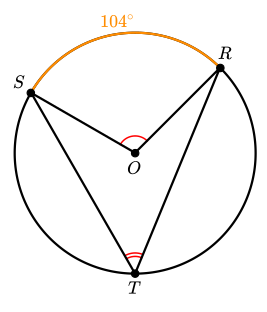
{"type":"text","form":{"type":"math","options":{"comparison":"1","nofractofloat":false,"keypad":{"simple":true,"useShortLog":false,"variables":[],"constants":[]},"rendered":false},"text":"<span class=\"katex\"><span class=\"katex-html\" aria-hidden=\"true\"><\/span><\/span>"},"formTextBefore":"<span class=\"katex\"><span class=\"katex-html\" aria-hidden=\"true\"><span class=\"base\"><span class=\"strut\" style=\"height:0.69224em;vertical-align:0em;\"><\/span><span class=\"mord mathdefault\">m<\/span><span class=\"mord\">\u2220<\/span><span class=\"mord mathdefault\" style=\"margin-right:0.05764em;\">S<\/span><span class=\"mord mathdefault\" style=\"margin-right:0.02778em;\">O<\/span><span class=\"mord mathdefault\" style=\"margin-right:0.00773em;\">R<\/span><span class=\"mspace\" style=\"margin-right:0.2777777777777778em;\"><\/span><span class=\"mrel\">=<\/span><\/span><\/span><\/span>","formTextAfter":"<span class=\"katex\"><span class=\"katex-html\" aria-hidden=\"true\"><span class=\"base\"><span class=\"strut\" style=\"height:0.674115em;vertical-align:0em;\"><\/span><span class=\"mord\"><span><\/span><span class=\"msupsub\"><span class=\"vlist-t\"><span class=\"vlist-r\"><span class=\"vlist\" style=\"height:0.674115em;\"><span style=\"top:-3.063em;margin-right:0.05em;\"><span class=\"pstrut\" style=\"height:2.7em;\"><\/span><span class=\"sizing reset-size6 size3 mtight\"><span class=\"mbin mtight\">\u2218<\/span><\/span><\/span><\/span><\/span><\/span><\/span><\/span><\/span><\/span><\/span>","answer":{"text":["104"]}}
{"type":"text","form":{"type":"math","options":{"comparison":"1","nofractofloat":false,"keypad":{"simple":true,"useShortLog":false,"variables":[],"constants":[]},"rendered":false},"text":"<span class=\"katex\"><span class=\"katex-html\" aria-hidden=\"true\"><\/span><\/span>"},"formTextBefore":"<span class=\"katex\"><span class=\"katex-html\" aria-hidden=\"true\"><span class=\"base\"><span class=\"strut\" style=\"height:0.69224em;vertical-align:0em;\"><\/span><span class=\"mord mathdefault\">m<\/span><span class=\"mord\">\u2220<\/span><span class=\"mord mathdefault\" style=\"margin-right:0.05764em;\">S<\/span><span class=\"mord mathdefault\" style=\"margin-right:0.13889em;\">T<\/span><span class=\"mord mathdefault\" style=\"margin-right:0.00773em;\">R<\/span><span class=\"mspace\" style=\"margin-right:0.2777777777777778em;\"><\/span><span class=\"mrel\">=<\/span><\/span><\/span><\/span>","formTextAfter":"<span class=\"katex\"><span class=\"katex-html\" aria-hidden=\"true\"><span class=\"base\"><span class=\"strut\" style=\"height:0.674115em;vertical-align:0em;\"><\/span><span class=\"mord\"><span><\/span><span class=\"msupsub\"><span class=\"vlist-t\"><span class=\"vlist-r\"><span class=\"vlist\" style=\"height:0.674115em;\"><span style=\"top:-3.063em;margin-right:0.05em;\"><span class=\"pstrut\" style=\"height:2.7em;\"><\/span><span class=\"sizing reset-size6 size3 mtight\"><span class=\"mbin mtight\">\u2218<\/span><\/span><\/span><\/span><\/span><\/span><\/span><\/span><\/span><\/span><\/span>","answer":{"text":["52"]}}
Challenge
Investigating the Orbit of a Satellite
In 2007, a satellite named SELENE was launched to explore the Moon's surface for a few years. It orbited the Moon in a circular path staying at a constant altitude of 100 kilometers. Given that the radius of the Moon is 1737 kilometers, find the distance that the satellite traveled when it completed 60% of its orbit.
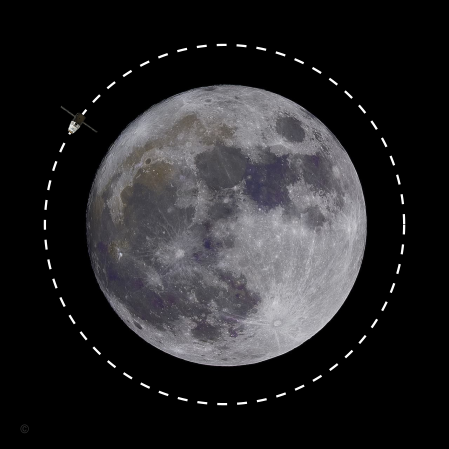
External credits: @wirestock
Discussion
Radian
In order to introduce the concept of radian measure, the definition of a radian should first be explored.
A radian, like a degree, is an angle unit. One radian is defined as the measure of the central angle that intercepts an arc equal in length to the radius of the circle. It corresponds to roughly 57.3∘.
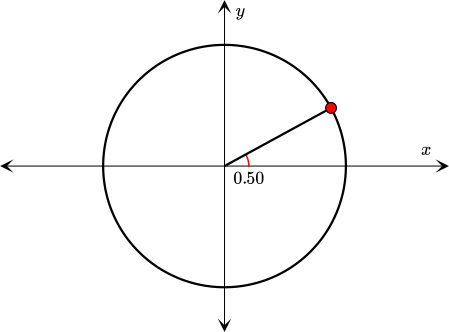
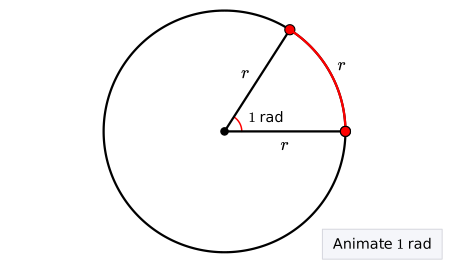 If the arc length is 2 radii, the measure of the corresponding central angle is 2 radians, and so on. Therefore, radians describe the number of radii an angle creates on a circle.
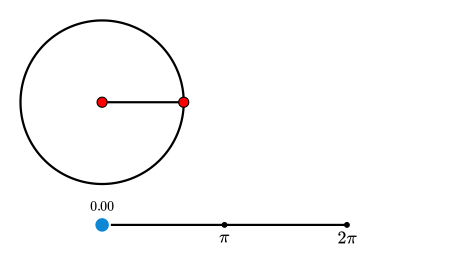
 It can be observed that a semicircle corresponds to an arc length of π radii and the circumference of a circle corresponds to an arc length of 2π radii.
 In calculations, even if the angle is given in radians,
radis seldom written. Instead, no unit marker indicates radians. Consider two expressions.
cos64∘andcos5
The first angle is given in degrees, and the other is given in radians. At first glance, radians might seem inconvenient, but they make calculations simpler in certain circumstances,. Radians are also the SI unit for angles.Rule
Relationship Between Radians and Degrees
Radians and degrees are two different units of measure for an angle. Knowing how to convert between the two is majestic, especially in trigonometry. Recall that a full circle measures 360∘, which corresponds to 2π radians.
360∘=2π rad⇔180∘=π rad
Using this equality, it is possible to find equivalent expressions for 1∘ and 1 rad. | Degrees to Radians | Radians to Degrees |
|---|---|
| 1∘=180π rad | 1 rad=π180∘ |
Proof
The arc length of one revolution around a circle is the circumference of the circle 2πr. The number of radians in a full revolution is calculated by dividing 2πr by the radius r of the circle.
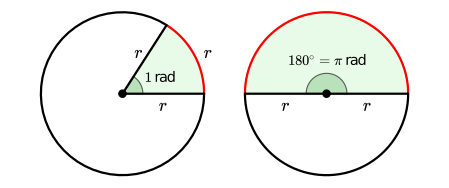 From the relation 180∘=π rad, it is possible to find two rules by dividing both sides by either 180 or π. To find an expression for 1∘, divide both sides by 180.
As shown, 1∘ corresponds to 180π rad, which is approximately 0.017 radians. To get an expression for 1 rad, divide both sides by π.
Therefore, 1 radian corresponds to π180∘, which is approximately 57.3∘.
From the relation 180∘=π rad, it is possible to find two rules by dividing both sides by either 180 or π. To find an expression for 1∘, divide both sides by 180.
As shown, 1∘ corresponds to 180π rad, which is approximately 0.017 radians. To get an expression for 1 rad, divide both sides by π.
Therefore, 1 radian corresponds to π180∘, which is approximately 57.3∘.
r2πr=2π
This means that one revolution is 2π radians which in degrees is 360∘, and that leads to the expression 360∘=2π rad. Both sides then divided by 2 gives the following equation.
180∘=π rad
Therefore, 180∘ correspond to π radians. 180∘=π rad
DivEqn
LHS/π=RHS/π
π180∘=ππ rad
CalcQuot
Calculate quotient
π180∘=1 rad
RearrangeEqn
Rearrange equation
1 rad=π180∘
Pop Quiz
Practice Converting Degrees Into Radians

Pop Quiz
Practice Converting Radians Into Degrees

Explore
Investigating the Radian Measure for Different Circles
Consider a circle with a radius of 3 units. Move the point on the circle and pay close attention to the ratio of the arc length to the radius as the arc measure changes. 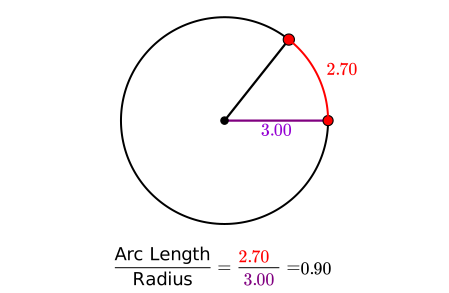 Next, consider a circle with an arc whose measure is constant. Examine the ratio of the arc length to the radius as the radius changes.
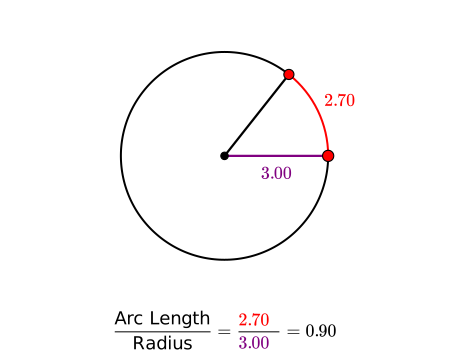 In the second case, why is the ratio constant? What does this say about the relationship between the arc length and the radius?
Discussion
Comparing Radian Measures of Concentric Circles
To understand the observed relation, consider two concentric circles with different radii r1 and r2.
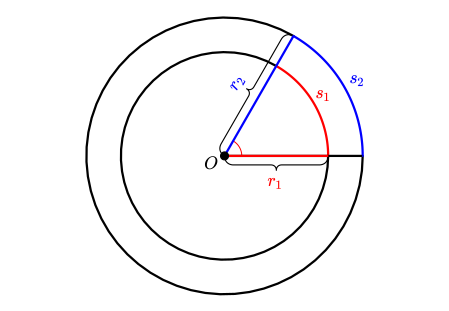
r2r1=s2s1
This proportion can be rewritten as an equivalent equation.
r2r1=s2s1
▼
Rearrange equation
MultEqn
LHS⋅r2s2=RHS⋅r2s2
r2r1⋅r2s2=s2s1⋅r2s2
CancelCommonFac
Cancel out common factors
r2r1⋅r2s2=s2s1⋅r2s2
SimpQuotProd
Simplify quotient and product
r1s2=s1r2
DivEqn
LHS/r1=RHS/r1
s2=r1s1r2
MovePartNumRight
ca⋅b=ca⋅b
s2=r1s1r2
DivEqn
LHS/r2=RHS/r2
r2s2=r1s1
Discussion
Using Radians to Calculate Arc Lengths
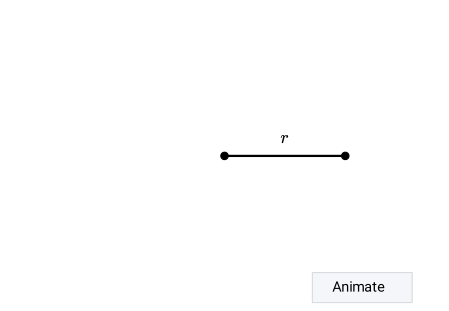
The radian measure of a central angle is defined as the quotient between the length of the arc intercepted by the angle and the radius of the circle.
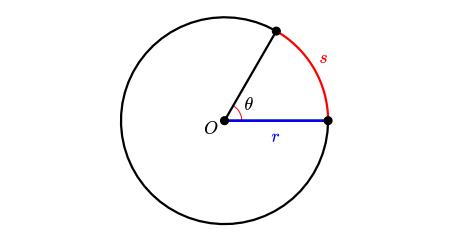
Based on the diagram above, the radian measure of the central angle ∠O is defined as follows.
θ=rs
By using this definition, the formula for the length of an arc can be derived.
s=θr
s=(180∘πθ)r⇕s=πr(180∘θ)
This formula is often written in the following equivalent manner.
s=2πr(360∘θ)
This equivalent form is convenient to work with because 2πr is the circumference of a circle. Since a full circle measures 360∘, dividing 2πr by 360 results in the length of an arc intercepted by a 1-degree central angle. Finally, by multiplying that value by the measure of the arc, its length is obtained.
Example
Arc Length Between the Long and Short hand of a Clock
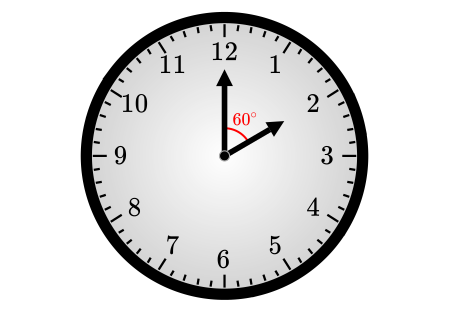
In her room Paulina has a big clock whose longer hand is 9 centimeters long. When Paulina came home and looked at her clock, it was exactly 2 P.M. She calculated the angle between the longer and shorter hands of the clock to be 60∘.
{"type":"text","form":{"type":"math","options":{"comparison":"1","nofractofloat":false,"keypad":{"simple":true,"useShortLog":false,"variables":["x"],"constants":["PI"]},"rendered":false},"text":"<span class=\"katex\"><span class=\"katex-html\" aria-hidden=\"true\"><\/span><\/span>"},"formTextBefore":"<span class=\"katex\"><span class=\"katex-html\" aria-hidden=\"true\"><span class=\"base\"><span class=\"strut\" style=\"height:0.9580078125em;vertical-align:-0.2080078125em;\"><\/span><span class=\"mord text\"><span class=\"mord Roboto-Regular\">Arc<\/span><span class=\"mord\">\u00a0<\/span><span class=\"mord Roboto-Regular\">Length<\/span><\/span><span class=\"mspace\" style=\"margin-right:0.2777777777777778em;\"><\/span><span class=\"mrel\">=<\/span><\/span><\/span><\/span>","formTextAfter":"cm","answer":{"text":["31.4"]}}
Hint
Since the central angle is given in degrees, the arc length can be calculated using the formula s=2πr(360∘θ).
Solution
To find the length of an arc using the measure of the corresponding central angle given in degrees, the following formula can be used.
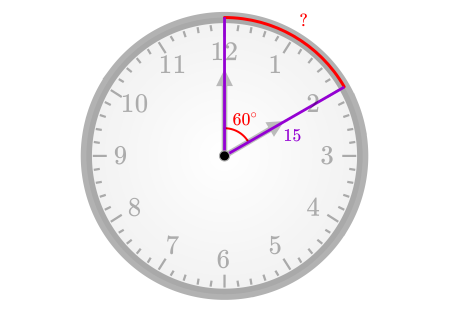 By substituting these values into the above formula, the length of the arc can be determined.
The arc between the hands of the clock is about 31.4 centimeters long.
By substituting these values into the above formula, the length of the arc can be determined.
The arc between the hands of the clock is about 31.4 centimeters long.
s=2πr(360∘θ)
It is known that the radius of the clock is about 15 centimeters and the central angle that intercepts the arc measures 60∘. s=2πr(360∘θ)
SubstituteII
r=15, θ=60∘
s=2π(15)(360∘60∘)
▼
Evaluate right-hand side
ReduceFrac
ba=b/60∘a/60∘
s=2π(15)(61)
MoveLeftFacToNumOne
a⋅b1=ba
s=62π(15)
Multiply
Multiply
s=330π
ReduceFrac
ba=b/3a/3
s=10π
UseCalc
Use a calculator
s=31.415926…
RoundDec
Round to 1 decimal place(s)
s≈31.4
Example
Finding the Length of an Arc
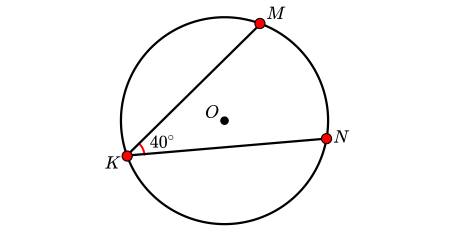
After having dinner, Paulina decided to do her math homework. She is given a circle with radius 5 inches and an inscribed angle that measures 40∘.
{"type":"text","form":{"type":"math","options":{"comparison":"1","nofractofloat":false,"keypad":{"simple":true,"useShortLog":false,"variables":[],"constants":[]},"rendered":false},"text":"<span class=\"katex\"><span class=\"katex-html\" aria-hidden=\"true\"><\/span><\/span>"},"formTextBefore":"Length of <span class=\"katex\"><span class=\"katex-html\" aria-hidden=\"true\"><span class=\"base\"><span class=\"strut\" style=\"height:1.02533em;vertical-align:0em;\"><\/span><span class=\"mord accent\"><span class=\"vlist-t\"><span class=\"vlist-r\"><span class=\"vlist\" style=\"height:1.02533em;\"><span style=\"top:-3em;\"><span class=\"pstrut\" style=\"height:3em;\"><\/span><span class=\"mord\"><span class=\"mord mathdefault\" style=\"margin-right:0.10903em;\">M<\/span><span class=\"mord mathdefault\" style=\"margin-right:0.10903em;\">N<\/span><\/span><\/span><span class=\"svg-align\" style=\"top:-3.6833299999999998em;\"><span class=\"pstrut\" style=\"height:3em;\"><\/span><span class=\"stretchy\" style=\"height:0.342em;min-width:0.888em;\"><span class=\"halfarrow-left\" style=\"height:0.342em;\"><svg width='400em' height='0.342em' viewBox='0 0 400000 342' preserveAspectRatio='xMinYMin slice'><path d='M400000 80\nH435C64 80 168.3 229.4 21 260c-5.9 1.2-18 0-18 0-2 0-3-1-3-3v-38C76 61 257 0\n 435 0h399565z'\/><\/svg><\/span><span class=\"halfarrow-right\" style=\"height:0.342em;\"><svg width='400em' height='0.342em' viewBox='0 0 400000 342' preserveAspectRatio='xMaxYMin slice'><path d='M0 80h399565c371 0 266.7 149.4 414 180 5.9 1.2 18 0 18 0 2 0\n 3-1 3-3v-38c-76-158-257-219-435-219H0z'\/><\/svg><\/span><\/span><\/span><\/span><\/span><\/span><\/span><span class=\"mspace\" style=\"margin-right:0.2777777777777778em;\"><\/span><span class=\"mrel\">=<\/span><\/span><\/span><\/span>","formTextAfter":"inches","answer":{"text":["7"]}}
Hint
To convert the measure of an angle from degrees to radians, use the conversion factor 180∘π. The length of the arc can be found by using the formula s=θr, where θ is the measure of the corresponding central angle in radians.
Solution
It can be seen in the diagram that ∠MKN, which is an inscribed angle, measures 40∘.
By multiplying this value by the conversion factor 180∘π, the measure of this angle can be converted from degrees to radians.
Next, to find the length of MN, the measure of the corresponding central angle should be known. Recall that the measure of the inscribed angle is half the measure of the corresponding central angle. In this case, ∠MKN corresponds to a central angle ∠MON. 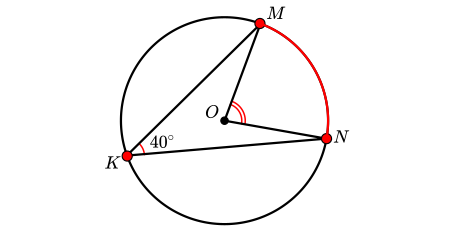 Using this information, the measure of ∠MON can be found.
Finally, the length of MN can be calculated using the corresponding formula.
The length of MN is approximately 7 inches.
Using this information, the measure of ∠MON can be found.
Finally, the length of MN can be calculated using the corresponding formula.
The length of MN is approximately 7 inches.
m∠MKN=21m∠MON
Substitute
m∠MKN=92π
92π=21m∠MON
▼
Solve for m∠MON
MultEqn
LHS⋅2=RHS⋅2
92π(2)=m∠MON
MoveRightFacToNum
ca⋅b=ca⋅b
92π(2)=m∠MON
Multiply
Multiply
94π=m∠MON
RearrangeEqn
Rearrange equation
m∠MON=94π
s=θr⇓MN=m∠MONr
Here, 94π and 5 can be substituted for m∠MON and r, respectively.
MN=m∠MONr
SubstituteII
m∠MON=94π, r=5
MN=(94π)(5)
▼
Evaluate right-hand side
MoveRightFacToNum
ca⋅b=ca⋅b
MN=94π(5)
Multiply
Multiply
MN=920π
UseCalc
Use a calculator
MN=6.981317…
RoundInt
Round to nearest integer
MN≈7
Example
Finding Angle Measures Given an Arc Length
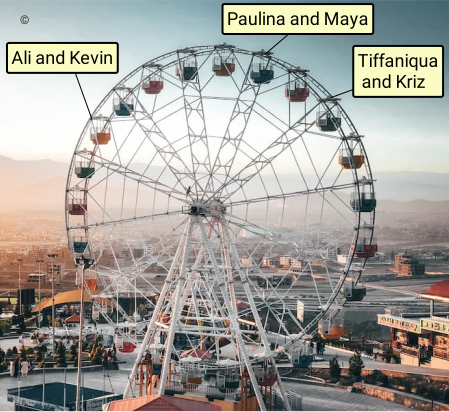
Finally, Paulina finished all her homework. She could now go to an amusement park with her friends. They get on a Ferris Wheel feeling super excited. The diagram indicates their positions.
External credits: @wirestock
{"type":"choice","form":{"alts":["<span class=\"katex\"><span class=\"katex-html\" aria-hidden=\"true\"><span class=\"base\"><span class=\"strut\" style=\"height:0.674115em;vertical-align:0em;\"><\/span><span class=\"mord\">2<\/span><span class=\"mord\">8<\/span><span class=\"mord\">.<\/span><span class=\"mord\"><span class=\"mord\">6<\/span><span class=\"msupsub\"><span class=\"vlist-t\"><span class=\"vlist-r\"><span class=\"vlist\" style=\"height:0.674115em;\"><span style=\"top:-3.063em;margin-right:0.05em;\"><span class=\"pstrut\" style=\"height:2.7em;\"><\/span><span class=\"sizing reset-size6 size3 mtight\"><span class=\"mbin mtight\">\u2218<\/span><\/span><\/span><\/span><\/span><\/span><\/span><\/span><\/span><\/span><\/span> and <span class=\"katex\"><span class=\"katex-html\" aria-hidden=\"true\"><span class=\"base\"><span class=\"strut\" style=\"height:0.674115em;vertical-align:0em;\"><\/span><span class=\"mord\">1<\/span><span class=\"mord\">4<\/span><span class=\"mord\">.<\/span><span class=\"mord\"><span class=\"mord\">3<\/span><span class=\"msupsub\"><span class=\"vlist-t\"><span class=\"vlist-r\"><span class=\"vlist\" style=\"height:0.674115em;\"><span style=\"top:-3.063em;margin-right:0.05em;\"><span class=\"pstrut\" style=\"height:2.7em;\"><\/span><span class=\"sizing reset-size6 size3 mtight\"><span class=\"mbin mtight\">\u2218<\/span><\/span><\/span><\/span><\/span><\/span><\/span><\/span><\/span><\/span><\/span>","<span class=\"katex\"><span class=\"katex-html\" aria-hidden=\"true\"><span class=\"base\"><span class=\"strut\" style=\"height:0.674115em;vertical-align:0em;\"><\/span><span class=\"mord\">3<\/span><span class=\"mord\">0<\/span><span class=\"mord\">.<\/span><span class=\"mord\"><span class=\"mord\">5<\/span><span class=\"msupsub\"><span class=\"vlist-t\"><span class=\"vlist-r\"><span class=\"vlist\" style=\"height:0.674115em;\"><span style=\"top:-3.063em;margin-right:0.05em;\"><span class=\"pstrut\" style=\"height:2.7em;\"><\/span><span class=\"sizing reset-size6 size3 mtight\"><span class=\"mbin mtight\">\u2218<\/span><\/span><\/span><\/span><\/span><\/span><\/span><\/span><\/span><\/span><\/span> and <span class=\"katex\"><span class=\"katex-html\" aria-hidden=\"true\"><span class=\"base\"><span class=\"strut\" style=\"height:0.674115em;vertical-align:0em;\"><\/span><span class=\"mord\">1<\/span><span class=\"mord\">5<\/span><span class=\"mord\">.<\/span><span class=\"mord\">2<\/span><span class=\"mord\"><span class=\"mord\">5<\/span><span class=\"msupsub\"><span class=\"vlist-t\"><span class=\"vlist-r\"><span class=\"vlist\" style=\"height:0.674115em;\"><span style=\"top:-3.063em;margin-right:0.05em;\"><span class=\"pstrut\" style=\"height:2.7em;\"><\/span><span class=\"sizing reset-size6 size3 mtight\"><span class=\"mbin mtight\">\u2218<\/span><\/span><\/span><\/span><\/span><\/span><\/span><\/span><\/span><\/span><\/span>","<span class=\"katex\"><span class=\"katex-html\" aria-hidden=\"true\"><span class=\"base\"><span class=\"strut\" style=\"height:0.674115em;vertical-align:0em;\"><\/span><span class=\"mord\">3<\/span><span class=\"mord\">2<\/span><span class=\"mord\">.<\/span><span class=\"mord\"><span class=\"mord\">4<\/span><span class=\"msupsub\"><span class=\"vlist-t\"><span class=\"vlist-r\"><span class=\"vlist\" style=\"height:0.674115em;\"><span style=\"top:-3.063em;margin-right:0.05em;\"><span class=\"pstrut\" style=\"height:2.7em;\"><\/span><span class=\"sizing reset-size6 size3 mtight\"><span class=\"mbin mtight\">\u2218<\/span><\/span><\/span><\/span><\/span><\/span><\/span><\/span><\/span><\/span><\/span> and <span class=\"katex\"><span class=\"katex-html\" aria-hidden=\"true\"><span class=\"base\"><span class=\"strut\" style=\"height:0.674115em;vertical-align:0em;\"><\/span><span class=\"mord\">1<\/span><span class=\"mord\">2<\/span><span class=\"mord\">.<\/span><span class=\"mord\"><span class=\"mord\">8<\/span><span class=\"msupsub\"><span class=\"vlist-t\"><span class=\"vlist-r\"><span class=\"vlist\" style=\"height:0.674115em;\"><span style=\"top:-3.063em;margin-right:0.05em;\"><span class=\"pstrut\" style=\"height:2.7em;\"><\/span><span class=\"sizing reset-size6 size3 mtight\"><span class=\"mbin mtight\">\u2218<\/span><\/span><\/span><\/span><\/span><\/span><\/span><\/span><\/span><\/span><\/span>"],"noSort":false},"formTextBefore":"","formTextAfter":"","answer":0}
Hint
Identify the type of each angle. Use the formula for the arc length.
Solution
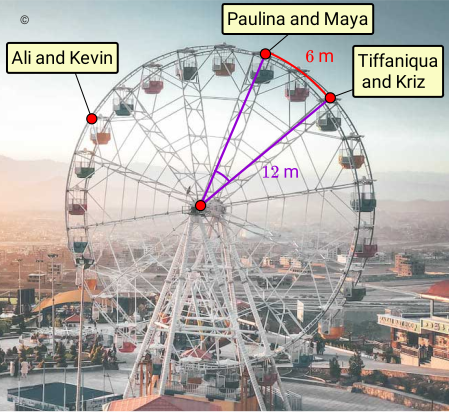
It is given that the length of an arc between each cabin is 3 meters. There is one cabin between Paulina and Tiffaniqua, so the arc between their cabins is 6 meters long.
s=2πr(360∘θ)
Here, θ is the measure of the central angle, in degrees, that intercepts the arc. In this case, this is the angle formed by Paulina, the center of rotation, and Tiffaniqua. By substituting s=6 and r=12, its measure can be calculated.
s=2πr(360∘θ)
SubstituteII
s=6, r=12
6=2π(12)(360∘θ)
▼
Solve for θ
Multiply
Multiply
6=24π(360∘θ)
MoveLeftFacToNum
a⋅cb=ca⋅b
6=360∘24πθ
ReduceFrac
ba=b/24a/24
6=15∘πθ
MultEqn
LHS⋅15∘=RHS⋅15∘
90∘=πθ
RearrangeEqn
Rearrange equation
πθ=90∘
DivEqn
LHS/π=RHS/π
θ=π90∘
UseCalc
Use a calculator
θ=28.647889…∘
RoundDec
Round to 1 decimal place(s)
θ≈28.6∘
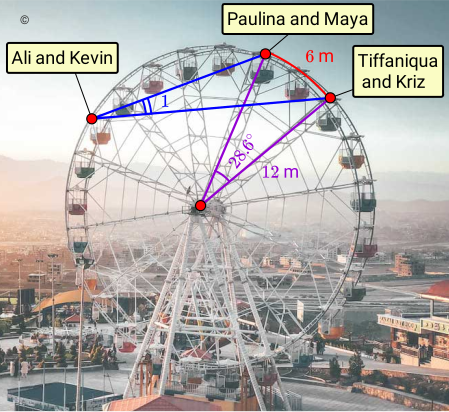
m∠1=228.6∘⇕m∠1=14.3∘
The measure of the angle formed by Paulina, Ali, and Tiffaniqua is about 14.3∘.
Closure
Finding the Orbit of a Satellite
The challenge presented at the beginning of this lesson can now be solved thanks to the concepts covered.
In 2007, a satellite named SELENE was launched to explore the Moon's surface for a few years. It orbited the Moon in a circular path staying at a constant altitude of 100 kilometers. Given that the radius of the Moon is 1737 kilometers, find the distance that the satellite traveled when it completed 60% of its orbit.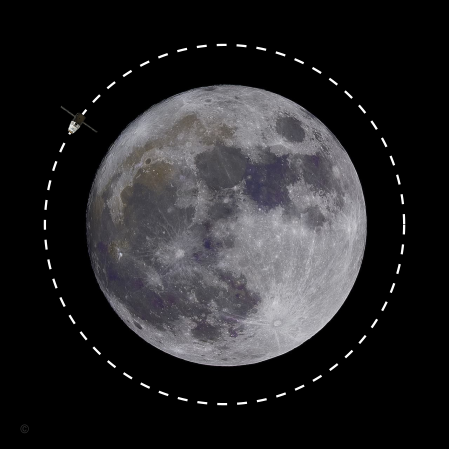
External credits: @wirestock
{"type":"text","form":{"type":"math","options":{"comparison":"1","nofractofloat":false,"keypad":{"simple":true,"useShortLog":false,"variables":["x"],"constants":["PI"]},"rendered":false},"text":"<span class=\"katex\"><span class=\"katex-html\" aria-hidden=\"true\"><\/span><\/span>"},"formTextBefore":null,"formTextAfter":"km","answer":{"text":["6925"]}}
Solution
A full orbit around the moon is the equivalent to one full circle, which has
a measure of 2π radians. By multiplying this value by 0.6, the measure of the arc that corresponds to 60% of a circumference can be found.
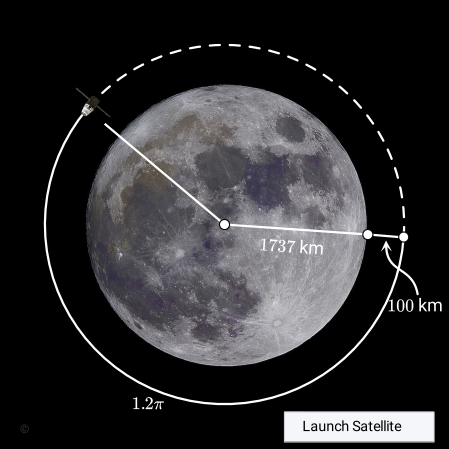 By the Segment Addition Postulate, the radius of the orbit is equal to the sum of the Moon's radius, which is 1737 kilometers, and 100 kilometers.
It has been determined that the distance traveled by the satellite when it completed 60% of its orbit is 6925 kilometers.
By the Segment Addition Postulate, the radius of the orbit is equal to the sum of the Moon's radius, which is 1737 kilometers, and 100 kilometers.
It has been determined that the distance traveled by the satellite when it completed 60% of its orbit is 6925 kilometers.
0.6⋅2π=1.2π
This relationship can be illustrated in the diagram.
External credits: @wirestock
r=1737+100⇔r=1837 km
To find the length of the desired arc, the following formula can be used.
s=θr
Here, θ is the measure, in radians, of the corresponding central angle. Recall that the measure of an arc is equal to the measure of its corresponding central angle. Therefore, θ equals 1.2π. By substituting θ=1.2π and r=1837 into the formula, the value of s can be calculated.
s=θr
SubstituteII
θ=1.2π, r=1837
s=(1.2π)(1837)
UseCalc
Use a calculator
s=6925.326845…
RoundInt
Round to nearest integer
s≈6925
Loading content