{{ tocSubheader }}
Sign In
{{ 'ml-label-loading-course' | message }}
An error ocurred, try again later!
Chapter {{ article.chapter.number }}
{{ article.number }}.
{{ article.displayTitle }}
{{ article.intro.summary }}
Show less Show more expand_more Lesson Settings & Tools
| | {{ 'ml-lesson-number-slides' | message : article.intro.bblockCount }} |
| | {{ 'ml-lesson-number-exercises' | message : article.intro.exerciseCount }} |
| | {{ 'ml-lesson-time-estimation' | message }} |
{{ article.displayTitle }}
Slide {{ slide.slideNumber }} of {{ article.intro.bblockCount }}
Certain situations need rates to be constant. For instance, playing an arcade game hourly requires paying more money at a constant rate. Such a case is said to have a proportional relationship between the given quantities. There are also cases of non-porportional relationships. This lesson will introduce various ones.
Catch-Up and Review
Here are a few recommended readings before getting started with this lesson.
Explore
Comparing Two Ratios
Consider different pairs of ratios. Compare their values and determine whether they are equal or not.
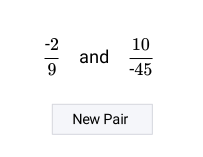 If the ratios are equal, how can this fact be written algebraically using only mathematics symbols?
Discussion
The Concept of Proportion
The value of two equivalent ratios is the same. Because of this, an equals sign can be written between two equivalent ratios to create a proportion.
Concept
Proportion
A proportion is an equation showing the equivalence of two ratios, or fractions, with different numerators and denominators.
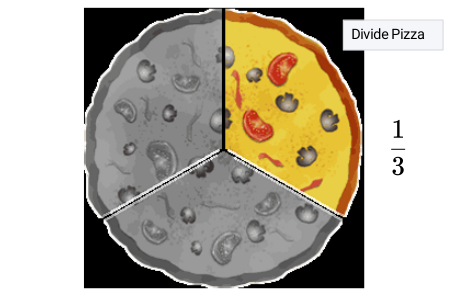 In this case, one-third of a pizza is the same amount of pizza as two-sixths or four-twelfths. If the simplified forms of two fractions are equal, then they are said to be proportional. For example, one-third is proportional to two-sixths and four-twelfths.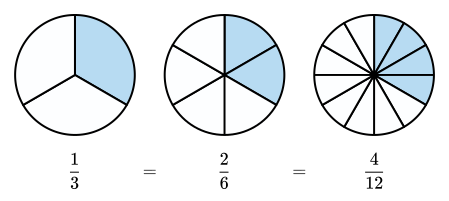
ba=dcora:b=c:d
The first and last numbers in the proportion are called the extremes, while the other two numbers are called the means.
ad↓means:↑b=↑c:extremesd↓
As an example of proportionality, consider slices of pizza. Depending on the number of times it has been sliced, the same amount of pizza could be cut into 1, 2, or 4 pieces.
In contrast, two ratios have a non-proportional relationship if they are not equivalent. Consider, for example, 32 and 23. These ratios are in their simplest form, but they are not equal. This means that they are non-proportional. This relationship is shown by writing an inequality symbol between the ratios.
32=23
Pop Quiz
Finding Equal Ratios
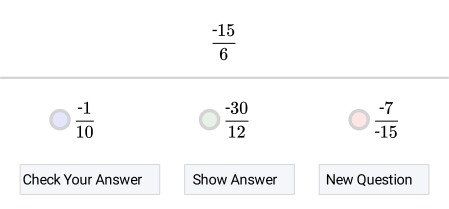
Consider the given ratio. Then, analyze the values of the ratios in each answer and choose which one forms a proportion with the given ratio.
Discussion
Cross Products Property
In a proportion, the product of the extremes is equal to the product of the means.
ba=dc⇒ad=bc
This property is also known as cross-multiplication or Means-Extremes Property of Proportion.
Proof
Cross Products PropertyThe Cross Products Property can be proven by using the Properties of Equality.
ba=dc
MultEqn
LHS⋅b=RHS⋅b
a=dc⋅b
MoveRightFacToNum
ca⋅b=ca⋅b
a=dcb
MultEqn
LHS⋅d=RHS⋅d
ad=cb
CommutativePropMult
Commutative Property of Multiplication
ad=bc
Example
Learning to Apply Cross Products Property Correctly
Dylan's mom is making chocolate chip cookies. She uses a recipe which claims that for every three cups of flour, two cups of white sugar must be added. However, she wants to make a larger batch so she uses six cups of white sugar for nine cups of flour. She is unsure if she is using the correct amount.
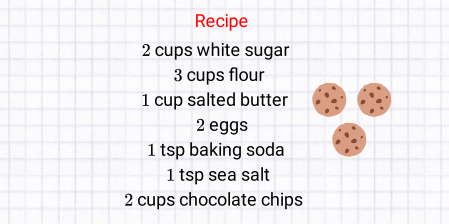
Dylan and his brother Mark help their mother by forming a proportion with the given white sugar and flour amounts to check whether their mother has the same rate of ingredients. Although both of the guys used the Cross Products Property, their solutions were different.
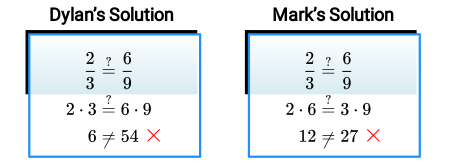
{"type":"choice","form":{"alts":["Dylan's","Mark's","Neither","Both"],"noSort":false},"formTextBefore":"","formTextAfter":"","answer":2}
Hint
Recall what the Cross Products Property states. Then identify the extremes and means in the proportion set by the boys. Are the second steps in either solution correct?
Solution
Begin by analyzing each solution separately.
Dylan's Solution
Dylan began by equating the given ratios to investigate if they form a proportion. He put a question mark above the equals sign until he knows if a proportion is formed or not.
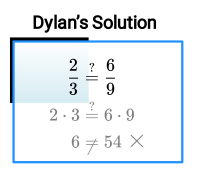
Focus on where Dylan applied the Cross Products Property.
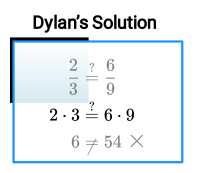
Recall what that property states to determine whether it was correctly applied.
ba=dc ⇒ ad=bc
The property claims that the product of the extremes is equal to the product of the means. Identify the extremes and means in the proportion written by Dylan.
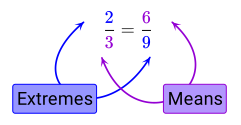
2⋅32⋅9=6⋅9 ×=3⋅6 ✓
This means that Dylan's solution is not correct. Mark's Solution
Next, Mark's solution will be analyzed. After writing the ratios as a likely proportion, he also chose to apply the Cross Products Property.
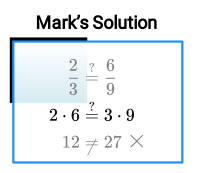
2⋅62⋅9=3⋅9 ×=3⋅6 ✓
Mark's solution is also incorrect. In other words, none of the given solutions are correct. Correct Solution
Now, it is time to solve the exercise properly. Since the cross products are equal, the ratios form a proportion. This is great news. Their mom already chose the ingredients in the correct amounts. However, the boys made the mistakes in their calcuations and the cookies came out tasting nasty!Example
Dilution of a Cleaning Concentrate
The family made a huge mess while baking the cookies. They need to clean the kitchen. Some instructions state that the dilution rate for cleaning concentrate is 2:9. This means 9 liters of water is used to 2 liters of cleaning concentrate.
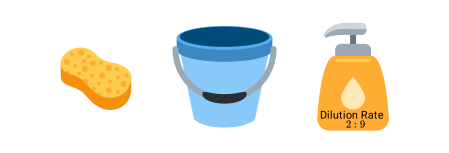
a How many liters of cleaning concentrate do they need to use for 3 liters of water?
{"type":"text","form":{"type":"math","options":{"comparison":"1","nofractofloat":false,"keypad":{"simple":true,"useShortLog":false,"variables":[],"constants":[]},"rendered":false},"text":"<span class=\"katex\"><span class=\"katex-html\" aria-hidden=\"true\"><\/span><\/span>"},"formTextBefore":null,"formTextAfter":"liters","answer":{"text":["\\dfrac{2}{3}"]}}
b How many liters of water do they need to use for 41 of a liter of cleaning concentrate?
{"type":"text","form":{"type":"math","options":{"comparison":"1","nofractofloat":false,"keypad":{"simple":true,"useShortLog":false,"variables":[],"constants":[]},"rendered":false},"text":"<span class=\"katex\"><span class=\"katex-html\" aria-hidden=\"true\"><\/span><\/span>"},"formTextBefore":null,"formTextAfter":"liters","answer":{"text":["\\dfrac{9}{8}"]}}
Hint
a Write the corresponding proportion and use the Cross Products Property to find the missing value in the proportion.
b Write the corresponding proportion and use the Cross Products Property to find the missing value in the proportion.
Solution
a Start by considering the dilution rate of the cleaning concentrate.
2:9=92
This means that they need to use 2 liters of cleaning concentrate for every 9 liters of water. Since she needs to keep this concentration the same, the ratio will be equivalent when she uses 3 liters of water. With this in mind, write an equivalent ratio. Let x be the amount of cleaning concentrate.
WaterCleaning Concentrate=3x
Next, set these ratios equal to get a proportion.
92=3x
This proportion can be solved by using the Cross Products Property. Now, set equal the product of extremes to the product of means.
2⋅3=9⋅x
Next, solve this equation for x.
2⋅3=9⋅x
Multiply
Multiply
6=9x
DivEqn
LHS/9=RHS/9
96=x
RearrangeEqn
Rearrange equation
x=96
ReduceFrac
ba=b/3a/3
x=32
b This time it is asked to find the amount of water to use 41 liters of cleaning concentrate. Once again, write an equivalent ratio to 2:9 to keep the concentration the same. Let y be the amount of water.
92=y41
Now, apply the Cross Products Property. 2⋅y=9⋅41
Finally, solve the obtained equation to find y.
2⋅y=9⋅41
MoveLeftFacToNum
a⋅cb=ca⋅b
2⋅y=49
MultEqn
LHS⋅4=RHS⋅4
2⋅y⋅4=49⋅4
CancelCommonFac
Cancel out common factors
2⋅y⋅4=49⋅4
SimpQuot
Simplify quotient
2⋅y⋅4=9
Multiply
Multiply
8y=9
DivEqn
LHS/8=RHS/8
y=89
Pop Quiz
Solving Proportions
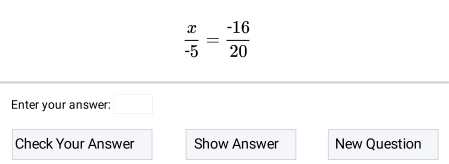
Solve the given proportion for the unknown variable x.
Discussion
Direct Variation
Direct variation is a relationship between two variables, x and y, where an increase in one variable causes the other to increase by a constant factor k. This means that if x increases, y increases, and if x decreases, y decreases. The following equation shows this relationship algebraically.
y=kx
y=kx⇔xy=k
An example of direct variation is the connection between the number of hours worked and the money earned. If the constant of proportionality is $10 per hour, this relationship can be expressed with following equation.
Money Earned=$10×Hours Worked
The money earned by someone who worked 5 hours can be found by multiplying $10 by 5.
Money Earned=$10⋅5=$50
In addition, the amount earned by someone who worked 8 hours can be calculated using a similar process.
Money Earned=$10⋅8=$80
Notice that the amount earned increases as the number of hours worked increases, and the rate of increase is constant at $10 per hour. This is the essence of direct variation.Pop Quiz
Identifying the Constant of Variation
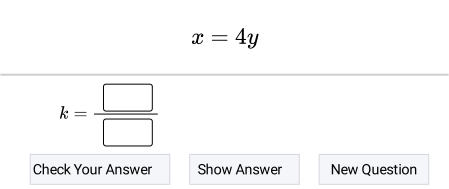
Recall that direct variation equations can be written in the forms y=kx, k=xy, or x=ky. Identify the constant of variation k in the given direct variation equation. If the value of k is a fraction, write it in its simplest form.
Discussion
Graphing a Direct Variation Using a Table of Values
A direct variation can be represented graphically by a line that passes through the origin on a coordinate plane. A table of values can help get the line of a direct variation given in the form y=kx. Consider, for example, the following equation of a direct variation.
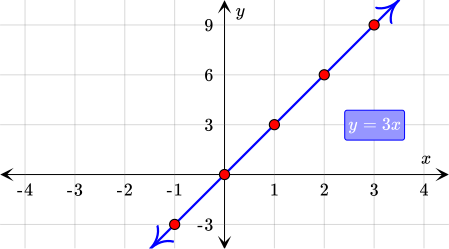 It is worth to keep in mind that if a line does not pass through the origin then it does not represent a direct variation. In other words, there is not a proportional relationship between the variables x and y.
y=3x
Three steps can be followed to draw the line for this equation.
1
Write the Equation in the form y=kx
expand_more Recall that a direct variation equation can be written in the following forms.
y=kx,xy=k, or ky=x
If a direct variation equation is in the form of xy=k or ky=x, then rewrite it to be in the form of y=kx. This form will help to apply the next steps more straightforwardly.
Note that the given equation is already in the form y=kx where the constant of variation k is 3. 2
Make a Table of Values
expand_more A table of values can be made by substituting several random values for x and then solving the equation for y.
| x | y=3x | y | (x,y) |
|---|---|---|---|
| -1 | y=3(-1) | -3 | (-1,-3) |
| 0 | y=3(0) | 0 | (0,0) |
| 1 | y=3(1) | 3 | (1,3) |
| 2 | y=3(2) | 6 | (2,6) |
| 3 | y=3(3) | 9 | (3,9) |
3
Plot the Ordered Pairs and Graph the Line
expand_more Finally, plot the ordered pairs from the table of values and connect them with a straight line.
Example
Perfomance of a Robotic Vacuum Cleaner
They will use a robotic vacuum cleaner to clean the floor of not only their kitchen but their entire house!

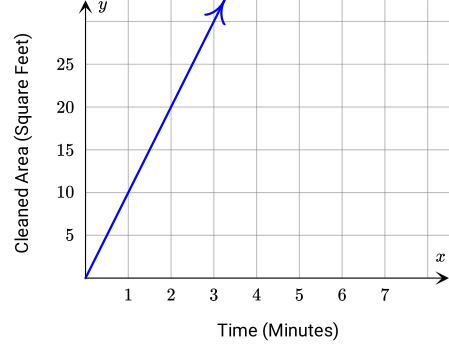
The following graph shows the cleaned area by the vacuum cleaner in x minutes.
{"type":"text","form":{"type":"math","options":{"comparison":"1","nofractofloat":false,"keypad":{"simple":true,"useShortLog":false,"variables":["x"],"constants":["PI"]},"rendered":false},"text":"<span class=\"katex\"><span class=\"katex-html\" aria-hidden=\"true\"><\/span><\/span>"},"formTextBefore":null,"formTextAfter":"square feet","answer":{"text":["10"]}}
{"type":"text","form":{"type":"math","options":{"comparison":"1","nofractofloat":false,"keypad":{"simple":true,"useShortLog":false,"variables":["x"],"constants":["PI"]},"rendered":false},"text":"<span class=\"katex\"><span class=\"katex-html\" aria-hidden=\"true\"><\/span><\/span>"},"formTextBefore":null,"formTextAfter":"minutes","answer":{"text":["25"]}}
Hint
The graph of a proportional relationship is a line that passes through the origin. This direct variation can be represented by an equation in the form y=kx.
Solution
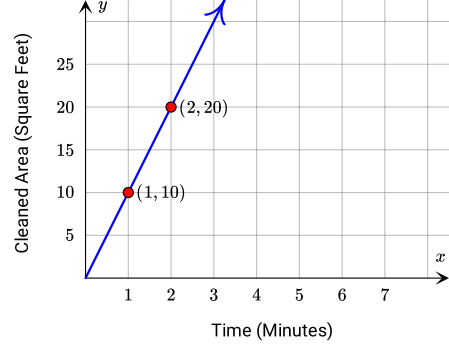
Notice that the given graph is a line that passes through the origin. This means that it represents a proportional relationship between the variables. With this in mind start by examining several points on the graph.
(1,10)
The y-coordinate of (1,10) is 10. This means that the robotic vacuum cleaner can clean 10 square feet in one minute. For a point as (1,r) in a direct variation graph, r represents the unit rate. In the context of the problem, unit rate means the area cleaned in one minute or per minute by the vacuum cleaner.
(1,r)⇒r=Unit Rate
Now, remember the general form of a direct variation equation.
y=kx
In this form, k is the constant of variation or the unit rate. With this in mind, substitute k=10 into this equation to have an equation representing the cleaned area by the robotic vacuum cleaner according to the time in minutes.
y=10x
Next, use this equation to find the time for cleaning the 250 square feet area. Notice that 250 represents the y-coordinate and it is asked to find the corresponding x-coordinate at that point. Now, substitute y=250 into the equation and solve it for x.
This means that the vacuum cleaner can finish cleaning the living room in 25 minutes.
Closure
Can the Constant of Variation of a Direct Variation Be Zero?
Recall that if the variables x and y are proportional, then there exists a direct variation between them. This relation can be represented by the following equation.
As it can be seen from the table, all the y values become 0 for any value of x. Since the variable y stays the same while the variable x is changing, it does not exist a direct variation between the variables. When k=0, its equation becomes y=0.
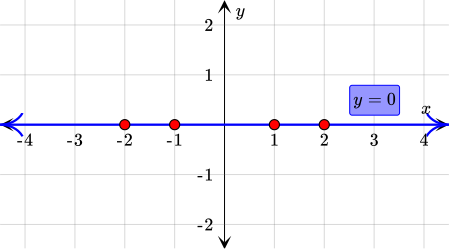 This means that if a line passes through the origin, it cannot necessarily be said that it is the graph of a direct variation. It must also be known that the constant of variation is not equal to zero.
y=kx
The value of k is the constant of variation. What if k=0? Make a table of values to see what happens when k is equal to zero. | x | y=kx | y |
|---|---|---|
| -2 | y=0⋅(-2) | 0 |
| -1 | y=0⋅(-1) | 0 |
| 1 | y=0⋅1 | 0 |
| 2 | y=0⋅2 | 0 |
y=0⋅x⇒y=0
Note that its graph is also a line passing through the origin.
Loading content