3. Properties of Cones
Sign In
An error ocurred, try again later!
Chapter 3
3.
Properties of Cones
This lesson delves into the geometric properties of cones, specifically their volume, surface area, and slant height. It uses the Pythagorean Theorem as a tool for calculations. Practical examples include determining the volume of a traffic cone or calculating the amount of material needed for a science fair project. Understanding these properties can be crucial in various fields such as engineering, architecture, and even everyday tasks like home improvement. The lesson serves as a comprehensive guide for those interested in applying these geometric principles in real-life scenarios.
Show less Show more expand_more 


Lesson Settings & Tools
| | 12 Theory slides |
| | 9 Exercises - Grade E - A |
| | Each lesson is meant to take 1-2 classroom sessions |
Properties of Cones
Slide of 12
Cone-shaped figures can be recognized in many places in everyday life, such as when eating ice cream. This lesson will focus on the formulas for the volume and the surface area of a cone.
Catch-Up and Review
Here are a few recommended readings before getting started with this lesson.
Explore
Share
Report error
Relating the Volumes of Cones and Cylinders
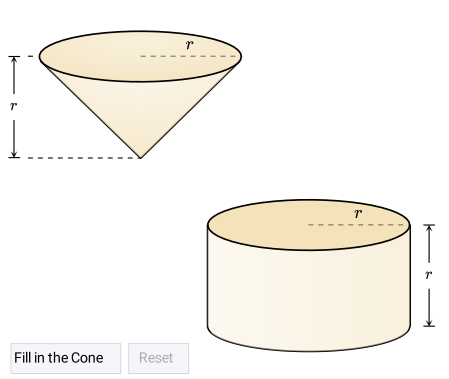
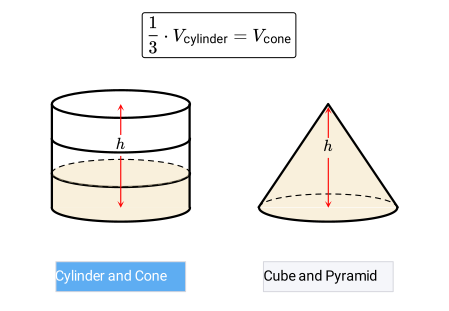
Heichi knows how to calculate the volume of a cylinder. He thinks that the volume of a cone can be found using cylinders. To do so, he makes a cone-shaped mold with a height and radius of r. Then, he fills it with sand and pours it into a cylinder with the same radius and height.
Discussion
Share
Report error
Cones
Before proceeding to the volume of a cone, the definition of a cone and its characteristics will be examined.
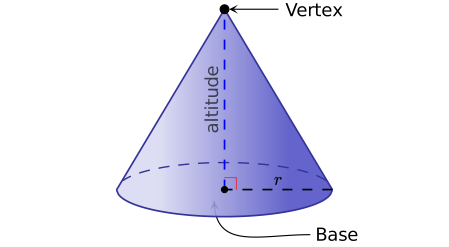
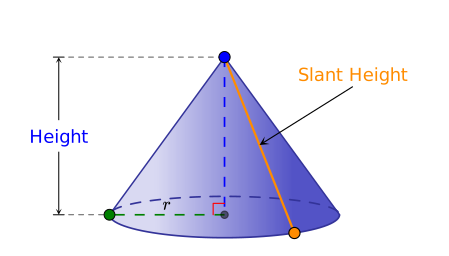
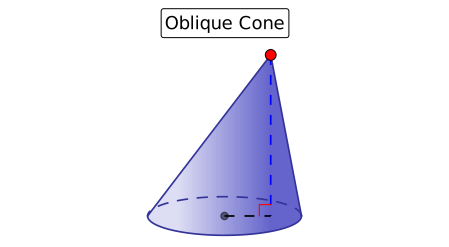
A cone is a three-dimensional solid with a circular base and a point, called the vertex or apex, that is not in the same plane as the base. The altitude of a cone is the segment that runs perpendicularly from the vertex to the base.
Considering Heichi's experiment, the formula for the volume of a cone will be one third of the volume of a cylinder with the same radius and height.
Rule
Share
Report error
Volume of a Cone
The volume of a cone is one third the product of its base area and its height.
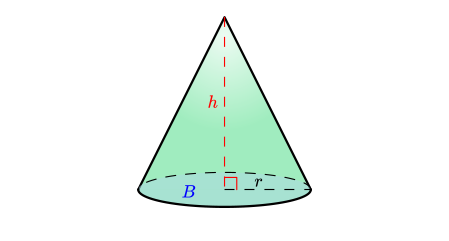
The base area B is the area of the circle and the height h is measured perpendicular to the base.
V = 1/3 B h
Since the base is a circle, its area depends on its radius. Therefore, the base area can also be expressed in terms of the radius r.
V = 1/3 π r^2 h
Proof
Informal JustificationConsider a cone and a cylinder that have the same base area and height.
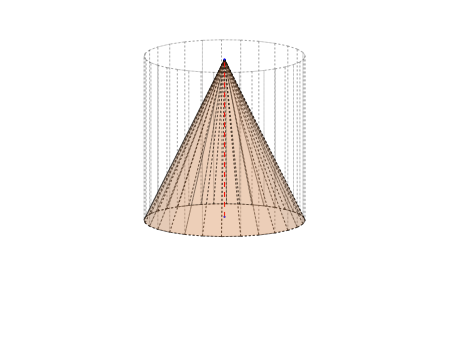 A cone can be modeled as a stack of cylinders. The sum of the volumes of the small cylinders will be greater than the cone's volume. However, the higher the number of cylinders, the more the sum will approximate the volume of the cone.
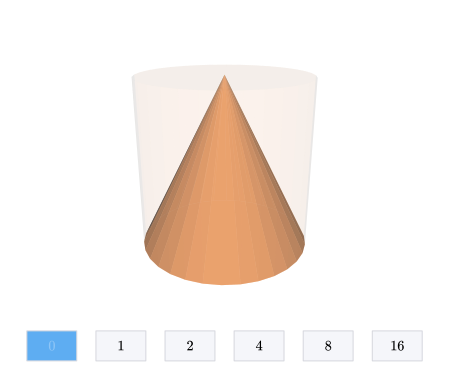 Furthermore, the ratio of the sum of the volumes of each small cylinder to the volume of the big cylinder nears 13 as the number of stacked cylinders increases.
| Number of Cylinders | Sum of Volumes of Stacked Cylinders/Volume of Large Cylinder |
|---|---|
| 4 | ≈ 0.469 |
| 16 | ≈ 0.365 |
| 64 | ≈ 0.341 |
| 256 | ≈ 0.335 |
| 1024 | ≈ 0.334 |
| 4096 | ≈ 0.333 |
| ∞ | 1/3 |
Therefore, the volume of a cone is one third the volume of the cylinder with the same base area and height. \begin{gathered} V_\text{cone} = \dfrac{1}{3}V_\text{cylinder}\\[0.7em] \Downarrow \\ V_\text{cone} = \dfrac{1}{3} {\color{#FD9000}{Bh}} \end{gathered} Since the base area is the area of a circle, that formula can be substituted for B to find a more detailed formula for the volume of the cone. \begin{gathered} V_\text{cone} = \dfrac{1}{3}\pi r^2 h \end{gathered}
Example
Share
Report error
Finding the Volume of the Cathedral of Maringá
The Cathedral of Maringá, one of the tallest churches in the world, was designed in the form of a cone by José Augusto Bellucci.

{"type":"text","form":{"type":"math","options":{"comparison":"1","nofractofloat":false,"keypad":{"simple":true,"useShortLog":false,"variables":["x"],"constants":["PI"]},"rendered":false},"text":" "},"formTextBefore":null,"formTextAfter":"m^3","answer":{"text":["298451"]}}
Hint
The volume of a cone is one third of the product of its base area and height.
Solution
To find the volume of the cathedral, the formula for the volume of a cone will be used.
V= 13π r^2 h
In this formula, r is the radius of the base and h is the height of the cone. The height of the conical cathedral is 114 meters and its radius is 50 meters. By substituting these values into the formula, the volume can be found.
The volume of the cone is approximately 298 451 cubic meters.
V=1/3π r^2 h
SubstituteII
r= 50, h= 114
V=1/3π ( 50)^2 ( 114)
▼
Simplify right-hand side
CalcPow
Calculate power
V=1/3π(2500)(114)
Multiply
Multiply
V=1/3285 000π
MoveRightFacToNumOne
1/b* a = a/b
V=285 000π/3
UseCalc
Use a calculator
V=298 451.302091 ...
RoundInt
Round to nearest integer
V ≈ 298 451
Example
Share
Report error
Finding the Volume a Chinese Conical Hat
Tadeo is learning how to make a traditional Chinese conical hat. He notices that the craftsman uses 20-centimeter bamboo sticks to make the framework.
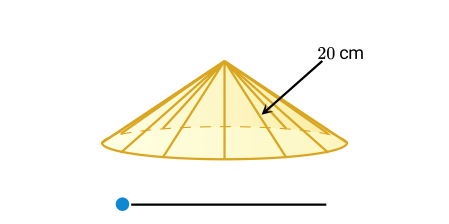
If the radius of the base is 16 centimeters, find the volume of the hat. Round the answer to the nearest cubic centimeter.
{"type":"text","form":{"type":"math","options":{"comparison":"1","nofractofloat":false,"keypad":{"simple":true,"useShortLog":false,"variables":["x"],"constants":["PI"]},"rendered":false},"text":" "},"formTextBefore":null,"formTextAfter":"cm^3","answer":{"text":["3217"]}}
Hint
Use the Pythagorean Theorem to find the height of the cone.
Solution
To find the volume of the conical hat, its height will be calculated first. Then, the formula for the volume of a cone will be used.
Finding Height of the Hat
The distance from the vertex of the cone to its base is the height of the cone. Each stick if the frame represents the slant height of the cone. Therefore, the cone has a slant height of 20 centimeters and a radius of 16 centimeters.
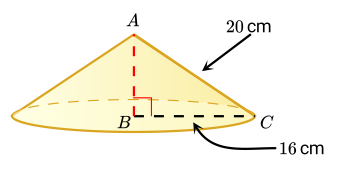
AC^2 = AB^2 + BC^2
SubstituteII
AC= 20, BC= 16
20^2 = AB^2 + 16^2
▼
Solve for AB
CalcPow
Calculate power
400 = AB^2 + 256
SubEqn
LHS-256=RHS-256
144 = AB^2
RearrangeEqn
Rearrange equation
AB^2 = 144
SqrtEqn
sqrt(LHS)=sqrt(RHS)
sqrt(AB^2) = sqrt(144)
SqrtPowToNumber
sqrt(a^2)=a
AB = 12
Finding the Volume of the Hat
Recall the formula for the volume of a cone. V= 13π r^2 h Here, r is the radius and h is the height of the cone. The height was found to be 12 centimeters, and the radius of the base is 16 centimeters. The volume of the hat can be found by substituting these values into the formula.V=1/3π r^2 h
SubstituteII
r= 16, h= 12
V=1/3π ( 16^2) ( 12)
▼
Simplify right-hand side
CalcPow
Calculate power
V=1/3π(256)(12)
Multiply
Multiply
V=1/33072π
MoveRightFacToNumOne
1/b* a = a/b
V=3072π/3
UseCalc
Use a calculator
V= 3216.990877 ...
RoundInt
Round to nearest integer
V ≈ 3217
Example
Share
Report error
Finding the Radius of a Traffic Cone
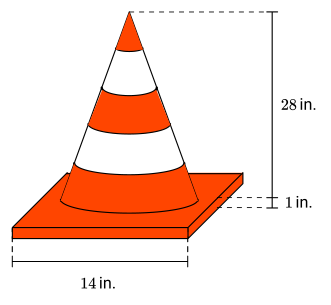
The diagram shows a traffic cone, which has a volume of 3128 cubic inches.
{"type":"text","form":{"type":"math","options":{"comparison":"1","nofractofloat":false,"keypad":{"simple":true,"useShortLog":false,"variables":["x"],"constants":["PI"]},"rendered":false},"text":" "},"formTextBefore":null,"formTextAfter":"in.","answer":{"text":["10"]}}
Hint
The volume occupied by the traffic cone is the sum of the volume of the prism base and the volume of the cone part.
Solution
The traffic cone is basically composed of two solids — a cone and a square prism. Therefore, the volume occupied by the traffic cone is the sum of the volume of the prism V_p and the volume of the cone V_c. V = V_p + V_c First the volume of the cone will be found. Then, the volume formula of a cone will be used to calculate the radius of the base of the cone.
Finding the Volume of the Cone
The base of the prism is a square with side lengths of 14 inches, so its area is the square of 14. B =14^2 ⇔ B=196 Since the volume of a prism is its base area times its height, the volume of the square prism can be found as follows. Given that the total volume of the traffic cone is 3128 cubic inches, the volume of the cone part can be found now.Finding the Radius of the Cone
Finally, using the formula for the volume of a cone, the radius of the cone can be found. V_c = 1/3 π r^2 h To do so, substitute 2932 for V_c and 28 for h into the formula and solve for r.V_c = 1/3 π r^2 h
SubstituteII
V_c= 2932, h= 28
2932= 1/3 π r^2 ( 28)
▼
Solve for r
MultEqn
LHS * 3=RHS* 3
8796 = π r^2 (28)
CommutativePropMult
Commutative Property of Multiplication
8796 = 28π r^2
DivEqn
.LHS /28 π .=.RHS /28 π .
8796/28 π = r^2
RearrangeEqn
Rearrange equation
r^2 = 8796/28 π
SqrtEqn
sqrt(LHS)=sqrt(RHS)
sqrt(r^2) = sqrt(8796/28 π)
SqrtPowToNumber
sqrt(a^2)=a
r = sqrt(8796/28 π)
UseCalc
Use a calculator
r = 9.999738 ...
RoundInt
Round to nearest integer
r ≈ 10
Example
Share
Report error
Cylinder With a Cone Inside
For the Jefferson High Science Fair, Ali is thinking about a chemistry experiment in which he will need a cylinder with a radius of 20 centimeters and a height 81 centimeters, with a cone inside. The cylinder must be open on both ends, and the cone must have an open bottom.
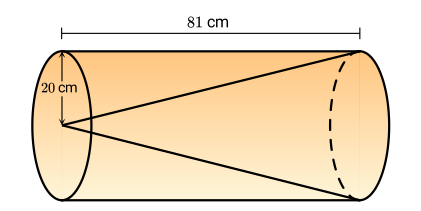
To conduct the experiment, Ali needs to answer some questions first. Help him find the answers in order to win the first prize in the fair!
a Ali will fill the cone with water and the interior portion of the cylinder not occupied by the cone with foam. How many cubic centimeters of water and foam does Ali need? Write the answers to the nearest integer.
{"type":"text","form":{"type":"math","options":{"comparison":"1","nofractofloat":false,"keypad":{"simple":true,"useShortLog":false,"variables":[],"constants":[]},"rendered":false},"text":" "},"formTextBefore":"Water:","formTextAfter":"cm^3","answer":{"text":["33929","33,929","33 929"]}}
{"type":"text","form":{"type":"math","options":{"comparison":"1","nofractofloat":false,"keypad":{"simple":true,"useShortLog":false,"variables":[],"constants":[]},"rendered":false},"text":" "},"formTextBefore":"Foam:","formTextAfter":"cm^3","answer":{"text":["67858","67 858","67,858"]}}
b What percent of the interior of the cylinder is not occupied by the cone? Round the answer to one decimal place.
{"type":"text","form":{"type":"math","options":{"comparison":"1","nofractofloat":false,"keypad":{"simple":true,"useShortLog":false,"variables":[],"constants":[]},"rendered":false},"text":" "},"formTextBefore":null,"formTextAfter":"%","answer":{"text":["66.7"]}}
Hint
a The volume of a cone is one third the product of π, the square of the radius, and the height. The volume of a cylinder is the product of π, the square of the radius, and the height.
b Use the exact values for the volumes obtained in Part A.
Solution
a The volumes will be calculated one at a time.
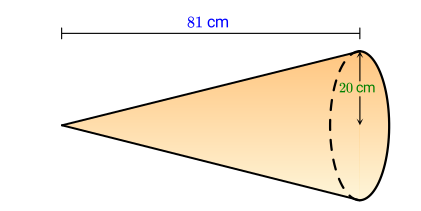 The volume of a cone is one third the product of π, the square of the radius, and the height.
V_(cone) = 1/3π r^2h
In the this formula, 81 and 20 can be substituted for h and r, respectively.
Therefore, the volume of water that Ali needs is 10 800π cubic centimeters. Finally, this number will be approximated to the nearest integer.
Ali needs about 33 929 cubic centimeters of water.
The volume of a cone is one third the product of π, the square of the radius, and the height.
V_(cone) = 1/3π r^2h
In the this formula, 81 and 20 can be substituted for h and r, respectively.
Therefore, the volume of water that Ali needs is 10 800π cubic centimeters. Finally, this number will be approximated to the nearest integer.
Ali needs about 33 929 cubic centimeters of water. 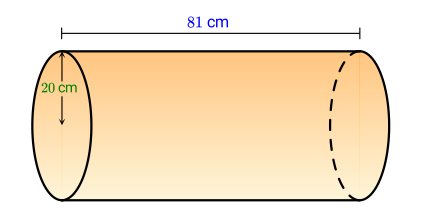 The volume of a cylinder is the product of π, the square of the radius, and the height.
V_(cylinder) =π r^2h
One more time, 81 and 20 can be substituted for h and r, respectively.
The volume of the cylinder is 32 400π cubic centimeters. The volume of the space inside the cylinder that is not occupied by the cone is the difference between the volume of the cylinder and the volume of the cone, which is 10 800π cubic centimeters. 32 400π- 10 800π = 21 600 π
The volume of the cylinder that is not occupied by the cone is 26 600π cubic centimeters and is the volume of foam that Ali will need. This number will be approximated to the nearest integer.
Ali needs about 67 858 cubic centimeters of foam.
The volume of a cylinder is the product of π, the square of the radius, and the height.
V_(cylinder) =π r^2h
One more time, 81 and 20 can be substituted for h and r, respectively.
The volume of the cylinder is 32 400π cubic centimeters. The volume of the space inside the cylinder that is not occupied by the cone is the difference between the volume of the cylinder and the volume of the cone, which is 10 800π cubic centimeters. 32 400π- 10 800π = 21 600 π
The volume of the cylinder that is not occupied by the cone is 26 600π cubic centimeters and is the volume of foam that Ali will need. This number will be approximated to the nearest integer.
Ali needs about 67 858 cubic centimeters of foam.
Volume of Water
Ali will fill the cone with water. Therefore, the volume of the cone is needed. The height and radius of the cone are the same as the height and radius of the cylinder. Therefore, the height of the cone is 81 centimeters and its radius is 20 centimeters.
V_(cone) = 1/3π r^2h
SubstituteII
h= 81, r= 20
V_(cone) = 1/3π ( 20^2)( 81)
▼
Evaluate right-hand side
CalcPow
Calculate power
V_(cone) = 1/3π (400)(81)
Multiply
Multiply
V_(cone) = 1/3π (32 400)
CommutativePropMult
Commutative Property of Multiplication
V_(cone) = 1/3(32 400)π
MoveRightFacToNumOne
1/b* a = a/b
V_(cone) = 32 000/3π
CalcQuot
Calculate quotient
V_(cone) = 10 800π
Volume of Foam
Ali will fill the part of the cylinder not occupied by the cone with foam. Therefore, the volume of this portion is needed. It is given that the height of the cylinder is 81 centimeters and that its radius is 20 centimeters.
b In Part A it was found that the volume of the cylinder is 32 400π cubic centimeters. It was also found that the volume of the portion of the cylinder not occupied by the cone is 21 600π cubic centimeters. The ratio of the second value to the first value will result in the desired percentage.
It can be concluded that the volume of the cylinder not occupied by the cone represents 66.7 % of the interior of the cylinder.
21 600π/32 400π
▼
Evaluate
CancelCommonFac
Cancel out common factors
21 600π/32 400π
SimpQuot
Simplify quotient
21 600/32 400
ReduceFrac
a/b=.a /10 800./.b /10 800.
2/3
▼
Convert to percent
FracToDiv
a/b=a÷ b
0.666666...
WritePercent
Convert to percent
66.666666... %
RoundDec
Round to 1 decimal place(s)
66.7 %
Discussion
Share
Report error
Surface Area of a Cone
Consider a right cone with radius r and slant height l.
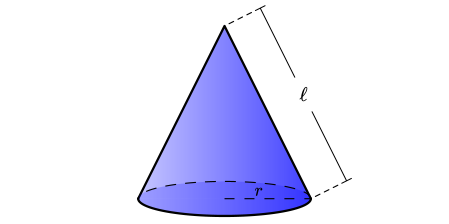
The surface area of a right cone is the sum of the base area and the lateral area. The area of the base is given by π r^2 and the lateral area is π rl.
SA=π r^2 +π r l
Proof
Informal JustificationThe surface area of a cone is made of two main components, the area of the circular base and the lateral area. 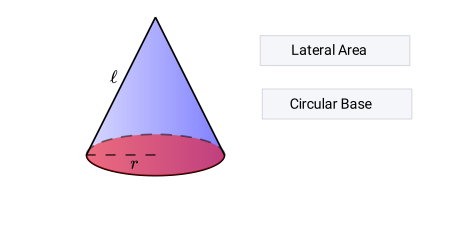 Let LA be the lateral area of a cone and BA the area of the circular base. The surface area SA of a cone is made of the sum of the area of the circular base and the lateral area.
SA = BA + LA
The area of the circular base is found using the formula for the area of a circle.
BA = π r^2
The lateral area can be better visualized in two dimensions. Suppose that the cone is cut and the lateral area is expanded.
Let LA be the lateral area of a cone and BA the area of the circular base. The surface area SA of a cone is made of the sum of the area of the circular base and the lateral area.
SA = BA + LA
The area of the circular base is found using the formula for the area of a circle.
BA = π r^2
The lateral area can be better visualized in two dimensions. Suppose that the cone is cut and the lateral area is expanded.
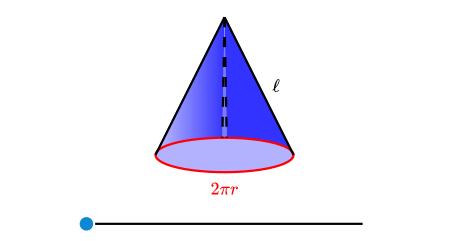 It should be noted that the figure obtained is a sector of a circle of radius l, the slant height of the cone. Then, the lateral area can be obtained using the formula for the area of a sector of a circle of radius l.
Area of a Sector = θ/360^(∘)* π l^2
But from the image it should also be noted that the arc of the sector has the same length as the circumference of the circular base of radius r. Using the formula for the length of an arc relative to its measure, it is possible to write an equation to equate these quantities.
Circumference of Base = Arc Length ⇓ 2π r = θ/360 ^(∘)* 2π l
Dividing both sides of the equation by 2π, this equation can be simplified.
r = θ/360 ^(∘)* l
Now it is possible to write an expression for the lateral area. First, the expression is the same as the formula for the area of a sector.
Finally, the expressions for the area of the circular base and the lateral area can be substituted to find the expression for the surface area of a cone.
SA = BA + LA ⇓ SA = π r^2 + π r l
It should be noted that the figure obtained is a sector of a circle of radius l, the slant height of the cone. Then, the lateral area can be obtained using the formula for the area of a sector of a circle of radius l.
Area of a Sector = θ/360^(∘)* π l^2
But from the image it should also be noted that the arc of the sector has the same length as the circumference of the circular base of radius r. Using the formula for the length of an arc relative to its measure, it is possible to write an equation to equate these quantities.
Circumference of Base = Arc Length ⇓ 2π r = θ/360 ^(∘)* 2π l
Dividing both sides of the equation by 2π, this equation can be simplified.
r = θ/360 ^(∘)* l
Now it is possible to write an expression for the lateral area. First, the expression is the same as the formula for the area of a sector.
Finally, the expressions for the area of the circular base and the lateral area can be substituted to find the expression for the surface area of a cone.
SA = BA + LA ⇓ SA = π r^2 + π r l
LA = θ/360^(∘)* π l^2
CommutativePropMult
Commutative Property of Multiplication
LA = (θ/360^(∘)* l) * π l
Substitute
θ/360^(∘)* l= r
LA = rπ l
Example
Share
Report error
Cylinder With a Cone Inside
For his experiment for the science fair, Ali plans to make the figure by himself.
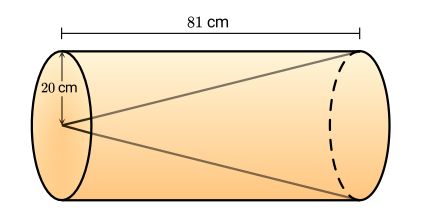
{"type":"text","form":{"type":"math","options":{"comparison":"1","nofractofloat":false,"keypad":{"simple":true,"useShortLog":false,"variables":[],"constants":[]},"rendered":false},"text":" "},"formTextBefore":"$","formTextAfter":null,"answer":{"text":["192.76"]}}
Hint
The area of the lateral surface of a cone is the product of π, the radius, and the slant height. A cylinder's lateral surface area is twice the product of π, the radius, and the height.
Solution
Since the cost is given per square meter, all the measures will be converted from centimeters to meters. To do this, the measures need to be multiplied by a conversion factor, 1 m100 cm. Height: 81 cm * 1 m/100 cm &= 0.81 m [1em] [-0.5em] Radius: 20 cm * 1 m/100 cm &= 0.2 m With this information, update the measures on the diagram.
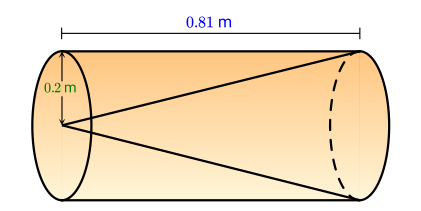
The lateral areas of the cylinder and the cone will be calculated one at a time. Then, their sum will be multiplied by the cost per square meter.
Lateral Area of the Cylinder
Recall that the cylinder is open in both ends. The lateral area of a cylinder is twice the product of π, the radius, and the height. LA_(cylinder)=2π r h In the above formula, 0.81 and 0.2 can be substituted for h and r, respectively.LA_(cylinder)=2π r h
SubstituteII
h= 0.81, r= 0.2
LA_(cylinder)=2π ( 0.2) ( 0.81)
▼
Evaluate right-hand side
CommutativePropMult
Commutative Property of Multiplication
LA_(cylinder)=2(0.2)(0.81)π
Multiply
Multiply
LA_(cylinder) = 0.324π
Lateral Area of the Cone
The lateral area of a cone is the product of π, the radius, and the slant height. LA_(cone) = π r l The slant height l is the hypotenuse of the right triangle formed by the radius, the height, and the segment that connects the center of the base of the cylinder with a point on the circumference of the opposite base.
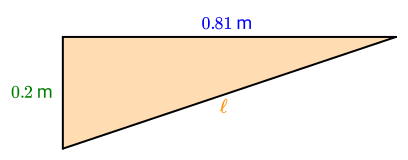
a^2+b^2=c^2
SubstituteValues
Substitute values
0.81^2+ 0.2^2= l^2
▼
Solve for l
CalcPow
Calculate power
0.6561+0.04=l ^2
AddTerms
Add terms
0.6961=l ^2
SqrtEqn
sqrt(LHS)=sqrt(RHS)
sqrt(0.6961)=l
RearrangeEqn
Rearrange equation
l=sqrt(0.6961)
LA_(cone)=π r l
SubstituteII
l= sqrt(0.6961), r= 0.2
LA_(cone)=π ( 0.2) ( sqrt(0.6961))
CommutativePropMult
Commutative Property of Multiplication
LA_(cone)= 0.2 sqrt(0.6961) π
Total Cost
Finally, the sum of the lateral areas will be multiplied by the cost per square meter. To make the shape that Ali needs, he has to spend about $192.76.Example
Share
Report error
Finding the Surface Area of a Cone
Tiffaniqua's teacher gives her a piece of paper on which a circle and a sector are drawn. The paper is a square of side length 10 centimeters.
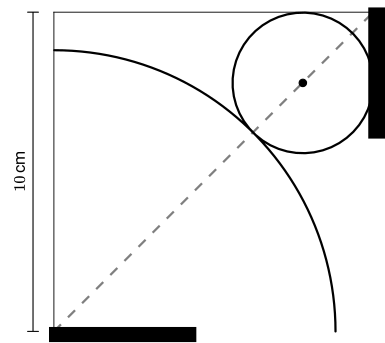
The teacher also gives the following set of information.
- The circle is tangent to the top and right sides of the paper as well as to the sector.
- The centers of the circle and sector are on the diagonal of the paper.
- The circle and the sector can form a cone.
Help Tiffaniqua answer the following questions.
a Find the radii of the circle and the sector. Write the answers to one decimal place.
{"type":"text","form":{"type":"math","options":{"comparison":"1","nofractofloat":false,"keypad":{"simple":true,"useShortLog":false,"variables":["x"],"constants":["PI"]},"rendered":false},"text":" "},"formTextBefore":"r=","formTextAfter":"cm","answer":{"text":["2.2"]}}
{"type":"text","form":{"type":"math","options":{"comparison":"1","nofractofloat":false,"keypad":{"simple":true,"useShortLog":false,"variables":["x"],"constants":["PI"]},"rendered":false},"text":" "},"formTextBefore":"l=","formTextAfter":"cm","answer":{"text":["8.8"]}}
b Find the surface area of the cone. Round the answer to the nearest square centimeter.
{"type":"text","form":{"type":"math","options":{"comparison":"1","nofractofloat":false,"keypad":{"simple":true,"useShortLog":false,"variables":[],"constants":[]},"rendered":false},"text":" "},"formTextBefore":null,"formTextAfter":"cm^2","answer":{"text":["76"]}}
Hint
a The circumference of the circle is equal to the arc length of the sector.
b The surface area of a cone is the sum of the base area and the lateral area.
Solution
a Let l be the radius of the sector and r be the radius of the circle. To find these values, a system of two equations should be written first. The equations can be written using the trigonometric ratios and the properties of cones. Then, the system of equations will be solved using the Substitution Method. 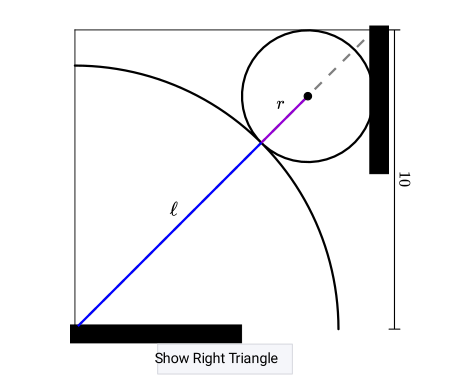 Since the diagonal of the square bisects the angle, the right triangle is also an isosceles triangle. Using the sine ratio of 45^(∘), an equation describing the relationship between r and l can be written. sin 45^(∘) = 10-r/l+r
Since sin 45^(∘) = 1sqrt(2), the above equation can be solved for l.
The first equation is obtained. It is also known that the sector of circle with radius l and the circle with radius r form a cone.
Since the diagonal of the square bisects the angle, the right triangle is also an isosceles triangle. Using the sine ratio of 45^(∘), an equation describing the relationship between r and l can be written. sin 45^(∘) = 10-r/l+r
Since sin 45^(∘) = 1sqrt(2), the above equation can be solved for l.
The first equation is obtained. It is also known that the sector of circle with radius l and the circle with radius r form a cone. 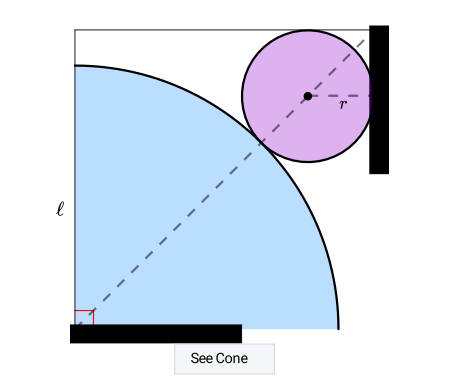 As shown above, l will be the slant height of the cone and r will be the radius of its circular base. Recall that in a cone, the circumference of the circular base is equal to the arc length of the sector. Since the measure of the sector is 90^(∘), its arc length can be found using the relationship between arc length and arc measure.
rl
Arc Length: & 90/360 * 2 π l [1.2em]
Circumference of Base: & 2 π r
Because these two lengths are equal, another equation can be obtained.
Now, a system of equations can be written using the two values of l. l = 10sqrt(2)-rsqrt(2)-r & (I) l = 4r & (II)
Next, the value of r can be substituted into the other equation to find the value of l.
The radii of the circle and the sector are about 2.2 and 8.8 centimeters, respectively.
As shown above, l will be the slant height of the cone and r will be the radius of its circular base. Recall that in a cone, the circumference of the circular base is equal to the arc length of the sector. Since the measure of the sector is 90^(∘), its arc length can be found using the relationship between arc length and arc measure.
rl
Arc Length: & 90/360 * 2 π l [1.2em]
Circumference of Base: & 2 π r
Because these two lengths are equal, another equation can be obtained.
Now, a system of equations can be written using the two values of l. l = 10sqrt(2)-rsqrt(2)-r & (I) l = 4r & (II)
Next, the value of r can be substituted into the other equation to find the value of l.
The radii of the circle and the sector are about 2.2 and 8.8 centimeters, respectively.
Writing the System of Equations
Start by drawing a right triangle whose hypotenuse is l+r centimeters.sin 45^(∘) = 10-r/l+r
Substitute
sin 45^(∘) = 1/sqrt(2)
1/sqrt(2) = 10-r/l+r
l = 10sqrt(2)-rsqrt(2) -r
90/360 * 2 π l = 2 π r
▼
Solve for l
DivEqn
.LHS /2 π .=.RHS /2 π .
90/360 * l = r
ReduceFrac
a/b=.a /90./.b /90.
1/4 * l = r
MultEqn
LHS * 4=RHS* 4
l = 4 r
Solving the System of Equations
The Substitution Method will be used to find the unknowns. First use the value of l to find the value of r.l = 10sqrt(2)-rsqrt(2)-r & (I) l = 4r & (II)
Substitute
(I): l= 4r
4r= 10sqrt(2)-rsqrt(2)-r l = 4r
▼
Solve for r
AddEqn
(I): LHS+rsqrt(2)+r=RHS+rsqrt(2)+r
5r + r sqrt(2) = 10sqrt(2) l = 4r
FactorOut
(I): Factor out r
r(5 + sqrt(2)) = 10sqrt(2) l = 4r
DivEqn
(I): .LHS /(5 + sqrt(2)).=.RHS /(5 + sqrt(2)).
r = 10sqrt(2)/5+ sqrt(2) l = 4r
UseCalc
(I): Use a calculator
r = 2.204812 ... l = 4r
RoundDec
(I): Round to 1 decimal place(s)
r ≈ 2.2 l = 4r
b The surface area of a cone is the sum of the base area and the lateral area.
S = π r^2 + π r l
By substituting l= 8.8 and r = 2.2, the surface area of the cone will be determined.
The surface area of the cone is about 76 square centimeters.
Pop Quiz
Share
Report error
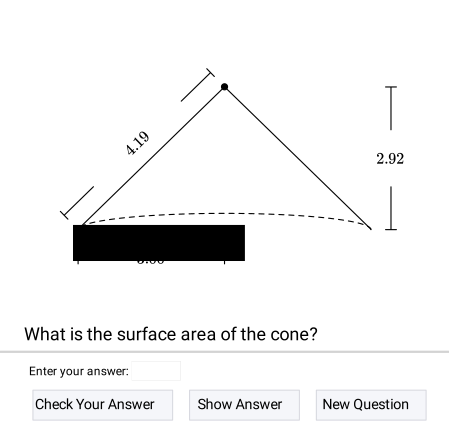
Practice Finding the Volume and Surface Area of a Cone
Closure
Share
Report error
Comparing the Volumes of a Pyramid and a Cube
In this lesson, the characteristics of cones have been studied, including their relationship with cylinders. It has been shown that the volume of a cone is one third the volume of a cylinder with the same radius and perpendicular height.
Properties of Cones
Exercise 1.1
Calculate the surface area of the cone. Leave your answer in terms of π
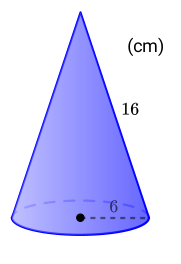
{"type":"text","form":{"type":"math","options":{"comparison":"1","nofractofloat":false,"keypad":{"simple":false,"useShortLog":false,"variables":["x"],"constants":["PI"]},"rendered":false},"text":" "},"formTextBefore":"S=","formTextAfter":"cm^2","answer":{"text":["132\\pi"]}}
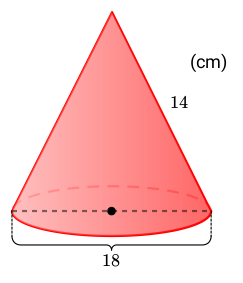
{"type":"text","form":{"type":"math","options":{"comparison":"1","nofractofloat":false,"keypad":{"simple":false,"useShortLog":false,"variables":["x"],"constants":["PI"]},"rendered":false},"text":" "},"formTextBefore":"S=","formTextAfter":"cm^2","answer":{"text":["207\\pi"]}}
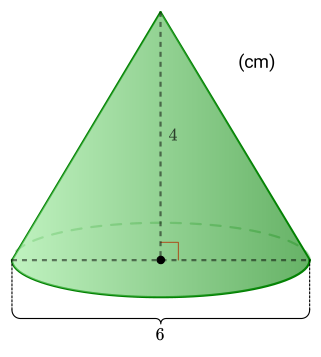
{"type":"text","form":{"type":"math","options":{"comparison":"1","nofractofloat":false,"keypad":{"simple":false,"useShortLog":false,"variables":["x"],"constants":["PI"]},"rendered":false},"text":" "},"formTextBefore":"S=","formTextAfter":"cm^2","answer":{"text":["24\\pi"]}}
security
report
code
security
report
code
The surface area of a cone is the sum of the cone's lateral surface and the base area. The lateral surface is the product of π, the radius, and the slant height of the cone. The base area is the product of the radius squared and π. S=π r^2+π rl We see that the slant height of the cone equals 16 centimeters and the radius is 6 centimeters. By substituting 6 for r and 16 for l into the formula, we can calculate the surface area.
The surface area is 132π square centimeters.
As in Part A, we will use the same formula to calculate the surface area of the cone. Notice that we have been given the diameter of the cone but we need the radius, which is half the diameter. r=18/2=9cm Now we can calculate the surface area.
The surface area is 207π square centimeters.
This time we have the cone's height and diameter. However, we need the radius and the slant height. As in Part B, we can figure out the radius by dividing the diameter by 2. Since the diameter is 6 centimeters, we get a radius of 3 centimeters.
Now we see that the slant height l is the hypotenuse of a right triangle with legs of 3 and 4 centimeters. This is a so-called Pythagorean triple and has a hypotenuse of 5 centimeters.
Now we can calculate the surface area of the cone.
The surface area is 24π square centimeters.
security
report
code
Calculate the volume of the cone. Leave your answer in terms of π.
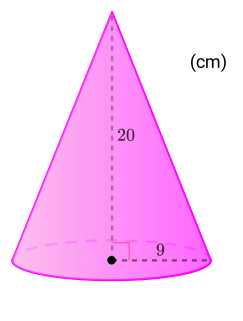
{"type":"text","form":{"type":"math","options":{"comparison":"1","nofractofloat":false,"keypad":{"simple":false,"useShortLog":false,"variables":["x"],"constants":["PI"]},"rendered":false},"text":" "},"formTextBefore":"V=","formTextAfter":"cm^3","answer":{"text":["540\\pi"]}}
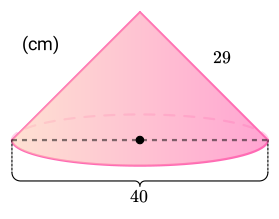
{"type":"text","form":{"type":"math","options":{"comparison":"1","nofractofloat":false,"keypad":{"simple":false,"useShortLog":false,"variables":["x"],"constants":["PI"]},"rendered":false},"text":" "},"formTextBefore":"V=","formTextAfter":"cm^3","answer":{"text":["2800\\pi"]}}
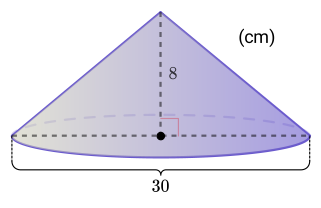
{"type":"text","form":{"type":"math","options":{"comparison":"1","nofractofloat":false,"keypad":{"simple":false,"useShortLog":false,"variables":["x"],"constants":["PI"]},"rendered":false},"text":" "},"formTextBefore":"V=","formTextAfter":"cm^3","answer":{"text":["600\\pi"]}}
security
report
code
security
report
code
The volume of a cone is one-third of the product of the base area and height. The base area is a circle, which means we have the following formula. V=1/3π r^2 h Let's substitute the value of r and h into the formula and evaluate the right-hand side.
Th volume is 540π cubic centimeters.
This time, we have been given the slant height and diameter of a cone. However, we need to know the radius and height between the base area and the cone's vertex. Since the diameter is 40 centimeters, the radius must be 20 centimeters.
The height h is the leg of a right triangle with a second leg of 20 centimeters and a hypotenuse of 29 centimeters. This is a so-called Pythagorean triple, and has a longer leg of 21 centimeters.
Now we can calculate the cone's volume.
The volume is 2800π cubic centimeters.
As in Part B, we know the diameter of the cone. Since the diameter is 30 centimeters, we know that the radius must be 15 centimeters. With this information, we have everything we need to calculate the cone's volume.
Th volume is 600π cubic centimeters.
security
report
code
Find the missing dimension of the cone.
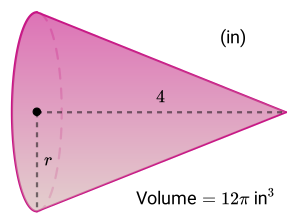
{"type":"text","form":{"type":"math","options":{"comparison":"1","nofractofloat":false,"keypad":{"simple":true,"useShortLog":false,"variables":["x"],"constants":["PI"]},"rendered":false},"text":" "},"formTextBefore":"r=","formTextAfter":"inches","answer":{"text":["3"]}}
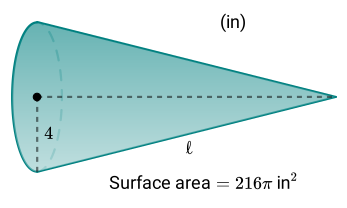
{"type":"text","form":{"type":"math","options":{"comparison":"1","nofractofloat":false,"keypad":{"simple":true,"useShortLog":false,"variables":["x"],"constants":["PI"]},"rendered":false},"text":" "},"formTextBefore":"l=","formTextAfter":"inches","answer":{"text":["50"]}}
security
report
code
security
report
code
To calculate the volume of a cone, we calculate one-third of the product of the base area and the height. V=1/3π r^2 h If we substitute the volume and height of the cone into this formula, we can solve for the radius of the cone.
The radius of the cone is 3 inches.
To calculate the surface area of a cone, we add the cone's lateral surface with its base area. S=π r^2+π rl if we substitute the surface area and radius of the cone into this formula, we can then solve for the slant height l of the cone.
The slant height of the cone is 50 inches.
security
report
code
Consider the following cone.
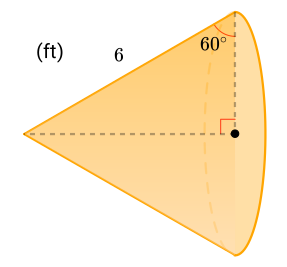
Calculate the following measures for the cone. Leave your answer in terms of π.
{"type":"text","form":{"type":"math","options":{"comparison":"1","nofractofloat":false,"keypad":{"simple":false,"useShortLog":false,"variables":["x"],"constants":["PI"]},"rendered":false},"text":" "},"formTextBefore":"V=","formTextAfter":"ft^3","answer":{"text":["9\\sqrt{3}\\pi"]}}
{"type":"text","form":{"type":"math","options":{"comparison":"1","nofractofloat":false,"keypad":{"simple":false,"useShortLog":false,"variables":["x"],"constants":["PI"]},"rendered":false},"text":" "},"formTextBefore":"S=","formTextAfter":"ft^2","answer":{"text":["27\\pi"]}}
security
report
code
security
report
code
To calculate the volume of the cone, we need to know its radius r and height h.
Examining the diagram, we see that the radius and height form a 30-60-90 triangle with a hypotenuse of 6 feet. In such a triangle, the shorter leg is half the length of the hypotenuse and the longer leg is sqrt(3) times greater than the shorter leg. With this information, we can find the lengths we need.
Now we can find the volume of the cone by calculating one-third of the product of the base area and height.
The volume is 9sqrt(3)π cubic feet.
The surface area of a cone is the sum of the lateral surface and the cone's base area. S=π r^2+π rl From the diagram we know the slant height of the cone, and in Part A, we calculated the radius to be 6 inches. Let's substitute them into the formula.
The cone has a surface area of 27π square feet.
security
report
code
Properties of Cones
Recommended exercises
To get personalized recommended exercises, please login first.
Loading content
≤
>
■2
■▢
e▢
7
8
9
×
÷■1
=
=
√▢
▢√
∫▢▢
4
5
6
+
−
≤
<
log
ln
log▢
1
2
3
()
∣
sin
cos
tan
0
.
π
x
y
Loading content