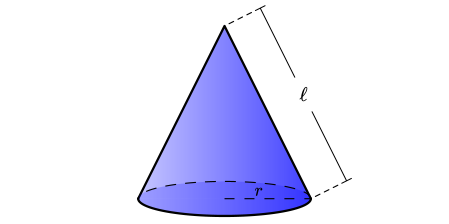
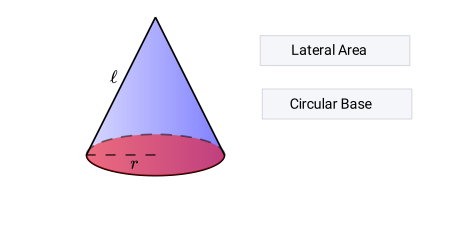
The surface area of a cone is made of two main components, the area of the circular base and the lateral area.
Let
LA be the lateral area of a cone and
BA the area of the circular base. The surface area
SA of a cone is made of the sum of the area of the circular base and the lateral area.
SA=BA+LA
The area of the circular base is found using the formula for the .
BA=πr2
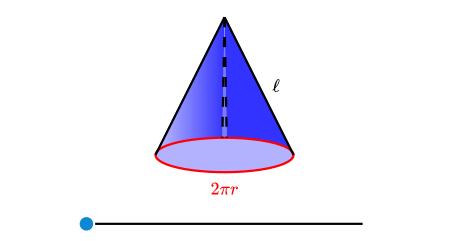
The lateral area can be better visualized in two dimensions. Suppose that the cone is cut and the lateral area is expanded.
It should be noted that the figure obtained is a of
ℓ, the slant height of the cone. Then, the lateral area can be obtained using the formula for the of radius
ℓ.
Area of a Sector=360∘θ⋅πℓ2
But from the image it should also be noted that the arc of the sector has the same length as the circumference of the circular base of radius
r. Using the formula for the relative to its measure, it is possible to write an equation to equate these quantities.
Circumference of Base=Arc Length⇓2πr=360∘θ⋅2πℓ
Dividing both sides of the equation by
2π, this equation can be simplified.
r=360∘θ⋅ℓ
Now it is possible to write an expression for the lateral area. First, the expression is the same as the formula for the area of a sector.
LA=360∘θ⋅πℓ2
LA=(360∘θ⋅ℓ)⋅πℓ
LA=rπℓ
Finally, the expressions for the area of the circular base and the lateral area can be substituted to find the expression for the surface area of a cone.
SA=BA+LA⇓SA=πr2+πrℓ