6. Polygons and Angles
Sign In
An error ocurred, try again later!
Chapter 9
6.
Polygons and Angles
Polygons are fundamental geometric shapes used to describe and analyze structures in mathematics and various practical contexts. This lesson provides an understanding of different types of polygons, including convex and concave, and examines key components such as vertices and diagonals. It also explains the theorems related to polygon interior and exterior angles, offering insights into their properties. Understanding these concepts helps students solve geometric problems and apply this knowledge in areas like architecture, design, and spatial reasoning.
Show less Show more expand_more 


Lesson Settings & Tools
| | 18 Theory slides |
| | 10 Exercises - Grade E - A |
| | Each lesson is meant to take 1-2 classroom sessions |
Polygons and Angles
Slide of 18
Triangles are figures with three angles. However, this is not the maximum number of angles a figure can have. In this lesson, geometric figures with more than three angles are presented and studied, as well as some relationships between their angles.
Challenge
Share
Report error
Stop!
Izabella is excited because her father got two tickets to a game played by their favorite baseball ⚾ team. On the way to the stadium, Izabella sees a stop sign and is curious about its shape. Her dad says that all the sides of the sign are the same length and all the interior angles have the same measure.

What is the measure of the labeled angle inside the stop sign?
{"type":"text","form":{"type":"math","options":{"comparison":"1","nofractofloat":false,"keypad":{"simple":true,"useShortLog":false,"variables":[],"constants":[]},"rendered":false},"text":" "},"formTextBefore":"x=","formTextAfter":"^(∘)","answer":{"text":["135"]}}
Discussion
Share
Report error
Figures With Three or More Angles
Plane figures can be classified according to the number of angles they have. For example, triangles have three angles. Triangles and figures with more than three angles are also called polygons because they have several angles.
Concept
Share
Report error
Polygon
A polygon consists of three or more line segments, called sides, whose endpoints connect end-to-end to enclose an area. Some examples of polygons include triangles, squares, and rectangles. Polygons are denoted algebraically by writing the names of their vertices in consecutive order, either clockwise or counterclockwise.
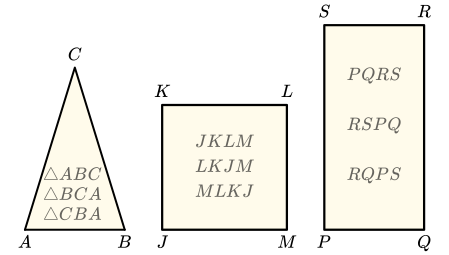
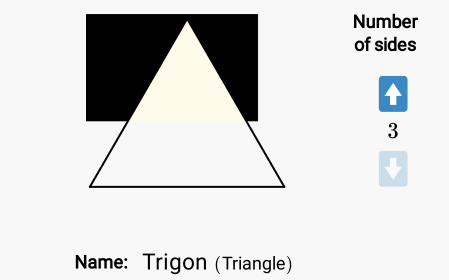
Polygons come in different shapes and sizes, and there is no maximum limit to the number of line segments used to form a polygon. Polygons with more than four sides are commonly named using the Greek prefix for the number of sides, followed by -gon.
Think about the name in the applet before pressing ⬆️ and ⬇️ to increase or decrease the number of sides.
Discussion
Share
Report error
Vertex of a Polygon
A vertex of a polygon is the point of intersection of two of its sides. A vertex can also be referred to as a corner.
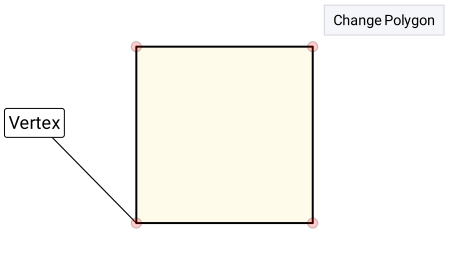 Any polygon has as many vertices as it has sides.
Discussion
Share
Report error
Connecting Non-consecutive Vertices
The sides of a polygon are line segments that connect two consecutive vertices. Segments that connect two non-consecutive vertices have a different name.
Concept
Share
Report error
Diagonal of a Polygon
A diagonal of a polygon is a line segment connecting two non-consecutive vertices of the polygon. 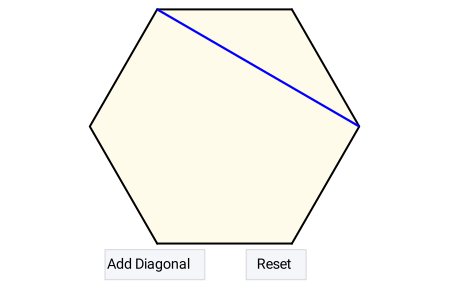 It should be noted that a line segment that connects two consecutive vertices of a polygon is a side of the polygon, not a diagonal. This means that triangles have no diagonals. The number of diagonals in an n-sided polygon can be calculated using the following formula. Number of Diagonals = n(n-3)/2
Discussion
Share
Report error
Classifying Polygons by Shape
Depending on its shape, a polygon can be classified as convex or concave. Alternatively, this classification can be done by studying the measures of the interior angles.
Concept
Share
Report error
Convex Polygon
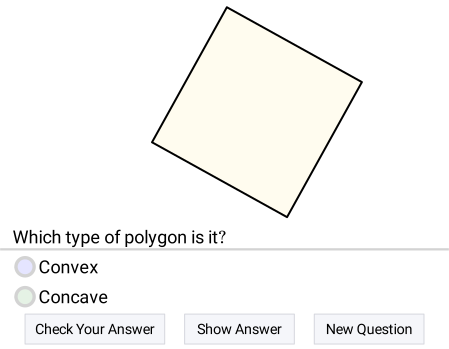
A convex polygon is a polygon in which no line that contains a side of the polygon contains points in the interior of the polygon. Alternatively, a polygon is convex if all the interior angles measure less than 180^(∘). Note that all triangles are convex polygons.
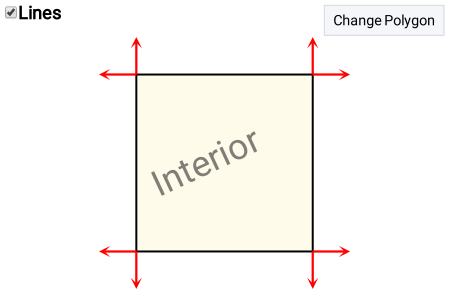 There are some characteristics that can be listed about convex polygons.
 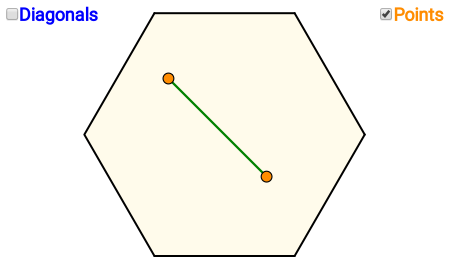 When a polygon is not convex, it is said to be concave.
- All the vertices of the polygon point outwards.
- All the diagonals lie inside the polygon.
- The segment joining any two interior points of the polygon is fully contained in the polygon.
Discussion
Share
Report error
Concave Polygon
A concave polygon is a polygon in which at least one line containing a side of the polygon also contains points in the interior of the polygon. Alternatively, a polygon is concave if one or more interior angles have a measure greater than 180^(∘). Note that only polygons with four or more sides can be concave.
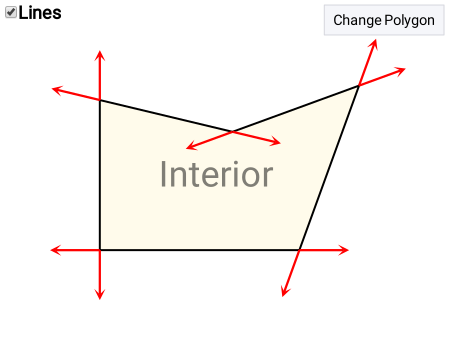 Some features can be listed about concave polygons.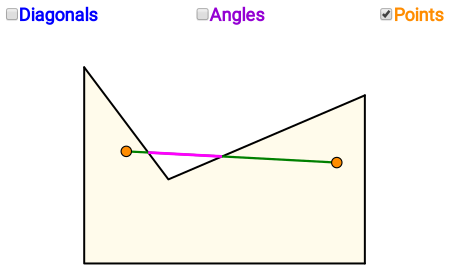
- At least one vertex of the polygon points inwards.
- Some of the diagonals may lie partly or entirely outside the polygon.
- There are points inside the polygon for which the segment joining them is not fully contained in the polygon.
Pop Quiz
Share
Report error
Convex or Concave?
Discussion
Share
Report error
Interior Angles of a Polygon
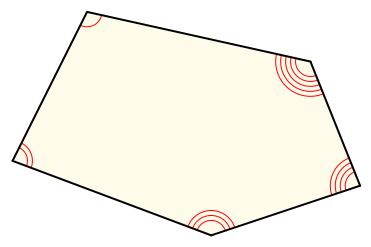
The interior angles of a polygon are the angles formed by two adjacent sides on the inside of the polygon.
Rule
Share
Report error
Polygon Interior Angles Theorem
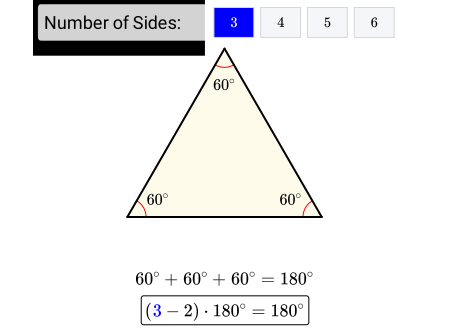
The sum of the measures of the interior angles of a polygon with n vertices is given by the following formula.
(n-2)180^(∘)
The formula can be applied to any polygon.
Example
Share
Report error
Play Ball!
Izabella is having a great time by the time she makes it inside the stadium. It is her first time in a baseball stadium and she is curious about everything.
a Izabella notices that home plate is in the shape of a pentagon.
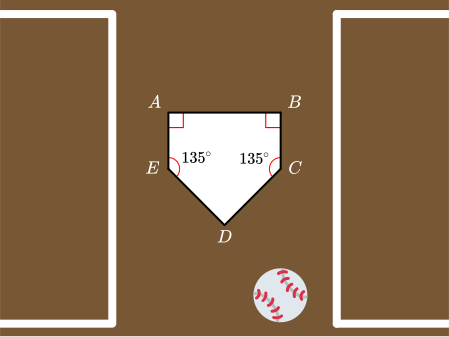
{"type":"text","form":{"type":"math","options":{"comparison":"1","nofractofloat":false,"keypad":{"simple":true,"useShortLog":false,"variables":[],"constants":[]},"rendered":false},"text":" "},"formTextBefore":"m∠ D =","formTextAfter":"^(∘)","answer":{"text":["90"]}}
b Izabella also observes that the field's border is a pentagon that looks like a diamond.
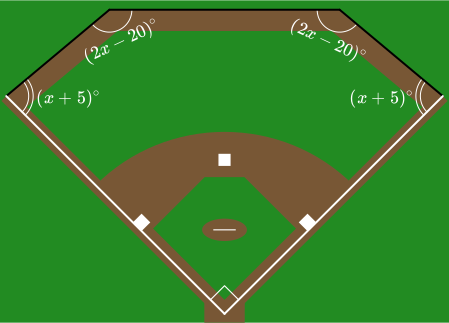
{"type":"text","form":{"type":"list","options":{"comparison":"1","nofractofloat":false,"keypad":{"simple":true,"useShortLog":false,"variables":[],"constants":[]},"rendered":false,"ordermatters":false,"numinput":5,"listEditable":false,"hideNoSolution":true},"text":" "},"formTextBefore":"Measures ={","formTextAfter":"}","answer":{"text":["90","85","85","140","140"]}}
Hint
a Use the Polygon Interior Angles Theorem to determine the sum of the interior angle measures of a pentagon. Solve the equation for m∠ D.
b Use the Polygon Interior Angles Theorem. Set and solve an equation for x. Substitute the value of x into the appropriate angle measures.
Solution
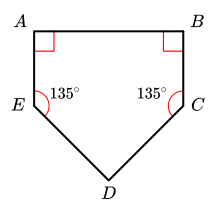
m∠ A + m∠ B + m∠ C + m∠ D + m∠ E = 540^(∘)
SubstituteValues
Substitute values
90^(∘) + 90^(∘) + 135^(∘) + m∠ D + 135^(∘) = 540^(∘)
AddTerms
Add terms
m∠ D + 450^(∘) = 540^(∘)
SubEqn
LHS-450^(∘)=RHS-450^(∘)
m∠ D = 90^(∘)
b The baseball field is a polygon with five sides. This means that the sum of the measures of the interior angles is 540^(∘). Notice that the angle at the home plate is a right angle, so it measures 90^(∘). Write an equation using all the given data. The degree symbol will be omitted for simplicity.
x+5 + 2x-20 + 2x-20 + x+5 + 90 = 540
AddSubTerms
Add and subtract terms
6x + 60 = 540
SubEqn
LHS-60=RHS-60
6x = 480
DivEqn
.LHS /6.=.RHS /6.
x = 80
| Expression | x=80 | Measure |
|---|---|---|
| x+5 | 80+5 | 85^(∘) |
| 2x-20 | 2( 80)-20 | 140^(∘) |
Finally, write a list with all the interior angle measures of the baseball field. Here, the degree symbols will not be included. {90, 85, 85, 140, 140 }
Discussion
Share
Report error
Regular Polygons
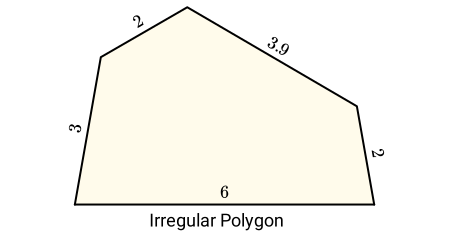
A regular polygon is a polygon whose sides and angles are all congruent.
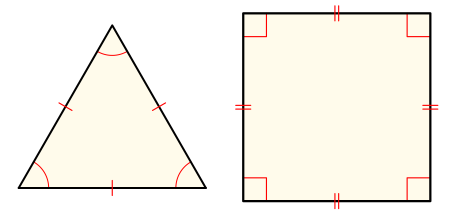
Regular polygons with three sides are generally referred to as either equilateral or equiangular triangles. Regular polygons with four sides are called squares. Regular polygons with more than four sides do not typically have special names.
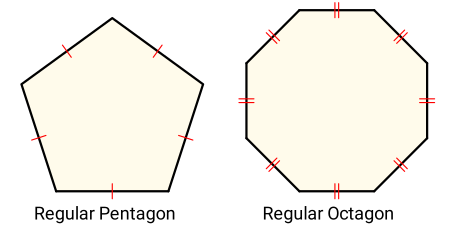
The greater the number of sides of a regular polygon, the more it resembles a circle. When a polygon is not regular, it is said to be an irregular polygon.
Example
Share
Report error
Honeycombs
The game ended with an incredible victory for Izabella's team. What a game! On the way home, she and her father stop at a bee farm to buy honey 🍯. There, Izabella learns that honeycombs are made up of many hexagons.
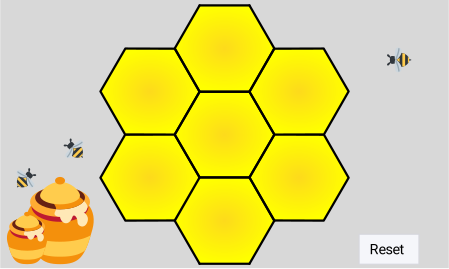 Assume each hexagon is regular. What is the measure of each interior angle?
 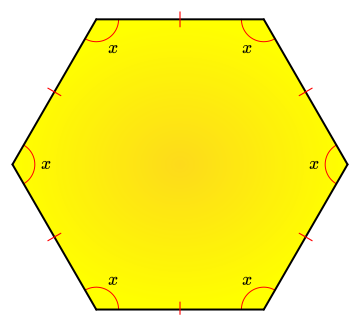 The sum of the measures of the interior angles is 6x. The total sum of these measures can be calculated using the Polygon Interior Angles Theorem. In this case, n=6.
The measure of each interior angle of a regular hexagon is 120^(∘).
The sum of the measures of the interior angles is 6x. The total sum of these measures can be calculated using the Polygon Interior Angles Theorem. In this case, n=6.
The measure of each interior angle of a regular hexagon is 120^(∘).
{"type":"text","form":{"type":"math","options":{"comparison":"1","nofractofloat":false,"keypad":{"simple":true,"useShortLog":false,"variables":[],"constants":[]},"rendered":false},"text":" "},"formTextBefore":null,"formTextAfter":"^(∘)","answer":{"text":["120"]}}
Hint
When a polygon is regular, all its sides and angles are congruent. Use the Polygon Interior Angles Theorem. Divide the sum of the measures of the interior angles by the total number of interior angles.
Solution
Start by recalling that in a regular polygon, all the angles have the same measure. Let x be the measure of each interior angle of a regular hexagon.
6x = (n-2)180^(∘)
Substitute
n= 6
6x = ( 6-2)180^(∘)
SubTerm
Subtract term
6x = (4)180^(∘)
Multiply
Multiply
6x = 720^(∘)
DivEqn
.LHS /6.=.RHS /6.
x = 120^(∘)
Pop Quiz
Share
Report error
Finding the Missing Angle Measure
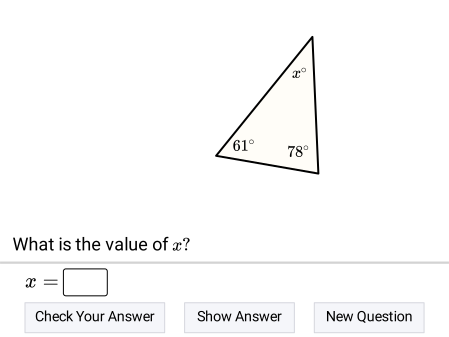
Determine the missing angle measure. Here, the polygons where all the sides are the same length are regular polygons. Round the answer to the nearest integer if needed.
Discussion
Share
Report error
Exterior Angles of a Polygon
An exterior angle of a polygon is an angle formed between one side of the polygon and the extension of an adjacent side. An n-sided polygon has 2n exterior angles, two at each vertex.
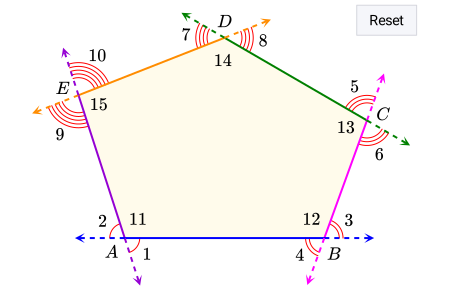 In a convex polygon, each exterior angle lies outside the polygon and forms a linear pair with its corresponding interior angle. This means that each exterior angle is supplementary to its interior angle.
| Interior Angle | Corresponding Exterior Angles | Sum of Measures |
|---|---|---|
| ∠ 11 | ∠ 1 and ∠ 2 | m∠ 1 + m∠ 11 = 180^(∘) m∠ 2 + m∠ 11 = 180^(∘) |
| ∠ 12 | ∠ 3 and ∠ 4 | m∠ 3 + m∠ 12 = 180^(∘) m∠ 4 + m∠ 12 = 180^(∘) |
| ∠ 13 | ∠ 5 and ∠ 6 | m∠ 5 + m∠ 13 = 180^(∘) m∠ 6 + m∠ 13 = 180^(∘) |
| ∠ 14 | ∠ 7 and ∠ 8 | m∠ 7 + m∠ 14 = 180^(∘) m∠ 8 + m∠ 14 = 180^(∘) |
| ∠ 15 | ∠ 9 and ∠ 10 | m∠ 9 + m∠ 15 = 180^(∘) m∠ 10 + m∠ 15 = 180^(∘) |
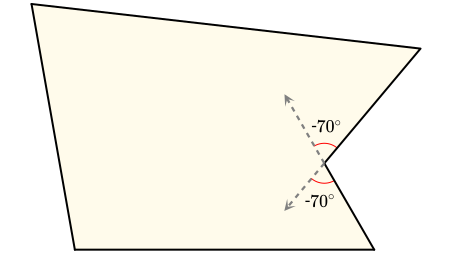
In contrast, when polygon is concave, some exterior angles might lie inside the polygon. In this case, the measures of those angles are considered to be negative.
Discussion
Share
Report error
Sum of Measures of Exterior Angles
Although the sum of the measures of the interior angles of a polygon varies according to the number of sides the polygon has, the sum of the measures of the exterior angles is always constant.
Rule
Share
Report error
Polygon Exterior Angles Theorem
The sum of the measures of the exterior angles of a polygon, one angle at each vertex, is 360^(∘).
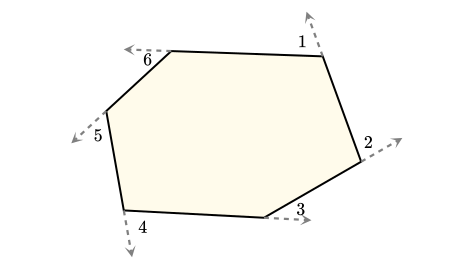
Based on the diagram, the relation below holds true.
m∠ 1 + m∠ 2 + m∠ 3 + m∠ 4 + m∠ 5 + m∠ 6 = 360^(∘)
Example
Share
Report error
Designing a Logo
When Izabella and her father got home, they went to the kitchen to prepare some pancakes and eat them with the honey they bought. What a way to end the day!

External credits: @upklyak
a While eating, Izabella noticed the cute name and cool logo on the honey pot.
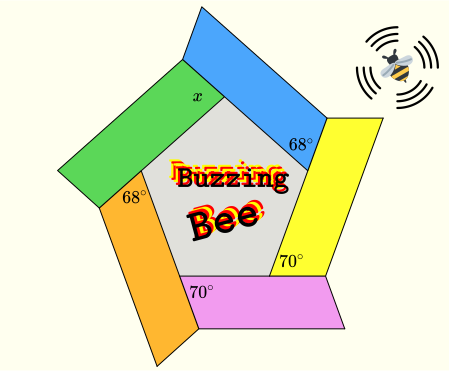
{"type":"text","form":{"type":"math","options":{"comparison":"1","nofractofloat":false,"keypad":{"simple":true,"useShortLog":false,"variables":[],"constants":[]},"rendered":false},"text":" "},"formTextBefore":"x=","formTextAfter":"^(∘)","answer":{"text":["84"]}}
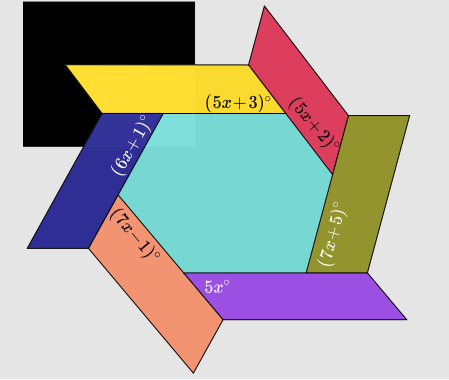
{"type":"text","form":{"type":"list","options":{"comparison":"1","nofractofloat":false,"keypad":{"simple":true,"useShortLog":false,"variables":[],"constants":[]},"rendered":false,"ordermatters":false,"numinput":6,"listEditable":false,"hideNoSolution":true},"text":" "},"formTextBefore":"Measures ={","formTextAfter":"}","answer":{"text":["75","52","53","61","69","50"]}}
Hint
a Use the Polygon Exterior Angles Theorem.
b Use the Polygon Exterior Angles Theorem. Solve the resulting equation for x. Substitute the value of x into each of the expressions for the angle measures.
Solution
a Start by noticing that each of the labeled angles is an exterior angle corresponding to the pentagon in the middle of the logo.
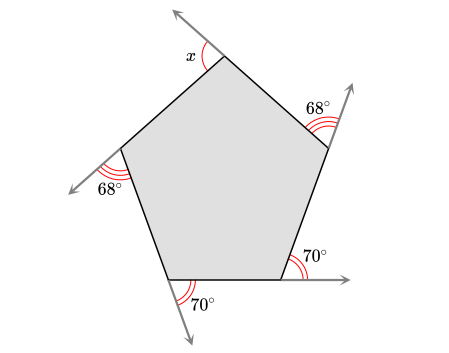
x + 68^(∘) + 68^(∘) + 70^(∘) + 70^(∘) = 360^(∘)
AddTerms
Add terms
x + 276^(∘) = 360^(∘)
SubEqn
LHS-344^(∘)=RHS-344^(∘)
x = 84^(∘)
b The angles labeled in Izabella's logo are exterior angles corresponding to the hexagon in the middle of the drawing.
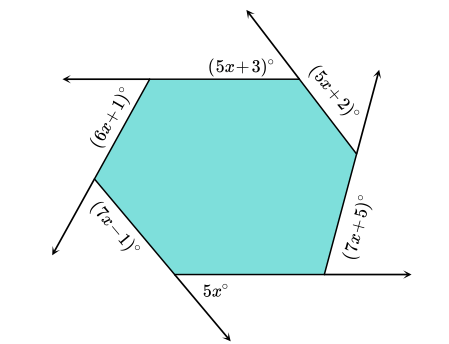
5x + 7x+5 + 5x+2 + 5x+3 + 6x+1 + 7x-1 = 360
AddSubTerms
Add and subtract terms
35x + 10 = 360
SubEqn
LHS-10=RHS-10
35x = 350
DivEqn
.LHS /35.=.RHS /35.
x = 10
| Expression | x=10 | Measure |
|---|---|---|
| 5x | 5( 10) | 50^(∘) |
| 7x+5 | 7( 10)+5 | 75^(∘) |
| 5x+2 | 5( 10)+2 | 52^(∘) |
| 5x+3 | 5( 10)+3 | 53^(∘) |
| 6x+1 | 6( 10)+1 | 61^(∘) |
| 7x-1 | 7( 10)-1 | 69^(∘) |
Pop Quiz
Share
Report error
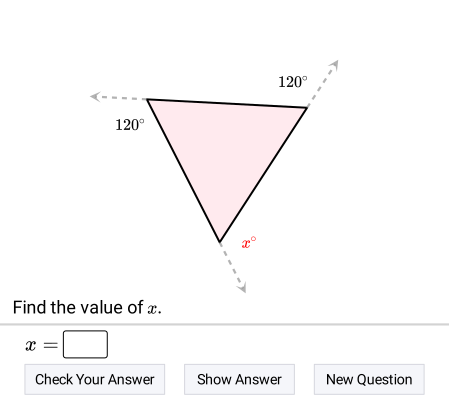
Finding an Exterior Angle Measure
Determine the missing angle measure. Remember, every exterior angle forms a linear pair with its interior angle.
Closure
Share
Report error
Final Stop
When Izabella was walking to the stadium, she saw a stop sign and wondered about the measure of one of its interior angles. According to her dad, all the sides of the stop sign are the same length and all the interior angles have the same measure.


Polygons and Angles
Exercise 2.1
Determine how many diagonals the given polygon has.
How many diagonals does the following polygon have?
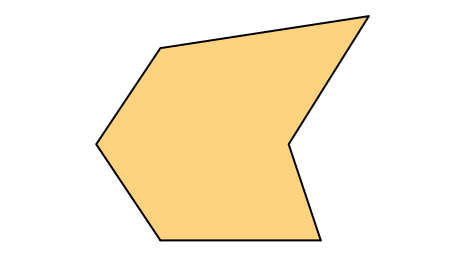
{"type":"text","form":{"type":"math","options":{"comparison":"1","nofractofloat":false,"keypad":{"simple":true,"useShortLog":false,"variables":[],"constants":[]},"rendered":false},"text":" "},"formTextBefore":"Number of Diagonals =","formTextAfter":null,"answer":{"text":["9"]}}
{"type":"text","form":{"type":"math","options":{"comparison":"1","nofractofloat":false,"keypad":{"simple":true,"useShortLog":false,"variables":[],"constants":[]},"rendered":false},"text":" "},"formTextBefore":"Number of Diagonals =","formTextAfter":null,"answer":{"text":["27"]}}
security
report
code
security
report
code
First, let's remember what a diagonal is.
Diagonal |- A line segment connecting two non-consecutive vertices of the polygon.
Let's draw the diagonals of the given polygon. We will draw as many diagonals as possible from each vertex to make sure we draw all of them.
The given polygon has a total of 9 diagonals.
In this case, we were not given a diagram of a polygon. All we know about it is that it has 9 sides. We can still determine the number of diagonals it has if we use the following formula.
Number of Diagonals = n(n-3)/2
In the formula, n represents the number of sides of the polygon. In our case, we will substitute 9 for n and simplify the right-hand side.
The polygon P has 27 diagonals.
security
report
code
Determine the missing angle measure.
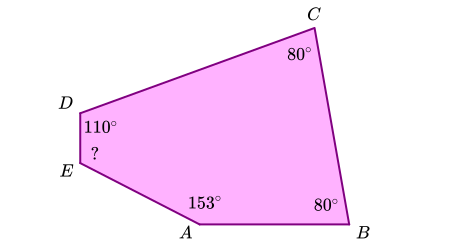
{"type":"text","form":{"type":"math","options":{"comparison":"1","nofractofloat":false,"keypad":{"simple":true,"useShortLog":false,"variables":[],"constants":[]},"rendered":false},"text":" "},"formTextBefore":"m∠ E=","formTextAfter":"^(∘)","answer":{"text":["117"]}}
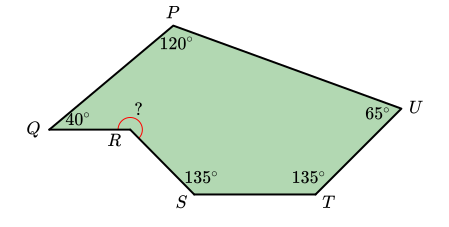
{"type":"text","form":{"type":"math","options":{"comparison":"1","nofractofloat":false,"keypad":{"simple":true,"useShortLog":false,"variables":[],"constants":[]},"rendered":false},"text":" "},"formTextBefore":"m∠ R=","formTextAfter":"^(∘)","answer":{"text":["225"]}}
security
report
code
security
report
code
We are given a polygon with four of its interior angle measures marked. Our mission is to determine the missing angle measure, m∠ E. Let's remember that the sum of the measures of the interior angles of a polygon with n vertices is given by the following formula. Sum of Angle Measures=(n-2)180^(∘) In our case, polygon ABCDE has five vertices. Substitute n=5 into the formula and evaluate.
The sum of the measures of the interior angles of polygon ABCDE is 540^(∘). In other words, if we add up all the given interior angle measures, we will get 540^(∘). Let's add them and solve the resulting equation for m∠ E.
The measure of ∠ E is 117^(∘).
We can see that the vertex R of the given polygon points inwards. This means that the polygon is concave and the measure of ∠ R is greater than 180^(∘). However, this does not help us find the exact measure. For this reason, let's use the Polygon Interior Angles Theorem. Sum of Angle Measures=(n-2)180^(∘) In this formula, n is the number of vertices in the polygon. Our polygon has six vertices, so let's substitute 6 for n.
Now, we can add all the given measures and set the result equal to 720^(∘). Then we can solve the resulting equation for m∠ R.
The measure of ∠ R is 225^(∘). This confirms the fact that the polygon is concave, as we said at the beginning.
security
report
code
Determine the value of x.
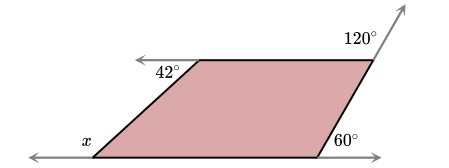
{"type":"text","form":{"type":"math","options":{"comparison":"1","nofractofloat":false,"keypad":{"simple":true,"useShortLog":false,"variables":[],"constants":[]},"rendered":false},"text":" "},"formTextBefore":"x=","formTextAfter":"^(∘)","answer":{"text":["138"]}}
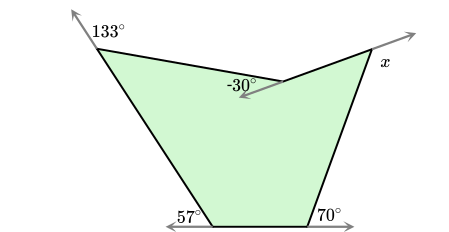
{"type":"text","form":{"type":"math","options":{"comparison":"1","nofractofloat":false,"keypad":{"simple":true,"useShortLog":false,"variables":[],"constants":[]},"rendered":false},"text":" "},"formTextBefore":"x=","formTextAfter":"^(∘)","answer":{"text":["130"]}}
security
report
code
security
report
code
We were given a quadrilateral with four extended sides and four labeled exterior angles. Our mission is to find the value of x, which is the measure of one exterior angle. Let's start by recalling what the Polygon Exterior Angles Theorem says.
Polygon Exterior Angles Theorem |- The sum of the measures of the exterior angles of a polygon, one angle at each vertex, is 360^(∘).
According to the theorem, if we add the four given angles measures together, the sum must be equal to 360^(∘). Let's write that equation and then solve it for x.
The measure of the fourth exterior angle is 138^(∘).
This time we are given a concave polygon with five extended sides and five angle measures. Notice that all the labeled angles are exterior angles, even though the 30^(∘)-angle lies inside the polygon. This angle is negative for this reason.
We can use the Polygon Exterior Angles Theorem one more time to equate the sum of the angles measures to 360^(∘). Then, we can solve the resulting equation for x.
The measure of the fifth exterior angles is 130^(∘).
security
report
code
How many sides does a regular polygon P have if an interior angle has a measure of 156^(∘)?
{"type":"text","form":{"type":"math","options":{"comparison":"1","nofractofloat":false,"keypad":{"simple":true,"useShortLog":false,"variables":[],"constants":[]},"rendered":false},"text":" "},"formTextBefore":null,"formTextAfter":"sides","answer":{"text":["15"]}}
security
report
code
security
report
code
Let n be the number of sides of P. We know that P is regular polygon, which means that all its angles have the same measure — that is, all have a measure of 156^(∘). Let's write an expression for the sum of the measures of the interior angles of P. Sum of Measures &= 156^(∘) + 156^(∘) + ⋯ + 156^(∘)_(n-times) &⇓ Sum of Measures &= n* 156^(∘) We can use the Polygon Interior Angles Theorem to write a second expression that represents the sum of the measures of the interior angles. Sum of Measures = (n-2)180^(∘) Let's equate these two expressions and solve the equation for n.
The polygon P has 15 sides. This polygons is called a pentadecagon.
security
report
code
Polygons and Angles
Recommended exercises
To get personalized recommended exercises, please login first.
Loading content
≤
>
■2
■▢
e▢
7
8
9
×
÷■1
=
=
√▢
▢√
∫▢▢
4
5
6
+
−
≤
<
log
ln
log▢
1
2
3
()
∣
sin
cos
tan
0
.
π
x
y
Loading content