Polygons and Angles

Concept

Exterior Angles of a Polygon

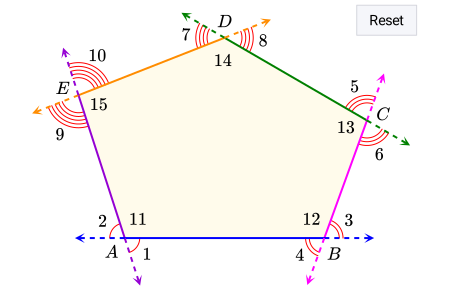
An exterior angle of a polygon is an angle formed between one side of the polygon and the extension of an adjacent side. An n-sided polygon has 2n exterior angles, two at each vertex.

Pentagon with exterior angles labeled

In a convex polygon, each exterior angle lies outside the polygon and forms a linear pair with its corresponding interior angle. This means that each exterior angle is supplementary to its interior angle.

Interior Angle Corresponding Exterior Angles Sum of Measures
∠ 11 ∠ 1 and ∠ 2 m∠ 1 + m∠ 11 = 180^(∘)
m∠ 2 + m∠ 11 = 180^(∘)
∠ 12 ∠ 3 and ∠ 4 m∠ 3 + m∠ 12 = 180^(∘)
m∠ 4 + m∠ 12 = 180^(∘)
∠ 13 ∠ 5 and ∠ 6 m∠ 5 + m∠ 13 = 180^(∘)
m∠ 6 + m∠ 13 = 180^(∘)
∠ 14 ∠ 7 and ∠ 8 m∠ 7 + m∠ 14 = 180^(∘)
m∠ 8 + m∠ 14 = 180^(∘)
∠ 15 ∠ 9 and ∠ 10 m∠ 9 + m∠ 15 = 180^(∘)
m∠ 10 + m∠ 15 = 180^(∘)

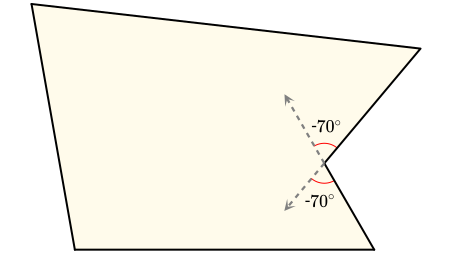
In contrast, when polygon is concave, some exterior angles might lie inside the polygon. In this case, the measures of those angles are considered to be negative.

In any case, the Polygon Exterior Angles Theorem guarantees that the sum of the measures of the exterior angles is always equal to 360^(∘).

Exercises
Edit Lesson