Polygons and Angles

Rule

Polygon Exterior Angles Theorem

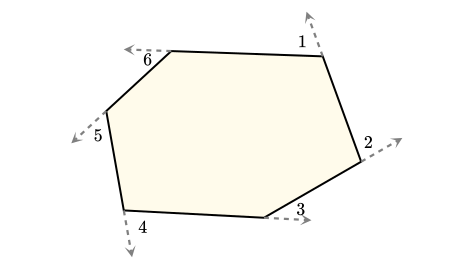
The sum of the measures of the exterior angles of a polygon, one angle at each vertex, is 360^(∘).

Based on the diagram, the relation below holds true.

m∠ 1 + m∠ 2 + m∠ 3 + m∠ 4 + m∠ 5 + m∠ 6 = 360^(∘)

Proof

Convex Polygon
Consider a hexagon and all its exterior angles. Let S be the sum of the measures of the exterior angles.

Notice that an interior angle and its exterior angle form a linear pair. Therefore, the sum of their measures is equal to 180^(∘). m∠ 1 + m∠ A = 180^(∘) m∠ 2 + m∠ B = 180^(∘) m∠ 3 + m∠ C = 180^(∘) m∠ 4 + m∠ D = 180^(∘) m∠ 5 + m∠ E = 180^(∘) m∠ 6 + m∠ F = 180^(∘) By the Polygon Interior Angles Theorem, the sum of the measures of the interior angles of a polygon with n sides is (n-2)* 180^(∘). With this information, add all the equations in the system above. m∠ 1 + m∠ A &= 180^(∘) m∠ 2 + m∠ B &= 180^(∘) m∠ 3 + m∠ C &= 180^(∘) m∠ 4 + m∠ D &= 180^(∘) m∠ 5 + m∠ E &= 180^(∘) + m∠ 6 + m∠ F &= 180^(∘) S + (6-2)* 180^(∘) &= 6* 180^(∘) Finally, the last equation can be solved for S.

S + (6-2)* 180^(∘) = 6* 180^(∘)
Solve for S
S + 4* 180^(∘) = 6* 180^(∘)
S + 720^(∘) = 1080^(∘)
S=360^(∘)

The desired result is obtained.

S=360^(∘)

Although the proof above used a hexagon, the same reasoning can be applied no matter the number of sides of the polygon.

Proof

Concave Polygon
Consider a concave polygon and one exterior angle at each vertex. Let S be the sum of the measures of the exterior angles.

Notice that ∠ 3 lies inside the polygon. In this case, its measure is considered to be negative. Because of this, ∠ 3 and ∠ C are supplementary. m∠ C + m∠ 3 = 180^(∘) (I) The rest of exterior angles form a linear pair with their corresponding interior angles. This means all those pair of angles are supplementary. m∠ 1 + m∠ A = 180^(∘) m∠ 2 + m∠ B = 180^(∘) m∠ 4 + m∠ D = 180^(∘) m∠ 5 + m∠ E = 180^(∘) Next, add these four equations to Equation (I). Remember that the Polygon Interior Angles Theorem states that the sum of the measures of the interior angles of a polygon with n sides is (n-2)* 180^(∘). m∠ 1 + m∠ A &= 180^(∘) m∠ 2 + m∠ B &= 180^(∘) m∠ 3 + m∠ C &= 180^(∘) m∠ 4 + m∠ D &= 180^(∘) + m∠ 5 + m∠ E &= 180^(∘) S + (5-2)* 180^(∘) &= 5* 180^(∘) Finally, solve the resulting equation for S.

S + (5-2)* 180^(∘) = 5* 180^(∘)
Solve for S
S + 3* 180^(∘) = 5* 180^(∘)
S + 540^(∘) = 900^(∘)
S=360^(∘)

As can be seen, the sum of the measures of the exterior angles of the concave polygon is 360^(∘), which completes the proof. Keep in mind that the same reasoning can be applied to any other concave polygon.
Exercises
Edit Lesson