Pearson Algebra 2 Common Core, 2011
PA
Pearson Algebra 2 Common Core, 2011 View details
4. Arithmetic Series
Continue to next subchapter

Exercise 32 Page 591

From the given series, identify the formula for the n^(th) term of the related sequence, the variable, and the starting and stopping numbers. The increment is always 1 unless we are told otherwise.

1757

Practice makes perfect

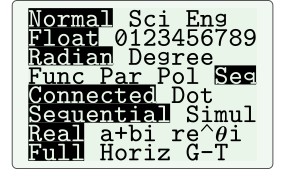
We want to find the sum of the given series using a graphing calculator. ∑_(n=5)^(25) (n^2-14n+32) Let's start by putting our calculator into sequence mode. To do so, we push MODE, use the down arrow to get to the Func row, use the right arrow to highlight Seq, and then push ENTER.

Next, we have to enter the list menu and find the sum function. To do this, we push 2ND and STAT. We will see the list menu.

After this, we use the right arrow to get to MATH and then push 5 to enter the sum function. We are almost there!

The next step is telling the calculator that we are going to be summing a sequence. We will need to go back to the list menu. This time we are going to look under OPS. Again, if we look at the fifth row, we see that it says seq. Push 5 and we are ready to go!

This is where we enter the formula for the n^(th) term of the related sequence, the variable, the starting and stopping numbers, and the increment. The increment is always 1 unless we are told otherwise. Let's identify the rest of the information.

∑_(n=5)^(25) (n^2-14n+32)
Formula n^2-14n+32
Variable n
Starting Number 5
Stopping Number 25
Increment 1

Inputting the above information, separated by a comma, in the calculator and pushing ENTER will give us the sum of the series.

The sum of the given series is 1757.