{{ tocSubheader }}
{{ 'ml-label-loading-course' | message }}
An error ocurred, try again later!
Chapter {{ article.chapter.number }}
{{ article.number }}.
{{ article.displayTitle }}
{{ article.intro.summary }}
Show less Show more expand_more Lesson Settings & Tools
| | {{ 'ml-lesson-number-slides' | message : article.intro.bblockCount }} |
| | {{ 'ml-lesson-number-exercises' | message : article.intro.exerciseCount }} |
| | {{ 'ml-lesson-time-estimation' | message }} |
In the case that a common difference occurs between the terms of a sequence, the terms represent a linear function. If the terms or the domain of the linear function are finite, then finding their sum makes sense in some cases. This lesson will introduce the way to find the finite sum of the terms of an arithmetic sequence.
Catch-Up and Review
Here are a few recommended readings before getting started with this lesson.
Challenge
Paying off a Loan
Diego's father has just taken a loan from the National Bank to start his own company. His first monthly payment will be $2400, after which the monthly payments will decrease by $100 each month — in other words, he will pay $2300 the second month, $2200 the third, and so on, until he pays a total of $24500, including interest.

a How much will Diego's father pay off in total after five months?
{"type":"text","form":{"type":"math","options":{"comparison":"1","nofractofloat":false,"keypad":{"simple":true,"useShortLog":false,"variables":[],"constants":[]},"rendered":false},"text":"<span class=\"katex\"><span class=\"katex-html\" aria-hidden=\"true\"><\/span><\/span>"},"formTextBefore":"<span class=\"katex\"><span class=\"katex-html\" aria-hidden=\"true\"><span class=\"base\"><span class=\"strut\" style=\"height:0.80556em;vertical-align:-0.05556em;\"><\/span><span class=\"mord\">$<\/span><\/span><\/span><\/span>","formTextAfter":null,"answer":{"text":["11000"]}}
b How much will Diego's father pay off in total after ten months?
{"type":"text","form":{"type":"math","options":{"comparison":"1","nofractofloat":false,"keypad":{"simple":true,"useShortLog":false,"variables":[],"constants":[]},"rendered":false},"text":"<span class=\"katex\"><span class=\"katex-html\" aria-hidden=\"true\"><\/span><\/span>"},"formTextBefore":"<span class=\"katex\"><span class=\"katex-html\" aria-hidden=\"true\"><span class=\"base\"><span class=\"strut\" style=\"height:0.80556em;vertical-align:-0.05556em;\"><\/span><span class=\"mord\">$<\/span><\/span><\/span><\/span>","formTextAfter":null,"answer":{"text":["19500"]}}
c How long will it take Diego's father to pay off his total debt of $24500?
{"type":"text","form":{"type":"math","options":{"comparison":"1","nofractofloat":false,"keypad":{"simple":true,"useShortLog":false,"variables":[],"constants":[]},"rendered":false},"text":"<span class=\"katex\"><span class=\"katex-html\" aria-hidden=\"true\"><\/span><\/span>"},"formTextBefore":null,"formTextAfter":"months","answer":{"text":["14"]}}
Discussion
Arithmetic Series
An arithmetic series is the sum of the terms of an arithmetic sequence. If the sequence is finite and short enough, calculating the sum of its terms is quite straightforward.
| Example Arithmetic Sequence | 1,3,5,7,9 |
|---|---|
| Related Arithmetic Series | 1+3+5+7+9=25 |
However, if the sequence is still finite but longer, it can be tedious to add the terms by hand. In that case, the formula for an arithmetic sum can be used. If the arithmetic series is infinite, then the sum is said to diverge.
Example Divergent Arithmetic Seriesn=1∑∞(3n+1)=4+7+10+…⇕n=1∑∞(3n+1)→∞
Pop Quiz
Identifying Arithmetic Series
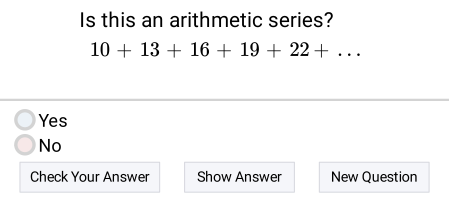
The applet shows the first five terms of a sum. Identify whether the given sum is an arithmetic series or not.
Discussion
Sum of an Arithmetic Series
For a finite arithmetic sequence with n terms and general formula an=a1+(n−1)d, where a1 is the first term and d the common difference, the sum of all terms Sn can be calculated using the following formula.
Sn=2n(a1+an)
Proof
Informal JustificationTo explain why the sum is determined this way, the sum of first nine natural numbers will be considered as an example for the arithmetic series.
Therefore, the addition of the first and last terms is the same as 5+5. The sum of the second and second to last terms can be rewritten in the same manner. In fact, the sum of all opposite pairs can be rewritten as 5+5.
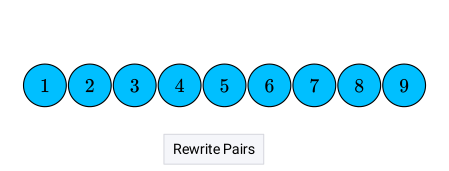 The sum of the 9 terms of the sequence is equivalent to adding nine 5s, which can be expressed as 9⋅5. Note that here, 5 is the average of the first and last terms. This means that it can be written as half the sum of the first term a1 and the last term an.
1+2+3+⋯+9
Instead of adding all the terms in one go, pay close attention to the first term 1 and last term 9. The number 9 can be written as 4+5. Then, by the Associative Property of Addition, the sum 1+9 can be written as 5+5.
1+9
WriteSum
Write as a sum
1+4+5
AssociativePropAdd
Associative Property of Addition
(1+4)+5
AddTerms
Add terms
5+5
Average of First and Last Terms2a1+an
To calculate the sum of the sequence's terms, which is the value of the related series Sn, this average is multiplied by the number of terms n.
Sn=n⋅(2a1+an)⇕Sn=2n(a1+an)
It is worth mentioning that all arithmetic series with infinite terms diverge, meaning they tend towards infinity. Therefore, for an infinite arithmetic series, it only makes sense to use this formula to find a partial sum.
Example
Calculating the Number of Tiles in the Restoration of the Floor
The board of the National Bank has decided to renew the old bank's floor. They decided to replace the old tiles with modern hexagonal tiles. The pavers start with a single tile and then form rings around it like a honeycomb. The diagram shows the progress of the work from the initial tile to the sixth ring.
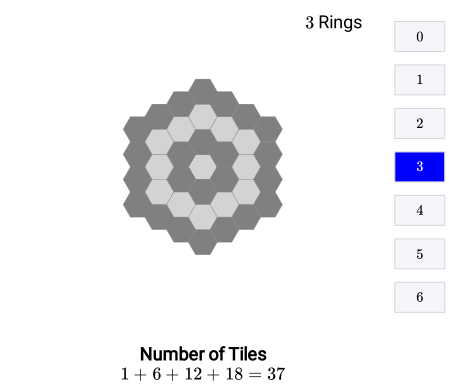
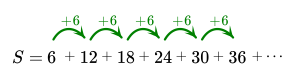 Since each ring has 6 more tiles than the previous one, the number of tiles in each ring represents an arithmetic sequence with common difference d=6. Also, the first ring has 6 tiles. This means that a1=6. With this information, the explicit rule for the arithmetic sequence can be written.
The number of tiles in the nth ring can be represented with the rule an=6n.
Since each ring has 6 more tiles than the previous one, the number of tiles in each ring represents an arithmetic sequence with common difference d=6. Also, the first ring has 6 tiles. This means that a1=6. With this information, the explicit rule for the arithmetic sequence can be written.
The number of tiles in the nth ring can be represented with the rule an=6n.
a Write a rule to represent the number of tiles in the nth ring. Note that the very first tile does not represent a ring.
{"type":"text","form":{"type":"math","options":{"comparison":"1","nofractofloat":false,"keypad":{"simple":false,"useShortLog":false,"variables":["n"],"constants":[]},"rendered":false},"text":"<span class=\"katex\"><span class=\"katex-html\" aria-hidden=\"true\"><\/span><\/span>"},"formTextBefore":"<span class=\"katex\"><span class=\"katex-html\" aria-hidden=\"true\"><span class=\"base\"><span class=\"strut\" style=\"height:0.58056em;vertical-align:-0.15em;\"><\/span><span class=\"mord\"><span class=\"mord mathdefault\">a<\/span><span class=\"msupsub\"><span class=\"vlist-t vlist-t2\"><span class=\"vlist-r\"><span class=\"vlist\" style=\"height:0.151392em;\"><span style=\"top:-2.5500000000000003em;margin-left:0em;margin-right:0.05em;\"><span class=\"pstrut\" style=\"height:2.7em;\"><\/span><span class=\"sizing reset-size6 size3 mtight\"><span class=\"mord mathdefault mtight\">n<\/span><\/span><\/span><\/span><span class=\"vlist-s\">\u200b<\/span><\/span><span class=\"vlist-r\"><span class=\"vlist\" style=\"height:0.15em;\"><span><\/span><\/span><\/span><\/span><\/span><\/span><span class=\"mspace\" style=\"margin-right:0.2777777777777778em;\"><\/span><span class=\"mrel\">=<\/span><\/span><\/span><\/span>","formTextAfter":null,"answer":{"text":["6n"]}}
b Calculate the sum of the number of tiles after the first 10 rings are formed.
{"type":"text","form":{"type":"math","options":{"comparison":"1","nofractofloat":false,"keypad":{"simple":true,"useShortLog":false,"variables":[],"constants":[]},"rendered":false},"text":"<span class=\"katex\"><span class=\"katex-html\" aria-hidden=\"true\"><\/span><\/span>"},"formTextBefore":null,"formTextAfter":"tiles","answer":{"text":["331"]}}
c Calculate the sum of the number of tiles after the first 100 rings are formed.
{"type":"text","form":{"type":"math","options":{"comparison":"1","nofractofloat":false,"keypad":{"simple":true,"useShortLog":false,"variables":[],"constants":[]},"rendered":false},"text":"<span class=\"katex\"><span class=\"katex-html\" aria-hidden=\"true\"><\/span><\/span>"},"formTextBefore":null,"formTextAfter":"tiles","answer":{"text":["30301"]}}
Hint
a Recall that the explicit rule for an arithmetic sequence is an=a1+(n−1)d.
b Use the formula for the sum of an arithmetic series.
c Keep in mind that the initial tile does not represent a ring.
Solution
a Start by analyzing the number of tiles in each ring to identify the rule for the number of tiles in the nth ring. Since the first tile does not represent a ring, it will not be considered for the sequence.
an=a1+(n−1)d
SubstituteII
a1=6, d=6
an=6+(n−1)6
Distr
Distribute 6
an=6+6n−6
SubTerms
Subtract terms
an=6n
b To calculate the total number of tiles after the 10th ring is formed, the initial tile and the tiles in each of the ten rings will be added.
1+a1+a2+a3+⋯+a9+a10
The number of tiles in each of the rings form an arithmetic series. Therefore, the sum of its first ten terms can be calculated by using the formula for the sum of an arithmetic series.
Sn=2n(a1+an)
In this case, n=10 will be substituted into the formula.
S10=210(a1+a10)
Since it is already known that a1=6, the value of a10 will be calculated by using the general formula for this sequence, which was found in Part A.
There will be 60 tiles in the tenth ring. Now the value of S10 can be found.
This means that there are 330 tiles from the first to the tenth ring. Adding the 1 initial tile will be the last step to calculate the total number of tiles after the tenth ring is formed.
1+S10⇓1+330=331
c The total number of tiles in the first 100 rings will be calculated in a process very similar to that in Part B.
1+a1+a2+a3+⋯+a99+a100
Once again, start by recalling the formula for the sum of an arithmetic series and substitute n=100.
Sn=2n(a1+an)⇓S100=2100(a1+a100)
Since there are a1=6 rings in the first round, the next step is to find the value of a100. To do so, use the general rule for this arithmetic sequence.
Now the formula for the sum of the arithmetic series can be used for n=100.
Finally, the initial tile will be added to this number.
1+S100⇓1+30300=30301
There will be 30301 tiles making up the floor after the 100th ring is formed.
Example
Finding the Access Code
The National Bank has just created new security codes for its investors. When someone tries to log in, they have three tries to enter their code correctly. The third wrong attempt will block the account. Diego received an e-mail from the bank with information about this update.
 Diego could really use some help. Help Diego to find his access code by calculating the sum!
{"type":"text","form":{"type":"math","options":{"comparison":"1","nofractofloat":false,"keypad":{"simple":true,"useShortLog":false,"variables":["x"],"constants":["PI"]},"rendered":false},"text":"<span class=\"katex\"><span class=\"katex-html\" aria-hidden=\"true\"><\/span><\/span>"},"formTextBefore":"Access code:","formTextAfter":null,"answer":{"text":["1760"]}}
Hint
Use the formula for the sum of an arithmetic series.
Solution
Diego's access code is given as the sum of a series written in summation notation.
The first term of the sequence is 5. The general rule will be used again to find the value of the last term a40.
The last term of the sequence is 83. Now the values of the first and last term can be used to calculate the sum of the series S40.
Diego's access code is 1760.
n=1∑402n+3
Here, the general rule of the series is a linear expression. This means that the series is arithmetic. With this in mind, the formula for the sum of an arithmetic series can be used.
Sn=2n(a1+an)
For Diego's case, n=40 will be substituted into the formula because the upper limit of the summation notation is 40. S40=240(a1+a40)
Next, the values of the first term a1 and the last term a40 will be found one at a time. To do so, the general rule of the series will be used. an=2n+3
Substitute
n=1
a1=2(1)+3
IdPropMult
Identity Property of Multiplication
a1=2+3
AddTerms
Add terms
a1=5
Pop Quiz
Calculating the Sum of the Arithmetic Series
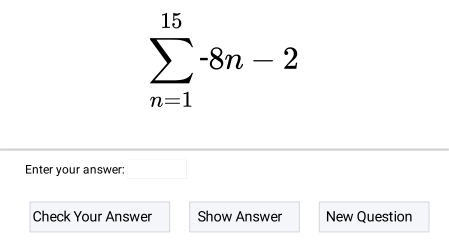
Calculate the sum of all the terms of the given finite arithmetic series written in summation notation. Use the formula for the sum of an arithmetic series.
Example
Calculating the Number of Gold Bars
A vicious gang of thieves, famous for the masks they wear, is concocting a scheme to steal the National Bank's gold reserve.

External credits: user2122532
Before they make their move, they need to know how many bars of gold are kept in the reserve. According to the gang's mastermind, the bars of gold are stacked in the form of a triangle where each row has one more bar than the previous one.
a Write a rule to represent the number of bars in the nth row of the triangular stack, supposing that there is one bar of gold in the top row.
{"type":"text","form":{"type":"math","options":{"comparison":"1","nofractofloat":false,"keypad":{"simple":false,"useShortLog":false,"variables":["n"],"constants":[]},"rendered":false},"text":"<span class=\"katex\"><span class=\"katex-html\" aria-hidden=\"true\"><\/span><\/span>"},"formTextBefore":"<span class=\"katex\"><span class=\"katex-html\" aria-hidden=\"true\"><span class=\"base\"><span class=\"strut\" style=\"height:0.58056em;vertical-align:-0.15em;\"><\/span><span class=\"mord\"><span class=\"mord mathdefault\">a<\/span><span class=\"msupsub\"><span class=\"vlist-t vlist-t2\"><span class=\"vlist-r\"><span class=\"vlist\" style=\"height:0.151392em;\"><span style=\"top:-2.5500000000000003em;margin-left:0em;margin-right:0.05em;\"><span class=\"pstrut\" style=\"height:2.7em;\"><\/span><span class=\"sizing reset-size6 size3 mtight\"><span class=\"mord mathdefault mtight\">n<\/span><\/span><\/span><\/span><span class=\"vlist-s\">\u200b<\/span><\/span><span class=\"vlist-r\"><span class=\"vlist\" style=\"height:0.15em;\"><span><\/span><\/span><\/span><\/span><\/span><\/span><span class=\"mspace\" style=\"margin-right:0.2777777777777778em;\"><\/span><span class=\"mrel\">=<\/span><\/span><\/span><\/span>","formTextAfter":null,"answer":{"text":["n"]}}
b Calculate the number of bars if the stack has 200 rows.
{"type":"text","form":{"type":"math","options":{"comparison":"1","nofractofloat":false,"keypad":{"simple":true,"useShortLog":false,"variables":[],"constants":[]},"rendered":false},"text":"<span class=\"katex\"><span class=\"katex-html\" aria-hidden=\"true\"><\/span><\/span>"},"formTextBefore":null,"formTextAfter":"bars of gold","answer":{"text":["20100"]}}
c Calculate the number of bars in a triangular stack with 200 rows, supposing that there are 20 bars of gold in the top row.
{"type":"text","form":{"type":"math","options":{"comparison":"1","nofractofloat":false,"keypad":{"simple":true,"useShortLog":false,"variables":[],"constants":[]},"rendered":false},"text":"<span class=\"katex\"><span class=\"katex-html\" aria-hidden=\"true\"><\/span><\/span>"},"formTextBefore":null,"formTextAfter":"bars of gold","answer":{"text":["23900"]}}
Hint
a The number of bars of gold in each row form an arithmetic sequence.
b Use the formula for the sum of an arithmetic series.
c Write a new general rule for the arithmetic sequence.
Solution
a Since each row has one more bar than the previous row, the number of bars in the rows form an arithmetic sequence. Knowing this, it is possible to write an explicit rule for the sequence.
an=a1+(n−1)d
Because the top row has one bar, the first term of this sequence is a1=1. Also, since each row has one more bar of gold than the previous one, the common difference is d=1. With this information, the general rule for the sequence can be written.
an=a1+(n−1)d
SubstituteII
a1=1, d=1
an=1+(n−1)1
▼
Simplify right-hand side
IdPropMult
Identity Property of Multiplication
an=1+(n−1)
RemovePar
Remove parentheses
an=1+n−1
SubTerm
Subtract term
an=n
b Since the number of bars in the stack increases by one, their sum represents an arithmetic series. This means that the sum can be calculated by using the formula for the sum of an arithmetic series.
Sn=2n(a1+an)
Now, n=200 will be substituted into the formula to find the sum of the number of bars in a stack with 200 rows.
S200=2200(a1+a200)
In this case, there is one bar of gold in the top row, so a1=1. The general rule of the sequence will be used to find the value of a200. an=nn=200a200=200
The last row of the stack has 200 bars of gold. Finally, the value of S200 can be calculated.
This means that there are 20100 total bars of gold in the National Bank's reserve.
c In this case, the values of the first and last terms of the sequence are different than in Part B, so a new general rule must be defined. Since the top row of the triangular stack has 20 bars of gold, the first term is a1=20. The common difference is still d=1. Now the explicit rule for the new arithmetic sequence can be written.
an=a1+(n−1)d
SubstituteII
a1=20, d=1
an=20+(n−1)(1)
▼
Simplify right-hand side
IdPropMult
Identity Property of Multiplication
an=20+(n−1)
RemovePar
Remove parentheses
an=20+n−1
SubTerm
Subtract term
an=n+19
Sn=2n(a1+an)⇓S200=2200(a1+a200)
Substitute the values into the formula and simplify.
There are 23900 bars of gold in this stack.
Example
Calculating the Number of Police Officers
After the gang of thieves took over the bank, several police officers surrounded the building. The gang's mastermind needs to gather some information about the police officers in order to plan their escape.
 When the gang's leader peeked out, he noticed that the police officers are arranged in rows and that each row has four more officers than the previous row.
a Write a rule for the number of police officers in the nth row if there are 50 officers in the first row.
{"type":"text","form":{"type":"math","options":{"comparison":"1","nofractofloat":false,"keypad":{"simple":false,"useShortLog":false,"variables":["n"],"constants":[]},"rendered":false},"text":"<span class=\"katex\"><span class=\"katex-html\" aria-hidden=\"true\"><\/span><\/span>"},"formTextBefore":"<span class=\"katex\"><span class=\"katex-html\" aria-hidden=\"true\"><span class=\"base\"><span class=\"strut\" style=\"height:0.58056em;vertical-align:-0.15em;\"><\/span><span class=\"mord\"><span class=\"mord mathdefault\">a<\/span><span class=\"msupsub\"><span class=\"vlist-t vlist-t2\"><span class=\"vlist-r\"><span class=\"vlist\" style=\"height:0.151392em;\"><span style=\"top:-2.5500000000000003em;margin-left:0em;margin-right:0.05em;\"><span class=\"pstrut\" style=\"height:2.7em;\"><\/span><span class=\"sizing reset-size6 size3 mtight\"><span class=\"mord mathdefault mtight\">n<\/span><\/span><\/span><\/span><span class=\"vlist-s\">\u200b<\/span><\/span><span class=\"vlist-r\"><span class=\"vlist\" style=\"height:0.15em;\"><span><\/span><\/span><\/span><\/span><\/span><\/span><span class=\"mspace\" style=\"margin-right:0.2777777777777778em;\"><\/span><span class=\"mrel\">=<\/span><\/span><\/span><\/span>","formTextAfter":null,"answer":{"text":["4n+46"]}}
b The gang's leader can see 15 rows of police. How many police officers are on the scene?
{"type":"text","form":{"type":"math","options":{"comparison":"1","nofractofloat":false,"keypad":{"simple":true,"useShortLog":false,"variables":[],"constants":[]},"rendered":false},"text":"<span class=\"katex\"><span class=\"katex-html\" aria-hidden=\"true\"><\/span><\/span>"},"formTextBefore":null,"formTextAfter":"police officers","answer":{"text":["1170"]}}
Hint
a The numbers of police officers in each row represent an arithmetic sequence.
b Use the formula for the sum of an arithmetic series.
Solution
a The difference in the number of police officers between consecutive rows is constant, which means that the numbers represent an arithmetic sequence. Therefore, an explicit rule can be used to calculate how many police officers stand in each row.
an=a1+(n−1)d
It is given that each row has four more policemen than the previous row. Therefore, the common difference of the arithmetic sequence is d=4. There are 50 officers in the first row. This means that the first term is a1=50. Now, substitute these values into the explicit rule.
an=a1+(n−1)d
SubstituteII
a1=50, d=4
an=50+(n−1)4
Distr
Distribute 4
an=50+4n−4
SubTerm
Subtract term
an=4n+46
b The total number of police officers represents an arithmetic series. Therefore, the formula for the sum of an arithmetic series will be used.
Sn=2n(a1+an)
Since there are 15 rows, n=15 will be substituted into this formula.
S15=215(a1+a15)
It is known that the first row has 50 officers, so a1=50. Therefore, only the number of police officers in the 15th row needs to be found. To do so, the general formula for the arithmetic sequence will be used.
The 15th row has 106 policemen. Now, S15 will be calculated.
S15=215(a1+a15)
SubstituteII
a1=50, a15=106
S15=215(50+106)
AddTerms
Add terms
S15=215(156)
Multiply
Multiply
S15=22340
CalcQuot
Calculate quotient
S15=1170
Closure
Paying off a Loan
At the beginning of the lesson, Diego's father took out a loan from the National Bank to start his own company. He will start his repayment schedule by paying $2400 in the first month, after which the monthly amount will decrease by $100 each month. In the second month he will pay $2300, in the third month $2200, and so on.

a How much will Diego's father pay off in total after five months?
{"type":"text","form":{"type":"math","options":{"comparison":"1","nofractofloat":false,"keypad":{"simple":true,"useShortLog":false,"variables":[],"constants":[]},"rendered":false},"text":"<span class=\"katex\"><span class=\"katex-html\" aria-hidden=\"true\"><\/span><\/span>"},"formTextBefore":"<span class=\"katex\"><span class=\"katex-html\" aria-hidden=\"true\"><span class=\"base\"><span class=\"strut\" style=\"height:0.80556em;vertical-align:-0.05556em;\"><\/span><span class=\"mord\">$<\/span><\/span><\/span><\/span>","formTextAfter":null,"answer":{"text":["11000"]}}
b How much will Diego's father pay off in total after ten months?
{"type":"text","form":{"type":"math","options":{"comparison":"1","nofractofloat":false,"keypad":{"simple":true,"useShortLog":false,"variables":[],"constants":[]},"rendered":false},"text":"<span class=\"katex\"><span class=\"katex-html\" aria-hidden=\"true\"><\/span><\/span>"},"formTextBefore":"<span class=\"katex\"><span class=\"katex-html\" aria-hidden=\"true\"><span class=\"base\"><span class=\"strut\" style=\"height:0.80556em;vertical-align:-0.05556em;\"><\/span><span class=\"mord\">$<\/span><\/span><\/span><\/span>","formTextAfter":null,"answer":{"text":["19500"]}}
c How long will it take Diego's father to pay off his total debt of $24500?
{"type":"text","form":{"type":"math","options":{"comparison":"1","nofractofloat":false,"keypad":{"simple":true,"useShortLog":false,"variables":[],"constants":[]},"rendered":false},"text":"<span class=\"katex\"><span class=\"katex-html\" aria-hidden=\"true\"><\/span><\/span>"},"formTextBefore":null,"formTextAfter":"months","answer":{"text":["14"]}}
Hint
a The amounts Diego's father will pay each month form an arithmetic sequence. The sum of these terms is an arithmetic series. Use the formula for the sum of an arithmetic series.
b As in Part A, use the formula for the sum of an arithmetic series.
c Solve the equation Sn=24500 for n, where Sn represents the sum of the n terms of an arithmetic series.
Solution
a The first payment is $2400 and the monthly payments decrease by $100 each month. This means that the difference between payments is constant and the sequence has a common difference in the amount to be paid. Consequently, the monthly payments represent the terms of an arithmetic sequence.
an=a1+(n−1)d
Here, a1 is the first term and d the common difference. In this case, since the payments decrease by $100 each month, the common difference is d=-100. Having the first payment a1=$2400, the explicit rule can be written by substituting these values into the formula.
an=a1+(n−1)d
SubstituteII
a1=2400, d=-100
an=2400+(n−1)(-100)
Distr
Distribute -100
an=2400−100n+100
AddTerms
Add terms
an=-100n+2500
Sn=2n(a1+an)⇓S5=25(a1+a5)
To find S5, the value of a5 — the amount to be paid in the 5th month — will be found by using the explicit rule.
an=-100n+2500
Substitute
n=5
a5=-100(5)+2500
MultNegPos
(-a)b=-ab
a5=-500+2500
AddTerms
Add terms
a5=2000
b This time the total amount of money paid will be calculated for 10 months.
S10=210(a1+a10)
First, n=10 will be substituted into the explicit rule of the corresponding arithmetic sequence to find a10.
This means that Diego's father will pay $1500 in the tenth month. Now S10 can be calculated by substituting a1=2400 and a10=1500 into the formula.
After ten months, Diego's father will pay off $19500.
c To complete all his payments and pay off his loan completely, Diego's father has to pay a total of $24500. The formula for the sum of an arithmetic series will be used to find how long it will take him to repay the loan completely.
Sn=24500⇕2n(a1+an)=24500
To solve this equation, the explicit rule an=-100n+2500 found in Part A and the first term of the sequence a1=2400 will be substituted into the left hand side of the equation.
2n(a1+an)=24500
SubstituteII
a1=2400, an=2500−100n
2n(2400+2500−100n)=24500
▼
Simplify
MultEqn
LHS⋅2=RHS⋅2
n(2400+2500−100n)=49000
AddTerms
Add terms
n(4900−100n)=49000
Distr
Distribute n
4900n−100n2=49000
AddEqn
LHS+100n2=RHS+100n2
4900n=49000+100n2
SubEqn
LHS−4900n=RHS−4900n
0=49000+100n2−4900n
RearrangeEqn
Rearrange equation
100n2−4900n+49000=0
FactorOut
Factor out 100
100(n2−49+490)=0
DivEqn
LHS/100=RHS/100
n2−49n+490=0
n2−49n+490=0
WriteDiff
Write as a difference
n2−14n−35n+490=0
n(n−14)−35(n−14)=0
FactorOut
Factor out (n−14)
(n−14)(n−35)=0
(n−14)(n−35)=0
▼
Solve using the Zero Product Property
ZeroProdProp
Use the Zero Product Property
n−14=0n−35=0(I)(II)
AddEqn
(I): LHS+14=RHS+14
n=14n−35=0
AddEqn
(II): LHS+35=RHS+35
n=14n=35
Loading content