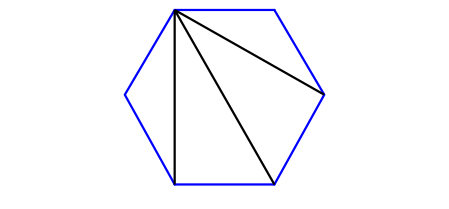
The sides of a polygon are the line segments that make it up. We will highlight the sides of the polygon on the diagram.
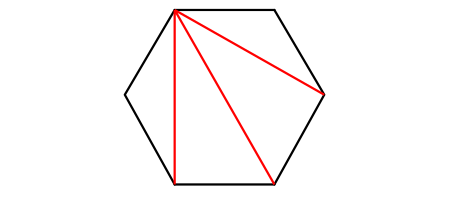
By looking at the diagram, we can see that the polygon has six sides. Next, let's determine the number of diagonals coming from one vertex. A diagonal is a line segment that connects two vertices of a polygon, but it is not the polygon's side.
There are three diagonals coming from one vertex of the given polygon.
b
Examples
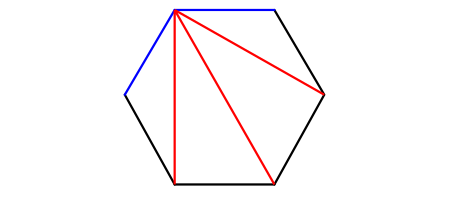
A diagonal is a line segment that connects two vertices of a polygon, but it is not the polygon's side. Let's take the given polygon as an example.
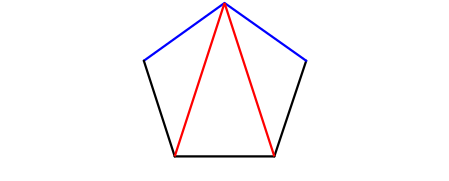
From Part A we know that this polygon is 6-sided. In total there are five line segments coming from one vertex, one less than the number of the sides. Only three of them are the diagonals. The remaining two line segments make up the sides. Next, let's consider a 5-sided polygon.
In total there are four line segments coming from one vertex, one less than the number of the sides. Again, two line segments make up the sides. Therefore, two diagonals are coming from one vertex.
Summary
Finally, let's consider one vertex of a polygon that has n sides. In total there are n−1 line segments coming from one vertex, one less than the number of the sides. Two of these line segments make up the sides and the rest are the diagonals.
n−1−2=n−3
There are n−3 diagonals coming from one vertex of a polygon that has n sides.
c The number of diagonals from all vertices of a polygon that has n sides is 2n(n−3). We are asked to write this polynomial in standard form. To do so, let's use the Distributive Property.
Mathleaks uses cookies for an enhanced user experience. By using our website, you agree to the usage of cookies as described in our policy for cookies.