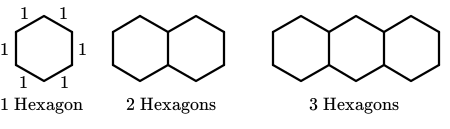
Counting the sides of the figures, make a table that shows the perimeter of the figures depending on the number of hexagons.
Interpreting the table, write an equation for the perimeter of the figures.
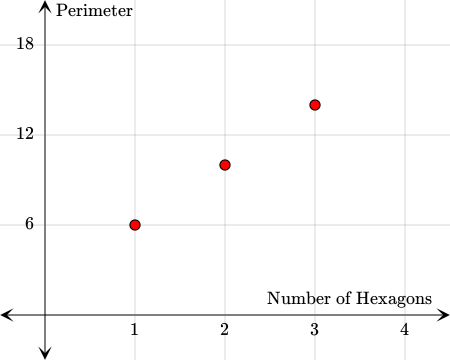
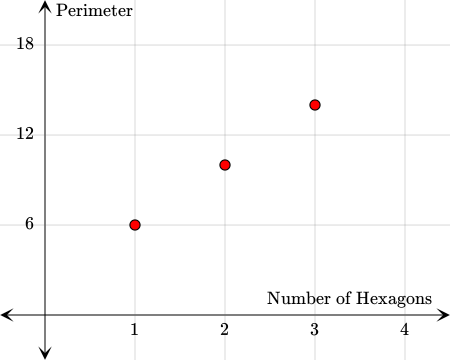
The table will have three ordered pairs. Use them to make a graph that represents the perimeter of the figures depending on the number of hexagons.
Table:
Number of Hexagons n
Perimeter p
1
6
2
10
3
14
Words: See solution. Equation: P=4n+2 Graph:
Practice makes perfect
Let's take a look at the given figures.
The perimeter of a regular hexagon can be found by multiplying the length of the sides a by 6, the number of sides.
P= 6 a
However, this formula does not work for adjacent hexagons. Therefore, we will first find the perimeters of the given figures by counting their sides.
Table
Let's make a table that shows the perimeter of the figures p depending the number of hexagons n.
Number of Hexagons n
Perimeter p
1
6
2
10
3
14
Next, we will interpret this table.
Interpretation of the Table
The pattern we see is that the perimeter of the figures increases by 4, as the number of hexagons increases by 1. We can use this to write an equation that represents the perimeter of the figures.
Equation
Using the table and our interpretation of it, we can write an equation.
P= 4n
Does the formula work? Let's check it for the first figure!
As we can see, the formula does not work for 1 hexagon. Let's apply the formula to the other figures and try to figure out the missing piece.
Number of Hexagons n
P=4n
Perimeter Found by the Formula
Actual Perimeter
1
P=4( 1)
4
6
2
P=4( 2)
8
10
3
P=4( 3)
12
14
The perimeter found by the incomplete formula is always 2 less than the actual perimeter. Therefore, we can complete our formula by adding 2 to the formula.
P= 4n+2
Next, we will make a graph that represents the perimeter of the given figures depending on the number of hexagons.
Graph
Using the table, we have three ordered pairs.
(1,6) (2,10) (3,14)
Plotting these points on the coordinate plane, we can have our graph. Let the x-axis represents the number of the hexagons that a figure has and the y-axis represents the perimeter of the figure.