Table of contents
Sign In
An error ocurred, try again later!
Chapter 3
2.
Multiply Fractions
This lesson delves into the methods for multiplying fractions and mixed numbers, as well as simplifying fractions. It covers various techniques, including the use of area models and number lines, to make the concepts more understandable. The lesson also emphasizes the importance of estimation strategies to assess the reasonableness of answers. Practical examples are provided to demonstrate how these mathematical concepts can be applied in everyday situations like calculating time spent on activities or determining the area of objects.
Show less Show more expand_more Lesson Settings & Tools
| | 10 Theory slides |
| | 10 Exercises - Grade E - A |
| | Each lesson is meant to take 1-2 classroom sessions |
Multiply Fractions
Slide of 10
This lesson will cover methods for multiplying fractions by whole numbers, fractions, and mixed numbers. Along with these methods, estimation strategies will be used to assess whether the products are reasonable.
Catch-Up and Review
Here are a few recommended readings before getting started with this lesson.
Challenge
Running Time
Paulina runs for two-sixths of her free time each day.
External credits: pikisuperstar
If Paulina has 5 hours of free time per day, how many hours does she run in 4 days? Give the exact answer.
{"type":"text","form":{"type":"math","options":{"comparison":"1","nofractofloat":false,"keypad":{"simple":true,"useShortLog":false,"variables":["x"],"constants":["PI"]},"rendered":false},"text":"<span class=\"katex\"><span class=\"katex-html\" aria-hidden=\"true\"><\/span><\/span>"},"formTextBefore":null,"formTextAfter":"hours","answer":{"text":["\\dfrac{20}{3}","6\\dfrac{2}{3}"]}}
Discussion
Multiplying Fractions
The product of two fractions is equal to the product of the numerators divided by the product of the denominators. The resulting fraction is then simplified to its lowest terms, if possible.
ba⋅dc=b⋅da⋅c
65⋅43
The result of this multiplication can be found in three steps.
1
Multiply the Numerators
expand_more 2
Multiply the Denominators
expand_more The product of the denominators is 6⋅4=24.
3
Simplify if Possible
expand_more Note that 3 is the greatest common factor of 15 and 24. Divide both the numerator and the denominator by 3 to simplify the fraction.
Therefore, the product of 65 and 43 simplified to its lowest terms is 85.
Example
Finding What Fraction of the Water in a Bottle Is Drunk
Paulina drinks one-third of the water in her bottle before PE class. During class, she drinks ten-twelfths of the remaining water.

a Write a numeric expression to represent the amount of water in the bottle that Paulina drinks during class.
{"type":"text","form":{"type":"math","options":{"comparison":"1","nofractofloat":false,"keypad":{"simple":false,"useShortLog":false,"variables":[],"constants":[]},"rendered":false},"text":"<span class=\"katex\"><span class=\"katex-html\" aria-hidden=\"true\"><\/span><\/span>"},"formTextBefore":null,"formTextAfter":null,"answer":{"text":["\\dfrac{2}{3} \\times \\dfrac{10}{12}"]}}
b Which of the following is the best estimate for the value of the expression written in Part A?
{"type":"choice","form":{"alts":["<span class=\"katex\"><span class=\"katex-html\" aria-hidden=\"true\"><span class=\"base\"><span class=\"strut\" style=\"height:2.00744em;vertical-align:-0.686em;\"><\/span><span class=\"mord\"><span class=\"mopen nulldelimiter\"><\/span><span class=\"mfrac\"><span class=\"vlist-t vlist-t2\"><span class=\"vlist-r\"><span class=\"vlist\" style=\"height:1.32144em;\"><span style=\"top:-2.314em;\"><span class=\"pstrut\" style=\"height:3em;\"><\/span><span class=\"mord\"><span class=\"mord\">9<\/span><\/span><\/span><span style=\"top:-3.23em;\"><span class=\"pstrut\" style=\"height:3em;\"><\/span><span class=\"frac-line\" style=\"border-bottom-width:0.04em;\"><\/span><\/span><span style=\"top:-3.677em;\"><span class=\"pstrut\" style=\"height:3em;\"><\/span><span class=\"mord\"><span class=\"mord\">8<\/span><\/span><\/span><\/span><span class=\"vlist-s\">\u200b<\/span><\/span><span class=\"vlist-r\"><span class=\"vlist\" style=\"height:0.686em;\"><span><\/span><\/span><\/span><\/span><\/span><span class=\"mclose nulldelimiter\"><\/span><\/span><\/span><\/span><\/span>","<span class=\"katex\"><span class=\"katex-html\" aria-hidden=\"true\"><span class=\"base\"><span class=\"strut\" style=\"height:2.00744em;vertical-align:-0.686em;\"><\/span><span class=\"mord\"><span class=\"mopen nulldelimiter\"><\/span><span class=\"mfrac\"><span class=\"vlist-t vlist-t2\"><span class=\"vlist-r\"><span class=\"vlist\" style=\"height:1.32144em;\"><span style=\"top:-2.314em;\"><span class=\"pstrut\" style=\"height:3em;\"><\/span><span class=\"mord\"><span class=\"mord\">1<\/span><span class=\"mord\">2<\/span><\/span><\/span><span style=\"top:-3.23em;\"><span class=\"pstrut\" style=\"height:3em;\"><\/span><span class=\"frac-line\" style=\"border-bottom-width:0.04em;\"><\/span><\/span><span style=\"top:-3.677em;\"><span class=\"pstrut\" style=\"height:3em;\"><\/span><span class=\"mord\"><span class=\"mord\">1<\/span><\/span><\/span><\/span><span class=\"vlist-s\">\u200b<\/span><\/span><span class=\"vlist-r\"><span class=\"vlist\" style=\"height:0.686em;\"><span><\/span><\/span><\/span><\/span><\/span><span class=\"mclose nulldelimiter\"><\/span><\/span><\/span><\/span><\/span>","<span class=\"katex\"><span class=\"katex-html\" aria-hidden=\"true\"><span class=\"base\"><span class=\"strut\" style=\"height:2.00744em;vertical-align:-0.686em;\"><\/span><span class=\"mord\"><span class=\"mopen nulldelimiter\"><\/span><span class=\"mfrac\"><span class=\"vlist-t vlist-t2\"><span class=\"vlist-r\"><span class=\"vlist\" style=\"height:1.32144em;\"><span style=\"top:-2.314em;\"><span class=\"pstrut\" style=\"height:3em;\"><\/span><span class=\"mord\"><span class=\"mord\">3<\/span><\/span><\/span><span style=\"top:-3.23em;\"><span class=\"pstrut\" style=\"height:3em;\"><\/span><span class=\"frac-line\" style=\"border-bottom-width:0.04em;\"><\/span><\/span><span style=\"top:-3.677em;\"><span class=\"pstrut\" style=\"height:3em;\"><\/span><span class=\"mord\"><span class=\"mord\">2<\/span><\/span><\/span><\/span><span class=\"vlist-s\">\u200b<\/span><\/span><span class=\"vlist-r\"><span class=\"vlist\" style=\"height:0.686em;\"><span><\/span><\/span><\/span><\/span><\/span><span class=\"mclose nulldelimiter\"><\/span><\/span><\/span><\/span><\/span>","<span class=\"katex\"><span class=\"katex-html\" aria-hidden=\"true\"><span class=\"base\"><span class=\"strut\" style=\"height:2.00744em;vertical-align:-0.686em;\"><\/span><span class=\"mord\"><span class=\"mopen nulldelimiter\"><\/span><span class=\"mfrac\"><span class=\"vlist-t vlist-t2\"><span class=\"vlist-r\"><span class=\"vlist\" style=\"height:1.32144em;\"><span style=\"top:-2.314em;\"><span class=\"pstrut\" style=\"height:3em;\"><\/span><span class=\"mord\"><span class=\"mord\">9<\/span><\/span><\/span><span style=\"top:-3.23em;\"><span class=\"pstrut\" style=\"height:3em;\"><\/span><span class=\"frac-line\" style=\"border-bottom-width:0.04em;\"><\/span><\/span><span style=\"top:-3.677em;\"><span class=\"pstrut\" style=\"height:3em;\"><\/span><span class=\"mord\"><span class=\"mord\">2<\/span><\/span><\/span><\/span><span class=\"vlist-s\">\u200b<\/span><\/span><span class=\"vlist-r\"><span class=\"vlist\" style=\"height:0.686em;\"><span><\/span><\/span><\/span><\/span><\/span><span class=\"mclose nulldelimiter\"><\/span><\/span><\/span><\/span><\/span>"],"noSort":false},"formTextBefore":"","formTextAfter":"","answer":2}
c Find the value of the expression found in Part A. Simplify the answer if possible.
{"type":"text","form":{"type":"math","options":{"comparison":"1","nofractofloat":false,"keypad":{"simple":true,"useShortLog":false,"variables":["x"],"constants":["PI"]},"rendered":false},"text":"<span class=\"katex\"><span class=\"katex-html\" aria-hidden=\"true\"><\/span><\/span>"},"formTextBefore":null,"formTextAfter":null,"answer":{"text":["\\dfrac{5}{9}"]}}
Hint
a What fraction of the bottle is full before the class? What mathematical operation must be performed to find ten twelfths of a number?
b If a fraction is greater than or equal to 21, round the fraction to 1. If a fraction is less than 21, round it to 0.
c To multiply fractions, start with the multiplication of the numerators, followed by the multiplication of the denominators. Then, simplify the resulting fractions.
Solution
a Start by finding what fraction of the bottle is full before the physical education class. To do so, subtract one-third from 1.
Expression1210×32
A number line can be used to help with this concept. First, divide the number line between 0 and 1 into thirds. Fill in 32, representing the water that remains in the bottle before class. Then, divide this section into 12 smaller equal parts and color in 10 of them. 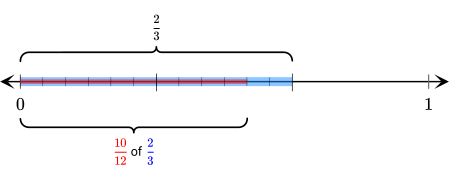
Notice that each third is divided into six smaller equal parts. The other third can also be divided into six parts. This will make it easier to find what fraction of the whole the red part represents.
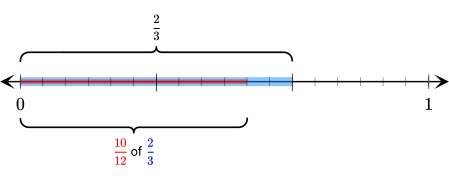
The red part shows what fraction of the water bottle Paulina drinks during class.
b Estimation is a great tool to get a rough idea of the result of an operation — in this case, the result of a multiplication. Consider the value of each fraction in the expression separately.
1210×32
Now compare each fraction with 21. These fractions do not have the same denominator. The denominators of the fractions are 12, 3, and 2. The least common denominator of these numbers is 12. Each fraction can be rewritten as an equivalent fraction with the common denominator to make it easier to compare them. | Rewrite | Compare with 21, or 126 | |
|---|---|---|
| 1210 | 1210 | 1210>126 |
| 32 | 3⋅42⋅4=128 | 128>126 |
Product:Estimate:1210↓1××32↓1
Since 1 is the identity element of multiplication, this product is also equal to 1. However, that does not say much about the original product, and 1 is not one of the possible answer options. Now think of rounding only one of the fractions to 1 one at a time. | Estimate for 1210×32 | |
|---|---|
| Round 1210 to 1 | 1×32=32 |
| Round 32 to 1 | 1210×1=1210 |
The fraction 1210 can be simplified to 65. The answer is either 32 or 65. The fractions in the options are in simplest form and 32 is among the options. Therefore, the answer is 32.
c To multiply the fractions, start with the multiplication of the numerators, followed by the multiplication of the denominators. Then, simplify the resulting fraction.
Result95≈Estimate96
Since the actual result and the estimate are close to each other, the answer 95 is reasonable.
Extra
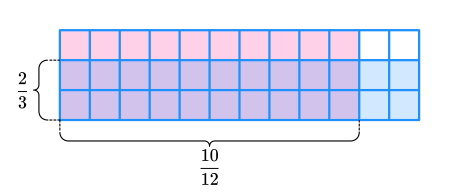
Using an Area Model to Represent the Product of FractionsIn addition to a number line, the product can also be represented by an area model. In this model, the denominators are used to divide a rectangular diagram into smaller parts. Consider modeling the following product.

1210×32
The denominators are 12 and 3. The rectangle is then divided into 12 columns and 3 rows. The numerators determine which parts will be shaded. Since 10 is the numerator of 1210, 10 of the 12 columns will be shaded. Similarly, 2 of the 3 rows will be shaded.
In this model, the overlapping region represents the product. For this example, the product is 3620=95.
Pop Quiz
Finding the Product of Fractions
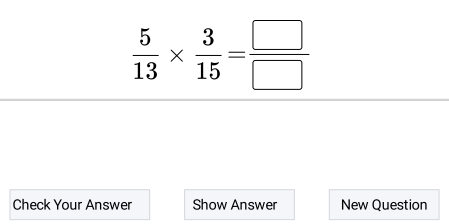
The product of two fractions is equal to the product of the numerators divided by the product of the denominators. Practice finding the product of fractions. Simplify the answer to its lowest terms.
Discussion
Multiplying Fractions by Whole Numbers and By Mixed Numbers
When multiplying fractions by whole numbers or mixed numbers, both factors should be in the form of a proper fraction or an improper fraction.
Multiplying Fractions By Whole Numbers
To multiply fractions with whole numbers, the whole number is written as a fraction with a denominator is 1. The following steps are identical to those for multiplying fractions. Consider multiplying 9 and 272.9×272
Rewrite
Rewrite 9 as 19
19×272
2718
ReduceFrac
ba=b/9a/9
27/918/9
SimpQuot
Simplify quotient
32
Multiplying Fractions By Mixed Numbers
Recall that mixed numbers are fractions that consist of a whole number and a proper fraction.354 {whole number: 3proper fraction: 54
The mixed fraction must be converted into an improper fraction before it can be multiplied by a fraction. The multiplication process can be better understood with the help of an example.
354×31
▼
Write mixed number as a fraction
519×31
1519
1519
▼
Write mixed number as a fraction
Rewrite
Rewrite 19 as 15+4
1515+4
WriteSumFrac
Write as a sum of fractions
1515+154
CalcQuot
Calculate quotient
1+154
Rewrite
Rewrite 1+154 as 1154
1154
Example
Finding Times Allocated For Activities
Paulina's PE class lasts for 1125 hours. The table shows what fraction of the class time is allocated for various activities.
| Activity | Fraction |
|---|---|
| Warm-up | 51 |
| Instruction | 21 |
| Playing a game | 101 |
| Cool-down | 51 |
a Find how many minutes are devoted to warming up and cooling down.
{"type":"text","form":{"type":"math","options":{"comparison":"1","nofractofloat":false,"keypad":{"simple":true,"useShortLog":false,"variables":["x"],"constants":["PI"]},"rendered":false},"text":"<span class=\"katex\"><span class=\"katex-html\" aria-hidden=\"true\"><\/span><\/span>"},"formTextBefore":null,"formTextAfter":"minutes","answer":{"text":["34"]}}
b Find how many minutes are devoted to the activities other than instruction.
{"type":"text","form":{"type":"math","options":{"comparison":"1","nofractofloat":false,"keypad":{"simple":true,"useShortLog":false,"variables":["x"],"constants":["PI"]},"rendered":false},"text":"<span class=\"katex\"><span class=\"katex-html\" aria-hidden=\"true\"><\/span><\/span>"},"formTextBefore":null,"formTextAfter":"minutes","answer":{"text":["42.5"]}}
Hint
a Start by determining what fraction of the class time is allocated for warm-up and cool-down. To do so, add the fractions corresponding to the activities. Multiply the portion of the lesson spent on those activities by the total class time. Finally, use the fact that 1 hour is 60 minutes.
b Determine what fraction of the class time is allocated for the activities other than instruction.
Solution
a The fractions for both the warm-up and the cool-down to find the amount of time spent on them. Take a look at the given table.
| Part of 1125-hour Class | ||
|---|---|---|
| Activity | Fraction | |
| Warm-up | 51 | |
| Instruction | 21 | |
| Playing game | 101 | |
| Cool-down | 51 | |
51+51=52
Next, the time spent on warming up and cooling down will be found by multiplying this fraction number by the lesson time 1125. This will give the amount of time in hours.
52×1125
This is a multiplication of a fraction by a mixed number. Before performing the multiplication, the mixed number will be rewritten as an improper fraction.
Now multiply the numerators and denominators.
Since a common factor exists between numerator and denominator, the fraction can be simplified.
60/234/2=3017
The fraction simplifies to 3017. This means that 3017 of an hour is spent on warming up and cooling down. Now the number of minutes spent on these activities will be found by multiplying the fraction by 60 because 1 hour is 60 minutes.
60×3017
This is a multiplication of a whole number by an improper fraction. Start by rewriting 60 as an improper fraction, then multiply the fractions.
60×3017
Rewrite
Rewrite 60 as 160
160×3017
MultFrac
Multiply fractions
1×3060×17
Multiply
Multiply
301020
CalcQuot
Calculate quotient
34
b Consider the given table again, this time focusing on the instruction time.
| Part of 1125-hour Class | ||
|---|---|---|
| Activity | Fraction | |
| Warm-up | 51 | |
| Instruction | 21 | |
| Playing game | 101 | |
| Cool-down | 51 | |
21×1125
Rewrite the mixed number as an improper fraction to find the product.
21×1125
▼
Write mixed number as a fraction
21×1217
60×2417
This is a multiplication of a whole number by a fraction. An easy way to find this product is to move the whole number to the numerator of the fraction as a factor.
The activities other than instruction last for 42.5 minutes.
Example
Finding the Area of a Printed Photograph
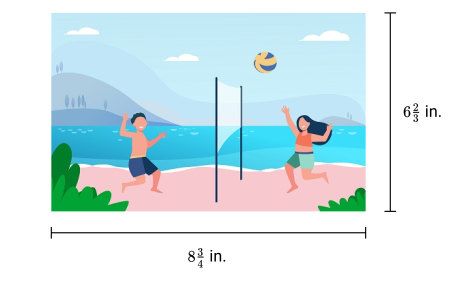
Paulina loves a photo of her playing volleyball and prints it. The diagram shows the dimensions of the photograph.
External credits: pch.vector
a Estimate the area of the photograph.
{"type":"text","form":{"type":"math","options":{"comparison":"1","nofractofloat":false,"keypad":{"simple":true,"useShortLog":false,"variables":["x"],"constants":["PI"]},"rendered":false},"text":"<span class=\"katex\"><span class=\"katex-html\" aria-hidden=\"true\"><\/span><\/span>"},"formTextBefore":"About","formTextAfter":"<span class=\"katex\"><span class=\"katex-html\" aria-hidden=\"true\"><span class=\"base\"><span class=\"strut\" style=\"height:0.924711125em;vertical-align:0em;\"><\/span><span class=\"mord\"><span class=\"mord text\"><span class=\"mord\">\u00a0<\/span><span class=\"mord Roboto-Regular\">in<\/span><span class=\"mord\">.<\/span><\/span><span class=\"msupsub\"><span class=\"vlist-t\"><span class=\"vlist-r\"><span class=\"vlist\" style=\"height:0.924711125em;\"><span style=\"top:-3.173603125em;margin-right:0.05em;\"><span class=\"pstrut\" style=\"height:2.7em;\"><\/span><span class=\"sizing reset-size6 size3 mtight\"><span class=\"mord mtight\">2<\/span><\/span><\/span><\/span><\/span><\/span><\/span><\/span><\/span><\/span><\/span>","answer":{"text":["63"]}}
b What is the area of the photograph? Write the answer as a mixed number.
{"type":"text","form":{"type":"math","options":{"comparison":"1","nofractofloat":false,"keypad":{"simple":true,"useShortLog":false,"variables":["x"],"constants":["PI"]},"rendered":false},"text":"<span class=\"katex\"><span class=\"katex-html\" aria-hidden=\"true\"><\/span><\/span>"},"formTextBefore":null,"formTextAfter":"<span class=\"katex\"><span class=\"katex-html\" aria-hidden=\"true\"><span class=\"base\"><span class=\"strut\" style=\"height:0.924711125em;vertical-align:0em;\"><\/span><span class=\"mord\"><span class=\"mord text\"><span class=\"mord\">\u00a0<\/span><span class=\"mord Roboto-Regular\">in<\/span><span class=\"mord\">.<\/span><\/span><span class=\"msupsub\"><span class=\"vlist-t\"><span class=\"vlist-r\"><span class=\"vlist\" style=\"height:0.924711125em;\"><span style=\"top:-3.173603125em;margin-right:0.05em;\"><span class=\"pstrut\" style=\"height:2.7em;\"><\/span><span class=\"sizing reset-size6 size3 mtight\"><span class=\"mord mtight\">2<\/span><\/span><\/span><\/span><\/span><\/span><\/span><\/span><\/span><\/span><\/span>","answer":{"text":["58\\dfrac{1}{3}"]}}
c Paulina frames the photo using a frame with a 51-centimeter border. What is the area of the photo including the frame? Write the answer as a mixed number.
{"type":"text","form":{"type":"math","options":{"comparison":"1","nofractofloat":false,"keypad":{"simple":true,"useShortLog":false,"variables":["x"],"constants":["PI"]},"rendered":false},"text":"<span class=\"katex\"><span class=\"katex-html\" aria-hidden=\"true\"><\/span><\/span>"},"formTextBefore":null,"formTextAfter":"<span class=\"katex\"><span class=\"katex-html\" aria-hidden=\"true\"><span class=\"base\"><span class=\"strut\" style=\"height:0.924711125em;vertical-align:0em;\"><\/span><span class=\"mord\"><span class=\"mord text\"><span class=\"mord\">\u00a0<\/span><span class=\"mord Roboto-Regular\">in<\/span><span class=\"mord\">.<\/span><\/span><span class=\"msupsub\"><span class=\"vlist-t\"><span class=\"vlist-r\"><span class=\"vlist\" style=\"height:0.924711125em;\"><span style=\"top:-3.173603125em;margin-right:0.05em;\"><span class=\"pstrut\" style=\"height:2.7em;\"><\/span><span class=\"sizing reset-size6 size3 mtight\"><span class=\"mord mtight\">2<\/span><\/span><\/span><\/span><\/span><\/span><\/span><\/span><\/span><\/span><\/span>","answer":{"text":["64\\dfrac{33}{50}"]}}
Hint
a Use the formula for the area of a rectangle. Round the mixed numbers to the nearest whole numbers
b To multiply fractions, multiply the numerators and denominators with each other.
c Add 2×51 to each side of the photo. Then repeat the process from Part A.
Solution
External credits: pch.vector
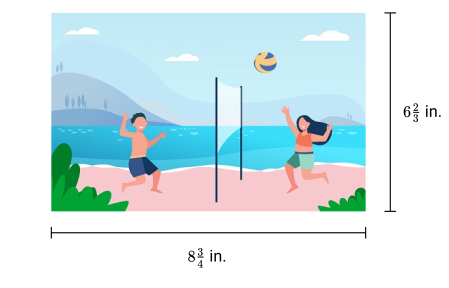
Area =843⋅632
Since the fractional parts of the mixed numbers are greater than 21, the mixed numbers can be rounded up. Area = 843⋅632 ↓ ↓ 9 ⋅ 7
Therefore, the area of the photo is about 9⋅7, or 63 square inches.
b Recall the expression for the area of the photo from Part A. It is the product of the two mixed numbers.
Area =843⋅632
To multiply these mixed numbers, they first need to be rewritten as improper fractions.
843⋅632
MixedToFrac
acb=ca⋅c+b
48⋅4+3⋅36⋅3+2
Multiply
Multiply
432+3⋅318+2
AddTerms
Add terms
435⋅320
435⋅320
MultFrac
Multiply fractions
4⋅335⋅20
Multiply
Multiply
12700
ReduceFrac
ba=b/4a/4
12/4700/4
CalcQuot
Calculate quotient
3175
▼
Write fraction as a mixed number
Rewrite
Rewrite 175 as 174+1
3174+1
WriteSumFrac
Write as a sum of fractions
3174+31
CalcQuot
Calculate quotient
58+31
Rewrite
Rewrite 58+31 as 5831
5831
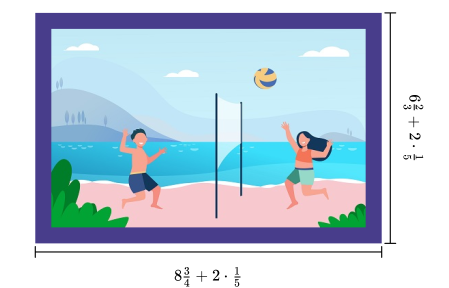
c In this part, start by adding a 51-inch border on each side of the photo. This will extend each side by 2⋅51 inches.
External credits: pch.vector
(843+2⋅51)⋅(632+2⋅51)⇕(843+52)⋅(632+52)
Once again, rewrite the fractions so that all of them are either proper or improper fractions.
(843+52)⋅(632+52)
▼
Write mixed number as a fraction
MixedToFrac
acb=ca⋅c+b
(48⋅4+3+52)⋅(36⋅3+2+52)
Multiply
Multiply
(432+3+52)⋅(318+2+52)
AddTerms
Add terms
(435+52)⋅(320+52)
▼
Add fractions
ExpandFrac
ba=b⋅5a⋅5
(4⋅535⋅5+52)⋅(320+52)
ExpandFrac
ba=b⋅4a⋅4
(4⋅535⋅5+5⋅42⋅4)⋅(320+52)
ExpandFrac
ba=b⋅5a⋅5
(4⋅535⋅5+5⋅42⋅4)⋅(3⋅520⋅5+52)
ExpandFrac
ba=b⋅3a⋅3
(4⋅535⋅5+5⋅42⋅4)⋅(3⋅520⋅5+5⋅32⋅3)
Multiply
Multiply
(20175+208)⋅(15100+156)
AddFrac
Add fractions
20175+8⋅15100+6
AddTerms
Add terms
20183⋅15106
20183⋅15106
MultFrac
Multiply fractions
20⋅15183⋅106
Multiply
Multiply
30019398
ReduceFrac
ba=b/6a/6
300/619398/6
CalcQuot
Calculate quotient
503233
▼
Write fraction as a mixed number
Rewrite
Rewrite 3233 as 3200+33
503200+33
WriteSumFrac
Write as a sum of fractions
503200+5033
CalcQuot
Calculate quotient
64+5033
Rewrite
Rewrite 64+5033 as 645033
645033
Pop Quiz
Finding the Product of Mixed Numbers
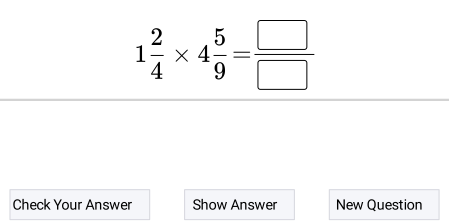
To multiply a fraction by a whole number, the whole number is multiplied by the numerator of the fraction. To multiply mixed numbers, the mixed numbers can be converted into improper fractions before multiplying. Practice finding the product of fractions. Simplify the answer to its lowest terms.
Closure
Finding Time Paulina Runs
The important point in multiplying fractions is to ensure that the fractions are either proper fractions or improper fractions.
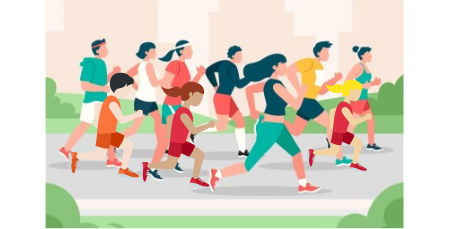 If Paulina has 5 hours of free time per day, how many hours does she run in 4 days?
162×2=68×12
The final step usually involves simplifying the resulting fraction. However, to make calculations easier, first check if the two fractions are already in their lowest forms. If not, the fractions can be simplified first before multiplying them.
4 683 ×12=34×12=38
Consider the challenge presented at the beginning of the lesson. Paulina devotes two-sixths of her free time to exercise. External credits: pikisuperstar
{"type":"text","form":{"type":"math","options":{"comparison":"1","nofractofloat":false,"keypad":{"simple":true,"useShortLog":false,"variables":["x"],"constants":["PI"]},"rendered":false},"text":"<span class=\"katex\"><span class=\"katex-html\" aria-hidden=\"true\"><\/span><\/span>"},"formTextBefore":null,"formTextAfter":"hours","answer":{"text":["\\dfrac{20}{3}","6\\dfrac{2}{3}"]}}
Hint
Start by finding the number of hours Paulina spends running in a day.
Solution
It is given that Paulina has 5 hours of free time per day and that two-sixths of this time is devoted to physical activities. The time spent on running can be found by finding two-sixths of 5.
In 4 days, Paulina runs 632 hours.
62×5
Notice that the fraction can be simplified to its lowest terms.
Paulina runs for 35 hours every day. Since the number of hours she runs in 4 days is required, the daily amount of activity should be multiplied by 4 to find the total amount of time.
This final fraction can also be written as a mixed number.
320
▼
Write fraction as a mixed number
Rewrite
Rewrite 20 as 18+2
318+2
WriteSumFrac
Write as a sum of fractions
318+32
CalcQuot
Calculate quotient
6+32
Rewrite
Rewrite 6+32 as 632
632
Multiply Fractions
Recommended exercises
To get personalized recommended exercises, please login first.
Loading content
Loading content