2. Mixed and Decimal Numbers
Sign In
An error ocurred, try again later!
Chapter 2
2.
Mixed and Decimal Numbers
This lesson focuses on four key mathematical concepts: mixed numbers, improper fractions, decimal conversion, and long division. It explains how these concepts are interconnected and can be used in various real-world situations. For example, if someone is trying to divide a pizza into equal slices but end up with a piece that is not a full slice, they can represent that piece as an improper fraction or a mixed number. Similarly, if someone is working on a budget and need to divide expenses, understanding decimal conversion can make the process much easier. Long division is also covered as a foundational skill for these conversions. The lesson aims to equip with the tools to make better decisions and solve problems in both academic and everyday settings.
Show less Show more expand_more 


Lesson Settings & Tools
| | 15 Theory slides |
| | 9 Exercises - Grade E - A |
| | Each lesson is meant to take 1-2 classroom sessions |
Mixed and Decimal Numbers
Slide of 15
There are different ways to write rational numbers. Each is useful in different situations. It is also possible to convert between these forms of numbers. This lesson will focus on exploring such number forms and converting them into each other.
Catch-Up and Review
Here are a few recommended readings before getting started with this lesson.
Explore
Share
Report error
A Different Way of Writing Improper Fractions
Consider two bars split into into an equal number of parts. Try to determine the fraction that the bars represent.
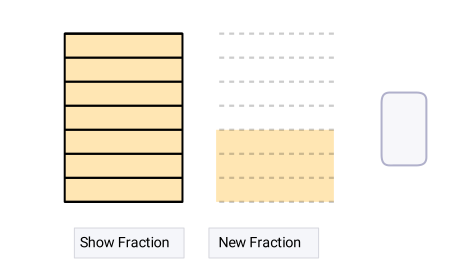 Notice that the first bar is always fully shaded. This indicates that an improper fraction represents the shown diagram each time. Also, the first bar can be represented by a fraction, whose numerator and denominator are the same. Its value is always 1.
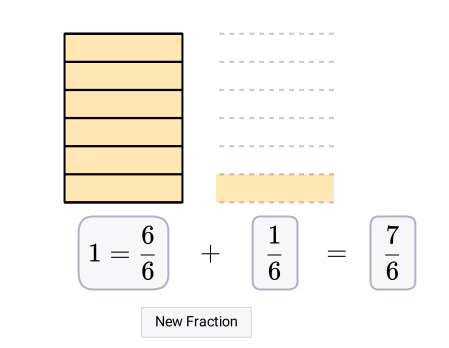 The fraction on the right-hand side can be represented by a proper fraction. Together, 1 and a proper fraction form a new way of writing the value of an improper fraction.
Discussion
Share
Report error
Mixed Numbers
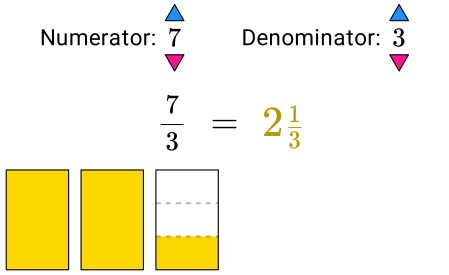
A mixed number consists of a non-zero integer number and a proper fraction.
a bc [0.5em]
whereais an integer,b

Discussion
Share
Report error
Converting a Mixed Number Into an Improper Fraction
Improper fractions and mixed numbers are two different ways of writing numbers that can have the same value. Sometimes, it is useful to convert between them. Consider the following mixed number.
5 29
This mixed number can be rewritten as an improper fraction in three steps.

1
Multiply the Integer Part by the Denominator
expand_more First, identify the integer part of the mixed number. This is the integer number written before the fraction.
Next, multiply the integer part by the denominator of the fraction. In this case, the denominator of the fraction is 9. 5* 9=45
2
Add the Numerator
expand_more Add the numerator of the fraction to the number from the previous step. In the given mixed number, the numerator of the fraction is 2. 45+ 2=47 This is the numerator of the improper fraction. 5 29=47/?
3
Write the Denominator
expand_more Write the numerator of the fraction part as the denominator of the improper fraction. The denominator in the fraction of the given mixed number is 9. Therefore, this is also the denominator of the improper fraction. 5 2 9=47/9
Extra
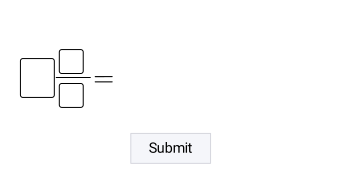
Interact With an Applet that Converts Different Mixed Numbers Into Improper FractionsSubmit the values of the integer part, numerator and denominator between 1 and 15, inclusively. Then, the process of converting the mixed number into an improper fraction will be illustrated.
Example
Share
Report error
Looking for the First Clue
Izabella's older sister Tiffaniqua wanted to encourage her to practice converting between mixed numbers and fractions. She came up with an idea to leave some clues for Tiffaniqua all over their house leading to a hidden present. She told Izabella to start at the door of Izabella's room. 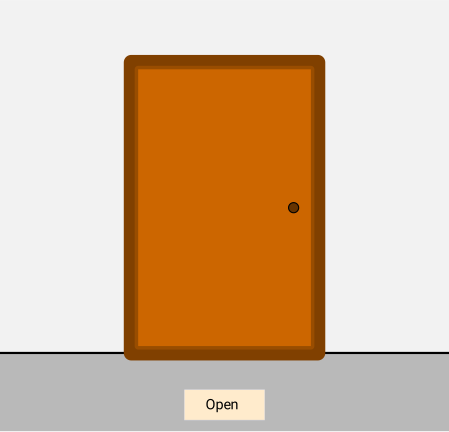 Izabella sprang up, running to her door she opened it quickly. She found the first clue. It asks her to rewrite two mixed numbers as fractions. Doing that will help her decode the directions to the hidden present.
a 4 13
{"type":"text","form":{"type":"math","options":{"comparison":"1","nofractofloat":false,"keypad":{"simple":true,"useShortLog":false,"variables":[],"constants":[]},"rendered":false},"text":" "},"formTextBefore":null,"formTextAfter":null,"answer":{"text":["\\dfrac{13}{3}"]}}
b 6 38
{"type":"text","form":{"type":"math","options":{"comparison":"1","nofractofloat":false,"keypad":{"simple":true,"useShortLog":false,"variables":[],"constants":[]},"rendered":false},"text":" "},"formTextBefore":null,"formTextAfter":null,"answer":{"text":["\\dfrac{51}{8}"]}}
b How many steps should Izabella take in the direction of Tiffaniqua's room? How many steps should Izabella take after turning left? Write each answer in list form.
{"type":"text","form":{"type":"list","options":{"comparison":"1","nofractofloat":false,"keypad":{"simple":true,"useShortLog":false,"variables":[],"constants":[]},"rendered":false,"ordermatters":true,"numinput":2,"listEditable":false,"hideNoSolution":true},"text":" "},"formTextBefore":null,"formTextAfter":null,"answer":{"text":["16","35"]}}
Hint
a Multiply the integer part by the denominator of the fractional part and add the numerator to find the numerator of the improper fraction.
b The denominator of the improper fraction is the same as the denominator of the fraction in the mixed number.
c Identify the values of x, y, z, and w by comparing the fractions.
Solution
a The first mixed number that should be rewritten is 4 1 3. Start by multiplying the integer part by the denominator of the fraction. Then, add the numerator of the fraction. The result is the numerator of the improper fraction.
b The second mixed number, 6 3 8, can be rewritten as an improper fraction by following the same method. First, multiply its integer part by the denominator and add the numerator.
c Each question will be answered one at a time.
First Question
In the note, the numerator of the first improper fraction is x and the denominator is y. x/y=13/3 This means that x= 13 and y= 3. The first instruction that Izabella received is the following. 1. Take x+ y steps toward my room. Add the known values of x and y to find how many steps in the direction of Tiffaniqua's room Izabella should take. 13+ 3=16 steps
Second Question
The numerator of the second improper fraction is z and the denominator is w. z/w=51/8 This means that z= 51 and w= 8. Now, consider the second instruction. 2. Turn left and take z-2 w steps. Substitute the values of z and w and evaluate the expression. Izabella should take 35 steps after turning left.Discussion
Share
Report error
Converting an Improper Fraction Into a Mixed Number
Converting an improper fraction into a mixed number can help to estimate the actual value of the fraction. Consider the following improper fraction.
21/4
This improper fraction can be rewritten as a mixed number in three steps.



1
Divide the Numerator by the Denominator
expand_more Start by dividing the numerator of the improper fraction by the denominator. Note that the quotient must be an integer number.
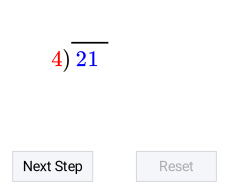 Here, the result of the division of 21 by 4 is the quotient of 5 with a reminder of 1.
2
Write the Integer Part
expand_more Recall that a mixed number consists of an integer part and a proper fraction. The integer part is equal to the quotient of the improper fraction. In this case, it is 5.
3
Write the Fraction Part
expand_more Now the numerator and denominator of the fraction part will be identified. The numerator is equal to the remainder of the division from the first step. In this case, the reminder is 1 and becomes the numerator of the fraction part.
Note that the numerator must be less than the denominator since the fraction part of a mixed number is a proper fraction. The denominator is the same as the denominator of the improper fraction. Therefore, its value is 4.
The numerator is less than the denominator, so the fraction is indeed a proper fraction. Finally, finding the mixed number corresponding to 214 is complete.
Example
Share
Report error
A Clue Hidden in the Office Room
Izabella completed the instructions from the first clue and she ended up in her dad's home office. Looking through piles of papers, she finally found the second clue in the book shelf.
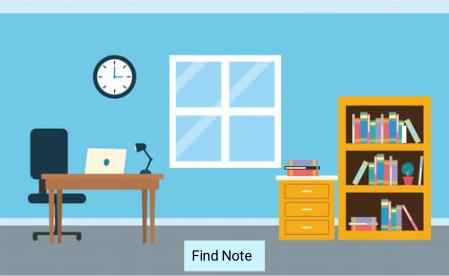 To find the numbers of steps she needs to take, Izabella needs to rewrite the improper fractions as mixed numbers.
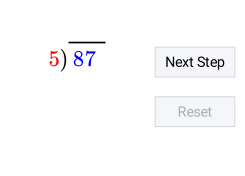 The quotient is 17 with a reminder of 2. Recall that the quotient represents the integer part of the corresponding mixed number. The remainder represents the numerator of the fraction in the mixed number. The denominator is the same as the denominator of improper fraction.
87/5= 172/5
The calculations show that Izabella needs to take 17 steps to the right after leaving the office room.
The quotient is 17 with a reminder of 2. Recall that the quotient represents the integer part of the corresponding mixed number. The remainder represents the numerator of the fraction in the mixed number. The denominator is the same as the denominator of improper fraction.
87/5= 172/5
The calculations show that Izabella needs to take 17 steps to the right after leaving the office room.
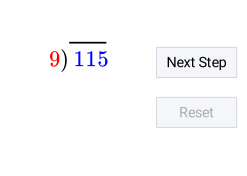 The quotient is 12 with a reminder of 7. The quotient represents the integer part and the reminder represents the numerator of the fraction in the mixed number. The denominator is equal to the denominator of improper fraction.
115/9= 127/9
According to the second instruction, Izabella should turn right and take 7 steps. Where will she end up?
The quotient is 12 with a reminder of 7. The quotient represents the integer part and the reminder represents the numerator of the fraction in the mixed number. The denominator is equal to the denominator of improper fraction.
115/9= 127/9
According to the second instruction, Izabella should turn right and take 7 steps. Where will she end up?
External credits: @gstudioimagen
a 87/5
{"type":"text","form":{"type":"math","options":{"comparison":"1","nofractofloat":false,"keypad":{"simple":true,"useShortLog":false,"variables":[],"constants":[]},"rendered":false},"text":" "},"formTextBefore":null,"formTextAfter":null,"answer":{"text":["17\\frac{2}{5}"]}}
b 115/9
{"type":"text","form":{"type":"math","options":{"comparison":"1","nofractofloat":false,"keypad":{"simple":true,"useShortLog":false,"variables":[],"constants":[]},"rendered":false},"text":" "},"formTextBefore":null,"formTextAfter":null,"answer":{"text":["12\\frac{7}{9}"]}}
Hint
a Divide the numerator by the denominator by using the long division.
b The quotient of the division of 115 and 9 represents the integer part of the corresponding mixed number.
Solution
a Izabella needs to rewrite 875 as a mixed number. This requires dividing the numerator by the denominator. Long division can be applied here.
b This time, Izabella needs to rewrite 1159 as an improper fraction. Again, divide 115 by 9 using long division.
Pop Quiz
Share
Report error
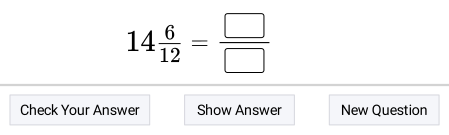
Converting Between Mixed Numbers and Improper Fractions
Convert the given mixed number into the corresponding improper fraction or the other way around — the given improper fraction into a mixed number. If the improper fraction corresponds to an integer number, leave the fraction fields empty. Do not simplify the fraction part in a mixed number.
Discussion
Share
Report error
Introducing Decimal Numbers
While mixed numbers help estimate the value of an improper fraction, they are not very convenient in calculations. For that reason, the equivalent number to the fraction of a mixed number can be written after the integer followed by a dot. 3 45 → 3. This observation leads to the definition of decimal numbers.
Concept
Share
Report error
Decimal Numbers
Numbers that lie between integers on the number line can be written as decimal numbers. These consist of an integer part, a decimal point as a separator, and a non-zero decimal part written to the right of the decimal point. Consider the number 12.346 as an example.
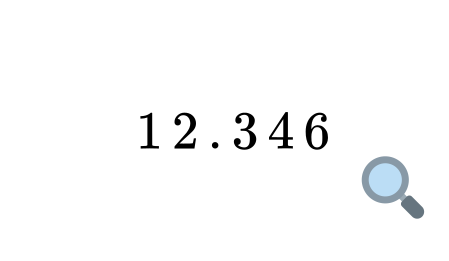 The integer part of this number is 12. Since there is a decimal part, 0.346, the number is greater than 12 but less than 13. Therefore, when plotting 12.346 on a number line, the point will lie between 12 and 13.
Discussion
Share
Report error
Converting a Decimal Number Into a Fraction
It is possible to convert a decimal number into a fraction and the other way around. Consider the following decimal number.
0.56
A decimal number can be rewritten as a fraction in three steps.

1
Count the Number of Decimal Places n
expand_more The number 0.56 can be read as 56 hundredths.
There are two decimal places.
2
Write as a Fraction With the Denominator of 10^n
expand_more The number has 2 decimal places. This means that 0.56 can be written it as a fraction with a numerator of 56 and with a denominator of 10^2. 0.56=56/10^2 ⇓ 0.56=56/100
3
Simplify the Fraction
expand_more Next, check whether 56100 can be simplified. Start by splittting the numerator and denominator into prime factors.
56 & = 2* 2* 2* 7 100 & = 2* 2* 5* 5
The numbers share two common factors. Their product is the GCF of 56 and 100.
GCF(56,100)=2* 2=4
Finally, divide both the numerator and denominator by 4.
The fractions 1425 and 56100 are equivalent and they both correspond to the decimal 0.56.
Extra
Interact With an Applet That Converts Decimals to FractionsSubmit a decimal number between 1 and 0.001 with no more than 3 digits after the decimal point. Then, the process of converting that decimal into a fraction will be shown.
Example
Share
Report error
A Clue Among the Kitchen Supplies
After successfully finding the second clue and following the instructions, Izabella ended up in the kitchen. She started looking for the third clue. 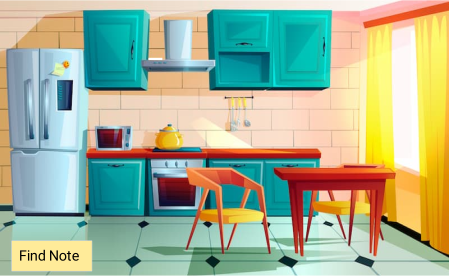 She found the clue over the oven vent. The instructions said to rewrite a decimal number as a fraction in the simplest form.
External credits: @upklyak
a 1.98
{"type":"text","form":{"type":"math","options":{"comparison":"1","nofractofloat":false,"keypad":{"simple":true,"useShortLog":false,"variables":[],"constants":[]},"rendered":false},"text":" "},"formTextBefore":null,"formTextAfter":null,"answer":{"text":["\\dfrac{99}{50}"]}}
b 0.564
{"type":"text","form":{"type":"math","options":{"comparison":"1","nofractofloat":false,"keypad":{"simple":true,"useShortLog":false,"variables":[],"constants":[]},"rendered":false},"text":" "},"formTextBefore":null,"formTextAfter":null,"answer":{"text":["\\dfrac{141}{250}"]}}
c How many steps in total should Izabella take?
{"type":"text","form":{"type":"math","options":{"comparison":"1","nofractofloat":false,"keypad":{"simple":true,"useShortLog":false,"variables":[],"constants":[]},"rendered":false},"text":" "},"formTextBefore":null,"formTextAfter":null,"answer":{"text":["81"]}}
Hint
a The number 1.98 has two decimal places. That means it can be rewritten as a fraction with the numerator of 198 and the denominator of 100.
b Simplify the fraction by dividing the numerator and denominator by their greatest common factor (GCF).
c Evaluate the expressions a-b and 2c-d and then add the values.
Solution
a The number 1.98 has two decimal places. That means it can be rewritten as a fraction with the numerator of 198 and the denominator of 100.
b The decimal of 0.564 can be converted into a fraction by following the same method. Since the number 0.564 is read as
564 thousandths,it can be written as 564 over 1000.
c First, find the values of a and b by setting the fractions corresponding to 1.98 equal.
Discussion
Share
Report error
Converting a Fraction Into a Decimal Number
It is possible to convert a fraction into a decimal number and the other way around. Consider the following fraction.
16/25
Divide the numerator of 16 by the denominator of 25 by using the long division to rewrite the fraction as a decimal.
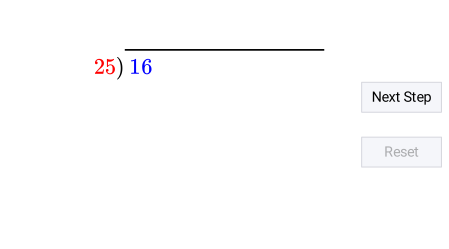 The result is 0.64. This is the decimal number that corresponds to the fraction 1625.
Then, move the decimal point of the numerator to the left the number of times equal to the number of zeros in the denominator. For example, in the case of 710, there is one zero. This indicates that the decimal point of 7 will be moved one place to the left.
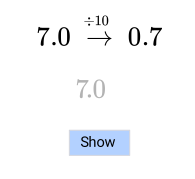 The rest of the fractions can be rewritten into decimal numbers in a similar manner.
Extra
Rewriting Fractions With the Denominators That Are Powers of 10A fraction can have a denominator that is a power of 10. Consider a few examples.
| Fraction | 7/10 | 26/100 | 782/1000 |
|---|
In that case, the procedure of the long division of the numerator by the denominator is not the best way to go. Instead, the fraction can be rewritten directly as a decimal. First, count how many zeros each denominator has.
| Fraction | 7/1 0 | 26/1 00 | 782/1 000 |
|---|---|---|---|
| Number of Zeros | 1 | 2 | 3 |
| Fraction | 7/10 | 26/100 | 782/1000 |
|---|---|---|---|
| Number of Zeros | 1 | 2 | 3 |
| Decimal | 0.7 | 0.26 | 0.782 |
Example
Share
Report error
Finding the Final Clue
The previous clue led Izabella to the living room. Tiffaniqua told her that there is one last clue remaining. Izabella is jumping off the walls in excitement. 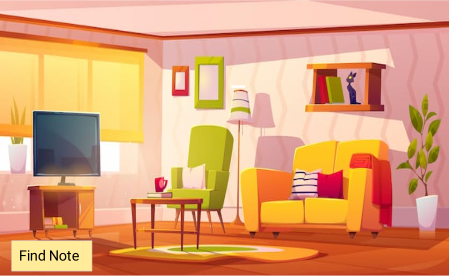 Izabella searches eagerly. There is the final clue. It is on the lamp! If she solves the last instructions and rewrites the fractions as decimals, she will find the present. The decimals should be written up to two decimal places.
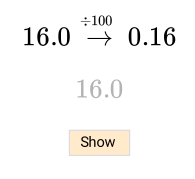 The calculations show that the fraction of 425 or 16100 corresponds to the decimal of 0.16.
16/100=0.16
Izabella needs to take 0.16* 100=16 steps.
The calculations show that the fraction of 425 or 16100 corresponds to the decimal of 0.16.
16/100=0.16
Izabella needs to take 0.16* 100=16 steps.
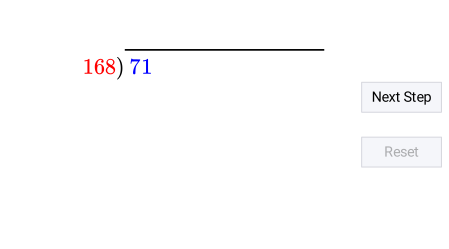 The decimal is 0.42. This means that the fraction 71168 corresponds to about 0.42. Then, Izabella needs to take 0.42* 100=42 steps. After taking those steps, Izabella found a huge present wrapped beautifully.
  A badminton racket and birdie! Izabella has wanted this for years. Now she can finally play badminton at the park with her neighborhood buddies!
External credits: @upklyak
a 4/25
{"type":"text","form":{"type":"math","options":{"comparison":"1","nofractofloat":false,"keypad":{"simple":true,"useShortLog":false,"variables":[],"constants":[]},"rendered":false},"text":" "},"formTextBefore":null,"formTextAfter":null,"answer":{"text":["0.16"]}}
b 71/168
{"type":"text","form":{"type":"math","options":{"comparison":"1","nofractofloat":false,"keypad":{"simple":true,"useShortLog":false,"variables":[],"constants":[]},"rendered":false},"text":" "},"formTextBefore":null,"formTextAfter":null,"answer":{"text":["0.42"]}}
Hint
a Multiply the numerator and denominator by 4 for the fraction to have the denominator of 100.
b Divide the numerator by the denominator by using the long division.
Solution
a The fraction 425 needs to be converted into a decimal. Start by multiplying the numerator and the denominator by 4. This will result in a fraction with the denominator of 100.
b The fraction 71168 needs to be rewritten as a decimal number. Divide the numerator of 71 by the denominator of 168 by using long division. Write the decimal up to two decimal places.
External credits: @pikisuperstar
Pop Quiz
Share
Report error
Converting Between Decimal Numbers and Fractions
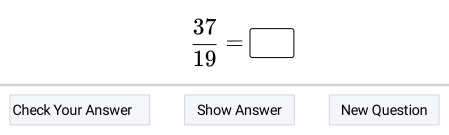
Convert the given decimal number into the corresponding fraction or the other way around — the given fraction into a decimal number. Round the decimal number to two decimal places, if needed.
Closure
Share
Report error
Advantages of Each Type of Numbers
In this lesson, three forms of numbers were discussed: fractions, mixed numbers, and decimal numbers.
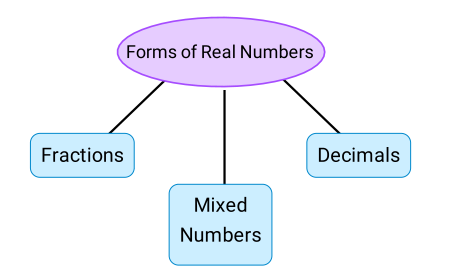
Each number form has their own advantages and disadvantages. Consider what those may be.
| Fractions | Mixed Numbers | Decimals | |
|---|---|---|---|
| Pros | Precise and accurate | Show the actual value of a number | Easy to use in calculations |
| Cons | More difficult to use in calculations | Very inconvenient in calculations | Sometimes, decimals are approximations of the exact value. |
Depending on the situation, some forms of numbers might be more useful than other. Here are some real-world examples.
- Two farmers want to sell a portion of their harvest to the other. One farmer says "Let's each sell 0.166666... of our harvests to each other!" The other farmer says "Hold up! That is such an inconvenient number. How about 16 of our harvests?" Now they agree.
- Imagine being told that a tree grew 134 feet last year. Now, imagine being told that same tree grew 3 14 feet last year. The second number form is more commonly used because it gives a clearer image of height.
- A local market writes the price of one kilogram of apples on one box as $4 1925 and on another box as $ 11925. Imagine trying to figure out how much cash to give at the register! It would be much easier to understand how to pay $4.76.
Mixed and Decimal Numbers
Exercises
Write each improper fraction as a mixed number.
{"type":"text","form":{"type":"math","options":{"comparison":"1","nofractofloat":false,"keypad":{"simple":true,"useShortLog":false,"variables":[],"constants":[]},"rendered":false},"text":" "},"formTextBefore":null,"formTextAfter":null,"answer":{"text":["2\\frac{4}{15}"]}}
{"type":"text","form":{"type":"math","options":{"comparison":"1","nofractofloat":false,"keypad":{"simple":true,"useShortLog":false,"variables":[],"constants":[]},"rendered":false},"text":" "},"formTextBefore":null,"formTextAfter":null,"answer":{"text":["3\\frac{27}{48}"]}}
security
report
code
security
report
code
We want to rewrite the given improper fraction as a mixed number. 34/15 Let's now recall what a mixed number is. It is a number that consists of an integer part and a fraction part.
When we rewrite an improper fraction, we use long division to divide its numerator by its denominator. This helps us to identify the integer and fraction parts of the corresponding mixed number. Then we use the quotient and the remainder to form the mixed number. In the case of 3415, we need to divide 34 by 15. Let's do it!
The quotient is 2 with a remainder of 4. Therefore, the integer part is 2, the numerator is 4 and the denominator is equal to the denominator of the improper fraction, 15. 34/15= 2 4 15
We will convert 17148 into a mixed number by dividing the numerator of 171 by the denominator by 48. Keep in mind that the quotient should be an integer number.
We got the quotient of 3 with the remainder of 27. This means that the integer part of the mixed number is 3 and the numerator of its fraction part is 27. The denominator of the improper fraction is 48, so the denominator of the fraction in the mixed number is also 48. 171/48= 3 27 48
security
report
code
Write each mixed number as an improper fraction.
{"type":"text","form":{"type":"math","options":{"comparison":"1","nofractofloat":false,"keypad":{"simple":true,"useShortLog":false,"variables":[],"constants":[]},"rendered":false},"text":" "},"formTextBefore":null,"formTextAfter":null,"answer":{"text":["\\dfrac{148}{5}"]}}
{"type":"text","form":{"type":"math","options":{"comparison":"1","nofractofloat":false,"keypad":{"simple":true,"useShortLog":false,"variables":[],"constants":[]},"rendered":false},"text":" "},"formTextBefore":null,"formTextAfter":null,"answer":{"text":["\\dfrac{216}{15}","\\dfrac{72}{5}"]}}
security
report
code
security
report
code
We can write a mixed number as an improper fraction by following some steps.
- Multiply the integer part by the denominator of the fraction part.
- Add the product with the numerator of the fraction part.
- Keep the denominator of the fraction part.
We can formulate these steps as follows. a b c=a* c+ b/c Let's substitute the values from the mixed number 29 3 5 and find the corresponding fraction.
Therefore, the mixed number corresponds to 1485.
In a similar fashion, we can convert the mixed number 14 615 into an improper fraction. We will use the same formula one more time. a b c=a c+ b/c We need to substitute the values a= 14, b= 6, and c= 15. Then, we can simplify the numerator of the improper fraction if possible.
Therefore, the mixed number corresponds to 21615. Let's check if this fraction can be simplified by splitting 216 and 15 into prime factors. 216 &=2 * 2 * 2 * 3 * 3 * 3 15 &= 3* 5 The numbers share a common factor of 3. This is their Greatest Common Factor (GCF). Divide the numerator and the denominator by 3.
The fraction simplifies to 725.
security
report
code
{"type":"text","form":{"type":"math","options":{"comparison":"1","nofractofloat":false,"keypad":{"simple":true,"useShortLog":false,"variables":[],"constants":[]},"rendered":false},"text":" "},"formTextBefore":null,"formTextAfter":null,"answer":{"text":["0.4"]}}
{"type":"text","form":{"type":"math","options":{"comparison":"1","nofractofloat":false,"keypad":{"simple":true,"useShortLog":false,"variables":[],"constants":[]},"rendered":false},"text":" "},"formTextBefore":"\u2248","formTextAfter":null,"answer":{"text":["1.59"]}}
security
report
code
security
report
code
We want to write the fraction as a decimal. Fraction & → & Decimal 48/120 & = & ? We will do this by dividing the numerator by the denominator. In this case, the numerator is 48 and the denominator is 120. Let's use the long division of two numbers.
The quotient is 0.4. Since this is the exact result, we do not need to round. Therefore, 48120 corresponds to the decimal of 0.4. Fraction & & Decimal 48/120 & = & 0.4
Let's rewrite the fraction 6239 as a decimal by dividing the numerator by the denominator. Fraction & → & Decimal 62/39 & ≈ & ? In this case, the numerator is 62 and the denominator is 39. We will divide using the long division up to three decimals. We need to find up to three decimal places because the digit in the thousandth place will determine whether we round up or down.
The quotient is approximately 1.589. The digit in the thousandths place is 9. Since this digit is greater than 5, we increase the digit in the hundredths place by one. We also remove the digits to the right of it. This means that 1.589 is about 1.59. We can conclude that 6239 is about 1.59. Fraction & → & Decimal 62/39 & ≈ & 1.59
security
report
code
Write each decimal as a fraction in its simplest form.
{"type":"text","form":{"type":"math","options":{"comparison":"1","nofractofloat":false,"keypad":{"simple":true,"useShortLog":false,"variables":[],"constants":[]},"rendered":false},"text":" "},"formTextBefore":null,"formTextAfter":null,"answer":{"text":["\\dfrac{47}{100}"]}}
{"type":"text","form":{"type":"math","options":{"comparison":"1","nofractofloat":false,"keypad":{"simple":true,"useShortLog":false,"variables":[],"constants":[]},"rendered":false},"text":" "},"formTextBefore":null,"formTextAfter":null,"answer":{"text":["\\dfrac{641}{250}"]}}
security
report
code
security
report
code
We read the given decimal as 47 hundredths
because the rightmost digit 7 is in the hundredths place. We can also observe that it has two decimal places.
0 . 4 7_(^(two decimal)_(0.23cmplaces))
This means that we can write it as a fraction with the numerator of 47 and the denominator of 100. Notice that it is 10 to the power of two.
0. 47=47/100
Since 47 is a prime number, the fraction cannot be simplified.
The decimal 2.564 has three decimal places. 2 . 5 6 4_(^(three decimal)_(0.23cmplaces)) This means that we can write it as a fraction with the numerator of 2564 and the denominator of 1000. This number is 10 to the power of three. 2.564=2564/1000 In the next step, we will simplify the fraction. First, let's split the numerator and the denominator into prime factors. 2564&= 2* 2* 641 1000&= 2* 2* 2* 5* 5* 5 The numbers share two common factors. The product of these factors is the greatest common factor of 2564 and 1000. GCF(2564,1000)=2* 2=4 Finally, we divide both the numerator and the denominator of the fraction by 4 to simplify it.
Therefore, the decimal of 2.564 corresponds to the fraction of 641250.
security
report
code
Mixed and Decimal Numbers
Recommended exercises
To get personalized recommended exercises, please login first.
Loading content
≤
>
■2
■▢
e▢
7
8
9
×
÷■1
=
=
√▢
▢√
∫▢▢
4
5
6
+
−
≤
<
log
ln
log▢
1
2
3
()
∣
sin
cos
tan
0
.
π
x
y
Loading content