Properties of Pyramids

Rule

Surface Area of a Pyramid

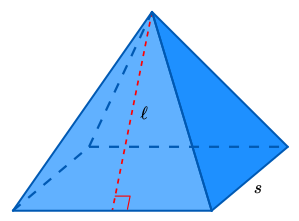
Consider a regular pyramid with an edge length s and a slant height l.

The surface area SA of a regular pyramid can be calculated using the following formula.

SA= 1/2pl + B

In this formula, p is the perimeter of the base, B is the base area, and l is the slant height. In the case that the pyramid is not regular, the area of each lateral face has to be calculated one by one and then added to the area of the base.

Proof

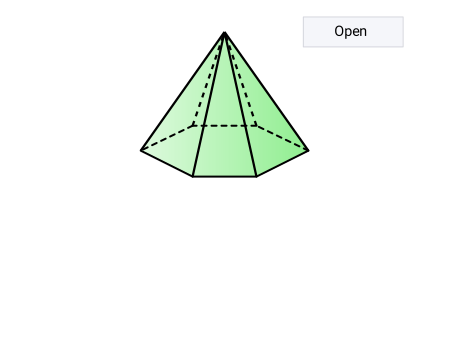
A regular pyramid's surface area can be seen as two separate parts: the lateral area and the base. Surface Area = Lateral Area+ Base Since for a regular pyramid, its base can be any n-sided regular polygon, the lateral area is the sum of the area of n congruent triangles. For example, consider a regular hexagonal pyramid with an edge length s and a slant height l. Take a look at its net.

Net of a pyramid

As can be seen, the area of each lateral face is 12sl. Therefore, the total lateral area will be 6 times 12sl, because there are 6 congruent lateral faces. Lateral Area [0.8em] 6( 1/2sl ) = 1/2 ( 6s)l Notice that 6s is the perimeter of the base, which can be denoted by p. Then, the lateral area can be expressed as follows. Lateral Area= 1/2 pl Therefore, the formula for the surface area is obtained.

ccccc Surface Area & = & Lateral Area & + & Base [0.8em] SA & =& 1/2pl & + & B

Exercises
Edit Lesson