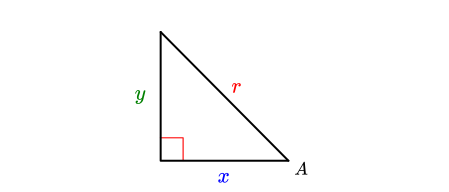
a Follow the instructions you are given in the book.
B
b Recall the definitions of the sine and the cosine of an angle.
C
c What can you say about the sum of the squared cosine and the squared sine looking at the table?
D
d Rewrite your conjecture from the previous part using algebraic expressions.
E
e Substitute appropriate ratios for the sine and cosine, and then simplify.
A
a See solution.
B
b See solution.
C
c In a right triangle the sum of the squared cosine and the squared sine of an acute angle is equal to 1.
D
d (cos X)^2+(sin X)^2=1
E
e See solution.
Practice makes perfect
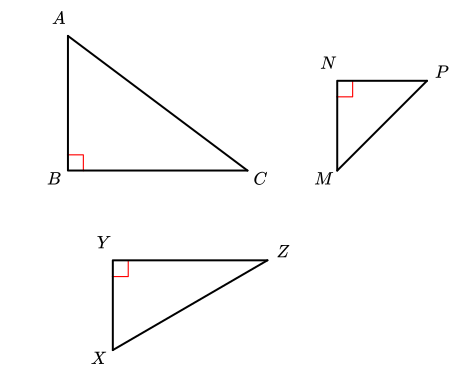
a We are asked to draw three right triangles that are not similar to each other. We will label them ABC, MNP and XYZ, with the right angles located at vertices B,N and Y, respectively.
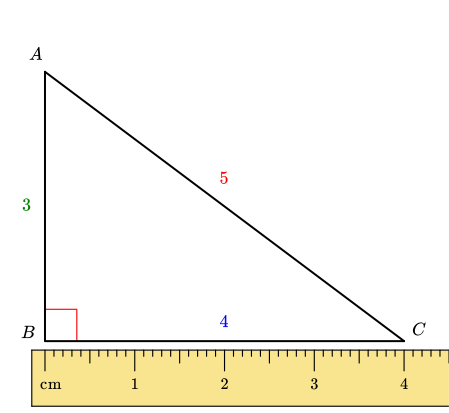
Next, we will measure and label each side of the three triangles. Let's start with △ ABC.
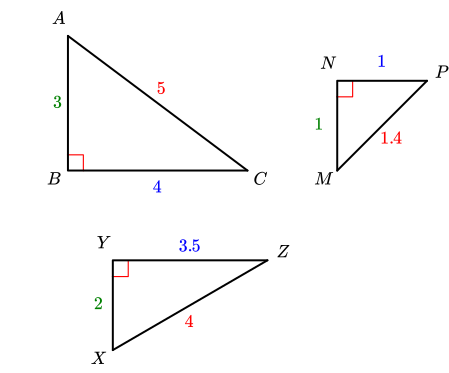
We will measure the rest of the sides in the same way.
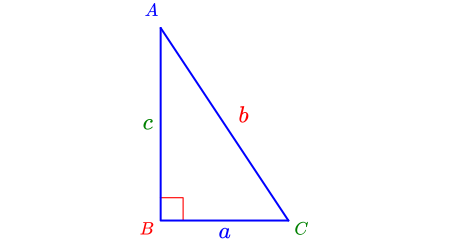
b Now we will evaluate the trigonometric ratios for both acute angles in each of our drawn triangles. To do this, let's recall the definitions of the sine and the cosine of an angle. We will use a random right triangle ABC.
If △ ABC is a right triangle with acute ∠ A, then we can define the sine and the cosine of ∠ A as follows.
Trigonometric Ratio
Words
Symbols
Sine
The sine of ∠ A is the ratio of the length of the leg opposite ∠ A to the length of the hypotenuse.
sin A=a/b
Cosine
The cosine of ∠ A is the ratio of the length of the leg adjacent to ∠ A to the length of the hypotenuse.
cos A=c/b
Using these definitions, we can complete the given table. We will evaluate each trigonometric ratio by substituting appropriate side lengths.
Triangle
Trigonometric Ratios
Sum of Ratios Squared
ABC
cos A
3/5=0.6
sin A
4/5=0.8
(cos A)^2+(sin A)^2
(0.6)^2+(0.8)^2=1
cos C
4/5=0.8
sin C
3/5=0.6
(cos C)^2+(sin C)^2
(0.8)^2+(0.6)^2=1
MNP
cos M
1/1.4≈0.7
sin M
1/1.4≈0.7
(cos M)^2+(sin M)^2
(0.7)^2+(0.7)^2≈ 1
cos P
1/1.4≈0.7
sin P
1/1.4≈0.7
(cos P)^2+(sin P)^2
(0.7)^2+(0.7)^2≈ 1
XYZ
cos X
2/4=0.5
sin X
3.5/4≈0.88
(cos X)^2+(sin X)^2
(0.5)^2+(0.88)^2≈1
cos Z
3.5/4≈0.88
sin Z
2/4=0.5
(cos Z)^2+(sin Z)^2
(0.88)^2+(0.5)^2≈1
c Looking at the table we made in the previous part, we can see that the sum of ratios squared is approximately 1 in each case. Therefore, we can assume that in a right triangle the sum of the squared cosine and the squared sine of an acute angle is equal to 1.
d Now we will express our conjecture using algebraic expressions.
The sum of thesquaredcosineand thesquaredsineof an acute angle X
is equal to 1.
(cos X)^2+(sin X)^2= 1
e In this part we are given a right triangle and asked to show that our conjecture is valid for ∠ A.
First let's rewrite sin A and cos A using trigonometric ratios. Recall that the sine is a ratio of the opposite leg to the hypotenuse and the cosine is a ratio of the adjacent leg to the hypotenuse.
(cos A)^2+(sin A)^2? =1
⇓
(x/r)^2+(y/r)^2? =1
Next let's simplify the left hand side to determine if the equation is satisfied.
From the Pythagorean Theorem, we know that the sum of squared legs of a right triangle is equal to its squared hypotenuse. Therefore, the sum of x^2 and y^2 is equal to r^2.