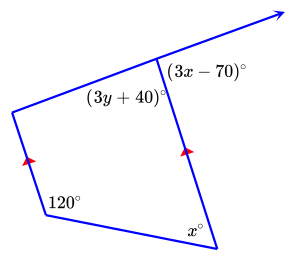
Find the relationships between the angles and use corresponding theorems and postulates.
x=60 by the Consecutive Interior Angles Theorem
y=10 by the Supplement Theorem
Practice makes perfect
Consider the diagram below. In order to find the values of the variables, we need to find the relationships between the angles and use the corresponding theorems and postulates.
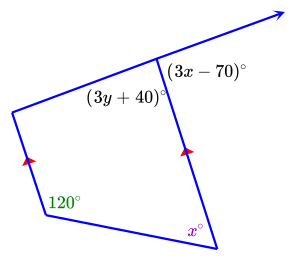
Recall that, by the Consecutive Interior Angles Theorem, the consecutive interior angles formed by parallel lines and a transversal are supplementary. Therefore, these angles are supplementary and the sum of their measures is 180.
x+ 120=180 ⇕ x=60
The value of x is 60 by the Consecutive Interior Angles Theorem.
Value of y
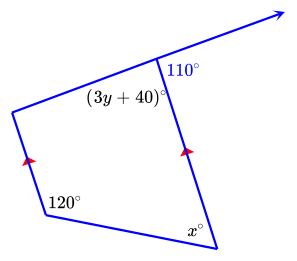
Before we find the value of y, we can use that x=60 to have fewer unknown angle measures. Let's calculate the measure of (3x-70).
The measure of this angle is 110^(∘). Let's mark this value on the diagram.
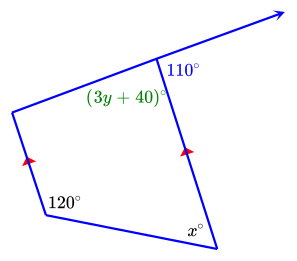
Now we can see that the angles that measure 3y+40 and 110 are supplementary angles.
Let's recall that, by the Supplement Theorem, the sum of the measures of the supplementary angles is 180.
(3y+40)+ 110=180
Now let's solve the equation for y.