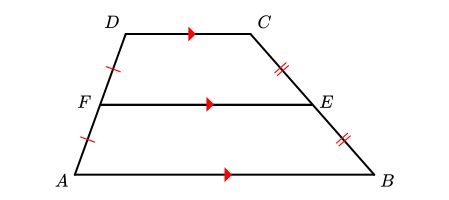
The midsegment of a trapezoid is parallel to each base, and its measure is half the sum of the lengths of the bases.
The following relation holds true for midsegment FE.
FE∥AB∥DC and FE=21(AB+CD)
Proof
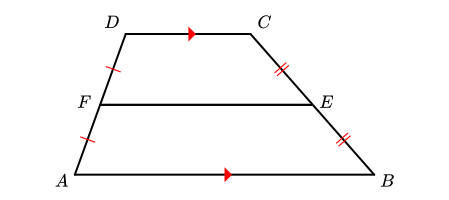
Let ABCD be a trapezoid and FE be its midsegment. By definition, the midsegment of a trapezoid connects the midpoints of the nonparallel sides.
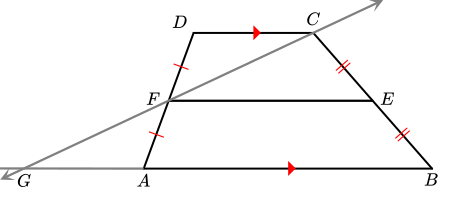
Next, draw the line connecting the points C and F, then extend the base AB such that it intersects with CF. Let G be the point of intersection between these two lines.
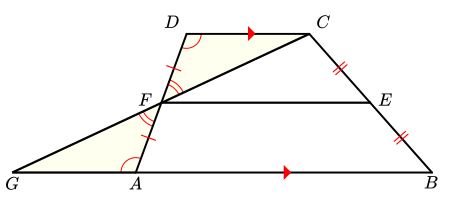
Triangles GAF and CDF have two pairs of congruent angles and a pair of included congruent sides. Therefore, by the ASA Congruence Theorem, it is concluded that △GAF≅△CDF. Since corresponding parts of congruent figures are congruent, then GA≅CD and FG≅FC.
△GAF≅△CDF↙↘GA≅CDFG≅FC
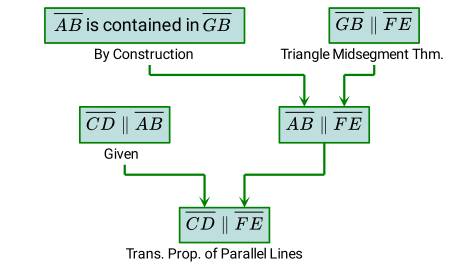
Since FG and FC are congruent, it can be stated that F is the midpoint of CG, and it is given that E is the midpoint of CB. Consequently, FE is a midsegment of △GBC. Therefore, by the Triangle Midsegment Theorem, FE and GB are parallel and FE is half GB.
FE∥GBandFE=21GB
Using the fact that FE and GB are parallel, the first part of the theorem can be obtained.