Sign In
An error ocurred, try again later!
Parallelogram Opposite Sides Theorem
Slide 1 of 0
Rule
Parallelogram Opposite Sides Theorem
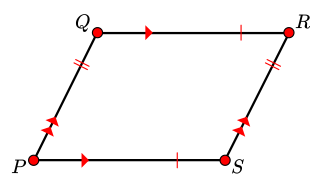
In respects to the characteristics of the diagram, the following statement holds true.
PQ≅SR and QR≅PS
Two proofs will be provided for this theorem.
Proof
Using CoordinatesThis theorem can be proven by placing the parallelogram on a coordinate plane. For simplicity, vertex P will be placed at the origin and vertex S on the x-axis.
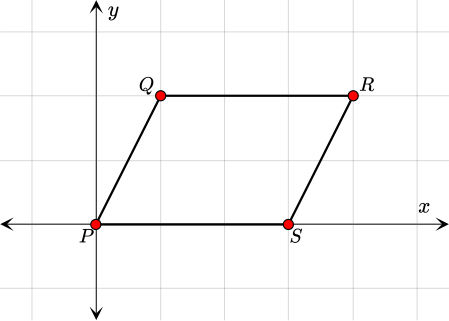
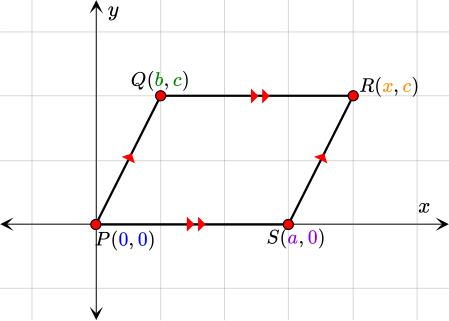
Since P lies on the origin, its coordinates are (0,0). Point S is on the x-axis, meaning its y-coordinate is 0. Let a be the x-coordinate of S. Furthermore, let b and c be the coordinates of Q. P(0,0) Q(b,c) S(a,0) Note that both P and S lie on the x-axis. Therefore, SP is a horizontal segment. Since opposite sides of a parallelogram are parallel, QR is also a horizontal segment. This means that Q and R have the same y-coordinate. Let x be the x-coordinate of R.
| m = y_2-y_1/x_2-x_1 | |||
|---|---|---|---|
| Side | Endpoints | Substitute | Simplify |
| PQ | P( 0, 0) and Q( b, c) | m_(PQ)=c- 0/b- 0 | m_(PQ)=c/b |
| SR | S( a, 0) and R( x, c) | m_(SR)=c- 0/x- a | m_(SR)=c/x-a |
c/b=c/x-a
▼
Solve for x
MultEqn
LHS * b=RHS* b
c=c/x-a(b)
MoveRightFacToNum
a/c* b = a* b/c
c=c(b)/x-a
MultEqn
LHS * (x-a)=RHS* (x-a)
c(x-a)=c(b)
DivEqn
.LHS /c.=.RHS /c.
x-a=b
AddEqn
LHS+a=RHS+a
x=b+a
CommutativePropAdd
Commutative Property of Addition
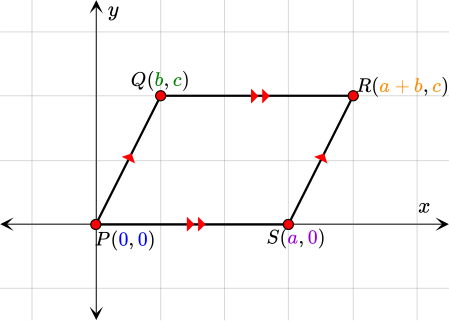
x=a+b
d = sqrt((x_2-x_1)^2 + (y_2-y_1)^2)
SubstituteValues
Substitute values
PQ=sqrt(( b- 0)^2+( c- 0)^2)
SubTerms
Subtract terms
PQ=sqrt(b^2+c^2)
| d = sqrt((x_2-x_1)^2 + (y_2-y_1)^2) | |||
|---|---|---|---|
| Side | Endpoints | Substitute | Simplify |
| PQ | P( 0, 0) and Q( b, c) | PQ= sqrt(( b- 0)^2+( c- 0)^2) | PQ=sqrt(b^2+c^2) |
| QR | Q( b, c) and R( a+b, c) | QR= sqrt(( a+b- b)^2+( c- c)^2) | QR=a |
| SR | S( a, 0) and R( a+b, c) | SR= sqrt(( a+b- a)^2+( c- 0)^2) | SR=sqrt(b^2+c^2) |
| PS | P( 0, 0) and S( a, 0) | PS= sqrt(( a- 0)^2+( 0- 0)^2) | PS=a |
By the Transitive Property of Equality, it can be said that PQ=SR and that QR=PS. cc PQ=sqrt(b^2+c^2) SR=sqrt(b^2+c^2) & QR=a PS=a ⇓ & ⇓ PQ=SR & QR=PS By definition of congruent segments, it can be stated that the opposite sides of a parallelogram are congruent.
PQ≅SR and QR≅PS
Proof
Using Congruent TrianglesThis theorem can also be proven by using congruent triangles. Consider the parallelogram PQRS and its diagonal PR.
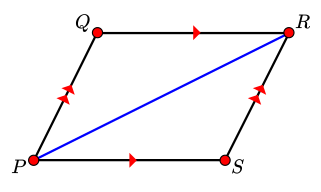
It can be noted that two triangles are formed with PR as a common side. △ PQR and △ RSP By the definition of a parallelogram, PQ and SR are parallel. Therefore, by the Alternate Interior Angles Theorem, it can be stated that ∠ QPR ≅ ∠ SRP and that ∠ QRP ≅ ∠ SPR. Furthermore, by the Reflexive Property of Congruence, PR is congruent to itself.
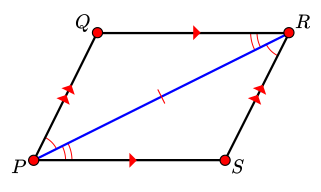
Consequently, △ PQR and △ RSP have two pairs of congruent angles and an included congruent side. ∠ QPR &≅ ∠ SRP PR&≅PR ∠ QRP &≅ ∠ SPR Therefore, by the Angle-Side-Angle Congruence Theorem, △ PQR and △ RSP are congruent triangles. △ PQR ≅ △ RSP Since corresponding parts of congruent figures are congruent, PS is congruent to QR and PQ is congruent to RS.
PQ≅SR and QR≅PS
Exercises
Recommended exercises
To get personalized recommended exercises, please login first.
Loading content
Loading content