7. Financial Literacy
Sign In
An error ocurred, try again later!
Chapter 5
7.
Financial Literacy
This lesson offers an in-depth look at financial literacy, specifically honing in on the concepts of simple interest and sales tax. Simple interest is the extra money you either earn from savings or owe when you borrow. Understanding this can help you make smarter decisions about loans or investments. Sales tax, on the other hand, is the additional cost you pay when purchasing goods. Being savvy about sales tax can help you budget more effectively. For example, knowing the sales tax rate can help you anticipate the final price of a product, avoiding surprises at the checkout. These concepts are not just theoretical; they have real-world applications that can affect your financial health.
Show less Show more expand_more 


Lesson Settings & Tools
| | 9 Theory slides |
| | 9 Exercises - Grade E - A |
| | Each lesson is meant to take 1-2 classroom sessions |
Financial Literacy
Slide of 9
This lesson focuses on the several ways to manage money and explores some related concepts. Concepts such as sales tax, markup, discount, markdown, principal, and simple interest will be introduced through examples. By the end of the lesson, a general understanding of these concepts and confidence in managing financial matters will be increased.
Catch-Up and Review
Here are a few recommended readings before getting started with this lesson.
Challenge
Share
Report error
Leaving a Tip
Vincenzo went out for dinner together with his family. The total cost of the meal was $124. Because they really enjoyed the food and the service, they left a 20 % tip.
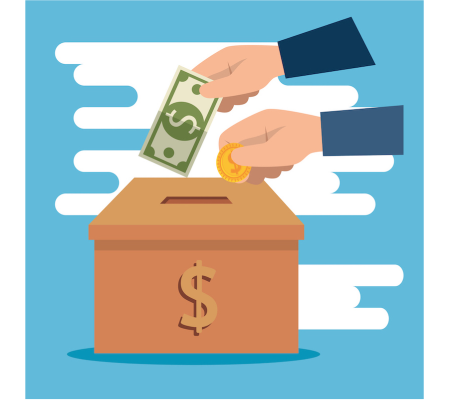
External credits: studiogstock
How much tip did they leave?
{"type":"text","form":{"type":"math","options":{"comparison":"1","nofractofloat":false,"keypad":{"simple":true,"useShortLog":false,"variables":["x"],"constants":["PI"]},"rendered":false},"text":" "},"formTextBefore":"$","formTextAfter":null,"answer":{"text":["24.80"]}}
Discussion
Share
Report error
Interest
Interest is the cost of borrowing money from a bank or additional money earned from keeping money in a bank account. There are several types of interest, but only simple interest will be introduced in this lesson.
Concept
Share
Report error
Simple Interest
The interest that is applied only to an initial amount of money is called simple interest. The initial amount is known as the principal. Simple interest is calculated as a product of principal, annual interest rate, and the time in years.
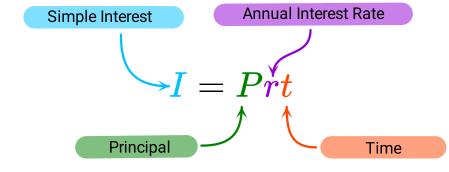
An interest rate is a percent used to calculate the interest on the principal. It may be easier to write it in decimal form to make the calculations easier. For instance, assume that a savings account earns 3% simple interest per year on a deposit of $1000. 1000 * 0.03* 1= $ 30 This means that the simple interest earned on $1000 in one year is $30. The final amount of money in the account is called the balance. The following table shows the balance over five years of an account that earns 3 % simple interest each year.
| Years | Amount of Simple Interest | Balance |
|---|---|---|
| 1 | 1000 * 0.03* 1=$ 30 | 1000+30=$ 1030 |
| 2 | 1000 * 0.03* 2=$ 60 | 1000+60=$ 1060 |
| 3 | 1000 * 0.03* 3=$ 90 | 1000+90=$ 1090 |
| 4 | 1000 * 0.03* 4=$ 120 | 1000+120=$ 1120 |
| 5 | 1000 * 0.03* 5=$ 150 | 1000+150=$ 1150 |
Example
Share
Report error
Calculating the Amount of Interest
Vincenzo is a very thrifty child and saves some of his allowance every month. His father thinks that opening a savings account for Vincenzo's savings would be great for him. He wants to support Vincenzo and plans to deposit $5000 in this account as principal.

After talking with several bankers, he notices that banks offer different interest rates.
a If the bank offers 4 % simple interest per year, what will be the balance after 10 years?
{"type":"text","form":{"type":"math","options":{"comparison":"1","nofractofloat":false,"keypad":{"simple":true,"useShortLog":false,"variables":["x"],"constants":["PI"]},"rendered":false},"text":" "},"formTextBefore":"$","formTextAfter":null,"answer":{"text":["7000"]}}
b If an account earns $100 in 4 years, what is the annual interest rate that the bank offers?
{"type":"text","form":{"type":"math","options":{"comparison":"1","nofractofloat":false,"keypad":{"simple":true,"useShortLog":false,"variables":["x"],"constants":["PI"]},"rendered":false},"text":" "},"formTextBefore":null,"formTextAfter":"%","answer":{"text":["0.5"]}}
Hint
a Use the simple interest formula.
b Substitute the given values into the simple interest formula and solve the equation for r.
Solution
a Notice that the balance is the final amount of money in the account after adding the interest. The amount of principal is $5000 and the bank offers 4 % simple interest for this amount. Using this information, the interest for Vincenzo's savings account can be calculated. Recall the simple interest formula to find the amount of interest.
I=Prt
SubstituteValues
Substitute values
I= 5000 * 4 % * 10
WriteDec
Write as a decimal
I=5000 * 0.04 * 10
Multiply
Multiply
I=2000
b This time the amount of interest earned in 4 years is given. Since the values of principal, time, and the amount of interest are known, the formula for simple interest can be applied again.
I=Prt
SubstituteValues
Substitute values
100= 5000 * r * 4
▼
Solve for r
Multiply
Multiply
100=20 000r
DivEqn
.LHS /20 000.=.RHS /20 000.
100/20 000=r
ReduceFrac
a/b=.a /100./.b /100.
1/200=r
WriteDec
Write as a decimal
0.005 =r
WritePercent
Convert to percent
0.5 %=r
RearrangeEqn
Rearrange equation
r=0.5 %
Example
Share
Report error
Who is Correct?
Vincenzo goes to Miami, Florida, to visit his aunt and uncle. The city's sales tax rate is 7 %. Vincenzo wants to buy a new coat. The price of the coat before tax is $120. Vincenzo says that the total cost can be calculated by finding 7 % of $120 and adding this value to $120.

{"type":"choice","form":{"alts":["Vincenzo","The salesperson","Both of them","Neither of them"],"noSort":true},"formTextBefore":"","formTextAfter":"","answer":2}
Hint
Calculate the total cost using the methods described by Vincenzo and the salesperson. Use the percent equation to calculate the amount of the tax.
Solution
It is given that the sales tax rate in Miami is 7 %. This means that to purchase an item, an additional 7 % of its original price must be paid as sales and use tax. Selling Price=Original Price + Tax Calculate the tax for a $120 coat in two ways to determine who is correct, Vincenzo or the salesperson.
Vincenzo's Way
Vincenzo prefers to calculate the total cost in two steps, by finding 7 % of $120 and then adding this amount to the original price of the coat. Recall that a percent of a number can be calculated as a product of the percent and that number. The percent equation can be helpful to do that. a= p % * w In this equation, a represents the amount of tax, p is the percent, and w is the original price of the item. Substitute the values into the percent equation and calculate 7 % of $120. Remember to write the percent as a decimal number.a=p % * w
SubstituteII
p= 7, w= 120
a= 7 % * 120
PercentToFrac
a %=a/100
a=7/100 * 120
MoveRightFacToNum
a/c* b = a* b/c
a=840/100
CalcQuot
Calculate quotient
a=8.40
The salesperson's Way
The salesperson calculates the total cost by multiplying $120 by 1.07. Check the result to see if it is the same as Vincenzo's solution.120 * 1.07
WriteSum
Write as a sum
120 * (1+0.07)
Distr
Distribute 120
120* 1 + 120 * 0.07
Multiply
Multiply
120+8.40
AddTerms
Add terms
128.40
Conclusion
Notice that both methods gave the same result. This is because multiplying 120 by 7 %, or 7100, and adding the result to 120 is the same as multiplying 120 by 1.07. 120 * 7/100 + 120 ⇔ 120 * (1.07) Both of the ways are correct and give the same total cost. This means that both Vincenzo and the salesperson are correct.
Example
Share
Report error
Calculating the Markup and Markdown
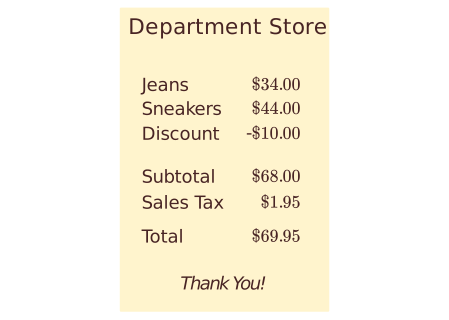
Vincenzo visits several more shopping centers in Miami. He buys a pair of sneakers and some jeans at a department store. Below is his receipt.
{"type":"text","form":{"type":"math","options":{"comparison":"1","nofractofloat":false,"keypad":{"simple":true,"useShortLog":false,"variables":["x"],"constants":["PI"]},"rendered":false},"text":" "},"formTextBefore":"About","formTextAfter":"%","answer":{"text":["29"]}}
b A few days later, Vincenzo saw the same shoes on an online shopping platform. He noticed that the price in-store had a 20 % markup compared to the price online. What is the price of the sneakers online? Round the answer to two decimal places.
{"type":"text","form":{"type":"math","options":{"comparison":"1","nofractofloat":false,"keypad":{"simple":true,"useShortLog":false,"variables":["x"],"constants":["PI"]},"rendered":false},"text":" "},"formTextBefore":"About $","formTextAfter":null,"answer":{"text":["36.67"]}}
Hint
a Discount or markdown refer to a reduction in the price of an item.
b Markup refers here to the difference between the price in-store and the price online.
Solution
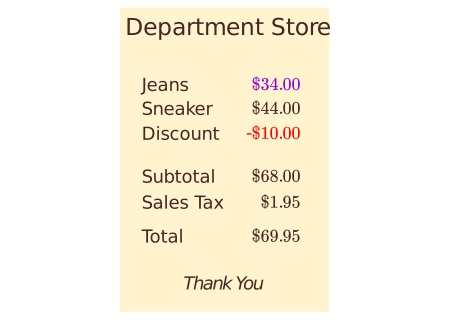
a Vincenzo received a $10 discount on the jeans, but the percent of that discount is unknown. Start by examining the receipt to find this amount as a percent.
a=p % * w
SubstituteII
a= 10.00, w= 34.00
10.00= p %* 34.00
▼
Solve for p
RearrangeEqn
Rearrange equation
p % * 34.00 =10.00
DivEqn
.LHS /34.00.=.RHS /34.00.
p % =10.00/34.00
UseCalc
Use a calculator
p % =0.294117 ...
WritePercent
Convert to percent
p % =29.4117 ... %
RoundInt
Round to nearest integer
p %≈ 29 %
b Vincenzo noticed that the price of the sneakers in store includes a 20 % markup compared to the price online. To find the price online, start by adding 20 % to 100 %.
a=p % * w
SubstituteII
a= 44.00, p % = 120 %
44.00= 120 %* w
▼
Solve for w
PercentToFrac
a %=a/100
44.00=120/100* w
MoveRightFacToNum
a/c* b = a* b/c
44.00=120w/100
MultEqn
LHS * 100=RHS* 100
4400=120w
DivEqn
.LHS /120.=.RHS /120.
4400/120=w
CalcQuot
Calculate quotient
36.666666 ... =w
RoundDec
Round to 2 decimal place(s)
36.67 ≈ w
RearrangeEqn
Rearrange equation
w ≈ 36.67
Example
Share
Report error
Calculating a Bonus
Vincenzo's aunt signed an agreement when she joined a company two years ago. If she is still working with the company after two years, she will receive a bonus equivalent to 8 % of the contract's total value.

{"type":"text","form":{"type":"math","options":{"comparison":"1","nofractofloat":false,"keypad":{"simple":true,"useShortLog":false,"variables":["x"],"constants":["PI"]},"rendered":false},"text":" "},"formTextBefore":"$","formTextAfter":null,"answer":{"text":["2304"]}}
Hint
Calculate the total amount of money that she earns in twenty-four months, then calculate 8 % of that amount.
Solution
Start by calculating the total value of the contract. Since Vincenzo's aunt earns $1200 per month, multiply this amount by 24 to find the total amount of money that she earns in two years.
1200 * 24 = 28 800
She earns 28 800 dollars in two years. Per her contract, 8 % of this amount will be given as a bonus. The percent equation can be used to calculate 8 % of 28 800.
a= p % * w
Recall that the part a is equal to the product of the percent p and the whole w. Substitute p %= 8 % and w= 28 800 into the percent equation to find the value of a.
Vincenzo's aunt will get $2304 as a bonus after working for the company for two years.
a=p % * w
SubstituteII
p= 8, w= 28 800
a= 8 % * 28 800
PercentToFrac
a %=a/100
a=8/100* 28 800
MoveRightFacToNum
a/c* b = a* b/c
a=8* 28 800/100
SplitIntoFactors
Split into factors
a=8* 288 * 100/100
CancelCommonFac
Cancel out common factors
a=8* 288 * 100/100
SimpQuot
Simplify quotient
a=8* 288
Multiply
Multiply
a=2304
Example
Share
Report error
Paying Back a Loan
Vincenzo's uncle borrows $2400 to repair his car. He will pay off the loan over 4 years by paying back the principal plus 3.5 % simple interest for each year.

a Help Vincenzo's uncle calculate how much money he will pay in interest.
{"type":"text","form":{"type":"math","options":{"comparison":"1","nofractofloat":false,"keypad":{"simple":true,"useShortLog":false,"variables":["x"],"constants":["PI"]},"rendered":false},"text":" "},"formTextBefore":"$","formTextAfter":null,"answer":{"text":["336"]}}
b How much will he pay back altogether?
{"type":"text","form":{"type":"math","options":{"comparison":"1","nofractofloat":false,"keypad":{"simple":true,"useShortLog":false,"variables":["x"],"constants":["PI"]},"rendered":false},"text":" "},"formTextBefore":"$","formTextAfter":null,"answer":{"text":["2736"]}}
Hint
a Start by using the percent equation to find the amount of interest Vincenzo's uncle will pay over one year.
b Add the amount of the loan to the total amount of interest found in Part A.
Solution
a Remember that simple interest represents a proportional relationship between the annual interest and the principal, or initial amount, of a certain amount of money. The ratio of annual interest to the principal is the interest rate.
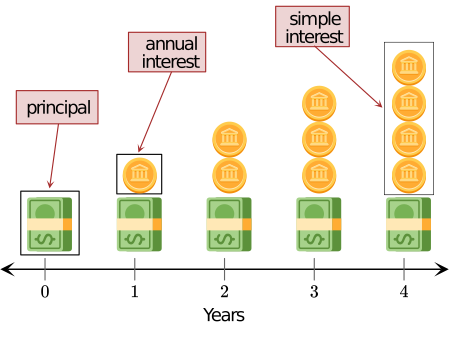
b To find out how much Vincenzo's uncle will pay in total when repaying the loan, add the principal to the total amount of interest. Remember that it was found in Part A that Vincenzo's uncle will pay $336 in total in interest over the four years of the loan.
$ 2400 + $ 336= $ 2736 This means that he will pay $ 2736 altogether when repaying the loan.
Closure
Share
Report error
Calculating the Amount of Tip
The challenge presented at the beginning of the lesson was to find 20 % of $124 in order to find the amount to tip. As done in the previous examples, use the percent equation to calculate a percent of the whole.
a= p% * w
Note that the percent p is 20 % and the total cost of the meal represents the whole, which is $124. Now substitute these values into the percent equation.
a= 20 %* $124
Evaluate the right-hand side of the equation to find the value of a. Remember to rewrite the percent as a fraction.
They left a $24.80 tip.
a=20% * 124
PercentToFrac
a %=a/100
a=20/100 * 124
MoveRightFacToNum
a/c* b = a* b/c
a=20 * 124/100
Multiply
Multiply
a=2480/100
CalcQuot
Calculate quotient
a=24.80
Financial Literacy
Exercise 3.1
A trampoline that costs $340 is discounted 50 %. The next month the sale price is discounted an additional 50 %. Is the trampoline now free?
{"type":"choice","form":{"alts":["Yes","No"],"noSort":false},"formTextBefore":"","formTextAfter":"","answer":1}
security
report
code
security
report
code
We want to determine whether the trampoline is free after applying both discounts. We will do this by calculating the price of the trampoline after both discounts one at a time.
Price After the First Discount
Let's find the sale price of the trampoline after the first 50 % discount. First, we will subtract 50 % from 100 % to find the percent that represent the sale price as a percent of the original price. 100 % - 50 %= 50 % The sale price is 50 % of the original price. Let's use the percent equation, which tells us that the part of the whole a is the percent p multiplied by the whole w. Here, the sale price is the part a, the percent is 50, and the whole w is the original price, 340 dollars.
The sale price of the trampoline after the first discount is $170.
Price After the Second Discount
Now we will calculate the sale price of the trampoline after the second 50 % discount. Let's use the percent equation once again. In this equation, the final sale price is the part a, the percent is still 50, and the whole w is the price after the first discount, 170 dollars.
As we can see, the final sale price of the trampoline after the second discount is $85. This means that the trampoline is not free.
Since the prompt asks whether or not the selling price will be zero, we can determine the answer by writing the percent discounts as fractions. Remember that when expressed as a fraction, the whole is 1. The original cost of the trampoline represents 100 % of the price and is also the whole. A 50 % discount represents 12 of that price. rcl 100 % & ⇔ & 1 [0.8em] 50 % & ⇔ & 1/2 Now let's calculate the first discount as a fraction. 1-1/2=1/2 After the first discount, the trampoline will cost half as much as the original price. The store offers another 50 % discount, so the price is lowered again by 12. In other words, the discounted price will be discounted again by half. Let's calculate half of the half as a fraction. 1/2 * 1/2=1/4 As we can see, the final selling price is a quarter of the original price. This means that the trampoline will not be free.
security
report
code
Financial Literacy
Recommended exercises
To get personalized recommended exercises, please login first.
Loading content
≤
>
■2
■▢
e▢
7
8
9
×
÷■1
=
=
√▢
▢√
∫▢▢
4
5
6
+
−
≤
<
log
ln
log▢
1
2
3
()
∣
sin
cos
tan
0
.
π
x
y
Loading content