We want to solve the following system of equations by graphing.
x^2 + y^2 = 25 & (I) y = x + 1 & (II)
Looking at the given system, it seems that Equation (I) is the equation of a circle and Equation (II) is the equation of linear function. To solve the system by graphing, we have to draw both of them on the same coordinate grid. Let's start with the circle.
Graphing the Circle
Let's recall the standard equation of a circle.
(x- h)^2+(y- k)^2= r^2
Here, the center is the point ( h, k) and the radius is r. To match this form, we will need to rewrite Equation (I) so that it matches the above form. Note that subtracting 0 from a number does not change the value. For this reason, we can subtract 0 from x and y and the left-hand side of our equation will not change its value.
x^2 + y^2 &= 25 ⇕ & (x- 0)^2 + (y- 0)^2 &= 25
Now, note that 5^2 =25. Let's use this fact to write the right-hand side of our equation as a square of a number.
(x-0)^2 + (y-0)^2 &= 25 ⇕ & (x- 0)^2 + (y- 0)^2 &= 5^2
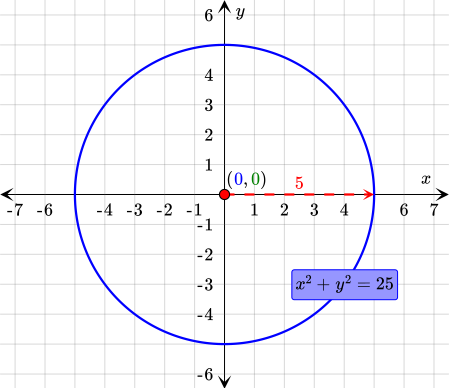
The center of the circle is the point ( 0, 0), and its radius is 5 units. Let's use these facts to draw our circle on a coordinate grid.
Graphing the Line
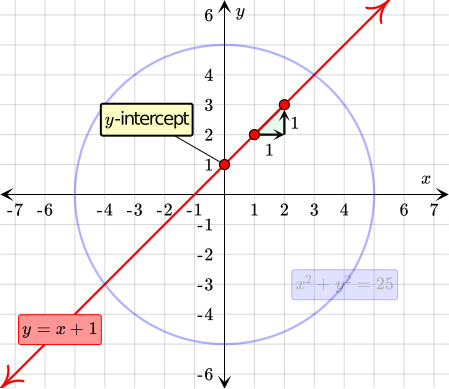
Let's now graph the linear function on the same coordinate plane. For a linear equation written in slope-intercept form, we can identify its slope m and y-intercept b.
y=x+1 ⇔ y=1x+ 1
The slope of the line is 1 and the y-intercept is 1.
Finding the Solutions
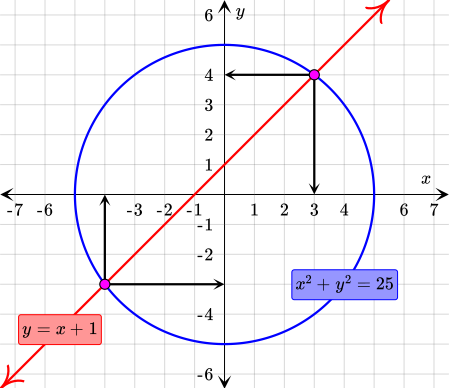
Finally, let's try to identify the coordinates of the points of intersection of the circle and the line.
It looks like the points of intersection occur at (-4, -3) and (4,3).
Checking the Answer
To check our answers, we will substitute the values of the points of intersection in both equations of the system. If they produce true statements, our solution is correct. Let's start with (- 4, -3).