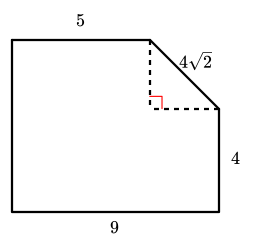
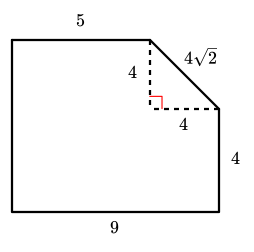
a To find the area of the figure, we will draw two additional segments creating a right triangle with 4sqrt(2) as the hypotenuse.
In all 45-45-90 triangles the hypotenuse is sqrt(2) times longer than the legs. From the diagram we see that the hypotenuse is a multiple of sqrt(2), which means this is, in fact, a 45-45-90 triangle with legs of 4.
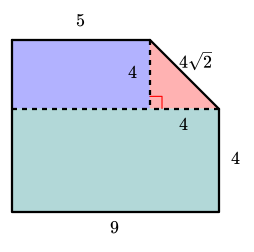
If we add one more segment, we have divided the shape into three shapes — one triangle and two rectangles.
To calculate the triangle's area we need its base and height, and to calculate the rectangles' area we need their width and length. From the diagram we see that we have all of these dimensions in all our shapes. Therefore, we can find the original shapes area by adding these products.
(4)(5)+ 1/2(4)(4)+(4)(9)=64 units^2
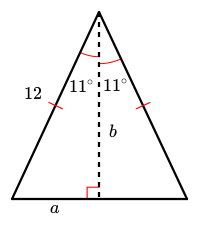
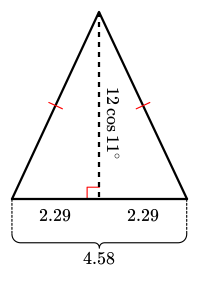
b Examining the diagram, we notice that this is an isosceles triangle. We know this because two sides have the same number of hatch marks. Therefore, if we draw the height from the vertex angle, b, we get two congruent right triangles. Also, note that the height bisects the vertex angle.
Using the cosine ratio, we can determine the height, b.
Knowing a, we only have half of the triangle's base. Therefore, by multiplying the value of a by 2 we obtain the base of the triangle.
Now we have enough information to calculate the area of the triangle.
A=1/2(4.58)(12cos 11^(∘))≈ 26.98 units^2
c Examining the diagram, we see that the triangle is a right triangle. To determine the area of a right triangle, we need to know both of its legs. Since we know the hypotenuse and a leg, we can find the second leg by using the Pythagorean Theorem.