6. Constructing and Interpreting Two-Way Frequency Tables
Sign In
An error ocurred, try again later!
Chapter 6
6.
Constructing and Interpreting Two-Way Frequency Tables
Two way frequency tables are valuable tools in the field of statistics, allowing us to examine the relationship between two categorical variables. These tables not only display counts or frequencies but also highlight patterns and relationships when comparing data sets. The concept of conditional relative frequency emerges from this, helping to determine the proportion or percentage of a particular outcome given a specific condition. By using these tools, professionals and researchers can make informed decisions, predict outcomes, and derive meaningful insights from vast amounts of data.
Show less Show more expand_more 


Lesson Settings & Tools
| | 12 Theory slides |
| | 7 Exercises - Grade E - A |
| | Each lesson is meant to take 1-2 classroom sessions |
Constructing and Interpreting Two-Way Frequency Tables
Slide of 12
In probability, tables are used to display a data set. For example, frequency tables show how often an outcome appears in a category. To represent a data set that includes two categories, another type of table is needed. This lesson will discuss how to create and interpret these tables.
Catch-Up and Review
Here are a few recommended readings before getting started with this lesson.
Challenge
Share
Report error
Chocolate Bar or Fruit?
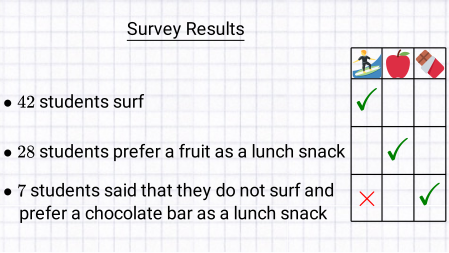
Zosia attends North High School in Honolulu. She asked 50 students whether they prefer a chocolate bar or a piece of fruit as a lunchtime snack and whether or not they surf. She obtained the following information.
{"type":"text","form":{"type":"math","options":{"comparison":"1","nofractofloat":false,"keypad":{"simple":true,"useShortLog":false,"variables":[],"constants":[]},"rendered":false},"text":" "},"formTextBefore":"P(A)=","formTextAfter":null,"answer":{"text":["0.84","\\dfrac{42}{50}","\\dfrac{21}{25}"]}}
{"type":"text","form":{"type":"math","options":{"comparison":"1","nofractofloat":false,"keypad":{"simple":true,"useShortLog":false,"variables":[],"constants":[]},"rendered":false},"text":" "},"formTextBefore":"P(B)=","formTextAfter":null,"answer":{"text":["0.56","\\dfrac{28}{50}","\\dfrac{14}{25}"]}}
{"type":"text","form":{"type":"math","options":{"comparison":"1","nofractofloat":false,"keypad":{"simple":true,"useShortLog":false,"variables":[],"constants":[]},"rendered":false},"text":" "},"formTextBefore":"P(A|B)=","formTextAfter":null,"answer":{"text":["0.96","\\dfrac{27}{28}","0.964"]}}
{"type":"text","form":{"type":"math","options":{"comparison":"1","nofractofloat":false,"keypad":{"simple":true,"useShortLog":false,"variables":[],"constants":[]},"rendered":false},"text":" "},"formTextBefore":"P(B|A)=","formTextAfter":null,"answer":{"text":["0.6","\\dfrac{27}{42}","\\dfrac{9}{14}","0.64","0.642","0.643"]}}
Discussion
Share
Report error
Two-Way Frequency Tables, Joint and Marginal Frequencies
A two-way frequency table, also known as a two-way table, displays categorical data that can be grouped into two categories. One of the categories is represented in the rows of the table, the other in the columns. For example, the table below shows the results of a survey where 100 participants were asked if they have a driver's license and if they own a car.
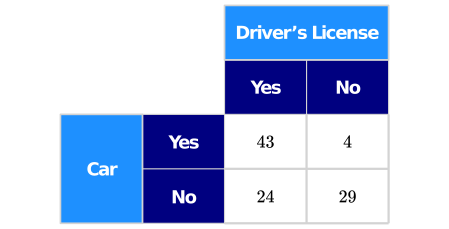
carand
driver's license.Both have possible responses of
yesand
no.The numbers in the table are called joint frequencies. Also, two-way frequency tables often include the total of the rows and columns — these are called marginal frequencies. Select any frequency in the table below to display more information.
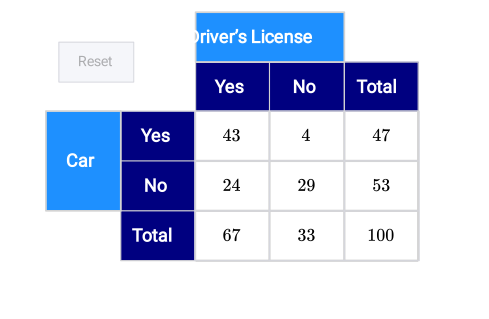
Totalrow and the
Totalcolumn, which in this case is 100, equals the sum of all joint frequencies. This is called the grand total. A joint frequency of 43 shows that 43 people have a driver's license and own a car. A marginal frequency of 53 shows that 53 people do not have a car. The rest of the numbers from the table can also be interpreted.
Discussion
Share
Report error
Making a Two-Way Frequency Table
Organizing data in a two-way frequency table can help with visualization, which in turn makes it easier to analyze and present the data. To draw a two-way frequency table, three steps must be followed.
- Determine the categories.
- Fill the table with the given data.
- Determine if there are any missing frequencies. If so, find those.
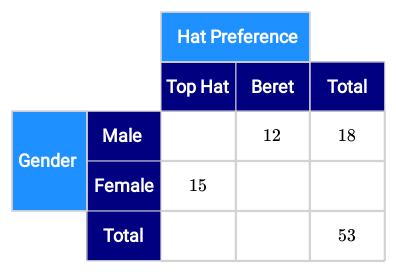
Suppose that 53 people took part in an online survey, where they were asked whether they prefer top hats or berets. Out of the 18 males that participated, 12 prefer berets. Also, 15 of the females chose top hats as their preference. The steps listed above will now be used to analyze and present the data.
1
Determine the Categories
expand_more First, the two categories of the table must be determined, after which the table can be drawn without frequencies. Here, the participants gave their hat preference and their gender, which are the two categories. Hat preference can be further divided into top hat and beret, and gender into female and male.
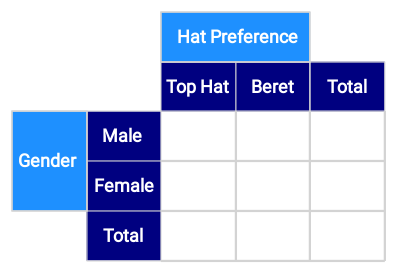
The total row and total column are included to write the marginal frequencies.
2
Fill the Table With Given Data
expand_more The given joint and marginal frequencies can now be added to the table.
3
Find Any Missing Frequencies
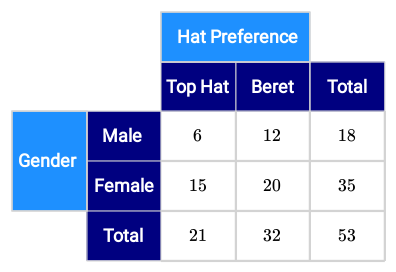
expand_more Using the given frequencies, more information can potentially be found by reasoning. For instance, because 12 out of the 18 males prefer berets, the number of males who prefer top hats is equal to the difference between these two values. 18 - 12 = 6 Therefore, there are 6 males who prefer top hats. Since there are 15 females who prefer top hats, the number of participants who prefer this type of hat is the sum of these two values. 6 + 15 = 21 It has been found that 21 participants prefer top hats. Continuing with this reasoning, the entire table can be completed.
Example
Share
Report error
Night Owl or Early Bird?
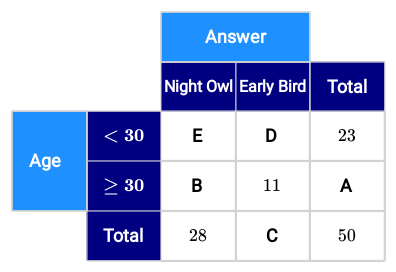
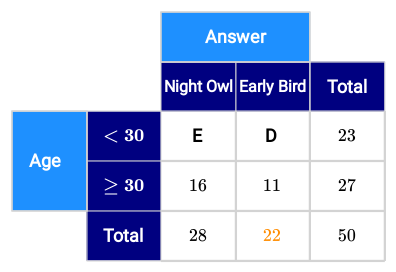
Zain has a job leading backpackers on excursions in the High Sierras. To better understand what time of day to plan certain activities, Zain posed a question to 50 backpackers about their sleep patterns: Are you a night owl or an early bird?
Zain then categorized the participants by sleep pattern and age — younger than 30 and 30 or older. Here is part of what was gathered.
- 11 people age 30 or older said they are early birds.
- 23 people younger than 30 participated in the survey.
- 28 people, of any age, said they are night owls.
Zain made a two-way frequency table with the data they collected. Unfortunately, some of the data values got smudged and are unable to be read! The missing data values have been replaced with letters, for now.
{"type":"pair","form":{"alts":[[{"id":0,"text":"A"},{"id":1,"text":"B"},{"id":2,"text":"C"},{"id":3,"text":"D"},{"id":4,"text":"E"}],[{"id":0,"text":"27"},{"id":1,"text":"16"},{"id":2,"text":"22"},{"id":3,"text":"11"},{"id":4,"text":"12"}]],"lockLeft":true,"lockRight":false},"formTextBefore":"","formTextAfter":"","answer":[[0,1,2,3,4],[0,1,2,3,4]]}
Hint
Begin by finding the number of people age 30 or older who participated in the survey. To do so, calculate the difference between the grand total and the number of participants younger than 30. That would be 50 divided by 23.
Solution
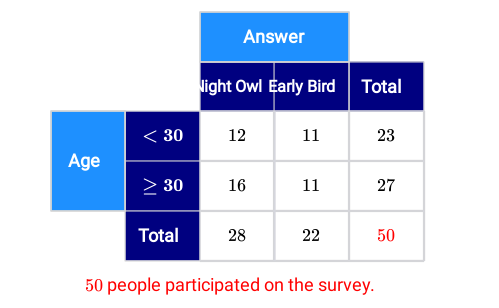
Start by finding the missing marginal frequency of the last column of the table, labeled A. Note that 50 people participated in the survey and 23 of them are younger than 30. Therefore, the number of participants who are 30 or older can be found by calculating the difference between these two values. 50-23= 27 This information can be added to the table.
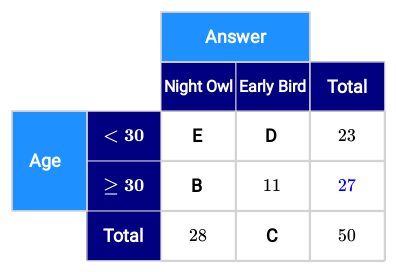
With this information, the joint frequency B that represents the number of night owls aged 30 or older can be calculated. Of the 27 participants aged 30 or older, 11 are early birds. Therefore, the number of night owls aged 30 or older is the difference between these two values. 27-11= 16 This information can also be added to the table.

The missing marginal frequency C in the last row will now be calculated. Of the 50 participants, 28 said they are night owls. To find the number of early birds, the difference between these two values will be calculated. 50-28= 22 One more cell can be filled in!
Discussion
Share
Report error
Joint and Marginal Relative Frequencies
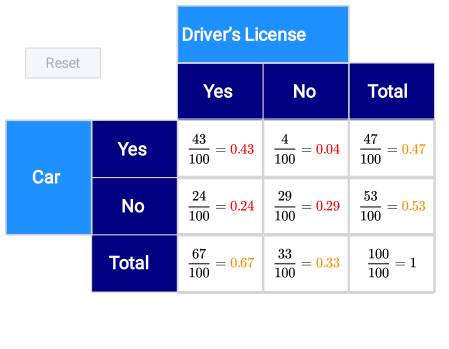
In a two-way frequency table, a joint relative frequency is the ratio of a joint frequency to the grand total. Similarly, a marginal relative frequency is the ratio of a marginal frequency to the grand total. Consider the following example of a two-way table.
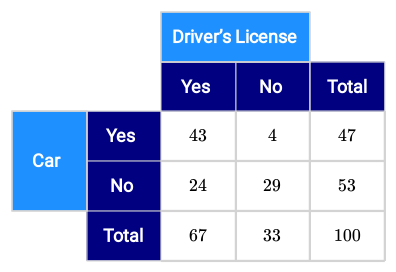
Here, the grand total is 100. The joint and marginal frequencies can now be divided by 100 to obtain the joint and marginal relative frequencies. Clicking in each cell will display its interpretation.
Example
Share
Report error
Joint and Marginal Relative Frequencies for Night Owls and Early Birds
Previously, Zain made a two-way frequency table about backpackers sleep patterns.
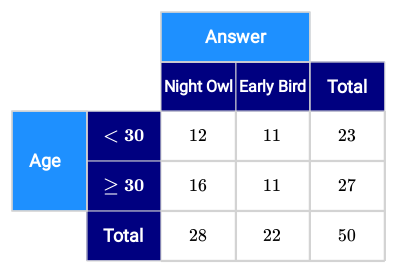
Zain wants to dig deeper into the data for even more clear interpretations, so they plan to calculate the joint and marginal relative frequencies.
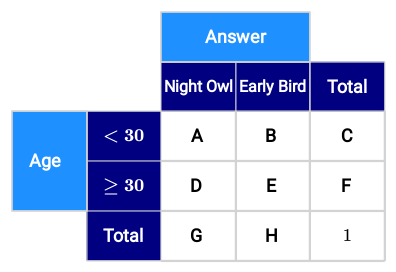
{"type":"pair","form":{"alts":[[{"id":0,"text":"A"},{"id":1,"text":"B"},{"id":2,"text":"C"},{"id":3,"text":"D"},{"id":4,"text":"E"},{"id":5,"text":"F"},{"id":6,"text":"G"},{"id":7,"text":"H"}],[{"id":0,"text":"0.24"},{"id":1,"text":"0.22"},{"id":2,"text":"0.46"},{"id":3,"text":"0.32"},{"id":4,"text":"0.22"},{"id":5,"text":"0.54"},{"id":6,"text":"0.56"},{"id":7,"text":"0.44"}]],"lockLeft":true,"lockRight":false},"formTextBefore":"","formTextAfter":"","answer":[[0,1,2,3,4,5,6,7],[0,1,2,3,4,5,6,7]]}
Solution
To calculate the joint and marginal relative frequencies, the joint and marginal frequencies must be divided by the grand total, 50.
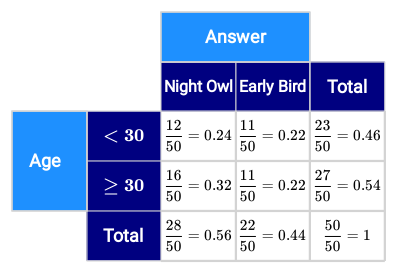
The table below shows the joint and marginal relative frequencies.
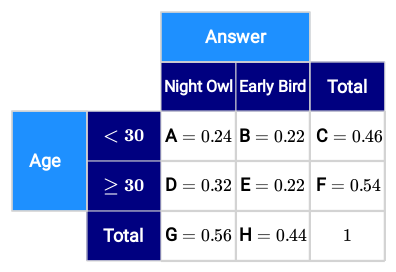
One finding — of a variety — based on the joint and marginal relative frequencies, shows that about one-third of the participants who are 30 or older are night owls. Additionally, Zain can see that the participants are almost equally distributed among the categories, as both pairs of marginal relative frequencies have values close to 50-50.
Discussion
Share
Report error
Conditional Relative Frequency
A conditional relative frequency is the ratio of a joint frequency to either of its two corresponding marginal frequencies. Alternatively, it can be calculated using joint and marginal relative frequencies. As an example, the following data will be used.
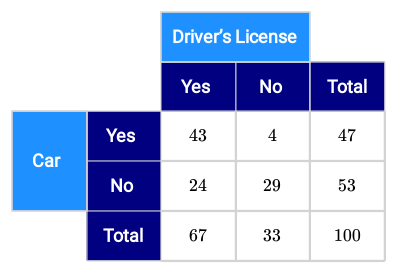
Referring to the column totals, the left column of joint frequencies should be divided by 67 and the right column by 33. Furthermore, since the column totals are used, the sum of the conditional relative frequencies of each column is 1.
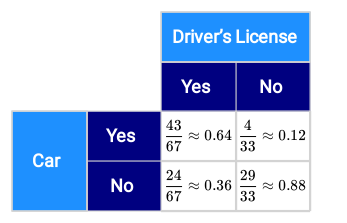
The resulting two-way frequency table can be interpreted to obtain the following information.
- Out of all the participants with a driver's license, about 64 % of them own a car.
- Out of all the participants with a driver's license, about 36 % of them do not own a car.
- Out of all the participants without a driver's license, about 12 % of them own a car.
- Out of all the participants without a driver's license, about 88 % of them do not own a car.
Example
Share
Report error
Conditional Relative Frequencies for Night Owls and Early Birds
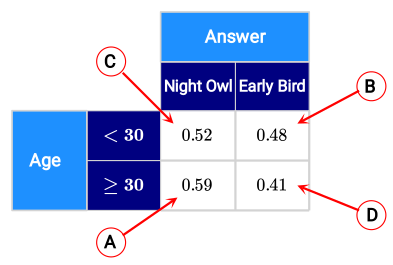
Using their two-way frequency table, Zain wants to continue improving the interpretation of their data by finding the conditional relative frequencies.
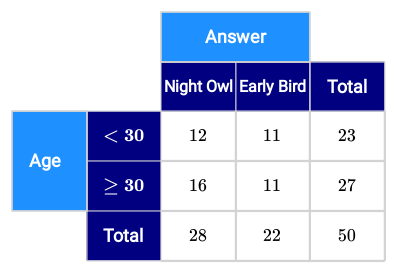
Zain will use the row totals to make the calculations.
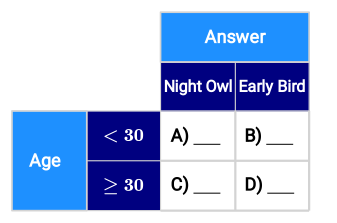
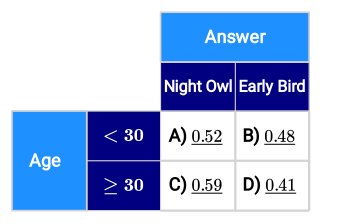
{"type":"pair","form":{"alts":[[{"id":0,"text":"A)"},{"id":1,"text":"B)"},{"id":2,"text":"C)"},{"id":3,"text":"D)"}],[{"id":0,"text":"\u2248 0.52"},{"id":1,"text":"\u2248 0.48"},{"id":2,"text":"\u2248 0.59"},{"id":3,"text":"\u2248 0.41"}]],"lockLeft":true,"lockRight":false},"formTextBefore":"","formTextAfter":"","answer":[[0,1,2,3],[0,1,2,3]]}
Hint
Since Zain uses the row totals, the joint frequencies in the first row must be divided by 23 and the joint frequencies in the second row must be divided by 27.
Solution
Zain uses the row totals. Therefore, the joint frequencies in the first row must be divided by 23 and the joint frequencies in the second row must be divided by 27.
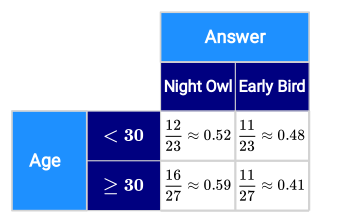
The table below shows the conditional relative frequencies.
Extra
Applying Zain's Findings to an Actual Backpacking TripZain interprets the various findings as reason to believe when planning night activities, like storytelling over a campfire, they could tailor the stories for an older generation. Interestingly, the older backpackers, as a whole, seem to prefer nights more than the younger backpackers. Zain can now plan according to these interpretations.
Example
Share
Report error
Finding Conditional Probabilities Using Conditional Relative Frequencies
Zain will now consider the two-way table that shows conditional relative frequencies obtained using row totals.
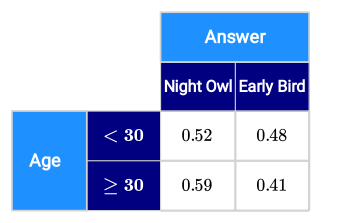
They want to calculate some conditional probabilities by using the table. Help Zain find these probabilities!
a Knowing that a person is aged 30 or older, find the probability that they are a night owl.
b Knowing that a person is younger than 30, find the probability that they are an early bird.
c Knowing that a person is younger than 30, find the probability that they are a night owl.
d Knowing that a person is aged 30 or older, find the probability that they are an early bird.
{"type":"pair","form":{"alts":[[{"id":0,"text":"A"},{"id":1,"text":"B"},{"id":2,"text":"C"},{"id":3,"text":"D"}],[{"id":0,"text":"0.59"},{"id":1,"text":"0.48"},{"id":2,"text":"0.52"},{"id":3,"text":"0.41"}]],"lockLeft":true,"lockRight":false},"formTextBefore":"","formTextAfter":"","answer":[[0,1,2,3],[0,1,2,3]]}
Hint
Consider the fact that the conditional relative frequencies were found using row totals.
Solution
The table was created using row totals. Therefore, the first cell of the first row shows the probability of a person being a night owl given that they are younger than 30. Similarly, the second cell of the first row shows the probability of a person being an early bird given that they are younger than 30.
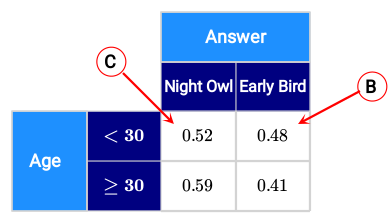
Likewise, the first cell of the second row shows the probability of a person being a night owl given that they aged 30 or older. Similarly, the second cell of the second row shows the probability of a person being an early bird given that they are aged 30 or older.
Example
Share
Report error
Using a Two-Way Table to Determine Independence
Paulina conducted a survey at Washington High. She asked 170 students whether they have cable TV and whether they took a vacation last summer. She displays the results in a two-way frequency table.
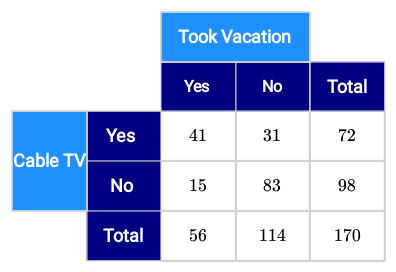
taking a vacationand
having cable TVare independent events for this population of 170 students.
{"type":"choice","form":{"alts":["The events are independent.","The events are not independent."],"noSort":true},"formTextBefore":"","formTextAfter":"","answer":1}
Hint
What is the probability that a student chosen at random took a vacation last summer? What is the probability that a random student who has cable TV took a vacation last summer?
Solution
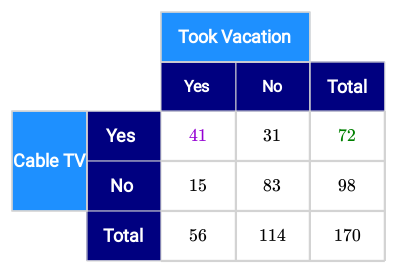
Let A be the event that a student took a vacation last summer and B be the event that a student has cable TV. The table shows that from a total of 170 participants, 56 students took a vacation last summer.
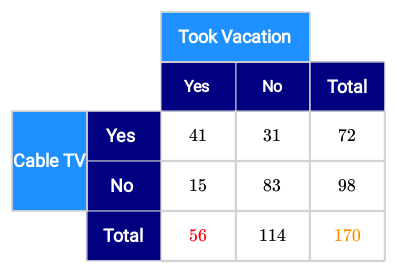
P(A)=56/170
P(A) ≈ 0.33
Closure
Share
Report error
Chocolate Bar or Fruit?
At the beginning of the lesson, Zosia asked 50 students of North High School in Honolulu whether they prefer a chocolate bar or a piece of fruit as a lunchtime snack and whether they surf or not.
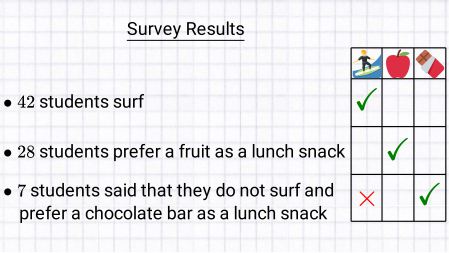
{"type":"text","form":{"type":"math","options":{"comparison":"1","nofractofloat":false,"keypad":{"simple":true,"useShortLog":false,"variables":[],"constants":[]},"rendered":false},"text":" "},"formTextBefore":"P(A)=","formTextAfter":null,"answer":{"text":["0.84","\\dfrac{42}{50}","\\dfrac{21}{25}"]}}
{"type":"text","form":{"type":"math","options":{"comparison":"1","nofractofloat":false,"keypad":{"simple":true,"useShortLog":false,"variables":[],"constants":[]},"rendered":false},"text":" "},"formTextBefore":"P(B)=","formTextAfter":null,"answer":{"text":["0.56","\\dfrac{28}{50}","\\dfrac{14}{25}"]}}
{"type":"text","form":{"type":"math","options":{"comparison":"1","nofractofloat":false,"keypad":{"simple":true,"useShortLog":false,"variables":[],"constants":[]},"rendered":false},"text":" "},"formTextBefore":"P(A|B)=","formTextAfter":null,"answer":{"text":["0.96","\\dfrac{27}{28}","0.964"]}}
{"type":"text","form":{"type":"math","options":{"comparison":"1","nofractofloat":false,"keypad":{"simple":true,"useShortLog":false,"variables":[],"constants":[]},"rendered":false},"text":" "},"formTextBefore":"P(B|A)=","formTextAfter":null,"answer":{"text":["0.6","\\dfrac{27}{42}","\\dfrac{9}{14}","0.64","0.642","0.643"]}}
Hint
Make a two-way frequency table to display the obtained information.
Solution
A two-way frequency table can be made to organize the obtained information.
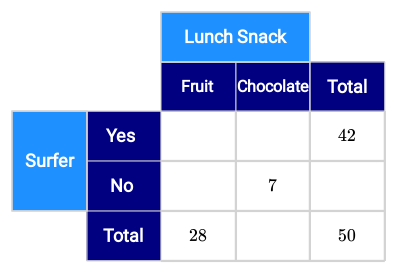
Next, the missing marginal frequencies can be calculated.
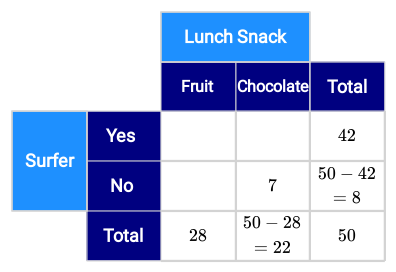
Now, two of the three missing joint frequencies can be calculated.
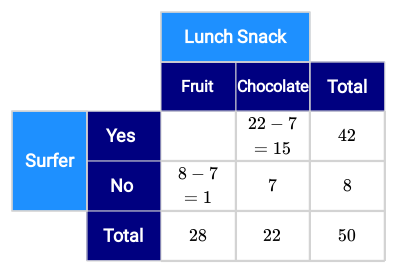
Finally, the last empty cell can be filled.
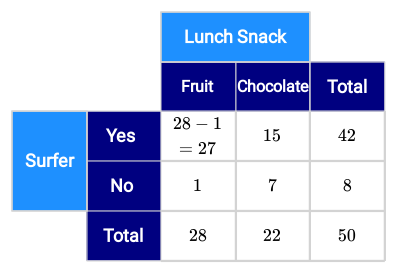
Now that the two-way table is complete, the desired probabilities can be found. Out of a total of 50 students, 42 surf and 28 prefer fruit as a lunch snack.
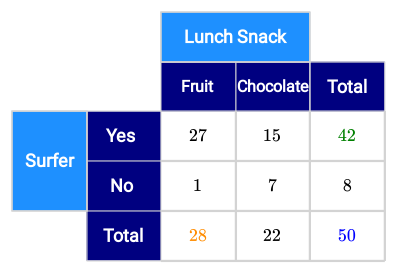
With this information, P(A) and P(B) can be calculated. c|c P(A) =42/50 & P(B)=28/50 ⇕ & ⇕ P(A)=21/25 & P(B)=14/25 Also, of the 28 students who prefer fruit, 27 surf. Likewise, of the 42 students who surf, 27 prefer fruit.
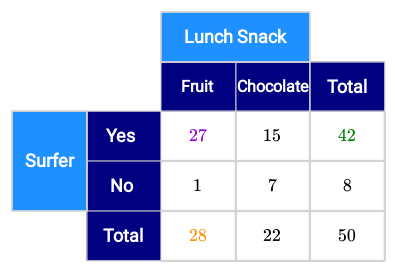
Knowing this, P(A|B) and P(B|A) can be calculated. c|c & P(B|A)=27/42 P(A|B)=27/28 & ⇕ & P(B|A)=9/14
Constructing and Interpreting Two-Way Frequency Tables
Exercises
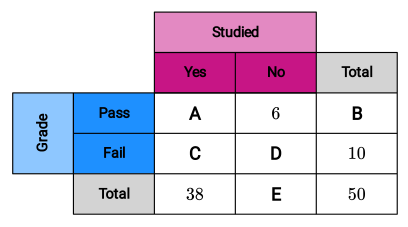
The two-way frequency table describes how many students passed a test and how many students reported that they had studied during the previous weekend.
{"type":"pair","form":{"alts":[[{"id":0,"text":"A"},{"id":1,"text":"B"},{"id":2,"text":"C"},{"id":3,"text":"D"},{"id":4,"text":"E"}],[{"id":0,"text":"34"},{"id":1,"text":"40"},{"id":2,"text":"4"},{"id":3,"text":"6"},{"id":4,"text":"12"}]],"lockLeft":true,"lockRight":false},"formTextBefore":"","formTextAfter":"","answer":[[0,1,2,3,4],[0,1,2,3,4]]}
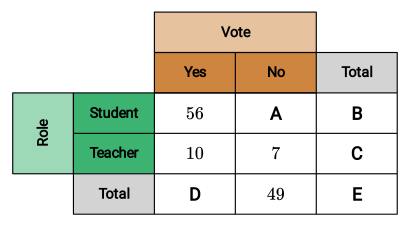
The two-way frequency table describes how many students and teachers voted on building a new cafeteria.
{"type":"pair","form":{"alts":[[{"id":0,"text":"A"},{"id":1,"text":"B"},{"id":2,"text":"C"},{"id":3,"text":"D"},{"id":4,"text":"E"}],[{"id":0,"text":"42"},{"id":1,"text":"98"},{"id":2,"text":"17"},{"id":3,"text":"66"},{"id":4,"text":"115"}]],"lockLeft":true,"lockRight":false},"formTextBefore":"","formTextAfter":"","answer":[[0,1,2,3,4],[0,1,2,3,4]]}
security
report
code
security
report
code
Examining the two-way frequency table, we see that in the row and column containing the totals we only have one missing value. This means we can solve for both B and E. B+10=50 &⇔ B= 40 E+38=50 &⇔ E= 12 Let's add this to the two-way frequency table.
In the row describing a passing grade, now A is the only unknown. Similarly, in the column describing how many students did not study before the test, only D is unknown. This means we can find both A and D. A+6=40 &⇔ A= 34 6+D=12 &⇔ D= 6 Let's add this to the diagram.
We can determine C, too. 34+C=38 ⇔ C= 4 Now we can complete the two-way frequency table.
Let's summarize what we have found. A &→ 34 B &→ 40 C &→ 4 D &→ 6 E &→ 12
Here, A and D are the only unknowns in the Yes
and No
columns. Therefore, we can determine their values.
56+10=D &⇔ D= 66
A+7=49 &⇔ A= 42
Let's add this to the diagram.
Now we have enough information to calculate B, C, and E. 56+42=B &⇔ B= 98 10+7=C &⇔ C= 17 66+49=E &⇔ E= 115 With this information we can complete our table.
Let's summarize. A &→ 42 B &→ 98 C &→ 17 D &→ 66 E &→ 115
security
report
code
Ignacio surveyed 190 men and 160 women passing through an airport and asked whether they washed their hands on a regular basis. Of these people, 143 men and 130 women reported that they washed their hands on a regular basis.
{"type":"text","form":{"type":"math","options":{"comparison":"1","nofractofloat":false,"keypad":{"simple":true,"useShortLog":false,"variables":["x"],"constants":["PI"]},"rendered":false},"text":" "},"formTextBefore":null,"formTextAfter":null,"answer":{"text":["30"]}}
{"type":"text","form":{"type":"math","options":{"comparison":"1","nofractofloat":false,"keypad":{"simple":true,"useShortLog":false,"variables":["x"],"constants":["PI"]},"rendered":false},"text":" "},"formTextBefore":null,"formTextAfter":null,"answer":{"text":["77"]}}
security
report
code
security
report
code
The joint frequencies in a two-way frequency table are the entries that are not the totals.
We know that Ignacio surveyed 190 men and 160 women, and from these 143 men and 130 women reported that they wash their hands regularly. Let's add this information to the two-way frequency table.
Now we can determine the unknown joint frequencies by subtracting the number of men and women answering Yes
from the totals in each of the corresponding rows. Let's label the number of men and women that answered No
as X and Y, respectively.
ccc
143+X=190 & ⇔ & X=47
130+Y=160 & ⇔ & Y=30
Let's add these results to the diagram.
We can see that the survey's lowest joint frequency is 30.
The marginal frequencies of a two-way frequency table are the sums of the rows and columns. In other words, we want to find the Total
of each category.
From the given information, we can identify two of the marginal frequencies. The total number of men surveyed is 190, and the total number of women surveyed is 160.
Now, let's calculate the marginal frequencies corresponding to Washes hands.
We can do this by adding the numbers in the Yes
and No
columns.
143+130&= 273
47+30&= 77
Let's add this to the information in our table.
We can see that lowest marginal frequency is 77.
security
report
code
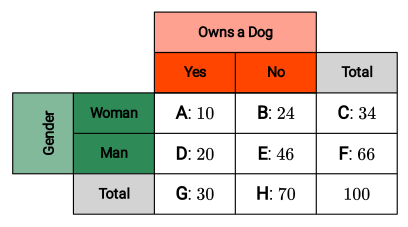
The following two-way frequency table shows the results of a survey given to 100 people, investigating whether or not they own a dog.
{"type":"pair","form":{"alts":[[{"id":0,"text":"A"},{"id":1,"text":"B"},{"id":2,"text":"D"},{"id":3,"text":"E"}],[{"id":0,"text":"0.10"},{"id":1,"text":"0.24"},{"id":2,"text":"0.20"},{"id":3,"text":"0.46"}]],"lockLeft":true,"lockRight":false},"formTextBefore":"","formTextAfter":"","answer":[[0,1,2,3],[0,1,2,3]]}
{"type":"pair","form":{"alts":[[{"id":0,"text":"C"},{"id":1,"text":"F"},{"id":2,"text":"G"},{"id":3,"text":"H"}],[{"id":0,"text":"0.34"},{"id":1,"text":"0.66"},{"id":2,"text":"0.30"},{"id":3,"text":"0.70"}]],"lockLeft":true,"lockRight":false},"formTextBefore":"","formTextAfter":"","answer":[[0,1,2,3],[0,1,2,3]]}
security
report
code
security
report
code
In a two-way frequency table, the joint frequencies are the entries that are not the totals.
A joint relative frequency is the ratio of a joint frequency to the grand total. Therefore, to find the joint relative frequencies we need to divide each of the joint frequencies in the two-way frequency table by 100, which is the grand total. Joint Relative Frequencies [1em] A: 10/100=0.10 B: 24/100=0.24 [1em] D: 20/100=0.20 E: 46/100=0.46 [1em]
The marginal frequencies in a two-way frequency table are the totals of each row and column.
A marginal relative frequency is the ratio of the a marginal frequency to the grand total. Therefore, to find the marginal relative frequencies we need to divide each of the marginal frequencies in the table by 100, which is the grand total. Marginal Relative Frequencies [1em] G: 30/100=0.30 C: 34/100=0.34 [1em] H: 70/100=0.70 F: 66/100=0.66 [1em]
security
report
code
In a school with 500 students, 430 of them ate lunch on a given day. Of the students who ate lunch, 40 reported that they felt tired at the end of the school day. Of the students who did not eat lunch, 50 of them reported that they felt tired at the end of the school day.
{"type":"text","form":{"type":"math","options":{"comparison":"1","nofractofloat":false,"keypad":{"simple":true,"useShortLog":false,"variables":["x"],"constants":["PI"]},"rendered":false},"text":" "},"formTextBefore":"P(felt tired|had lunch)\u2248","formTextAfter":"%","answer":{"text":["9"]}}
{"type":"text","form":{"type":"math","options":{"comparison":"1","nofractofloat":false,"keypad":{"simple":true,"useShortLog":false,"variables":["x"],"constants":["PI"]},"rendered":false},"text":" "},"formTextBefore":"P(no lunch|no tired)\u2248","formTextAfter":"%","answer":{"text":["5"]}}
security
report
code
security
report
code
To calculate the probability that a student felt tired given that they had lunch, we will first make a two-way frequency table. After that, we will calculate the required conditional probability.
Two-Way Frequency Table
We know that there are 500 students at the school, therefore, this is our grand total. We also know that 40 out of the 430 students that had lunch reported that they felt tired and that 50 students who did not have lunch felt tired. Let's depict this information using a two-way frequency table. We will also label the empty cells using the letters A through E.
With the information known, we can set up equations to solve for the values of D, A, and C. 40+50&=D &&⇔ D=90 40+A&=430 &&⇔ A=390 430+C&=500 &&⇔ C=70 Let's add this information to the table.
Conditional Probability
We want to determine the conditional probability that a student felt tired given that they had lunch. P(felt tired|had lunch) This means that we are interested in the first row of the two-way frequency table.
Calculating the required conditional probability is equivalent to calculating the conditional relative frequency of the students who had lunch
and felt tired
by using the marginal frequency of students who had lunch.
The total number of students who had lunch is 430, and the number of students who felt tired and had lunch is 40.
The probability that a student felt tired given that they had lunch is about 9 %.
Now we are interested in the probability that a student did not have lunch given that they did not feel tired. Let's go back to our two-way frequency table.
Since the rest of the totals and the grand total are now known from the previous part, we can set up equations for B and E. 50+B&=70 &&⇔ B=20 90+E&=500 &&⇔ E=410 Let's add this information to the diagram.
Conditional Relative Probability
We want to determine the conditional probability that a student did not have lunch given that they did not feel tired. P(no lunch|not tired) Since our population this time is the students who did not feel tired, we are only interested in the second column of the two-way table.
Calculating the required probability is equivalent to calculating the conditional relative frequency of the students who did not have lunch and did not feel tired by using the marginal frequency of students who did not feel tired. The total number of students who did not feel tired is 410. The joint frequency of students who did not have lunch and did not feel tired is 20.
The probability that a student did not have lunch given that the student did not feel tired is about 5 %.
security
report
code
Constructing and Interpreting Two-Way Frequency Tables
Recommended exercises
To get personalized recommended exercises, please login first.
Loading content
≤
>
■2
■▢
e▢
7
8
9
×
÷■1
=
=
√▢
▢√
∫▢▢
4
5
6
+
−
≤
<
log
ln
log▢
1
2
3
()
∣
sin
cos
tan
0
.
π
x
y
Loading content