AThe slope is a ratio used to compare how a variable changes in relation to another variable.
BWhen two quantities x and y are proportional, the relationship can be represented by the equation y=mx.
AFingernails, see solution.
BSee solution.
Practice makes perfect
We are told that toenails grow about 13 millimeters per year, and fingernail growth follows the pattern of the given table.
Weeks
1
2
3
4
Fingernail Growth (millimeters)
0.7
1.4
2.1
2.8
Since the the toenail growth is given in millimeters per year and the fingernail growth is in millimeters per weeks, we need to start by converting years into weeks. To do so, remember that 1 year has 52 weeks. We can divide 13 by 52 to obtain the amount of toenail growth per week.
13 millimeters/year * 1 year/52 weeks = 13millimeters/52week
Let's calculate the quotient!
This means that the toenails grow about 0.25 millimeters per year. The value of the weeks and its corresponding value of fingernail growth represents an ordered pair. We want to find which nails grow faster. To do so, remember that the slope is a ratio used to compare how a variable changes in relation to another variable.
m= Change in Variable 2/Change in Variable 1
In our case, the growth per week is what we are looking at. To find the nails with faster growth we can calculate the slope of each case and see which one is greater. Since toenails grow about 0.25 millimeters per week, the slope is equal to 0.25. Now, we will use the Slope Formula to calculate the slope of the fingernail growth.
The slope of the fingernails growth is 0.7. Since 0.7 is greater than 0.25, fingernails grow faster than toenails.
Consider that toenail growth is a proportional relationship. This means that we can write an equation for the growth with the following form.
y=mx
Here, m is the constant of proportionality. The graph of this equation will be a line with a slope m that passes through the origin. Since we know that the slope of toenail growth is equal to 0.7, we can write its equation by substituting m=0.7 into the above equation.
y=0.7x
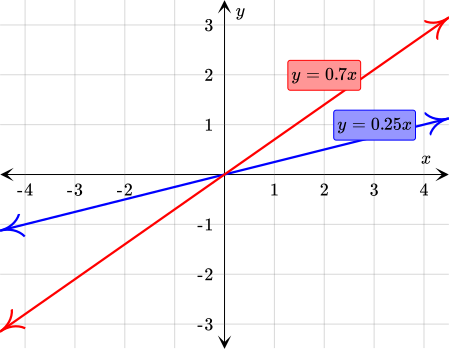
Now that we have the equation of each growth case, we can graph these linear equations by using a table of values. We will replace x with 1, 2, and 3 to find the value of y in each case.
Weeks x
1
2
3
Fingernail Growth y
0.7
1.4
2.1
Toenail Growth y
0.25
0.50
0.75
The value of x and its corresponding value of y represents an ordered pair that can be plotted in a coordinate plane. Let's plot the ordered pairs and draw a line through the points.
Notice that the graph of fingernail growth is steeper than the graph representing toenail growth. This means that fingernails grow faster than toenails.