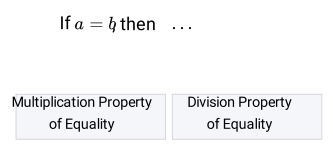
We want to find which equation does not belong with the other three. To find the different equation, we will first review the Multiplication and Division Properties of Equality.
When looking at the Multiplication and Division Properties of Equality, we can see that multiplying or dividing both sides of an equation by the same nonzero number results in an equivalent equation. Also recall that multiplication and division are inverse operations which means they undo each other.
a * c ÷ c=b * c ÷ c
⇓
a=b
When we solve an equation for x, we want the left-hand side of the equation to only have x-terms and the right-side of the equation to only have numbers.
x-terms=numbers
Now we will solve the given equations.
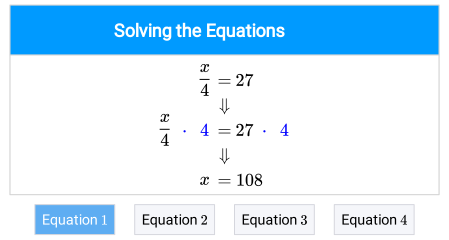
Solving the Equations
First we will solve one of the equations step-by-step.
3/4x=9
One way to think about this equation is that x is divided by 4 and multiplied by 3. To undo division, we multiply the equation by 4. By the Multiplication Property of Equality, the sides of the equation remain equal when we do this.
Another way to think about this equation is that x is being multiplied by 34. We can also solve for x by multiplying both sides of the equation by 43.
3/4x* 4/3&=9* 4/3 [0.5em]
&⇓ [0.5em]
x&=12
Now we will find the value of x for each equation by following the similar steps.
We can see that the value of x is different for the first equation. Equation 14x=27 does not belong with the other three.