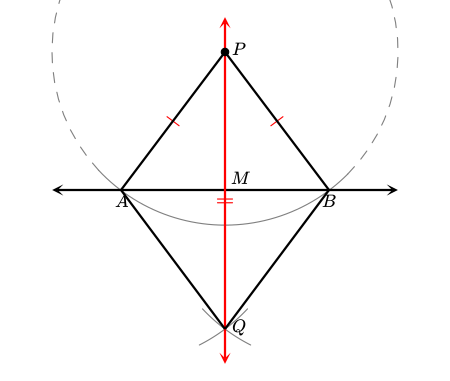
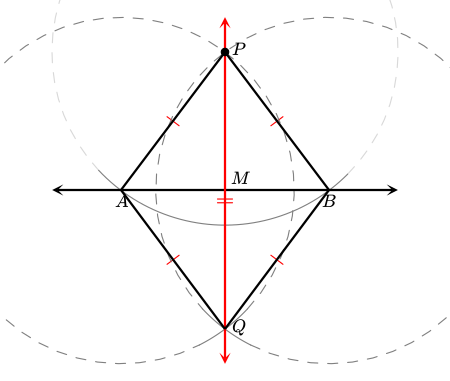
Note that A, B and Q are all radii of identical arcs.
See solution
Practice makes perfect
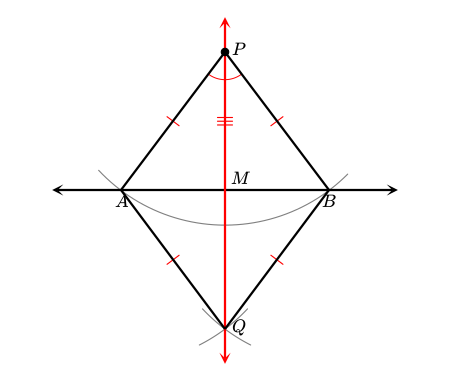
Let's use the plans step-by-step to prove the construction is valid.
Proving △ APQ ≅ △ BPQ
The two triangles share PQ as a side so we know this side is congruent by the Reflexive Property of Congruence. Additionally, A and B on the horizontal line have been marked by drawing an arc with P as the center. Therefore, PA and PB are congruent since they are the radii of the same arc.
Similarly, Q has been marked by drawing two additional arcs with centers in A an B using the same compass settings. Therefore, AQ and BQ are congruent since they are the radii of identical arcs.
Knowing that △ APQ ≅ △ BPQ, we also know that ∠ APQ ≅ ∠ BPQ because these are congruent corresponding angles. Also, △ APQ and △ BPQ share PM as a side, which means this side is congruent in our triangles.
As △ AMP ≅ △ BMP, we know that ∠ AMP ≅ ∠ BMP as these are congruent corresponding angles. Examining the diagram, we also see that ∠ AMP and ∠ BMP forms a linear pair which means they are supplementary angles:
m∠ AMP+m∠ BMP=180^(∘)
Since these angles are congruent, they are right angles. Thus, the constructions is correct.
Alternative Solution
Two-Column Proof
Let's show this as a two-column proof as well.
Statement
Reason
1.
AP≅BP, AQ≅BQ
1.
Given
2.
PQ≅ PQ
2.
Reflexive Property of Congruence
3.
△ APQ ≅ △ BPQ
3.
SSS Congruence Theorem
4.
∠ APQ ≅ ∠ BPQ
4.
Corresponding parts of congruent triangles are congruent
5.
PM≅ PM
5.
Reflexive Property of Congruence
6.
△ APM ≅ △ BPM
6.
SAS Congruence Theorem
7.
∠ AMP ≅ ∠ BMP
7.
Corresponding parts of congruent triangles are congruent