1. An Introduction to Series
Sign In
An error ocurred, try again later!
Chapter 8
1.
An Introduction to Series
Carl Friedrich Gauss, a renowned mathematician, made a significant contribution to the understanding of series, notably when he tackled the sum of the first 100 natural numbers. The realm of series in mathematics is vast, encompassing both finite and infinite sequences of terms added together. These series have myriad applications, from engineering to physics, and are fundamental in solving problems that deal with accumulative values over time or space. Infinite series exercises challenge learners to comprehend the behavior and value of endless sequences, which has implications in real-world scenarios like forecasting, optimization, and data analysis. Grasping these concepts opens up avenues to solve intricate mathematical and practical problems.
Show less Show more expand_more 


Lesson Settings & Tools
| | 10 Theory slides |
| | 9 Exercises - Grade E - A |
| | Each lesson is meant to take 1-2 classroom sessions |
An Introduction to Series
Slide of 10
Many situations in daily life refer to a series such as calling regularly aired episodes of Dora the Explorer a series. When used in mathematics, however, the term takes on a more elaborate meaning. In this lesson, the mathematical concept of a series will be defined, and the ways to find the sum of various special series will be practiced through real-world examples.
Catch-Up and Review
Here are a few recommended readings before getting started with this lesson.
Explore
Share
Report error
Finding the Sum of the First 100 Natural Numbers
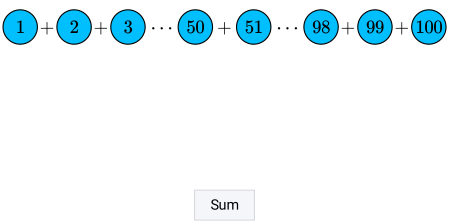
Consider the following applet. The flashing squares can be placed on any two numbers.
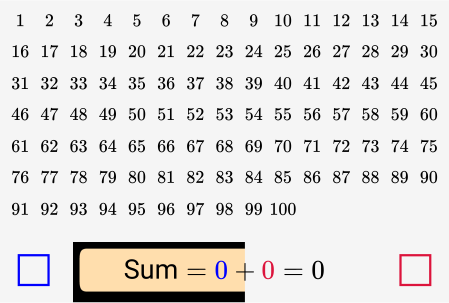 Now, take the sum of the first and last numbers of the given ones. Next, select the second from the initial number, and the second to the last number on the list. What is their sum? Then, select the third number and the third to last number. What is their sum? Continue doing so for a few more pairings. c
1 & + & 100 = ? 2 &+ & 99 = ? 3 & + & 98 = ? & . & . & . A pattern begins to emerge. How could this pattern be applied in calculating the sum of the first 100 natural numbers?
Now, take the sum of the first and last numbers of the given ones. Next, select the second from the initial number, and the second to the last number on the list. What is their sum? Then, select the third number and the third to last number. What is their sum? Continue doing so for a few more pairings. c
1 & + & 100 = ? 2 &+ & 99 = ? 3 & + & 98 = ? & . & . & . A pattern begins to emerge. How could this pattern be applied in calculating the sum of the first 100 natural numbers?
Discussion
Share
Report error
Series
The sum of the terms of a sequence is called a series. Example Sequence:& 2 , 4 , 6 , 8 Example Series:& 2 + 4 + 6 + 8 Depending on the number of terms, a series can be finite or infinite. A finite series has a finite number of terms. This means that there is a first and last term. On the other hand, an infinite series has an infinite number of terms. Therefore, there is a first term but not a last term because the terms continue to infinity. Example Finite Series 2 + 4 + 6 + 8 [1em] Example Infinite Series 2 + 4 + 6 + 8 + 10 + ⋯
If the sum of an infinite series approaches a number as n tends to infinity, then the series is said to converge to that number. Otherwise, the series diverges.Concept
Share
Report error
Sigma Notation
Sigma notation, also known as summation notation, is a compact way of expressing addition. This notation consists of four parts.
- The Greek letter sigma Σ. This letter indicates that the terms are added together.
- The general form of all the terms being added, in terms of a variable. The variables n and i are commonly used.
- The summation index and the starting index, also called the lower limit. They are placed below the letter sigma and are connected with an equals sign. The summation index is the variable used in the general form of the terms. The starting index is the first value that the variable takes.
- The final index or upper limit. This number is placed above the letter sigma and indicates the value for the variable in the last term of the summation.
In the example below, all four parts are shown.
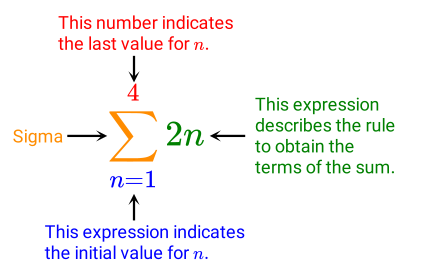
The variable n — the summation index — only takes integer values. To write this sum explicitly, the variable n must be replaced with the integers from the initial value through the final value. ∑_(n= 1)^4 2n &= 2( 1_(n= 1)) + 2( 2_(n= 2)) + 2( 3_(n= 3))+2( 4_(n= 4)) [1.5em] ∑_(n=1)^4 2n &= 0.26cm2 0.26cm+ 0.26cm4 0.26cm+ 0.26cm6 0.26cm+ 0.26cm8 0.1cm [1.5em] ∑_(n=1)^4 2n &= 20
Extra
Notable Aspects of Summation NotationThere are some aspects that are worth noting.
- The summation does not depend on the summation index used. ∑_(n=1)^4 2n = ∑_(k=1)^4 2k = ∑_(i=1)^4 2i = 20
- Sometimes a summation may involve other variables. These should not be confused with the summation index. ∑_(n=1)^3 2n/k Here, the summation index is n. Therefore, the indicated values should only be substituted for n and not for k. ∑_(n= 1)^3 2n/k &= 2( 1)/k_(n= 1) + 2( 2)/k_(n= 2) + 2( 3)/k_(n= 3) [1.5em] ∑_(n=1)^3 2n/k &= 0.23cm2/k 0.23cm+ 0.23cm4/k 0.23cm+ 0.23cm6/k 0.23cm [1.5em] ∑_(n=1)^3 2n/k &= 12/k 3.35cm
- The initial value can be any integer less than or equal to the final index. The final index only indicates the last value to be substituted for n — it does not indicate the number of terms. ∑_(n= 8)^(10) 3n &= 3( 8)_(n= 8) + 3( 9)_(n= 9) + 3( 10)_(n= 10)
The summation notation is not only useful for working with sums involving a large number of terms, but it can also be used to represent an infinite sum. If an infinite number of terms is to be added, the symbol ∞
is used in the final index.
∑_(n=1)^(∞) 1/2^n=1/2^1+1/2^2+1/2^3+...
Example
Share
Report error
Loaves of Bread
Wilson's is a newly opened supermarket in the city center of Birmingham. There is a tasty bakery inside the supermarket.

On the day it first opened, only 22 loaves of bread were sold. Each day after that, the bakery sold 5 more loaves of breads than the previous day.
a Choose the option that represents the total number of loaves of bread sold in four days.
{"type":"choice","form":{"alts":["\u2211_(n=0)^4 5n+17","\u2211_(n=1)^4 5n+17","\u2211_(n=1)^5 5n","\u2211_(n=0)^4 n+5"],"noSort":false},"formTextBefore":"","formTextAfter":"","answer":1}
b Choose the option that represents the total number of loaves of bread sold in an infinite number days.
{"type":"choice","form":{"alts":["\u2211_(n=0)^4 \u221e","\u2211_(n=1)^(\u221e) 5n+17","\u2211_(n=1)^(\u221e) 5n","\u2211_(n=0)^(\u221e) n+5"],"noSort":false},"formTextBefore":"","formTextAfter":"","answer":1}
Hint
a Write the general rule for the number of loaves of bread sold daily.
b What will be the final index of the summation notation for an infinite number of days?
Solution
a The loaves of bread sold in four days will be expressed using summation notation. To accomplish that, the general rule of the series needs to be written. The number of loaves of bread sold in four days can be examined in a table.
The table shows that there is a pattern between the loaves sold each day. Therefore, these numbers can be considered as the terms of a sequence. Since the difference of 5 between the terms is constant, the terms represent an arithmetic sequence. Recall the explicit rule of an arithmetic sequence to best represent the number of loaves sold on n^\text{th} day.
a_n= a_1+(n-1) d
Now, substitute the first term a_1= 22 and the common difference d= 5 into this explicit rule.
Now with the general rule of the series in hand, the summation notation can be completed. To represent the first day, set the lower limit to 1. The upper limit, which represents the fourth day, is 4.
∑_(n= 1)^4 5n+17 This is a finite series.
| Day | Loaves of Bread |
|---|---|
| 1 | 22 |
| 2 | 22+5 |
| 3 | 22+5+5 |
| 4 | 22+5+5+5 |
a_n=a_1+(n-1)d
SubstituteII
a_1= 22, d= 5
a_n= 22+(n-1) 5
▼
Simplify right-hand side
Distr
Distribute 5
a_n=22+5n-5
CommutativePropAdd
Commutative Property of Addition
a_n=5n+22-5
SubTerms
Subtract terms
a_n=5n+17
b In the case of finding the number best representing number of loaves sold in an infinite number of days, the summation notation is the same as in Part A, but it has a different upper limit. Here, the final index is ∞.
∑_(n=1)^(∞) 5n+17
Note that the pattern of the series and the number of loaves of bread sold each day do not change. This is why the only difference is the upper limit. Also, the series diverges since the sum does not converge to a number as n tends to infinity.Example
Share
Report error
Stacking Lemons in the Shape of a Square Pyramid
Magdalena is super stoked to get a job at the new supermarket. Her first task is to make a lemon display. She wants to stack the lemons in the shape of a pyramid with five square layers but first she needs to determine how many lemons she will need. She draws the following model sketch as a side view of a square pyramid which is formed with lemons.

a Choose the expression that represents the number of lemons in the pyramid Magdelana wants to make.
{"type":"choice","form":{"alts":["\u2211_(n=1)^5 n^2","\u2211_(n=1)^5 2n+1","\u2211_(n=1)^5 2n-1","\u2211_(n=0)^5 n^2"],"noSort":false},"formTextBefore":"","formTextAfter":"","answer":0}
b Calculate the total number of lemons needed to make this pyramid.
{"type":"text","form":{"type":"math","options":{"comparison":"1","nofractofloat":false,"keypad":{"simple":true,"useShortLog":false,"variables":[],"constants":[]},"rendered":false},"text":" "},"formTextBefore":null,"formTextAfter":"lemons","answer":{"text":["55"]}}
Hint
a Write the rule for the number of lemons in each layer.
b Add the number of lemons in each layer one by one.
Solution
a To write the series using summation notation, consider first each layer of the pyramid.

A rule for the number of lemons in each layer will be written. To do so, a table will be made to identify the number of lemons in each layer.
| Layer | Number of Lemons |
|---|---|
| 1 | 1^2=1 |
| 2 | 2^2=4 |
| 3 | 3^2=9 |
| 4 | 4^2=16 |
| 5 | 5^2=25 |
The number of lemons in each layer is equal to the square of the layer's level. Therefore, if the layer's level is n, and the number of lemons in the corresponding layer can be expressed as n^2. Using these characteristics, the summation notation can be partially written. ∑ n^2 Finally, the limits of the summation notation will be determined. Refer to the table to see that the initial value for the layers is 1. This means that the lower limit of the notation is 1, and because the last value for the layers is 5, the upper limit of the notation is 5. ∑_(n= 1)^5 n^2
b To calculate the total number of lemons in the stack, the table from Part A can be used.
| Layer | Number of Lemons |
|---|---|
| 1 | 1 |
| 2 | 4 |
| 3 | 9 |
| 4 | 16 |
| 5 | 25 |
Having the number of lemons in each layer, they can simply be added. 1+4+9+16+25=55 A total of 55 lemons are needed to make Magdalena's pyramid display.
Pop Quiz
Share
Report error
Calculating the Sum of the Series
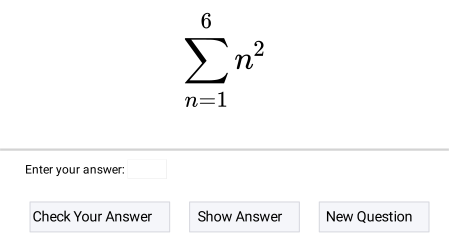
Calculate the sum of the series.
Discussion
Share
Report error
Special Series
The sum of various series can be expressed by a formula. The series that share this characteristic are called special series. The table shows some of the common ones as an explicit sum and also in a summation notation.
| Series | Sum | Summation Notation |
|---|---|---|
| Sum of n terms of 1. | 1+1+ ... + 1 | ∑_(i=1)^n 1 |
| Sum of first n positive integers. | 1+2+ ... + n | ∑_(i=1)^n i |
| Sum of squares of first n positive integers. | 1^2+2^2+ ... + n^2 | ∑_(i=1)^n i^2 |
| Sum of cubes of first n positive integers. | 1^3+2^3+ ... + n^3 | ∑_(i=1)^n i^3 |
Rule
Share
Report error
Formulas for Special Series
The table shows the formulas for some special series.
| Special Series | Formula |
|---|---|
| Sum of n terms of 1. | ∑_(i=1)^n 1 = n |
| Sum of first n positive integers. | ∑_(i=1)^n i = n(n+1)/2 |
| Sum of squares of first n positive integers. | ∑_(i=1)^n i^2 = n(n+1)(2n+1)/6 |
| Sum of cubes of first n positive integers. | ∑_(i=1)^n i^3 = [ n(n+1)/2 ]^2 |
Proof
Sum of n Terms of 1Adding the same number n times is the same as multiplying the number by n. In this case, since the number is 1, the result of this operation is 1* n, which equals n. ∑_(i=1)^n 1 &= 1+1+1+ ... + 1_(ntimes) &= n* 1 &= n
Proof
Sum of First n Positive IntegersMathematical induction will be used to prove the following statement.
∑_(i=1)^n i = n(n+1)2
The first step in an inductive proof is to show that the equation holds true for n=1. The statement is true for n=1. Now, assume that the statement is true for some positive integer k.
∑_(i=1)^k i = k(k+1)2 ✓ In the final step, the aim is to show that the statement is true for n=k+1. To do so, the above equation will be manipulated using the Properties of Equality.
The left-hand side of the above equation is the sum of the first k+1 positive integers. The right-hand side is the expression obtained when substituting k+1 for n. Therefore, the statement holds true for all positive integers.
∑_(i=1)^n i = n(n+1)/2
Substitute
n= 1
∑_(i=1)^1 i ? = 1( 1+1)/2
Rewrite
Rewrite ∑_(i=1)^1 i as 1
1 ? = 1(1+1)/2
AddTerms
Add terms
1 ? = 1(2)/2
IdPropMult
Identity Property of Multiplication
1 ? = 2/2
QuotOne
a/a=1
1=1 ✓
∑_(i=1)^k i = k(k+1)/2
AddEqn
LHS+( k+1)=RHS+( k+1)
∑_(i=1)^k i + ( k+1) = k(k+1)/2 + ( k+1)
Rewrite
Rewrite ∑_(i=1)^k i + (k+1) as ∑_(i=1)^(k+1) i
∑_(i=1)^(k+1) i = k(k+1)/2 + (k+1)
▼
Simplify right-hand side
NumberToFrac
a = 2* a/2
∑_(i=1)^(k+1) i = k(k+1)/2 + 2(k+1)/2
AddFrac
Add fractions
∑_(i=1)^(k+1) i = k(k+1)+2(k+1)/2
FactorOut
Factor out (k+1)
∑_(i=1)^(k+1) i = (k+1)(k+2)/2
WriteSum
Write as a sum
∑_(i=1)^(k+1) i = ( k+1)( k+1+1)/2
Proof
Sum of Squares of First n Positive IntegersThe following statement will be proved using mathematical induction.
∑_(i=1)^n i^2 = n(n+1)(2n+1)/6
For the first step, it should be shown that the equation holds true for n=1.
The statement is true for n=1. Now, assume that the statement is true for some positive integer k.
∑_(i=1)^k i^2 = k(k+1)(2k+1)/6 ✓ Next, show that the statement is true for n=k+1. To do so, start by adding (k+1)^2 to both sides of the above equation.
Add the terms on the right-hand side, then factor the numerator of the fraction.
The left-hand side is the sum of the squares of the first n positive integers. The right-hand side is the expression obtained when substituting k+1 for n. Therefore, the statement holds for all positive integers n.
∑_(i=1)^n i^2 = n(n+1)(2n+1)/6
Substitute
n= 1
∑_(i=1)^1 i^2 ? = 1( 1+1)(2( 1)+1)/6
1 ? = 1(1+1)(2(1)+1)/6
▼
Evaluate right-hand side
IdPropMult
Identity Property of Multiplication
1 ? = 1(1+1)(2+1)/6
AddTerms
Add terms
1 ? = 1(2)(3)/6
Multiply
Multiply
1 ? = 6/6
QuotOne
a/a=1
1=1 ✓
∑_(i=1)^k i^2 = k(k+1)(2k+1)/6
AddEqn
LHS+ (k+1)^2=RHS+ (k+1)^2
∑_(i=1)^k i^2 + (k+1)^2 = k(k+1)(2k+1)/6 + (k+1)^2
Rewrite
Rewrite ∑_(i=1)^k i^2 + (k+1)^2 as ∑_(i=1)^(k+1) i^2
∑_(i=1)^(k+1) i^2 = k(k+1)(2k+1)/6+(k+1)^2
∑_(i=1)^(k+1) i^2 = k(k+1)(2k+1)/6+(k+1)^2
▼
Simplify right-hand side
NumberToFrac
a = 6* a/6
∑_(i=1)^(k+1) i^2 = k(k+1)(2k+1)/6+ 6(k+1)^2/6
AddFrac
Add fractions
∑_(i=1)^(k+1) i^2 = k(k+1)(2k+1)+ 6(k+1)^2/6
FactorOut
Factor out (k+1)
∑_(i=1)^(k+1) i^2 = (k+1)[k(2k+1)+ 6(k+1)]/6
Distr
Distribute k & 6
∑_(i=1)^(k+1) i^2 = (k+1)(2k^2+k+ 6k+6)/6
WriteSum
Write as a sum
∑_(i=1)^(k+1) i^2 = (k+1)(2k^2+k+3k+3k+6)/6
AddTerms
Add terms
∑_(i=1)^(k+1) i^2 = (k+1)(2k^2+4k+3k+6)/6
FactorOut
Factor out 2k
∑_(i=1)^(k+1) i^2 = (k+1)[2k(k+2)+3k+6]/6
FactorOut
Factor out 3
∑_(i=1)^(k+1) i^2 = (k+1)[2k(k+2)+3(k+2)]/6
FactorOut
Factor out (k+2)
∑_(i=1)^(k+1) i^2 = (k+1)(k+2)(2k+3)/6
WriteSum
Write as a sum
∑_(i=1)^(k+1) i^2 = (k+1)(k+1+1)(2k+2+1)/6
FactorOut
Factor out 2
∑_(i=1)^(k+1) i^2 = ( k+1)( k+1+1)[2( k+1)+1]/6
Proof
Sum of Cubes of First n Positive IntegersThe following statement can be proved by mathematical induction.
∑_(i=1)^n i^3 = [ n(n+1)/2 ]^2
In the first step, it should be shown that the equation holds true for n=1.
The statement is true for n=1. Now, assume that the statement is true for some positive integer k.
∑_(i=1)^k i^3 = [ k(k+1)/2 ]^2 ✓ Finally, to show that the statement is true for k+1, the above equation will be manipulated.
This final equation shows that the statement is true for n=k+1. Therefore, the statement holds for all positive integers n.
∑_(i=1)^n i^3 = [ n(n+1)/2 ]^2
Substitute
n= 1
∑_(i=1)^1 i^3 ? = [ 1( 1+1)/2 ]^2
1 ? = [ 1(1+1)/2 ]^2
▼
Evaluate right-hand side
AddTerms
Add terms
1 ? = [ 1(2)/2 ]^2
IdPropMult
Identity Property of Multiplication
1 ? = ( 2/2 )^2
QuotOne
a/a=1
1 ? = 1^2
BaseOne
1^a=1
1=1 ✓
∑_(i=1)^k i^3 = k^2(k+1)^2/4
AddEqn
LHS+ (k+1)^3=RHS+ (k+1)^3
∑_(i=1)^k i^3 + (k+1)^3 = k^2(k+1)^2/4 + (k+1)^3
Rewrite
Rewrite ∑_(i=1)^k i^3 + (k+1)^3 as ∑_(i=1)^(k+1) i^3
∑_(i=1)^(k+1) i^3 = k^2(k+1)^2/4 +(k+1)^3
▼
Simplify right-hand side
NumberToFrac
a = 4* a/4
∑_(i=1)^(k+1) i^3 = k^2(k+1)^2/4+4(k+1)^3/4
AddFrac
Add fractions
∑_(i=1)^(k+1) i^3 = k^2(k+1)^2+4(k+1)^3/4
FactorOut
Factor out (k+1)^2
∑_(i=1)^(k+1) i^3 = (k+1)^2(k^2+4(k+1))/4
Distr
Distribute 4
∑_(i=1)^(k+1) i^3 = (k+1)^2(k^2+4k+4)/4
FacPosPerfectSquare
a^2+2ab+b^2=(a+b)^2
∑_(i=1)^(k+1) i^3 = (k+1)^2(k+2)^2/4
ProdPowII
a^m b^m = (a b)^m
∑_(i=1)^(k+1) i^3 = [(k+1)(k+2)]^2/4
WritePow
Write as a power
∑_(i=1)^(k+1) i^3 = [(k+1)(k+2)]^2/2^2
a^m/b^m=(a/b)^m
∑_(i=1)^(k+1) i^3 = [(k+1)(k+2)/2]^2
WriteSum
Write as a sum
∑_(i=1)^(k+1) i^3 = [( k+1)( k+1+1)/2]^2
Example
Share
Report error
Saving Money
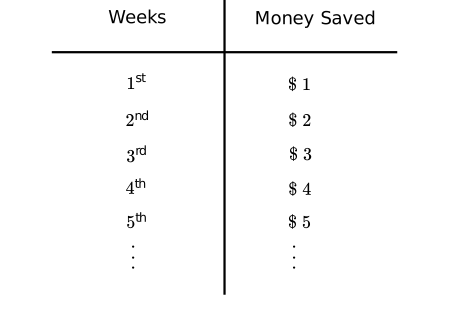
Magdalena wants to save some money starting from this summer to go on a vacation next summer. She begins by saving a dollar on the first week that she started working at the supermarket. Each consecutive week she continues to save 1 dollar more than she saved the week before.

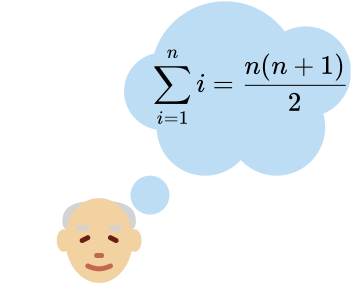
However, Magdalena is not sure about the amount of money she will have after 52 weeks. Her grandfather, who is an old mathematics teacher, tells her that she can calculate the total amount of money saved by using a summation formula.
{"type":"text","form":{"type":"math","options":{"comparison":"1","nofractofloat":false,"keypad":{"simple":true,"useShortLog":false,"variables":[],"constants":[]},"rendered":false},"text":" "},"formTextBefore":null,"formTextAfter":"dollars","answer":{"text":["1378"]}}
Hint
Substitute 52 for n into the summation formula and calculate the result.
Solution
After she started working, Magdalena saves money. She does this by saving one dollar on her first week, two dollars on her second week, three dollars on her third week, and so on.
Example
Share
Report error
Number of People in a Market
Magdalena has enjoyed working at Wilson's Supermarket but feels her tasks have been too easy. She decides to challenge herself and prepare a report about the number of people shopping from 9:00AM to 6:00PM on a weekday. She will present this report to her coworkers.

After collecting data, she is able to make the following table which highlights the number of people and the corresponding times they are shopping.
| Time Interval | Number of People Shopping |
|---|---|
| 09:00-10:00 | 8 |
| 10:00-11:00 | 27 |
| 11:00-12:00 | 64 |
| 12:00-13:00 | 125 |
| 13:00-14:00 | 216 |
| 14:00-15:00 | 125 |
| 15:00-16:00 | 64 |
| 16:00-17:00 | 27 |
| 17:00-18:00 | 8 |
{"type":"text","form":{"type":"math","options":{"comparison":"1","nofractofloat":false,"keypad":{"simple":true,"useShortLog":false,"variables":[],"constants":[]},"rendered":false},"text":" "},"formTextBefore":null,"formTextAfter":"people","answer":{"text":["664"]}}
Hint
The numbers in the table can be rewritten as the cubes of some positive integers. Use this general rule while representing the series in summation notation.
Solution
To express the given numbers as a series in summation notation, a general rule needs to be found first. Begin by rewriting the integers representing the number of people shopping into exponent form and recognize any emerging pattern.
| Time Intervals | Number of People Shopping |
|---|---|
| 09:00-10:00 | 8= 2^3 |
| 10:00-11:00 | 27= 3^3 |
| 11:00-12:00 | 64= 4^3 |
| 12:00-13:00 | 125= 5^3 |
| 13:00-14:00 | 216= 6^3 |
| 14:00-15:00 | 125= 5^3 |
| 15:00-16:00 | 64= 4^3 |
| 16:00-17:00 | 27= 3^3 |
| 17:00-18:00 | 8= 2^3 |
∑_(k=1)^6 k^3 -a_1
Rewrite
Rewrite ∑_(k=1)^6 k^3 as [n(n+1)/2 ]^2
[n(n+1)/2 ]^2-a_1
Substitute
n= 6
[6( 6+1)/2 ]^2-a_1
441-a_1
∑_(k=1)^5 k^3 -a_1
Rewrite
Rewrite ∑_(k=1)^5 k^3 as [n(n+1)/2 ]^2
[n(n+1)/2 ]^2-a_1
Substitute
n= 5
[5( 5+1)/2 ]^2-a_1
225-a_1
Closure
Share
Report error
Gauss Summation
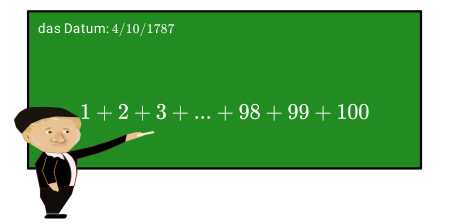
Carl Friedrich Gauss was one of the greatest mathematicians of all time. Even as a middle school student in Germany, Gauss was already trying to find the sum of the first one-hundred natural numbers.

Total Sum=Number of pairs * Sum of each pair
SubstituteValues
Substitute values
Total Sum= n/2* (n+1)
MoveRightFacToNum
a/c* b = a* b/c
Total Sum= n(n+1)/2
An Introduction to Series
Exercise 1.1
Represent the following series in summation notation.
8 + 11 + 14 + 17 + 20
{"type":"choice","form":{"alts":["\u2211 _(i=0)^5 (8i+3)","\u2211 _(i=1)^5 (3i+5)","\u2211 _(i=1)^5 (i+3)","\u2211 _(i=0)^4 (3i-5)"],"noSort":false},"formTextBefore":"","formTextAfter":"","answer":1}
security
report
code
security
report
code
We want to write the given series in summation notation. To do so, we need to find a general rule to represent each term in the series, then determine the limits of the series. Let's start by finding the differences between the terms.
Notice that the terms of the sum form an arithmetic sequence with first term a_1= 8 and common difference d= 3. 8, 11, 14, 17, 20 Now, let's recall the explicit formula for a sequence. a_n=a_1+(n-1)d We will use this formula to represent each term of the given sum in the summation notation. Let's substitute a_1= 8 and d= 3 into this formula.
Note that the series has 5 terms. Therefore, the upper limit of the series is 5. Finally, let's write the summation notation of the series by using i as the summation index. ∑^5_(i=1) (3i+5)
security
report
code
Represent the following series in summation notation.
- 1/2 - 1/4 - 1/8 - 1/16 - ...
{"type":"choice","form":{"alts":["\u2211 _(n=1)^(\u221e) - 1\/4^n","\u2211 _(n=1)^(\u221e) - 1\/2^n","\u2211 _(n=1)^(\u221e) 1\/2^n","\u2211 _(n=1)^(\u221e) 2^n"],"noSort":false},"formTextBefore":"","formTextAfter":"","answer":1}
security
report
code
security
report
code
We want to write the given series in summation notation. To do so, let's find the common ratio between the terms by dividing the second term by the first term.
The common ratio of the series is 12.
Notice that the terms of this sum represents a geometric sequence with first term a_1= - 12 and common ratio r= 12. -1/2, -1/4, -1/16, -1/32, ... Now, we will use the explicit formula to represent each term in summation notation. a_n=a_1* r^(n-1) Let's substitute a_1= - 12 and r= 12 into this formula!
Notice that the series is infinite. Therefore, the upper limit of the series is ∞. Finally, let's write the summation notation of the series! ∑^(∞)_(n=1) -1/2^n
security
report
code
List all the terms of the following series given in summation notation.
∑^6_(i=1) 2i^2
{"type":"text","form":{"type":"list","options":{"comparison":"1","nofractofloat":false,"keypad":{"simple":true,"useShortLog":false,"variables":["x"],"constants":["PI"]},"rendered":false,"ordermatters":true,"numinput":6,"listEditable":true,"hideNoSolution":true},"text":" "},"formTextBefore":null,"formTextAfter":null,"answer":{"text":["2","8","18","32","50","72"]}}
security
report
code
security
report
code
We are given a finite series in summation notation. Recall that each term in a series represented in summation notation can be calculated by the general rule written on the right-hand side of the symbol. The lower limit shows the initial value for the variable i and the upper limit shows the last value for i. ∑^6_(i=1) 2i^2 We want to list the terms of the given series. To do so, we will first substitute i=1 into the general formula of the series, 2i^2.
Great! The first term is 2. Let's apply the same process to find the rest of the terms by substituting i=2, 3, 4, 5, and 6 into the general formula of the series and noting each result.
| a_i=2i^2 | |
|---|---|
| Substitute | Evaluate |
| a_1=2( 1)^2 | a_1=2 |
| a_2=2 ( 2)^2 | a_2=8 |
| a_3=2 ( 3)^2 | a_3=18 |
| a_4=2 ( 4)^2 | a_4=32 |
| a_5=2 ( 5)^2 | a_5=50 |
| a_6=2 ( 6)^2 | a_6=72 |
The terms of the series are 2, 8, 18, 32, 50, and 72.
security
report
code
Find the sum of the following series given in summation notation.
∑^4_(n=0) 2n^3+1
{"type":"text","form":{"type":"math","options":{"comparison":"1","nofractofloat":false,"keypad":{"simple":true,"useShortLog":false,"variables":["x"],"constants":["PI"]},"rendered":false},"text":" "},"formTextBefore":null,"formTextAfter":null,"answer":{"text":["205"]}}
security
report
code
security
report
code
We are given a finite series in summation notation. We want to find its sum. ∑^4_(n=0) 2n^3+1 To do so, we will add up all the terms one by one. Let's first find these terms separately. We will substitute n=0,1,2,3, and 4 into the general expression that describes the terms of the series. Then, we will calculate them one by one in a table.
| a_n=2n^3+1 | ||
|---|---|---|
| n | Substitute | Evaluate |
| 0 | 2 ( 0)^3+1 | 1 |
| 1 | 2 ( 1)^3+1 | 3 |
| 2 | 2 ( 2)^3+1 | 17 |
| 3 | 2 ( 3)^3+1 | 55 |
| 4 | 2 ( 4)^3+1 | 129 |
Finally, we can find the sum of the terms. ∑^4_(n=0) 2n^3+1 =1+3+17+55+129 ⇕ ∑^4_(n=0) 2n^3+1=205 The sum of the series is 205.
security
report
code
Find the sum of the following series written in summation notation.
∑^(12)_(n=10) 4/n-1
Write the result as a fraction.
{"type":"text","form":{"type":"math","options":{"comparison":"1","nofractofloat":false,"keypad":{"simple":true,"useShortLog":false,"variables":[],"constants":[]},"rendered":false},"text":" "},"formTextBefore":null,"formTextAfter":null,"answer":{"text":["598\/495"]}}
security
report
code
security
report
code
We are given a finite series in summation notation. We want to find its sum. ∑^(12)_(k=10) 4/n-1 To do so, we will add up all the terms. Let's first find the terms separately, starting with the tenth term. We will calculate them one by one in a table.
| a_n=4/n-1 | ||
|---|---|---|
| n | Substitute | Evaluate |
| 10 | 4/10-1 | 4/9 |
| 11 | 4/11-1 | 4/10 |
| 12 | 4/12-1 | 4/11 |
To find the sum of these three fractions, we will first reduce them as much as possible.
Now, we need to find the least common denominator (LCD) of the three fractions. Notice that the LCD of 9,5, and 11 is the product of these three numbers. 9 (5)(11) = 495 Great! Let's continue adding them up!
The sum of the series is 598495.
security
report
code
An Introduction to Series
Recommended exercises
To get personalized recommended exercises, please login first.
Loading content
≤
>
■2
■▢
e▢
7
8
9
×
÷■1
=
=
√▢
▢√
∫▢▢
4
5
6
+
−
≤
<
log
ln
log▢
1
2
3
()
∣
sin
cos
tan
0
.
π
x
y
Loading content