{{ tocSubheader }}
{{ 'ml-label-loading-course' | message }}
An error ocurred, try again later!
Chapter {{ article.chapter.number }}
{{ article.number }}.
{{ article.displayTitle }}
{{ article.intro.summary }}
Show less Show more expand_more Lesson Settings & Tools
| | {{ 'ml-lesson-number-slides' | message : article.intro.bblockCount }} |
| | {{ 'ml-lesson-number-exercises' | message : article.intro.exerciseCount }} |
| | {{ 'ml-lesson-time-estimation' | message }} |
In this lesson, several popular 3D figures like cylinders, cones, and spheres will be explored. To better understand their characteristics, their volume and surface area formulas will be introduced.
Catch-Up and Review
Here are a few recommended readings before getting started with this lesson.
Challenge
Relating the Volumes of Cones and Cylinders
The year is about to end and New Year's Eve parties are right around the corner. Tiffaniqua and her grandmother decide to bake chewy chocolate chip cookies for their gathering. As a part of their baking steps, Tiffaniqua fills a cone-shaped cup with flour and pours it into a cylindrical cup.
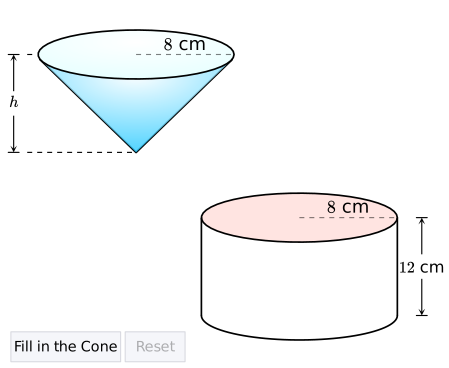 The cylindrical cup and cone-shaped cup have the same radius of 8 centimeters. The height of the cylindrical cup is 12 centimeters. What is the height of the cone-shaped cup if it takes three of them, completely filled with flour, to fill one cylindrical cup?
{"type":"text","form":{"type":"math","options":{"comparison":"1","nofractofloat":false,"keypad":{"simple":true,"useShortLog":false,"variables":["x"],"constants":["PI"]},"rendered":false},"text":"<span class=\"katex\"><span class=\"katex-html\" aria-hidden=\"true\"><\/span><\/span>"},"formTextBefore":null,"formTextAfter":"cm","answer":{"text":["12"]}}
Discussion
Cylinder
The first 3D figure of this lesson to breakdown is the cylinder. Here, the method of how to calculate the volume and surface area of a cylinder will be understood.
Rule
Volume of a Cylinder
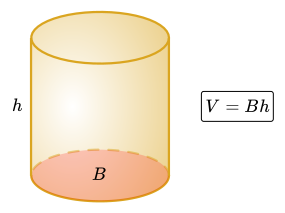
Note that the surface area of a cylinder consists of the two equal circular areas and one rectangular lateral face.
Rule
Surface Area of a Cylinder
Consider a cylinder of height h and radius r.
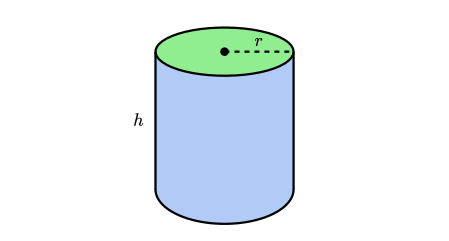
The surface area of this cylinder is given by the following formula.
S=2πrh+2πr2
Example
Finding the Volume and Surface Area of a Cylinder
Tiffaniqua loves fireworks. Her and her grandmother team up to buy a box full of them to celebrate the new year.  One of the types of fireworks that came in the box Tiffaniqua bought is in the shape of a cylinder. The firework's height is 18 centimeters and its radius is 4 centimeters.
a Calculate the volume of the cylindrical-shaped firework. Round the answer to the nearest integer.
{"type":"text","form":{"type":"math","options":{"comparison":"1","nofractofloat":false,"keypad":{"simple":true,"useShortLog":false,"variables":["x"],"constants":["PI"]},"rendered":false},"text":"<span class=\"katex\"><span class=\"katex-html\" aria-hidden=\"true\"><\/span><\/span>"},"formTextBefore":null,"formTextAfter":"<span class=\"katex\"><span class=\"katex-html\" aria-hidden=\"true\"><span class=\"base\"><span class=\"strut\" style=\"height:0.8238736249999999em;vertical-align:-0.009765625em;\"><\/span><span class=\"mord\"><span class=\"mord text\"><span class=\"mord Roboto-Regular\">cm<\/span><\/span><span class=\"msupsub\"><span class=\"vlist-t\"><span class=\"vlist-r\"><span class=\"vlist\" style=\"height:0.8141079999999999em;\"><span style=\"top:-3.063em;margin-right:0.05em;\"><span class=\"pstrut\" style=\"height:2.7em;\"><\/span><span class=\"sizing reset-size6 size3 mtight\"><span class=\"mord mtight\">3<\/span><\/span><\/span><\/span><\/span><\/span><\/span><\/span><\/span><\/span><\/span>","answer":{"text":["905"]}}
b Calculate the surface area of the cylindrical-shaped firework. Round the answer to the nearest integer.
{"type":"text","form":{"type":"math","options":{"comparison":"1","nofractofloat":false,"keypad":{"simple":true,"useShortLog":false,"variables":["x"],"constants":["PI"]},"rendered":false},"text":"<span class=\"katex\"><span class=\"katex-html\" aria-hidden=\"true\"><\/span><\/span>"},"formTextBefore":null,"formTextAfter":"<span class=\"katex\"><span class=\"katex-html\" aria-hidden=\"true\"><span class=\"base\"><span class=\"strut\" style=\"height:0.8238736249999999em;vertical-align:-0.009765625em;\"><\/span><span class=\"mord\"><span class=\"mord text\"><span class=\"mord Roboto-Regular\">cm<\/span><\/span><span class=\"msupsub\"><span class=\"vlist-t\"><span class=\"vlist-r\"><span class=\"vlist\" style=\"height:0.8141079999999999em;\"><span style=\"top:-3.063em;margin-right:0.05em;\"><span class=\"pstrut\" style=\"height:2.7em;\"><\/span><span class=\"sizing reset-size6 size3 mtight\"><span class=\"mord mtight\">2<\/span><\/span><\/span><\/span><\/span><\/span><\/span><\/span><\/span><\/span><\/span>","answer":{"text":["553"]}}
Hint
a The volume of a cylinder is the product of π, the square of its radius, and its height.
b The surface area of a cylinder is the sum of the areas of the base and top circles and the lateral face.
Solution
a It is a given that the firework is in the shape of a cylinder. This means we can use the formula for the volume of a cylinder to determine its volume.
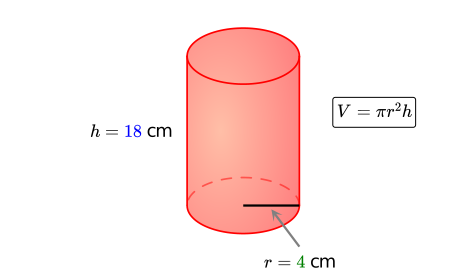 It is known that h=18 and r=4. Substitute these two values into the formula.
The volume of a firework is about 905 cubic centimeters.
It is known that h=18 and r=4. Substitute these two values into the formula.
The volume of a firework is about 905 cubic centimeters.
b It is now time to calculate the surface area of a cylindrical firework. Notice that the surface area of a cylinder consists of the areas of the base and top circles and the lateral face.
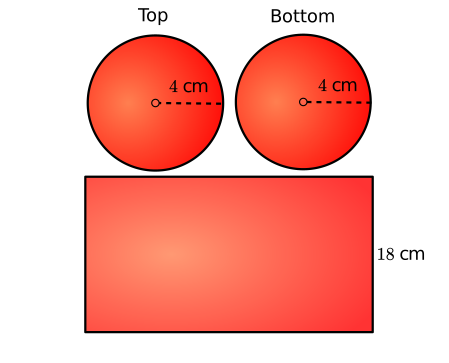 Recall the surface area formula as the sum of these three areas.
SA=2πrh+2πr2
Once again, substitute h=18 and r=4 into the surface area formula.
The surface area of a cylindrical firework is about 553 square centimeters. Pop Quiz
Practice Finding the Surface Area and Volume of a Cylinder
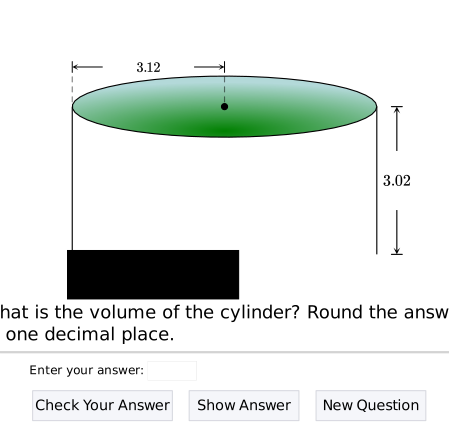
Find the volume or surface area of the cylinder. The radius and height are given in centimeters.
Discussion
Cone
The second 3D figure of this lesson to understand is the cone. One by one, the formulas of the volume and surface area of a cone will be considered.
Rule
Volume of a Cone
The volume of a cone is one third the product of its base area and its height.
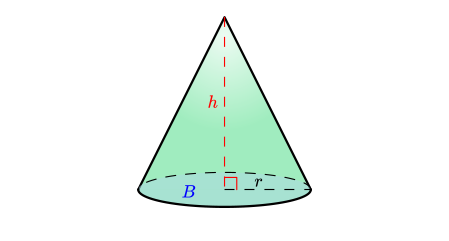
The base area B is the area of the circle and the height h is measured perpendicular to the base.
V=31Bh
Since the base is a circle, its area depends on its radius. Therefore, the base area can also be expressed in terms of the radius r.
V=31πr2h
Note that the surface area of a right cone consists of a circular base and a curved lateral face.
Rule
Surface Area of a Cone
Consider a right cone with radius r and slant height ℓ.
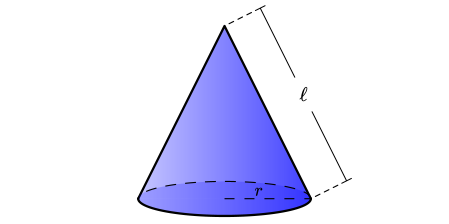
The surface area of a right cone is the sum of the base area and the lateral area. The area of the base is given by πr2 and the lateral area is πrℓ.
SA=πr2+πrℓ
Example
Finding the Volume and Surface Area of a Cone
During her winter vacation, Tiffaniqua wants to design a paper Christmas tree that spins! The tree will be made in a conical shape. She plans to use 136-centimeter sticks to make the framework of the lateral face. In that case, the radius of the base will be 64 centimeters. 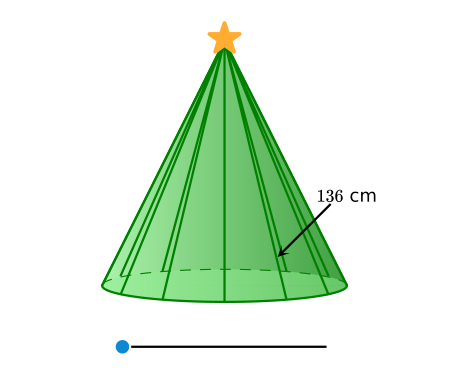 She needs to make some calculations to finish the tree's design.
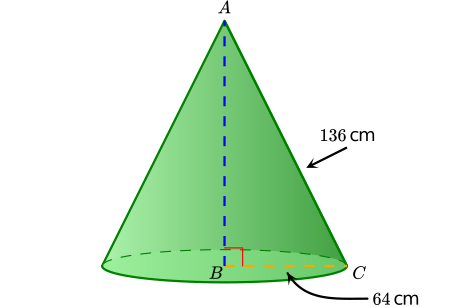 The height, radius, and slant height of the cone form a right triangle, △ABC. Use the Pythagorean Theorem to find the height of the cone, AB.
Since a negative root does not make sense for a side length, consider only the positive root. The height of the cone is 120 centimeters. Now, recall the volume formula of the cone.
The volume of the cone is about 514719 cubic centimeters.
The height, radius, and slant height of the cone form a right triangle, △ABC. Use the Pythagorean Theorem to find the height of the cone, AB.
Since a negative root does not make sense for a side length, consider only the positive root. The height of the cone is 120 centimeters. Now, recall the volume formula of the cone.
The volume of the cone is about 514719 cubic centimeters.
a Help her calculate the volume of the conical Christmas tree. Round the answer to the nearest cubic centimeter.
{"type":"text","form":{"type":"math","options":{"comparison":"1","nofractofloat":false,"keypad":{"simple":true,"useShortLog":false,"variables":["x"],"constants":["PI"]},"rendered":false},"text":"<span class=\"katex\"><span class=\"katex-html\" aria-hidden=\"true\"><\/span><\/span>"},"formTextBefore":"<span class=\"katex\"><span class=\"katex-html\" aria-hidden=\"true\"><span class=\"base\"><span class=\"strut\" style=\"height:0.759765625em;vertical-align:-0.009765625em;\"><\/span><span class=\"mord text\"><span class=\"mord Roboto-Regular\">About<\/span><span class=\"mord\">\u00a0<\/span><\/span><\/span><\/span><\/span>","formTextAfter":"<span class=\"katex\"><span class=\"katex-html\" aria-hidden=\"true\"><span class=\"base\"><span class=\"strut\" style=\"height:0.8238736249999999em;vertical-align:-0.009765625em;\"><\/span><span class=\"mord\"><span class=\"mord text\"><span class=\"mord Roboto-Regular\">cm<\/span><\/span><span class=\"msupsub\"><span class=\"vlist-t\"><span class=\"vlist-r\"><span class=\"vlist\" style=\"height:0.8141079999999999em;\"><span style=\"top:-3.063em;margin-right:0.05em;\"><span class=\"pstrut\" style=\"height:2.7em;\"><\/span><span class=\"sizing reset-size6 size3 mtight\"><span class=\"mord mtight\">3<\/span><\/span><\/span><\/span><\/span><\/span><\/span><\/span><\/span><\/span><\/span>","answer":{"text":["514719"]}}
b Help her calculate the surface area of the conical Christmas tree. Round the answer to the nearest square centimeter.
{"type":"text","form":{"type":"math","options":{"comparison":"1","nofractofloat":false,"keypad":{"simple":true,"useShortLog":false,"variables":["x"],"constants":["PI"]},"rendered":false},"text":"<span class=\"katex\"><span class=\"katex-html\" aria-hidden=\"true\"><\/span><\/span>"},"formTextBefore":"<span class=\"katex\"><span class=\"katex-html\" aria-hidden=\"true\"><span class=\"base\"><span class=\"strut\" style=\"height:0.759765625em;vertical-align:-0.009765625em;\"><\/span><span class=\"mord text\"><span class=\"mord Roboto-Regular\">About<\/span><span class=\"mord\">\u00a0<\/span><\/span><\/span><\/span><\/span>","formTextAfter":"<span class=\"katex\"><span class=\"katex-html\" aria-hidden=\"true\"><span class=\"base\"><span class=\"strut\" style=\"height:0.8238736249999999em;vertical-align:-0.009765625em;\"><\/span><span class=\"mord\"><span class=\"mord text\"><span class=\"mord Roboto-Regular\">cm<\/span><\/span><span class=\"msupsub\"><span class=\"vlist-t\"><span class=\"vlist-r\"><span class=\"vlist\" style=\"height:0.8141079999999999em;\"><span style=\"top:-3.063em;margin-right:0.05em;\"><span class=\"pstrut\" style=\"height:2.7em;\"><\/span><span class=\"sizing reset-size6 size3 mtight\"><span class=\"mord mtight\">2<\/span><\/span><\/span><\/span><\/span><\/span><\/span><\/span><\/span><\/span><\/span>","answer":{"text":["40212"]}}
Hint
a The volume of a cone is one-third of the product of the area of its base and height. Use the Pythagorean Theorem to find the height of the cone.
b The surface area of a cone is the sum of the area of its base and the area of its lateral face.
Solution
a The volume of a cone is one-third of the product of the area of its base and height. The base is already known, therefore, start by calculating the height of the conical Christmas tree. Recall that the distance from the vertex of the cone to its base is the height of the cone. The slant height of the cone is 136 centimeters and a radius is 64 centimeters.
AC2=AB2+BC2
SubstituteII
AC=136, BC=64
1362=AB2+642
▼
Solve for AB
CalcPow
Calculate power
18496=AB2+4096
SubEqn
LHS−4096=RHS−4096
14400=AB2
RearrangeEqn
Rearrange equation
AB2=14400
SqrtEqn
LHS=RHS
AB2=14400
SqrtPowToNumber
a2=a
AB=120
V=31πr2h
Here, r is the radius and h is the height of the cone. Substitute r=64 and h=120 into the volume formula.
V=31πr2h
SubstituteII
r=64, h=120
V=31π(64)2(120)
▼
Evaluate right-hand side
CalcPow
Calculate power
V=31π(4096)(120)
Multiply
Multiply
V=31⋅π⋅491520
MoveRightFacToNumOne
b1⋅a=ba
V=3491520π
CalcQuot
Calculate quotient
V=163840π
UseCalc
Use a calculator
V=514718.540364…
RoundInt
Round to nearest integer
V≈514719
b This time, the surface area of the cone will be calculated. Recall that the surface area of a cone is the sum of the base area and lateral face.
SA=πr2+πrℓ
Note that the radius of the base r is 64 centimeters and the slant height of the cone ℓ is 136 centimeters. Substitute these two values into the formula.
The conical tree will be about 40212 square centimeters. Note that this means Tiffaniqua needs to have at least 40212 square centimeters green paper to design the moving Christmas tree.
Pop Quiz
Practice Finding the Volume and Surface Area of a Cone
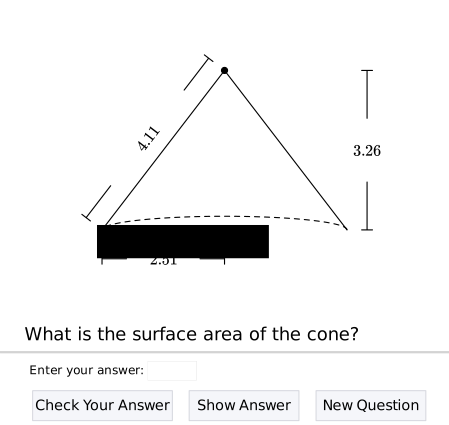
The applet shows right cones. The dimensions of the figure are given in decimeters. Use the given information to answer the question. If necessary, round the answer to one decimal place.
Discussion
Sphere
The next 3D figure of the lesson is a perfectly rounded figure called the sphere.
Concept
Sphere
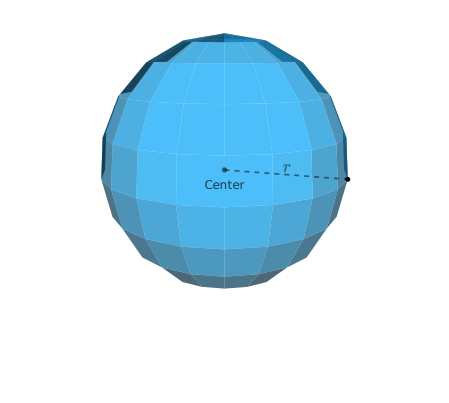
Now, how to calculate the volume and surface area of a sphere will be examined.
Rule
Volume of a Sphere
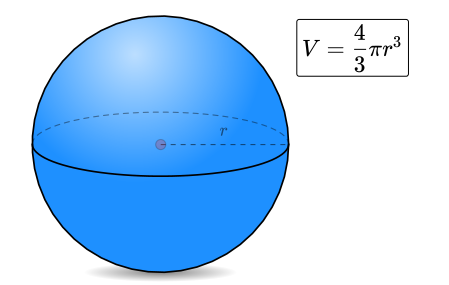
Rule
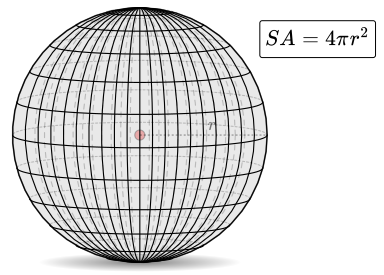
Surface Area of a Sphere
The surface area of a sphere with radius r is four times pi multiplied by the radius squared.
Example
Finding the Volume and Radius of a Sphere
It snowed a lot before winter break. Tiffaniqua's school organized an inter-class snowperson competition on the last day before the holiday. The person who makes the biggest snowperson wins.  Tiffaniqua and her class worked together. They decided to make two huge spherical snowballs. Then, they will put them on top of each other and shape the snowmperson. They plan that the head of the snowperson will have 1 meter of radius and the body will have 32 square meters surface area.
a Calculate the volume of a spherical snowball with a radius of 1 meter. Round the answer to the nearest cubic meter.
{"type":"text","form":{"type":"math","options":{"comparison":"1","nofractofloat":false,"keypad":{"simple":true,"useShortLog":false,"variables":["x"],"constants":["PI"]},"rendered":false},"text":"<span class=\"katex\"><span class=\"katex-html\" aria-hidden=\"true\"><\/span><\/span>"},"formTextBefore":null,"formTextAfter":"<span class=\"katex\"><span class=\"katex-html\" aria-hidden=\"true\"><span class=\"base\"><span class=\"strut\" style=\"height:0.8141079999999999em;vertical-align:0em;\"><\/span><span class=\"mord\"><span class=\"mord text\"><span class=\"mord Roboto-Regular\">m<\/span><\/span><span class=\"msupsub\"><span class=\"vlist-t\"><span class=\"vlist-r\"><span class=\"vlist\" style=\"height:0.8141079999999999em;\"><span style=\"top:-3.063em;margin-right:0.05em;\"><span class=\"pstrut\" style=\"height:2.7em;\"><\/span><span class=\"sizing reset-size6 size3 mtight\"><span class=\"mord mtight\">3<\/span><\/span><\/span><\/span><\/span><\/span><\/span><\/span><\/span><\/span><\/span>","answer":{"text":["4"]}}
b Calculate the radius of a spherical snowball with a surface area of 32 square meters. Round the answer to one decimal place.
{"type":"text","form":{"type":"math","options":{"comparison":"1","nofractofloat":false,"keypad":{"simple":true,"useShortLog":false,"variables":["x"],"constants":["PI"]},"rendered":false},"text":"<span class=\"katex\"><span class=\"katex-html\" aria-hidden=\"true\"><\/span><\/span>"},"formTextBefore":null,"formTextAfter":"<span class=\"katex\"><span class=\"katex-html\" aria-hidden=\"true\"><span class=\"base\"><span class=\"strut\" style=\"height:0.5380859375em;vertical-align:0em;\"><\/span><span class=\"mord text\"><span class=\"mord Roboto-Regular\">m<\/span><\/span><\/span><\/span><\/span>","answer":{"text":["1.6"]}}
Hint
a Recall the formula for the volume of a sphere.
b Recall the formula for the surface area of a sphere.
Solution
a Start by recalling the formula for the volume of a sphere.
V=34πr3
It is known that the radius of the spherical snowball will be 1 meter. Substitute r=1 into the formula and calculate V.
V=34πr3
Substitute
r=1
V=34π(1)3
BaseOne
1a=1
V=34π⋅1
IdPropMult
Identity Property of Multiplication
V=34π
UseCalc
Use a calculator
V=4.188790…
RoundInt
Round to nearest integer
V≈4
b In the second scenario, they plan to make a snowball that has 32 square meters surface area. Recall the formula for the surface area of a sphere.
SA=4πr2
Now, substitute SA=32 into the formula to find r.
SA=4πr2
Substitute
SA=32
32=4πr2
▼
Solve for r
DivEqn
LHS/4π=RHS/4π
4π32=r2
RearrangeEqn
Rearrange equation
r2=4π32
SqrtEqn
LHS=RHS
r2=4π32
SqrtPowToNumber
a2=a
r=4π32
UseCalc
Use a calculator
r=1.595769…
RoundDec
Round to 1 decimal place(s)
r≈1.6
Discussion
Hemisphere
The final figure is the half of a sphere which is called hemisphere.
Concept
Hemisphere
A hemisphere is a three-dimensional object formed by half of a sphere and a flat circular base. Any plane that goes through the center of a sphere divides it into two hemispheres.
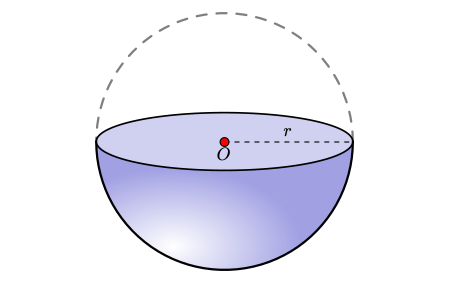
VolumeV=32πr3
The surface area of a hemisphere with radius r is the circular flat area plus half the surface area of a sphere with radius r. Surface Area2πr2+πr2=3πr2
Example
Finding the Surface Area and Radius of a Hemisphere
Tiffaniqua's father bought a big snow globe as a gift for her Christmas present.
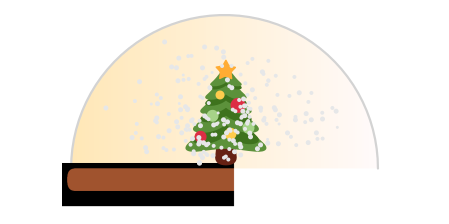
a Since this is a present for Tiffaniqua, her father wants to use beautiful wrapping paper to make it even more special. The radius of the hemispherical part is 11 centimeters. Help him to find the surface area of this present to determine the amount of the wrapping paper. Round the answer to the nearest square centimeter.
{"type":"text","form":{"type":"math","options":{"comparison":"1","nofractofloat":false,"keypad":{"simple":true,"useShortLog":false,"variables":["x"],"constants":["PI"]},"rendered":false},"text":"<span class=\"katex\"><span class=\"katex-html\" aria-hidden=\"true\"><\/span><\/span>"},"formTextBefore":null,"formTextAfter":"<span class=\"katex\"><span class=\"katex-html\" aria-hidden=\"true\"><span class=\"base\"><span class=\"strut\" style=\"height:0.8238736249999999em;vertical-align:-0.009765625em;\"><\/span><span class=\"mord\"><span class=\"mord text\"><span class=\"mord Roboto-Regular\">cm<\/span><\/span><span class=\"msupsub\"><span class=\"vlist-t\"><span class=\"vlist-r\"><span class=\"vlist\" style=\"height:0.8141079999999999em;\"><span style=\"top:-3.063em;margin-right:0.05em;\"><span class=\"pstrut\" style=\"height:2.7em;\"><\/span><span class=\"sizing reset-size6 size3 mtight\"><span class=\"mord mtight\">2<\/span><\/span><\/span><\/span><\/span><\/span><\/span><\/span><\/span><\/span><\/span>","answer":{"text":["1140"]}}
b Her father also has a box in the shape of a hemisphere to put the gift into it. The box has the volume of 3 cubic centimeters. Does the snow globe fit this box?
{"type":"choice","form":{"alts":["Yes","No"],"noSort":false},"formTextBefore":"","formTextAfter":"","answer":0}
Hint
a Recall the surface area formula of a hemisphere.
b Recall the volume formula of a hemisphere.
Solution
a The snow globe has a radius of 11 centimeters. Notice that the surface area of this hemispherical globe consists of a circular base and a half of the surface area of a sphere with the same radius, 11 centimeters. Recall the sum of these formulas.
SA=2πr2+πr2=3πr2
Now, substitute r=11 centimeters into the formula and calculate it.
SA=3πr2
Substitute
r=11
SA=3π(11)2
CalcPow
Calculate power
SA=3π⋅121
Multiply
Multiply
SA=363π
UseCalc
Use a calculator
SA=1140.398133…
RoundInt
Round to nearest integer
SA≈1140
b This time, the volume of the snow globe will be calculated. Recall that the volume of a hemisphere is half of the volume of sphere with the same radius.
Notice that the box is 3 cubic decimeters. Multiply it by 100 to convert cubic decimeters to cubic centimeters.
V=32πr3
Now, substitute r=11 into the volume formula.
V=32πr3
Substitute
r=11
V=32π(11)3
CalcPow
Calculate power
V=32π(1331)
MoveRightFacToNum
ca⋅b=ca⋅b
V=32662π
UseCalc
Use a calculator
V=2787.639881…
RoundInt
Round to nearest integer
V≈2788
3 dm 3=3000 cm3
Since the volume of the box is greater than 2788 cubic centimeters, the gift fits this box. The answer is yes. Pop Quiz
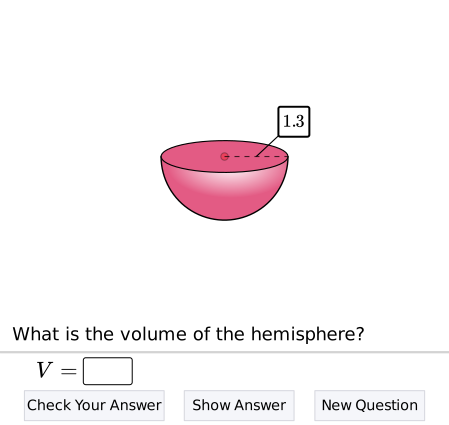
Finding the Volume or Surface Area of Different Spheres and Hemispheres
In the following applet, calculate either the volume or the surface area of the given sphere or hemisphere. The radius is given in centimeters. Round the answer to the nearest integer.
Closure
Calculating the Volumes of Cones and Cylinders
The challenge presented at the beginning of this lesson said that Tiffaniqua and her grandmother filled a cone-shaped cup with flour and poured it into a cylindrical cup.
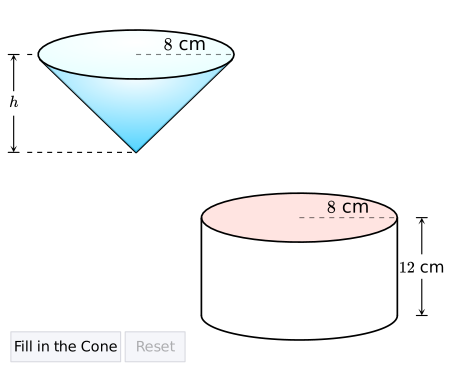 It is given that the cylindrical cup and cone-shaped cup have the same radius of 8 centimeters. The height of the cylindrical cup is 12 centimeters. What is the height of the cone-shaped cup if she fills up the the cylinder after needing to pour into it three times?
{"type":"text","form":{"type":"math","options":{"comparison":"1","nofractofloat":false,"keypad":{"simple":true,"useShortLog":false,"variables":["x"],"constants":["PI"]},"rendered":false},"text":"<span class=\"katex\"><span class=\"katex-html\" aria-hidden=\"true\"><\/span><\/span>"},"formTextBefore":null,"formTextAfter":"cm","answer":{"text":["12"]}}
Hint
The volume of a cylinder is equal to the product of its base area and height. The volume of a cone is equal to one third of the product of its base area and height.
Solution
It is a given that the cylindrical cup is filled up by the given cone-shaped cup after three pours. This means that the volume of the given cylinder is equal to three times the volume of the given cone.
The height of the cone-shaped cup is 12 centimeters. It can be concluded that if the volume of a cylinder is three times the volume of a cone and their radii are the same then their heights should also be the same.
Vcylinder=3×Vcone
Recall that the volume of a cylinder is equal to the product of its base area and height. The volume of a cone is equal to one-third of the product of its base area and height. Note that both have circular bases.
Vcylinder=πr12h1Vcone=31πr22h2
Notice that both circular bases have the same radius. That is, r1=r2=8 centimeters. Now, substitute the radii, h1=h, and h2=12 into the corresponding formulas. Then, multiply the volume of the cone by 3 and set it equal to the volume of the cylinder.
Vcylinder=3×Vcone⇓π(8)2(h)=3⋅31π(8)2(12)
Simplify the obtained equation and solve it for h.
π(8)2(h)=3⋅31π(8)2(12)
▼
Solve for h
MoveLeftFacToNumOne
a⋅b1=ba
π(8)2(h)=33π(8)2(12)
CalcQuot
Calculate quotient
π(8)2(h)=1π(8)2(12)
IdPropMult
Identity Property of Multiplication
π(8)2(h)=π(8)2(12)
DivEqn
LHS/(π82)=RHS/(π82)
π(8)2π(8)2(h)=π(8)2π(8)2(12)
CancelCommonFac
Cancel out common factors
π(8)2π(8)2(h)=π(8)2π(8)2(12)
SimpQuot
Simplify quotient
h=12
Loading content