1. Three Dimensional Figures and Cross Sections
Sign In
An error ocurred, try again later!
Chapter 10
1.
Three Dimensional Figures and Cross Sections
Understanding three-dimensional figures and their cross-sections is fundamental in geometry and its applications. These concepts allow for the visualization and analysis of shapes in real-world contexts, helping to identify their properties, relationships, and dimensions. Exploring elements such as solids, planes, and nets provides clarity on how these figures can be constructed, deconstructed, and visualized. Practical uses include designing objects, interpreting technical drawings, and solving spatial problems. By examining cross-sections of figures like prisms, cylinders, cones, and pyramids, insights into their structure and geometry are revealed. This understanding is key for mastering spatial reasoning and mathematical problem-solving, which are widely applicable across fields like architecture, engineering, and science.
Show less Show more expand_more 


Lesson Settings & Tools
| | 20 Theory slides |
| | 10 Exercises - Grade E - A |
| | Each lesson is meant to take 1-2 classroom sessions |
Three Dimensional Figures and Cross Sections
Slide of 20
People live in a three-dimensional world and are surrounded by many three-dimensional figures. This lesson will explore some of the different types of 3D figures that are commonly studied in math and analyze their cross-sections.
Catch-Up and Review
Here is a recommended reading before getting started with this lesson.
Explore
Share
Report error
Comparing the Cross-Sections of Two 3D Figures
Consider two different 3D figures. A plane parallel to their bases passes through both of them, creating their cross-sections.
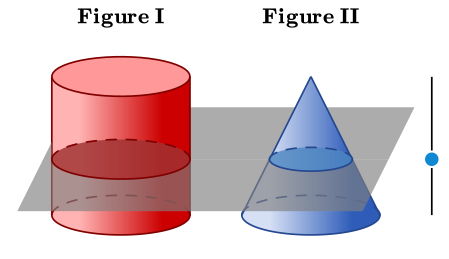 What conclusions can be made about the cross-sections of Figure I? Are the cross-sections all the same or different? What about the cross-sections of Figure II?
Discussion
Share
Report error
Three-Dimensional Figures
Most objects in the real world have three dimensions. Consider the definition of a three-dimensional figure.
Concept
Share
Report error
Three-Dimensional Figure
A three-dimensional figure is a geometrical figure that has three dimensions — length, width, and height. Unlike two-dimensional figures, three-dimensional figures have height, which can also be referred to as thickness or depth.
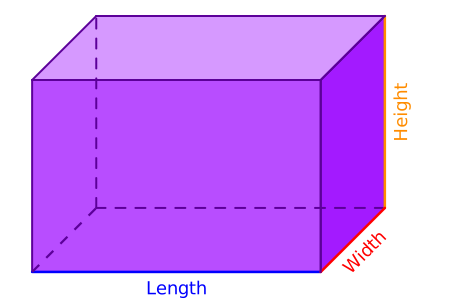
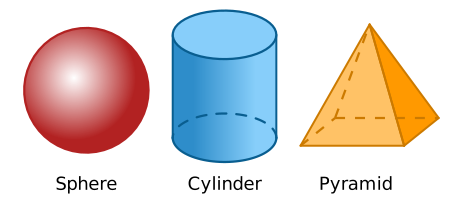
All three-dimensional figures occupy space, which is measured in terms of volume. Some examples of basic three-dimensional figures are spheres, cones, pyramids, cubes, and prisms.
Three-dimensionalis often written as
3D,so these figures are commonly called 3D figures.
Discussion
Share
Report error
Solid
A solid is a stable three-dimensional object with its interior completely filled. An object containing a fluid, for example, is not a solid. Solids are completely enclosed, occupy space, and have a definite shape and volume. Solids can have flat faces, curved surfaces, or a combination of both. Here are some examples of solids.
Discussion
Share
Report error
Net of a Solid
A net of a solid is a two-dimensional representation of a three-dimensional figure. A net shows all the faces of a figure in one view and can be folded
into the three-dimensional shape.
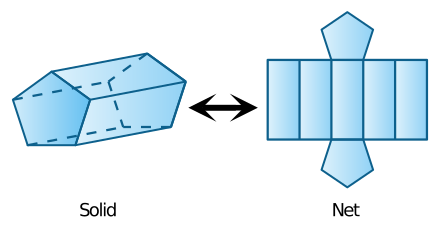
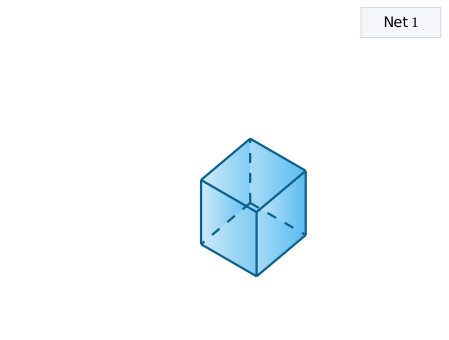
Note that the net of a solid is not unique, as a three-dimensional figure can have multiple nets. However, the area of each net of a solid is always the same and is equal to the surface area of the solid.
Example
Share
Report error
Matching Solids With Their Nets
Dominika is playtesting a new video game that her friend made. Every single thing in the game is a 3D geometric object. On the first level of the game, her character is hosting a party where her friends give her many cool presents. 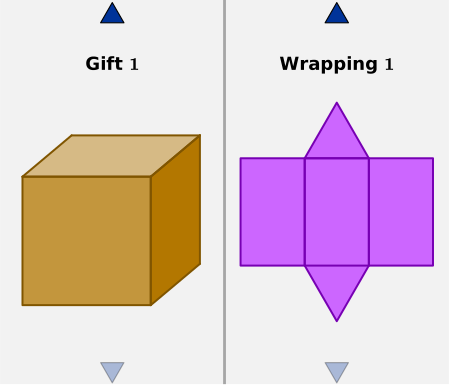 Dominika is very excited to open all the presents! Only later she realizes that the names of gift-givers are written on the wrapping paper of the presents. Dominika is asked to figure out who gave her which gift and send thank you cards, so she needs to match the wrapping paper to the gifts.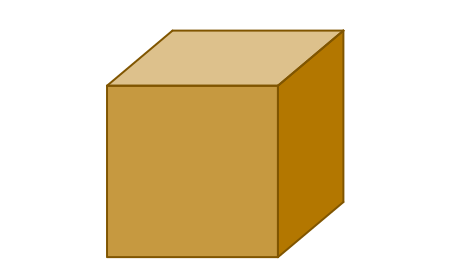
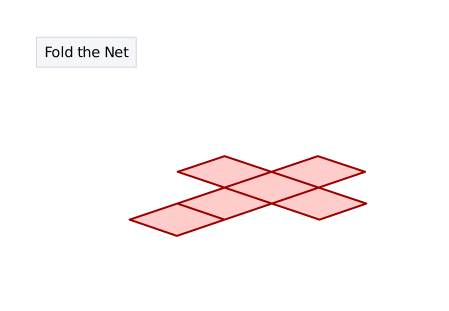
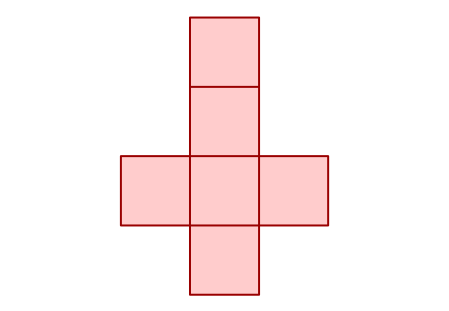 Therefore, Wrapping 3 corresponds to Gift 1. See how this wrapping can be folded into a cube.
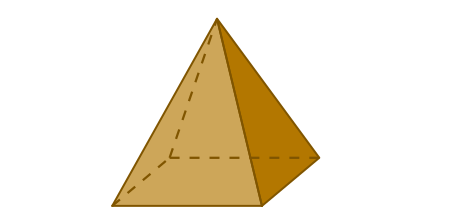
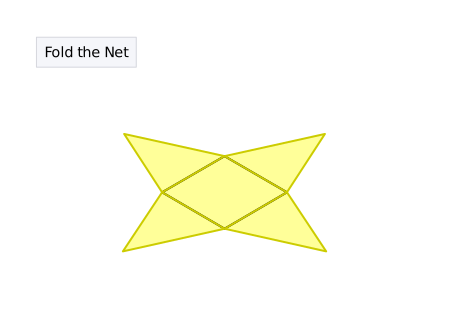
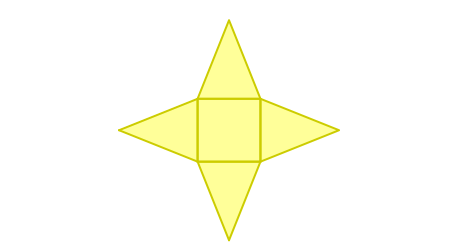 Therefore, Wrapping 4 is the wrapping of Gift 2. See how it can be folded into a pyramid.
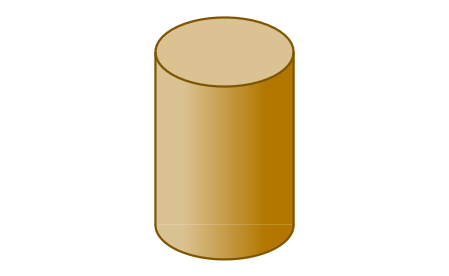
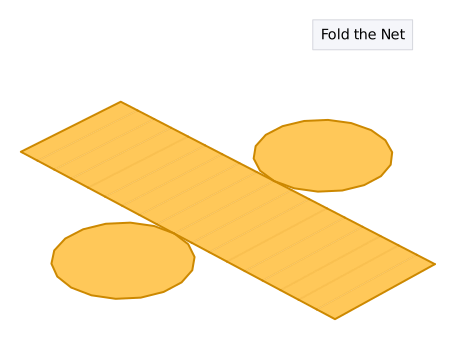
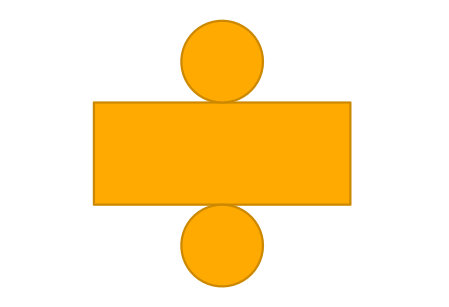 Looking at all the given wrapping options, only Wrapping 2 has a rectangle with two circles attached to the sides. This means that Gift 3 corresponds to Wrapping 2.
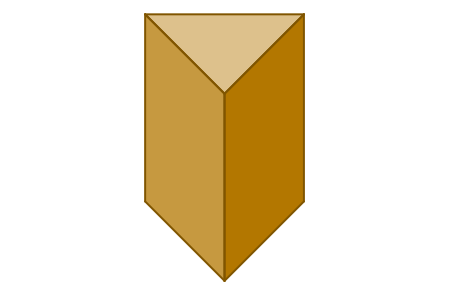
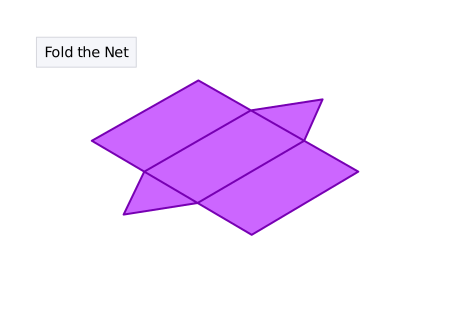
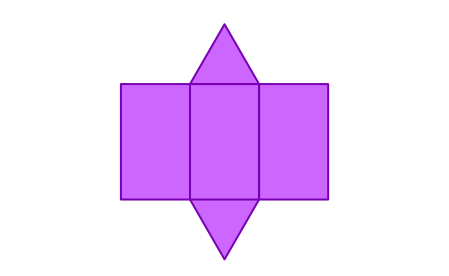 Wrapping 1 consists of three rectangles and two triangles, so it matches the surface of Gift 4 perfectly.
{"type":"pair","form":{"alts":[[{"id":0,"text":"Gift1"},{"id":1,"text":"Gift2"},{"id":2,"text":"Gift3"},{"id":3,"text":"Gift4"}],[{"id":0,"text":"Wrapping1"},{"id":1,"text":"Wrapping2"},{"id":2,"text":"Wrapping3"},{"id":3,"text":"Wrapping4"}]],"lockLeft":true,"lockRight":false},"formTextBefore":"","formTextAfter":"","answer":[[0,1,2,3],[2,3,1,0]]}
Hint
Analyze the surface of each gift. Do their sides resemble any geometric figures such as squares, rectangles, triangles, or circles? Find the wrapping paper that consists of the same figures.
Solution
To match the gifts to their wrapping paper, the shape of each gift will be analyzed. Notice that wrappings match the shape of the surface of each gift. This means that the wrapping papers are basically the nets of the solids.
Gift 1
First, consider the first gift.
It has the shape of a cube. Including the sides of the box not visible from this angle, there are 6 square sides. Therefore, its net will be made up of exactly 6 squares that can be folded into a cube. Now consider the given wrapping papers. Wrapping 3 consists of exactly 6 squares, so it matches the sides of the gift box perfectly.
Gift 2
Now consider the shape of the Gift 2.
This gift box has four triangular sides and a rectangular or square base. This means that the matching wrapping should consist of a rectangle or a square and four triangles attached in a way that allows it to be folded into a pyramid. Notice that Wrapping 4 matches this description!
Gift 3
This time consider the shape of the Gift 3.
This gift box has two circular parallel bases joined by a curved side surface. The curved surface could be covered by a long rectangular piece of wrapping paper. To cover the circular bases, there should be two circles attached to the longer sides of the rectangle. In other words, its net would be a rectangle with two circles attached.
Gift 4
Finally, examine the shape of Gift 4.
It has two triangular bases at the top and bottom connected by three rectangular lateral sides. Look for a net that consists of these parts to find the match.
Discussion
Share
Report error
Definition of a Plane
Visualize a flat surface in a three-dimensional environment, such as a tabletop or a sheet of paper. How can this object be described?
Concept
Share
Report error
Plane
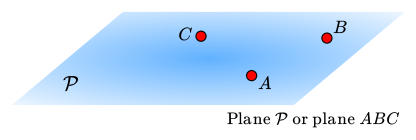
A plane is a two-dimensional object that has infinite width and length but no height. An endless sheet of paper can represent a plane. A plane can be named by using three points on it or by using a capital letter.
Discussion
Share
Report error
Coplanar Points
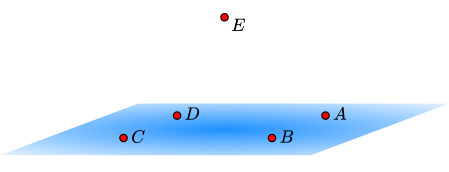
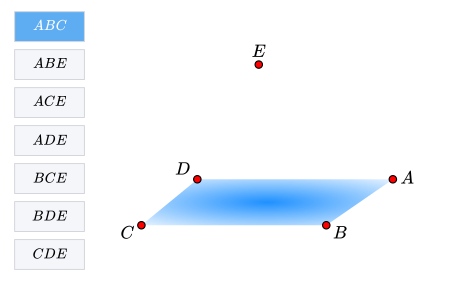
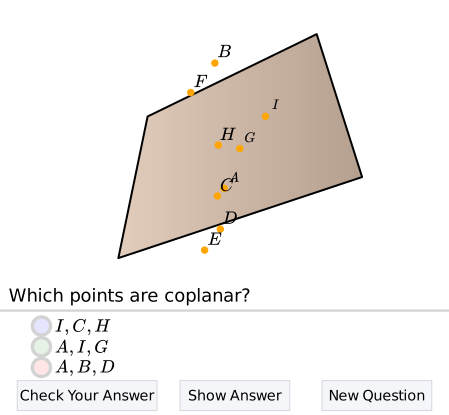
Any set of points that lie on the same plane are said to be coplanar.
Pop Quiz
Share
Report error
Points and Planes
Discussion
Share
Report error
Positions of Two Planes
Two planes can have three positions in respect to each other:
- They can overlap. In that case, the planes are essentially the same plane and cannot be distinguished from each other.
- They can intersect. In that case, they share a common line.
- They can be parallel.
Here is a deeper dive into the last case.
Concept
Share
Report error
Parallel Planes
Two distinct planes are called parallel if they never intersect each other, similar to parallel lines. Parallel planes do not share any common lines or points.
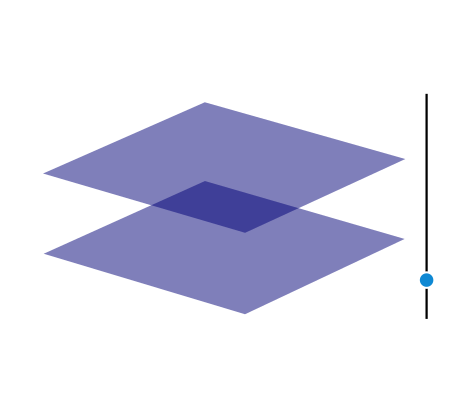 Parallel planes are denoted by using the symbol
∥.For example, parallel planes P and M can be denoted as P || M.
Discussion
Share
Report error
Cross-Sections of Solids
Discussion
Share
Report error
Polyhedron
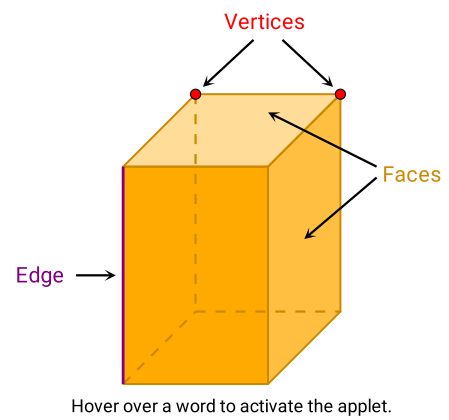
A polyhedron is a three-dimensional figure whose surfaces are polygons. Each of these polygons is a face of the polyhedron. An edge is a segment formed by the intersection of two faces. A vertex is a point where three or more edges meet.
Example
Share
Report error
Coloring the Polyhedron by Parts
On the next level, Dominika sees a huge polyhedron with an interesting shape. She is asked to paint its parts in different colors: the vertices in purple, the edges in pink, and the faces in a darker shade of blue.
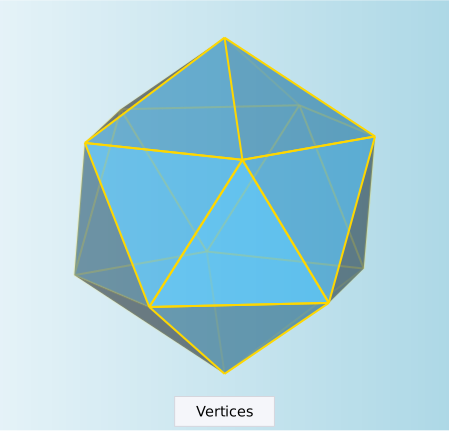 Complete this task along with Dominika! Write the names of all the vertices, edges, and faces while painting them in the needed colors. How many vertices, edges, and faces does this polyhedron have?
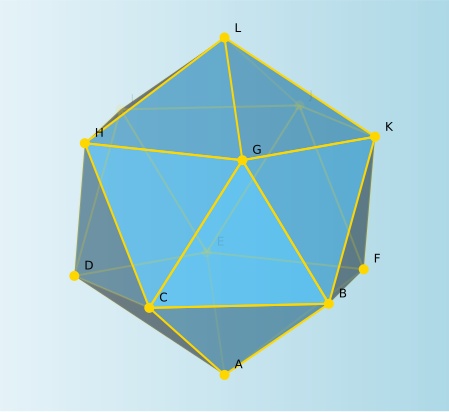 Click on each vertex to paint it purple, then write out the list of vertices.
Vertices: A, B, C, D, E, F, G, H, I, J, K, L
There are in total 12 vertices in this polyhedron. Next, consider the edges of the polyhedron. These are the segments between each pair of vertices and are often named using the two capital letters of the vertices.
Click on each vertex to paint it purple, then write out the list of vertices.
Vertices: A, B, C, D, E, F, G, H, I, J, K, L
There are in total 12 vertices in this polyhedron. Next, consider the edges of the polyhedron. These are the segments between each pair of vertices and are often named using the two capital letters of the vertices.
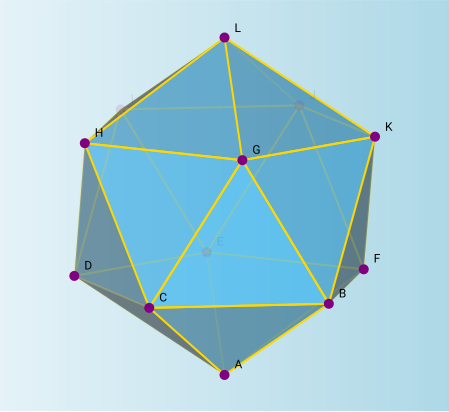 Click on each edge to paint it pink, then write out the list of edges.
Edges: ccccc
AB,& AC,& AD,& AE,& AF, BF,& BK,& BG,& BC,& CG, CH,& CD,& DH,& DI,& DE, EI,& EJ,& EF,& FJ,& FK, KJ,& KL,& KG,& GL,& GH, HL,& HI,& IL,& IJ,& LJ
This polyhedron has a total of 30 edges. Finally, consider the faces of the polyhedron. These are the polygons that make up the surface of the polyhedron. Each face can be named by the vertices that make it up.
Click on each edge to paint it pink, then write out the list of edges.
Edges: ccccc
AB,& AC,& AD,& AE,& AF, BF,& BK,& BG,& BC,& CG, CH,& CD,& DH,& DI,& DE, EI,& EJ,& EF,& FJ,& FK, KJ,& KL,& KG,& GL,& GH, HL,& HI,& IL,& IJ,& LJ
This polyhedron has a total of 30 edges. Finally, consider the faces of the polyhedron. These are the polygons that make up the surface of the polyhedron. Each face can be named by the vertices that make it up. 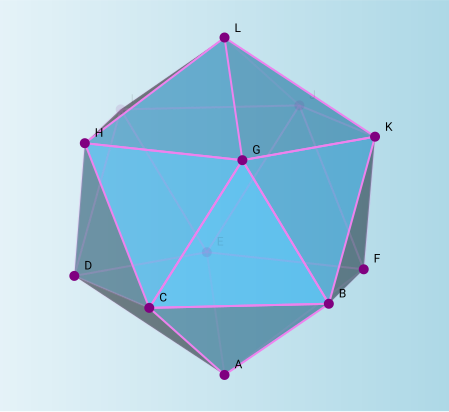 Click on each face to paint it in a darker shade of blue color, then write down a complete list of the faces.
ccccc
& & Faces:& & ABC, & ACD, & ADE, & AEF, & ABF, BCG, & CHG, & CDH, & DHI, & DEI, EJI, & EFJ, & FKJ, & BFK, & BGK, GKL, & GHL, & HIL, & JIL, & JKL
There are 20 faces in total. Dominika has successfully painted the whole polyhedron in its new colors!
Click on each face to paint it in a darker shade of blue color, then write down a complete list of the faces.
ccccc
& & Faces:& & ABC, & ACD, & ADE, & AEF, & ABF, BCG, & CHG, & CDH, & DHI, & DEI, EJI, & EFJ, & FKJ, & BFK, & BGK, GKL, & GHL, & HIL, & JIL, & JKL
There are 20 faces in total. Dominika has successfully painted the whole polyhedron in its new colors!
{"type":"text","form":{"type":"math","options":{"comparison":"1","nofractofloat":false,"keypad":{"simple":true,"useShortLog":false,"variables":[],"constants":[]},"rendered":false},"text":" "},"formTextBefore":"Number of Vertices:","formTextAfter":null,"answer":{"text":["12"]}}
{"type":"text","form":{"type":"math","options":{"comparison":"1","nofractofloat":false,"keypad":{"simple":true,"useShortLog":false,"variables":[],"constants":[]},"rendered":false},"text":" "},"formTextBefore":"Number of Edges:","formTextAfter":null,"answer":{"text":["30"]}}
{"type":"text","form":{"type":"math","options":{"comparison":"1","nofractofloat":false,"keypad":{"simple":true,"useShortLog":false,"variables":[],"constants":[]},"rendered":false},"text":" "},"formTextBefore":"Number of Faces:","formTextAfter":null,"answer":{"text":["20"]}}
Hint
Recall the definitions of the vertices, edges, and faces of a polyhedron.
Solution
It is given that Dominika needs to paint different parts of the polyhedron in different colors. First, recall the definitions of a face, an edge, and a vertex of a polyhedron.
|
A face is a flat surface of a polyhedron in the shape of a polygon. |
Discussion
Share
Report error
Prisms and Their Cross-Sections
An often used type of solid that can be found in various forms in the real world is the prism.
Concept
Share
Report error
Prism
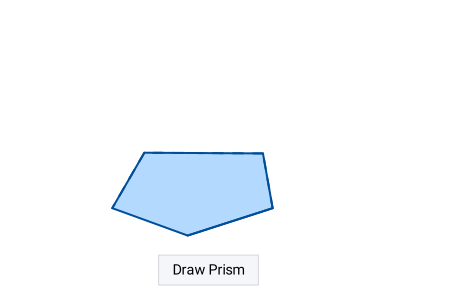
A prism is a three-dimensional object created by connecting a polygon with a translated version of the same polygon, vertex to vertex. The two parallel congruent polygons are called bases. The other faces are called lateral faces. The intersection of two lateral faces is called a lateral edge.
 A prism with perpendicular lateral faces and bases is a right prism. Otherwise, it is is called an oblique prism. The lateral faces of a prism can either be rectangles or parallelograms. In an oblique prism, at least one lateral face must be a parallelogram. In contrast, in a right prism, all lateral faces are rectangles.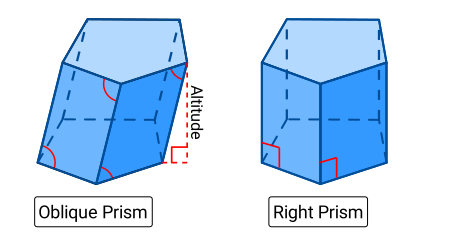
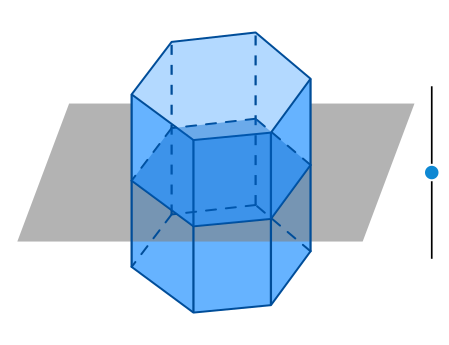
When a plane is drawn through a prism, it creates a cross-section of the prism. It is important to note that all cross-sections that are parallel to a base of a prism are identical to each other and to the base.
Example
Share
Report error
Identifying Prisms
Dominika successfully painted the polyhedron and beat the level in the game. On the next level, she appears in a completely dark room. Different solids are placed in the middle of the room. Dominika needs to identify the prisms because they have things inside of them needed for the next levels. 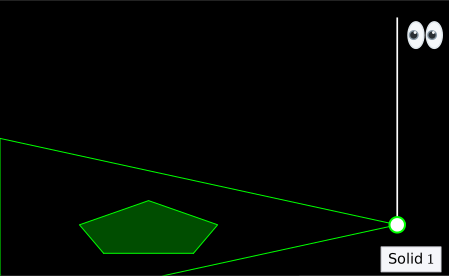 She can only use a laser that x-rays the entire room parallel to the floor and makes the outline of the solid visible. Which solids should she identify as prisms?
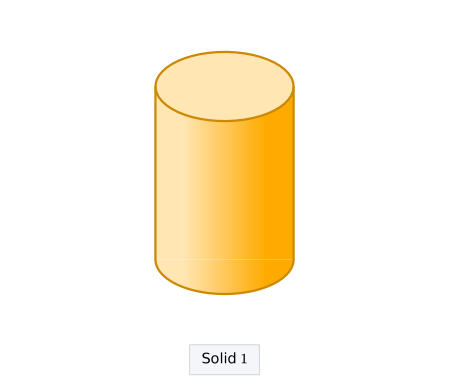
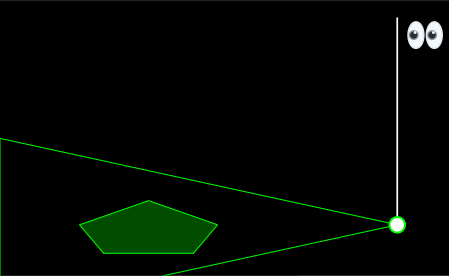 All the cross-sections are pentagons of different sizes. The cross-section at the bottom of the solid has the greatest area. As the laser moves up, the pentagons get smaller and smaller. The last visible cross-section seems to be a point. Since the cross-sections are not identical, this solid is not a prism.
Solid1: Not a prism *
All the cross-sections are pentagons of different sizes. The cross-section at the bottom of the solid has the greatest area. As the laser moves up, the pentagons get smaller and smaller. The last visible cross-section seems to be a point. Since the cross-sections are not identical, this solid is not a prism.
Solid1: Not a prism * 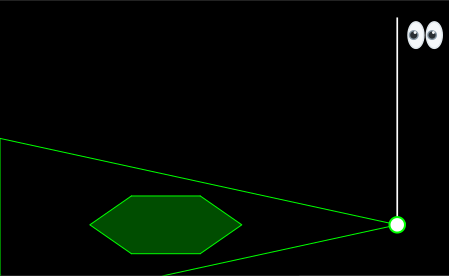 All the cross-sections are hexagons of the same size. This means that the solid is a prism with hexagonal bases. Solid2: A prism ✓
The first box with goods has been found!
All the cross-sections are hexagons of the same size. This means that the solid is a prism with hexagonal bases. Solid2: A prism ✓
The first box with goods has been found! 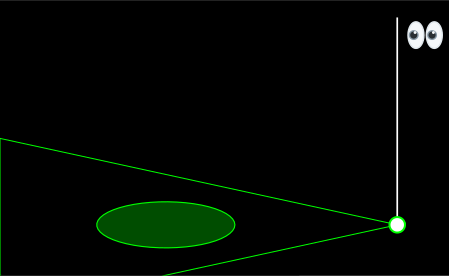 The cross-sections are ellipses that might be circles. They all have the same size, which fulfills the requirement about the cross-sections being identical. However, the lateral faces of prisms are parallelograms and the bases are polygons. This solid has a smooth, curved lateral surface and the bases are ellipses, which are not polygons. Therefore, this is not a prism.
Solid3: Not a prism *
The cross-sections are ellipses that might be circles. They all have the same size, which fulfills the requirement about the cross-sections being identical. However, the lateral faces of prisms are parallelograms and the bases are polygons. This solid has a smooth, curved lateral surface and the bases are ellipses, which are not polygons. Therefore, this is not a prism.
Solid3: Not a prism * 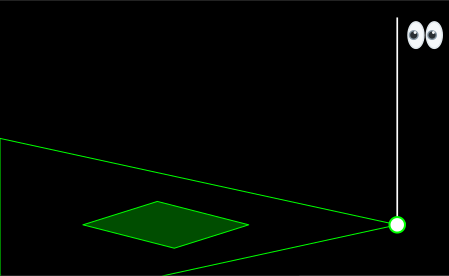 The cross-sections are parallelograms that could possibly be rectangles or even squares. They are all the same size. This suggests that the solid is a prism.
Solid4: A prism ✓
Notice that the cross-sections in this prism are not located strictly on top of each other like they were in previous three solids — instead, the cross-sections seem to move a little to the right as the laser moves up. This indicates that the solid is an oblique prism.
The cross-sections are parallelograms that could possibly be rectangles or even squares. They are all the same size. This suggests that the solid is a prism.
Solid4: A prism ✓
Notice that the cross-sections in this prism are not located strictly on top of each other like they were in previous three solids — instead, the cross-sections seem to move a little to the right as the laser moves up. This indicates that the solid is an oblique prism.
{"type":"multichoice","form":{"alts":["Solid 1 ","Solid 2","Solid 3","Solid 4"],"noSort":true},"formTextBefore":"","formTextAfter":"","answer":[1,3]}
Hint
Recall the definition of a prism. What geometric shapes can the bases and lateral faces of a prism have? Use the fact that all cross-sections of a prism parallel to the base are the same.
Solution
Dominika is asked to identify which solids are prisms. First, recall the definition of a prism.
|
Definition of a Prism |
|
A prism is a polyhedron where two faces, called bases, are congruent polygons lying in parallel planes, and the remaining faces are parallelograms that have common sides with these polygons. |
Notice that the laser scans the room and each solid parallel to the floor and, therefore, to the base of the solid. This means that the laser shows cross-sections of solids parallel to their bases. Since Dominika needs to identify all the prisms, she can use the following fact to guide her.
|
All cross-sections of a prism parallel to a base are identical to each other and to the base. |
Now, examine the cross-sections of each given solid one at a time.
Solid 1
Start by analyzing the cross-sections of Solid 1.Solid 2
Next, consider the cross-sections of Solid 2.Solid 3
This time examine the cross-sections of Solid 3.Solid 4
Lastly, analyze the cross-sections of Solid 4.Discussion
Share
Report error
Other Types of Solids
Not all solids are prisms. Some might have curved sides or not have two identical polygonal bases. This section will introduce a few nonprismatic solids.
Concept
Share
Report error
Cylinder
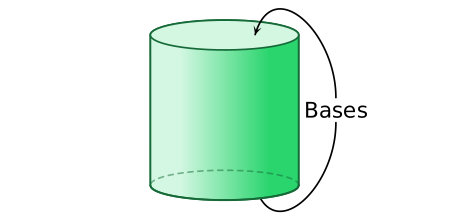
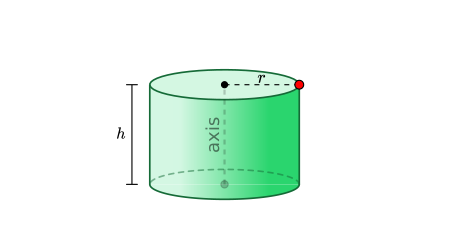
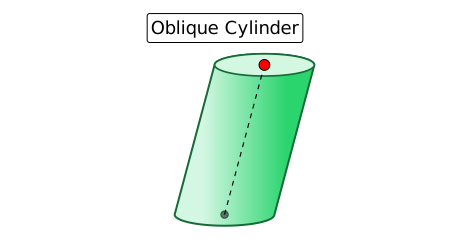
A cylinder is a three-dimensional figure that has two circular bases that are parallel and equal in size, connected by a curved surface.
Discussion
Share
Report error
Cone
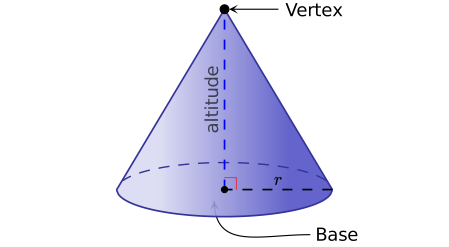
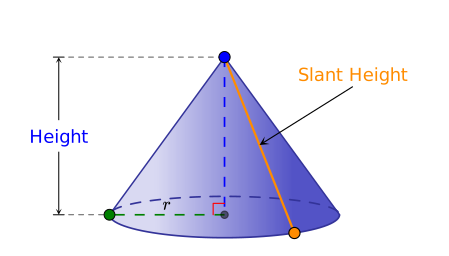
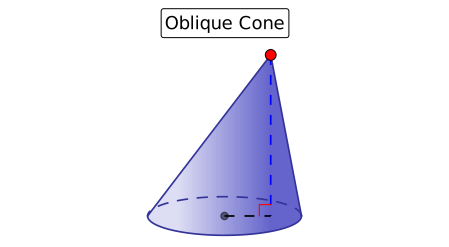
A cone is a three-dimensional solid with a circular base and a point, called the vertex or apex, that is not in the same plane as the base. The altitude of a cone is the segment that runs perpendicularly from the vertex to the base.
Discussion
Share
Report error
Pyramid
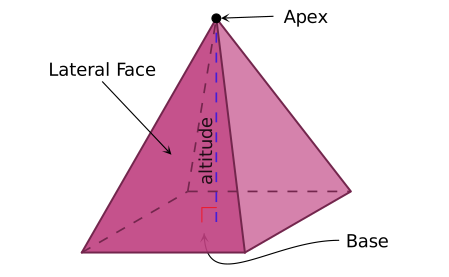
A pyramid is a polyhedron that has a base, which can be any polygon, and faces that are triangular and meet at a vertex called the apex. The triangular faces are called lateral faces. The altitude of a pyramid is the perpendicular segment that connects the apex to the base, similar to the altitude of a triangle.
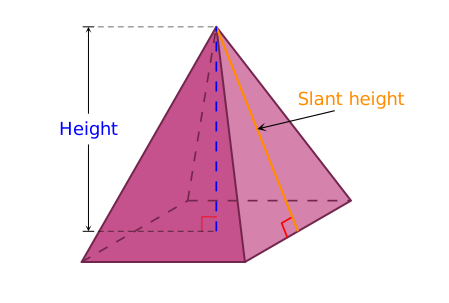
The length of the altitude is the height of the pyramid. If a pyramid has a regular polygon as its base and congruent, isosceles triangles as its lateral faces, it is called a regular pyramid. The altitude of each lateral face in a regular pyramid is also known as the slant height of the pyramid.
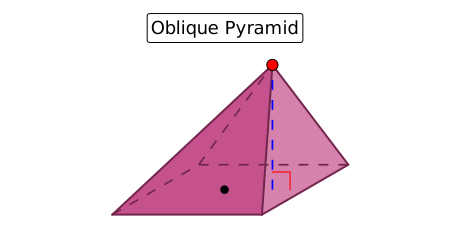
If the apex of the pyramid is over the center of its base, it is called a right pyramid. Otherwise, it is called an oblique pyramid.
Pop Quiz
Share
Report error
Identifying Different Solids
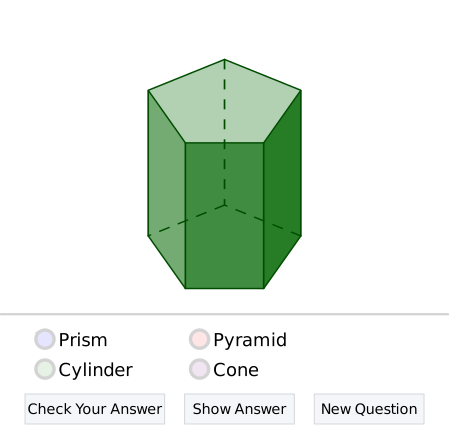
Closure
Share
Report error
Space Occupied by a Solid
In this lesson, different three-dimensional figures were introduced. Consider the Venn diagram that illustrates the relations between some of the concepts covered this lesson.
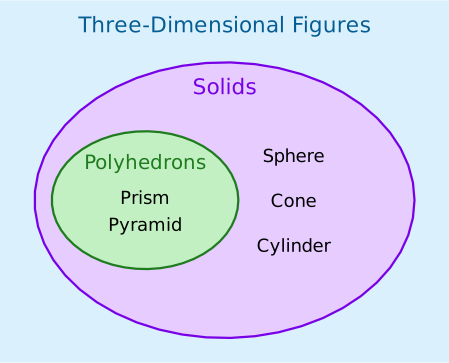
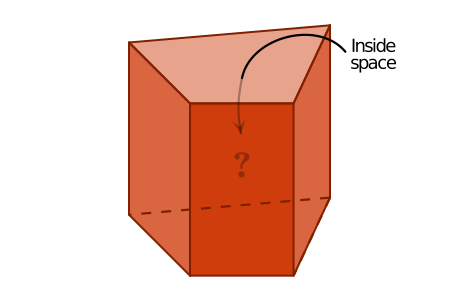
Additionally, different parts of solids such as vertices, edges, and faces, were named and identified. Vertices of a solid can be located using coordinates, edges can be measured by length, and the area of the faces can be calculated. However, what about the space inside a solid? Is there a way to measure it?
Three Dimensional Figures and Cross Sections
Exercise 1.1
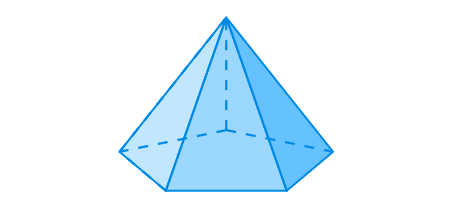
Classify the solid.
{"type":"choice","form":{"alts":["Square prism","Cube","Triangular pyramid","Pentagonal pyramid","Right cone"],"noSort":false},"formTextBefore":"","formTextAfter":"","answer":3}
{"type":"choice","form":{"alts":["Triangular prism","Square prism","Square pyramid","Oblique cylinder","Sphere"],"noSort":true},"formTextBefore":"","formTextAfter":"","answer":0}
security
report
code
security
report
code
We are asked to classify the following solid.
The surface of this solid is made up of polygons, which indicates that this is a polyhedron. Polyhedrons can be classified based on the following characteristics.
- The number of bases
- The shape of the base(s)
- The shape of the sides
Notice that the given polyhedron has triangular sides and only one base. This suggests that the given polyhedron is a pyramid.
Also, we can see that the base of the pyramid is a pentagon. This makes it a pentagonal pyramid.
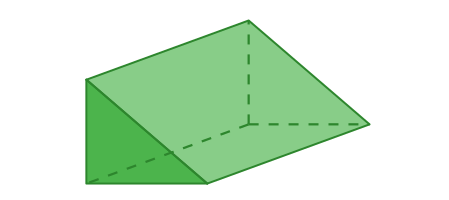
Let's consider the given solid.
Its surface is also made up of polygons, which means that this is a polyhedron. To classify this polyhedron, let's find the number of its bases and examine the shape of the bases and sides. We can see that the solid has two bases and three rectangular faces.
This suggests that the given polyhedron is a prism that lies on a side face instead of the base. We can also see that the bases of the prism are triangles. This makes it a triangular prism.
security
report
code
Identify the solid from its net.
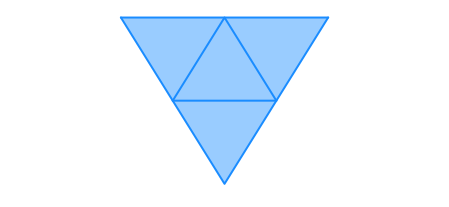
{"type":"choice","form":{"alts":["Triangular pyramid","Triangular prism","Triangle","Pentagonal pyramid"],"noSort":false},"formTextBefore":"","formTextAfter":"","answer":0}
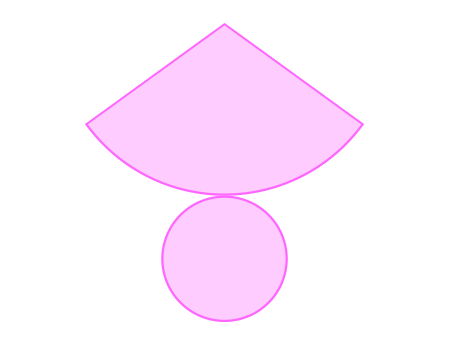
{"type":"choice","form":{"alts":["Right cylinder","Pyramid","Right cone","Prism"],"noSort":false},"formTextBefore":"","formTextAfter":"","answer":2}
security
report
code
security
report
code
We are asked to identify the solid based on its net.
This net shows four identical triangular faces. The triangular face in the middle could be the base and the other faces could be the sides of the figure.
This figure has one base and its sides are triangular. This means that it is a pyramid. What is more, since the base is a triangle, it is a triangular pyramid.
Let's begin by analyzing the shapes of the net parts.
We can see that the net consists of two parts, a circle, which can be the base of the solid, and a figure similar to a triangle with one curved side. It can represent the curved side surface of a cone.
Moreover, because the side surface is symmetrical, the top vertex must be located over the center of the base. This indicates that the cone is a right cone.
security
report
code
Ramsha wants to draw a net of a rectangular prism. How many rectangles should be in her drawing?
{"type":"text","form":{"type":"math","options":{"comparison":"1","nofractofloat":false,"keypad":{"simple":true,"useShortLog":false,"variables":[],"constants":[]},"rendered":false},"text":" "},"formTextBefore":null,"formTextAfter":"rectangles","answer":{"text":["6"]}}
security
report
code
security
report
code
Let's start by recalling the definition of a rectangular prism.
Rectangular Prism |-A prism is a polyhedron with two congruent polygon bases that lie in parallel planes. The remaining faces are parallelograms that have common sides with the bases. A rectangular prism is a prism with a rectangular base.
Consider an example of a rectangular prism.
Let's draw a net of this prism.
We can see that there are 6 rectangles in the net of a rectangular prism. This means that Ramsha will have to draw 6 rectangles in her net.
security
report
code
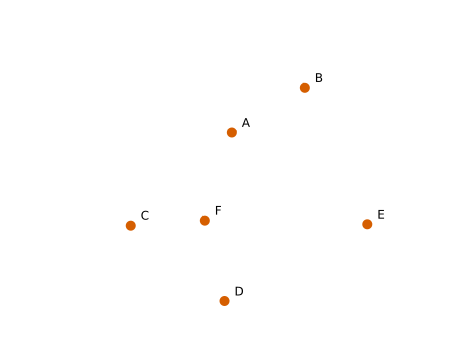
{"type":"multichoice","form":{"alts":["A","B","C","D","E","F"],"noSort":true},"formTextBefore":"","formTextAfter":"","answer":[2,4,5]}
{"type":"text","form":{"type":"math","options":{"comparison":"1","nofractofloat":false,"keypad":{"simple":false,"useShortLog":false,"variables":["F","E","D","C","B","A"],"constants":[]},"rendered":false},"text":" "},"formTextBefore":null,"formTextAfter":null,"answer":{"text":["CEF","CFE","ECF","EFC","FEC","FCE"]}}
security
report
code
security
report
code
We are asked to name all the coplanar points on the diagram. Let's start by recalling that coplanar points are points that lie on the same plane. There is one plane shown in the diagram. Rotating the diagram to view it from different perspectives can help us identify all the points that lie on the plane.
We can see that points C, E, and F lie on the same plane, while A, B, and D do not lie on that plane. Therefore, C, E, and F are coplanar points.
From Part A, we know that three points lie on the plane.
A plane can be named by any three points that lie on the plane. Let's write all the possible names of the plane using the points that lie in it. CEF, CFE, ECF, EFC, FEC, FCE Alternatively, we can name the plane by assigning an arbitrary capital letter to the plane. For example, P or S could also be names of the plane.
security
report
code
Identify the figure. Then name the bases, faces, edges, and vertices. What is the sum of the numbers of all the faces, edges, and vertices?
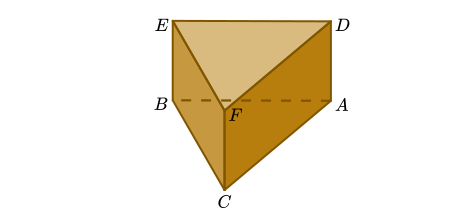
{"type":"choice","form":{"alts":["Square prism, 20","Square prism, 24","Triangular pyramid, 16","Triangular prism, 20","Triangular prism, 26","Right prism, 22"],"noSort":false},"formTextBefore":"","formTextAfter":"","answer":3}
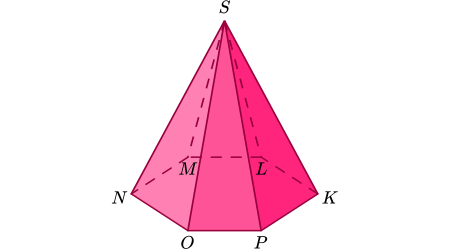
{"type":"choice","form":{"alts":["Pentagonal pyramid, 26","Pentagonal pyramid, 28","Hexagonal pyramid, 26","Hexagonal pyramid, 27","Hexagonal prism, 30","Square prism, 24"],"noSort":false},"formTextBefore":"","formTextAfter":"","answer":2}
security
report
code
security
report
code
We are asked to identify the following polyhedron.
We can see that the polyhedron has two bases, ABC and EDF, and three rectangular side faces, EBCF, FCAD, and ABED. Bases: & ABC, EDF Faces: & EBCF, FCAD, ABED The bases are identical and the sides are polygons, which indicates that the polyhedron is a prism. Additionally, the bases are triangles, so this is a triangular prism. Next, write the names of all the edges by listing the segments where the faces intersect. Edges: AD, BE, CF, AB, BC, CA, DE, EF, FD The polyhedron has 9 edges. Now let's list all the vertices of the solid. Vertices: A, B, C, D, E, F We found that there are 6 vertices. Finally, we can add the numbers of all the faces, edges, and vertices. Note that the bases are also faces of the solid, so we will count them, too. 2+ 3+ 9+ 6=20
We are asked to identify the following polyhedron.
We can see that the polyhedron has 1 base, KLMNOP, and 6 triangular side faces. Bases: & KLMNOP Faces: & KLS, LMS, MNS, & NOS, OPS, PKS This indicates that the polyhedron is a pyramid. What is more, the base is a hexagon, so this is a hexagonal pyramid. Next, let's write the names of all the edges by listing the segments where the faces intersect. Edges: KL, LM, MN, NO, OP, PK, SK, SL, SM, SN, SO, SP The polyhedron has 12 edges. Let's now list all the vertices of the solid. Vertices: K, L, M, N, O, P, S We found that there are 7 vertices. Finally, let's count how many faces, edges, and vertices the polyhedron has in total. Note that the base is also a face of the solid, so we will count it, too! 1+ 6+ 12+ 7=26
security
report
code
Three Dimensional Figures and Cross Sections
Recommended exercises
To get personalized recommended exercises, please login first.
Loading content
≤
>
■2
■▢
e▢
7
8
9
×
÷■1
=
=
√▢
▢√
∫▢▢
4
5
6
+
−
≤
<
log
ln
log▢
1
2
3
()
∣
sin
cos
tan
0
.
π
x
y
Loading content