7. The Coordinate Plane
Sign In
An error ocurred, try again later!
Chapter 1
7.
The Coordinate Plane
If one is an aspiring athlete like Dominika, the coordinate plane can be used to improve performance in sports. The coordinate plane is a two-dimensional grid created by the intersection of a vertical and a horizontal number line. It is divided into four areas known as quadrants. Points on this plane are represented by ordered pairs, where the first number indicates the distance along the horizontal axis and the second number indicates the distance along the vertical axis. These ordered pairs can mark the locations of homes, friends' homes, and sports facilities. The concept of reflection can also be explored, which involves flipping a point across an axis to produce its mirror image. This concept can help identify advantageous positions on a sports field or court. The coordinate plane is not merely a mathematical abstraction; it is a practical tool that can be applied in various real-life situations such as sports strategy, navigation, and design.
Show less Show more expand_more 


Lesson Settings & Tools
| | 13 Theory slides |
| | 13 Exercises - Grade E - A |
| | Each lesson is meant to take 1-2 classroom sessions |
The Coordinate Plane
Slide of 13
A number line helps visualize one-dimensional quantities like temperature and time. However, there are situations where two dimensions are needed, such as when latitude and longitude when locating places on a map. The coordinate plane is used in these situations! This lesson will teach how to locate points on a coordinate plane and explore some of its uses.
Catch-Up and Review
Here are a few recommended readings before getting started with this lesson.
Explore
Share
Report error
The Battleship Game Board
Get ready for an adventure! Discover the location of enemy ships hidden on the game board by using specific points. Each point on the board is represented by the combination of a letter and a number. Place the boats by dragging them from the stern, or the back, and rotate them by clicking on the bow, or the front.
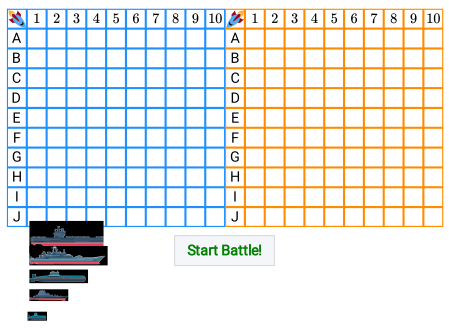 Consider the following questions.
External credits: Freepik
- How does using the letter and number combination to locate enemy ships in the game relate to finding a location on a map in real life?
- What are other situations where two numbers, two letters, or a combination of both help to indicate a location?
Discussion
Share
Report error
Coordinate System
A coordinate system is a reference framework used to describe the positions of objects like points, lines, and surfaces in a space. A fixed point called the origin is used as a reference in the coordinate system. The most common types of coordinate systems are one-, two-, or three-dimensional.
Coordinate Plane
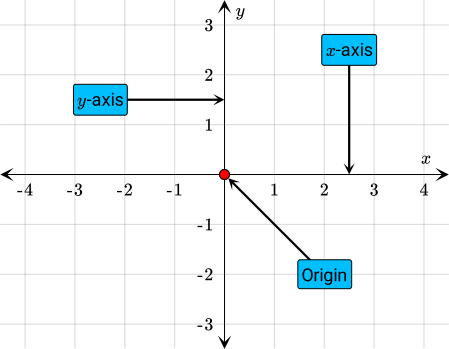
A coordinate plane, also known as a Cartesian or a rectangular coordinate system, is a two-dimensional coordinate system. It is a grid that results from intersecting a vertical number line with a horizontal number line at their zero points. The horizontal number line is usually named the x-axis and the vertical number line is usually the y-axis.
Discussion
Share
Report error
Coordinate
A coordinate is the position of an object in a coordinate system relative to the corresponding axis. Coordinates are often seen together with other coordinates, which can describe the position of an object in a coordinate system with one, two, three, or even more dimensions.
In Two Dimensions
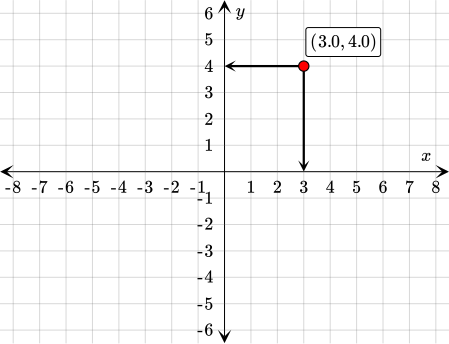
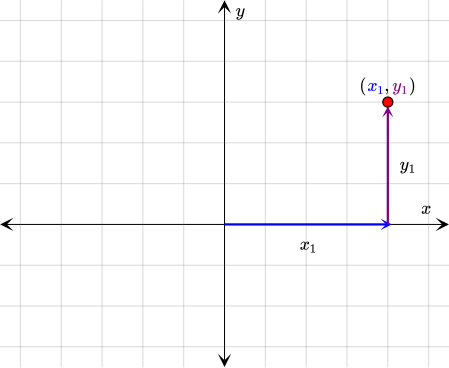
In a two-dimensional coordinate system, points are usually expressed as a coordinate pair — also called an ordered pair — denoted by (x,y). The first coordinate states the position along the x-axis and the second coordinate states the position along the y-axis.
Pop Quiz
Share
Report error
Random Points on a Coordinate System
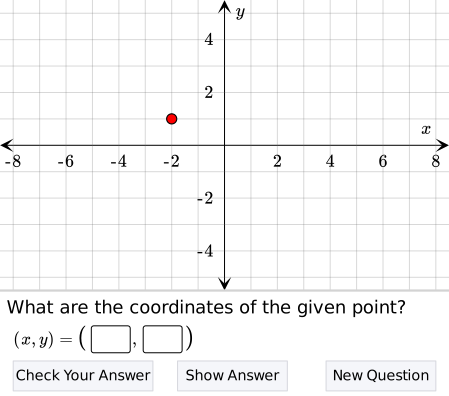
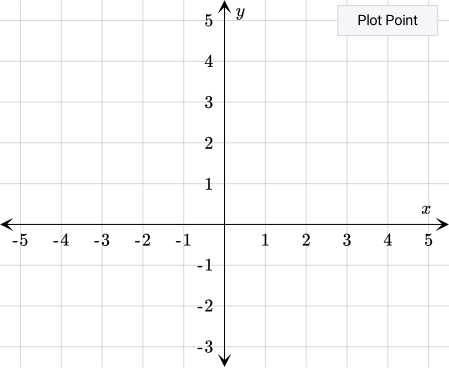
Identify the coordinates of the given point. Write the coordinates as an ordered pair (x,y), where x represents the x-coordinate and y the y-coordinate.
Example
Share
Report error
The Path From Home to the Basketball Court
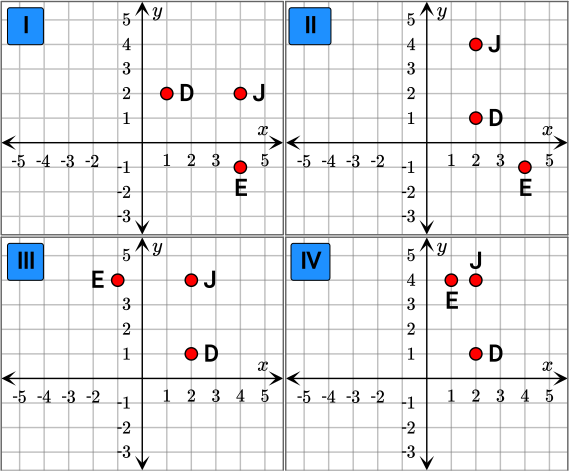
Dominika plays basketball with her friends every afternoon. She warms up by running and picks up two friends, Jordan and Emily, on the way to the court. Dominika uses ordered pairs to represent the positions of her and her friends' houses.
| Position | |
|---|---|
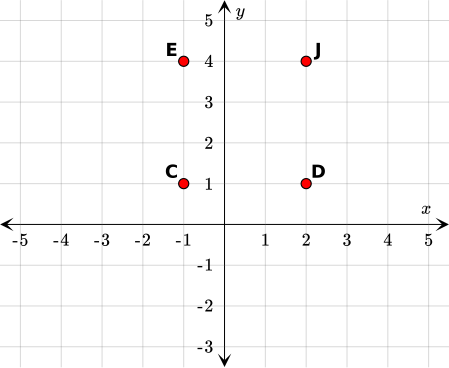
| Dominika's House | D=(2,1) |
| Jordan's House | J=(2,4) |
| Emily's House | E=(-1,4) |
a Dominika wants to display this information on a coordinate plane. Which graph correctly displays the positions of the three houses?
{"type":"choice","form":{"alts":["I","II","III","IV"],"noSort":true},"formTextBefore":"","formTextAfter":"","answer":2}
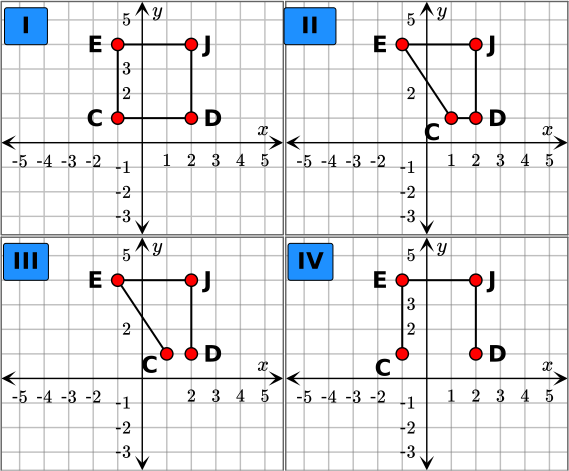
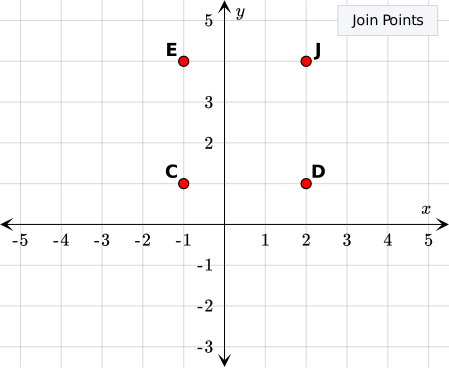
b The basketball court is at the point C=(-1,1), and Dominika's whole path from her house to the court and back can be represented by joining points D, J, E, C, and D. Which graph shows Dominika's whole path?
{"type":"choice","form":{"alts":["I","II","III","IV"],"noSort":true},"formTextBefore":"","formTextAfter":"","answer":0}
Hint
a An ordered pair can be graphed on a coordinate plane by moving horizontally from the origin the number of units specified in its x-coordinate and then vertically the number of units specified in its y-coordinate.
b Plot the coordinates of the basketball court. Connect the points using line segments in the given order.
Solution
a The positions of the girls' houses are given as ordered pairs. Recall that an ordered pair can be graphed on a coordinate plane by moving horizontally from the origin the number of units specified in its x-coordinate and vertically the number of units specified in its y-coordinate.
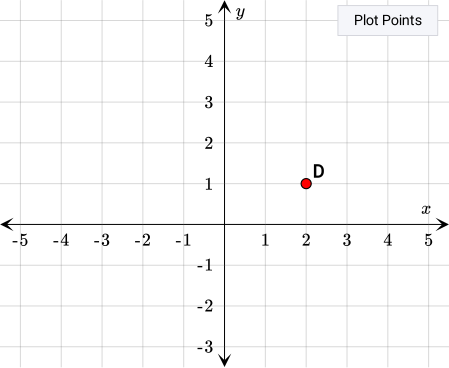
b Begin by considering the coordinates of the position of the basketball court.
Basketball Court C=( -1, 1) Add this point to the graph from the previous part. Move 1 unit horizontally to the left of the origin and then 1 unit up.
Example
Share
Report error
Dominika's Running Routine
Dominika's house is represented by the point (2,1) on a coordinate plane. Every morning, she runs to a place five blocks away from her house, then returns home using the same route.
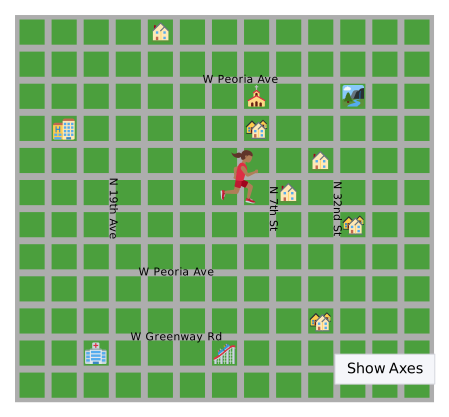 If Dominika picks a different spot to visit every day, which graph displays all the places she could go? Consider that every unit on the coordinate plane represents one block and that Dominika stays on the straight roads.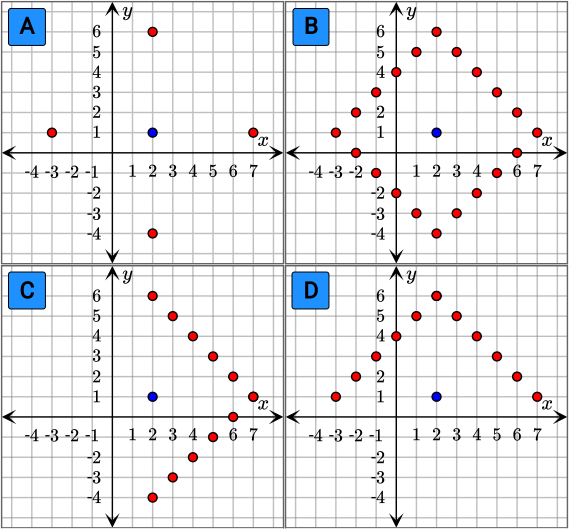
Join all the potential places Dominika could go. What shape do these points form? 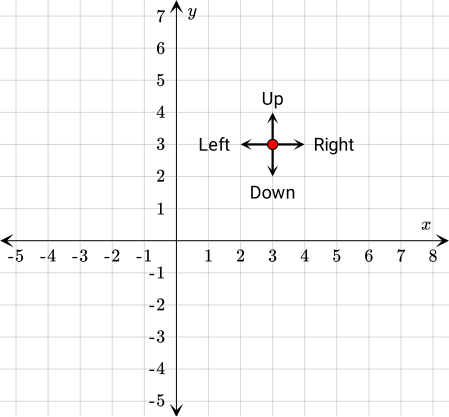
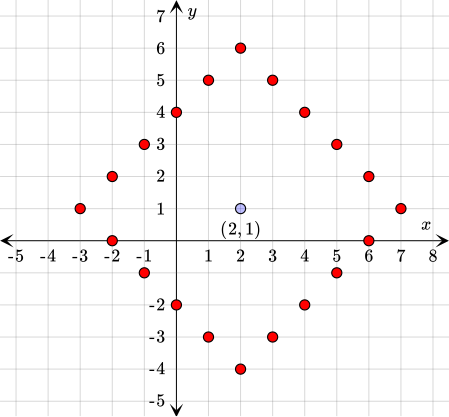
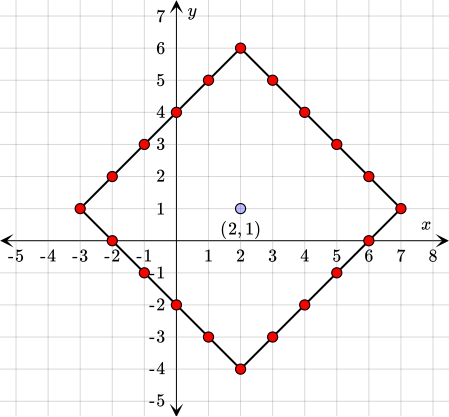
{"type":"choice","form":{"alts":["A","B","C","D"],"noSort":true},"formTextBefore":"","formTextAfter":"","answer":1}
{"type":"choice","form":{"alts":["Square","Triangle","Star","Circle"],"noSort":false},"formTextBefore":"","formTextAfter":"","answer":0}
Hint
Moving one unit on the x-axis or y-axis on the coordinate plane is counted as moving one block. Since Dominika can only stay on the straight roads, her position can only move up, down, left, and right on the graph.
Solution
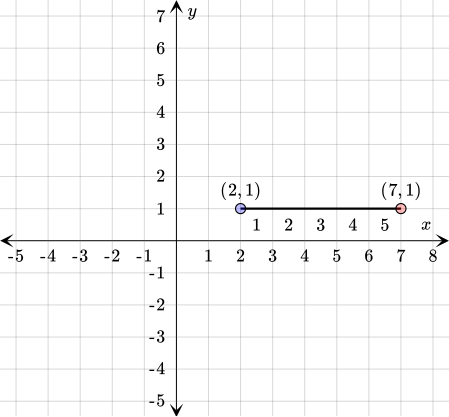
Moving one unit on the x-axis or y-axis on the coordinate plane is the same as Dominika moving one block. Dominika only runs on the straight roads, so her progress on the graph can only move in four directions — up, down, left, and right.
Keeping this in mind, one route she can take is moving five blocks directly to the right. Move 5 units to the right starting her house to show this possible destination. Remember that Dominika's house is located at (2,1), not the origin!
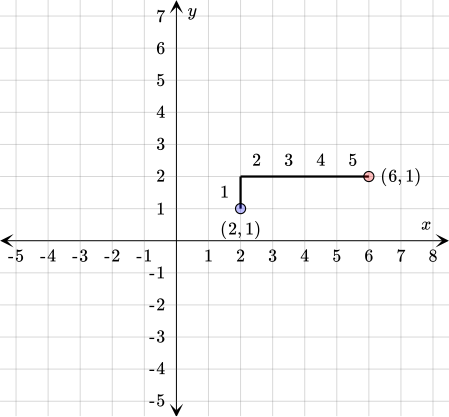
Another spot Dominika might go is one block up and four blocks to the right of her starting point. It does not matter if she moves up on her first, second, third, fourth, or final move. Her destination will always be the same if she moves one block up out of the five total moves.
Follow the same reasoning to find the other places that Dominika can go. Plot each as ordered pairs on the coordinate plane.
Now that all the points are plotted on the graph, connect them with lines to see the overall shape.
The shape is a rotated square.
Showing Our Work
Finding All the Places Dominika Can GoThe places Dominika can go can be determined by identifying all the possible routes she can take. Remember, she can only go five blocks away from her home. Moving left or down indicates a negative direction on the corresponding axis, represented by negative numbers.
| Route from Home | Calculations | Destination |
|---|---|---|
| 5 blocks to the right | (2+ 5,1) | (7,1) |
| 4 blocks to the right and 1 block up | (2+ 4,1+ 1) | (6,2) |
| 3 blocks to the right and 2 blocks up | (2+ 3,1+ 2) | (5,3) |
| 2 blocks to the right and 3 blocks up | (2+ 2,1+ 3) | (4,4) |
| 1 block to the right and 4 blocks up | (2+ 1,1+ 4) | (3,5) |
| 5 blocks up | (2,1+ 5) | (2,6) |
| 1 block to the left and 4 blocks up | (2- 1,1+ 4) | (1,5) |
| 2 blocks to the left and 3 blocks up | (2- 2,1+ 3) | (0,4) |
| 3 blocks to the left and 2 blocks up | (2- 3,1+ 2) | (-1,3) |
| 4 blocks to the left and 1 block up | (2- 4,1+ 1) | (-2,2) |
| 5 blocks to the left | (2- 5,1) | (-3,1) |
| 4 blocks to the left and 1 block down | (2- 4,1- 1) | (-2,0) |
| 3 blocks to the left and 2 blocks down | (2- 3,1- 2) | (-1,-1) |
| 2 blocks to the left and 3 blocks down | (2- 2,1- 3) | (0,-2) |
| 1 block to the left and 4 blocks down | (2- 1,1- 4) | (1,-3) |
| 5 blocks down | (2,1- 5) | (2,-4) |
| 1 block to the right and 4 blocks down | (2+ 1,1- 4) | (3,-3) |
| 2 blocks to the right and 3 blocks down | (2+ 2,1- 3) | (4,-2) |
| 3 blocks to the right and 2 blocks down | (2+ 3,1- 2) | (5,-1) |
| 4 blocks to the right and 1 block down | (2+ 4,1- 1) | (6,0) |
Discussion
Share
Report error
Quadrants
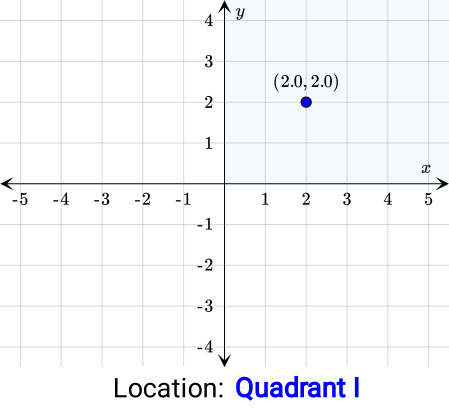
In a coordinate plane, the intersection of the x-axis and the y-axis produces four regions called quadrants. The quadrants are numbered counterclockwise from the top right quadrant as Quadrant I to Quadrant IV in the bottom right.
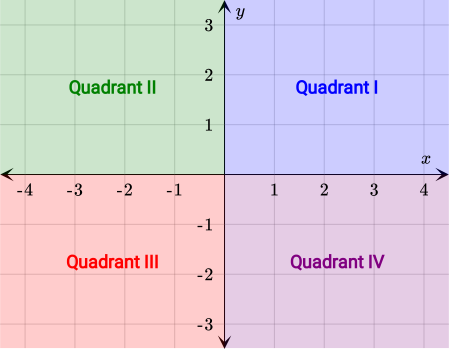
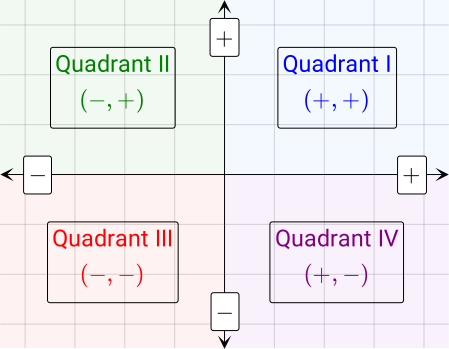
The signs of the coordinates of a point can be determined based on which quadrant the point lies in.
Pop Quiz
Share
Report error
Finding the Quadrant in Which a Point Lies
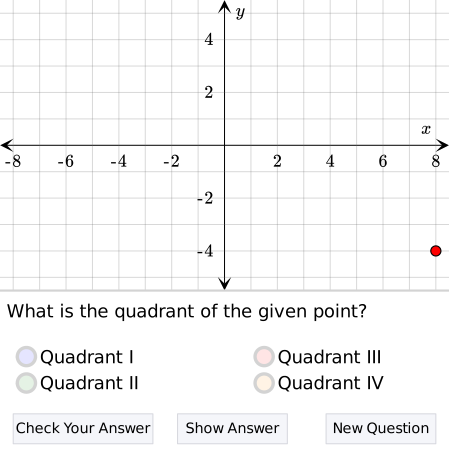
A coordinate system has four quadrants that provide information about the signs of the x- and y-coordinates of a point. In the following applet, identify in which quadrant the given point lies.
Example
Share
Report error
Designing the Team's Logo
Dominika is drafting a logo for her basketball team to wear on their jerseys. She wants the logo to have a cool geometric shape, so she sets some points that she thinks will look good. Help her design the logo by matching each point with its corresponding quadrant on the coordinate plane.
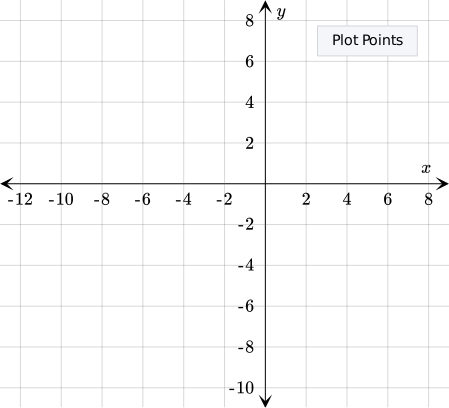
Now that the quadrant of each point has been identified, plot the points on a coordinate plane. Move horizontally from the origin the number of units indicated by the x-coordinate and vertically the number of units specified by the y-coordinate of each point.
 The logo is a hit, and the team gains more and more fans as a result!
{"type":"pair","form":{"alts":[[{"id":0,"text":"Quadrant I"},{"id":1,"text":"Quadrant II"},{"id":2,"text":"Quadrant III"},{"id":3,"text":"Quadrant IV"}],[{"id":1,"text":"(4,3)"},{"id":0,"text":"(-11,3)"},{"id":2,"text":"(-2,-8)"},{"id":3,"text":"(4,-2)"}]],"lockLeft":true,"lockRight":false},"formTextBefore":"","formTextAfter":"","answer":[[0,1,2,3],[1,0,2,3]]}
Hint
Look at the signs of the coordinates of each point to identify their quadrants.
Solution
The quadrant in which a point lies can be determined by looking at the signs of its coordinates. For instance, a point in Quadrant I has a positive x-coordinate and a positive y-coordinate. Consider the given points and see if any of them fit this description. (-2,-8) (4,-2) (-11,3) ( 4, 3) The point ( 4, 3) is located in Quadrant I because both of its coordinates are positive. In contrast, a point in Quadrant II has a negative x-coordinate and a positive y-coordinate. Look at the remaining points to see which one fits this description. (-2,-8) (4,-2) ( -11, 3) (4,3) The point ( -11, 3) is in Quadrant II because its x-coordinate is negative but its y-coordinate is positive. Follow a similar reasoning to find the corresponding quadrants of the remaining points.
| Point | Signs of Coordinates | Quadrant |
|---|---|---|
| ( -2, -8) | ( -, -) | Quadrant III |
| ( 4, -2) | ( +, -) | Quadrant IV |
| ( -11, 3) | ( -, +) | Quadrant II |
| ( 4, 3) | ( +, +) | Quadrant I |
External credits: Image by Freepik
Discussion
Share
Report error
Reflecting a Point Across an Axis on the Coordinate Plane
Reflecting a point means making a mirror image of that point by flipping it across a certain line or axis. The following rules show how to find reflected points across a specific axis.
| Point | Axis of Reflection | Procedure | Reflected Point |
|---|---|---|---|
| (x_1,y_1) | x | Change the y-coordinate to its opposite. | (x_1,- y_1) |
| (x_1,y_1) | y | Change the x-coordinate to its opposite. | (- x_1,y_1) |
| (x_1,y_1) | x and y | Change the x- and y-coordinates to their opposites. | (- x_1,- y_1) |
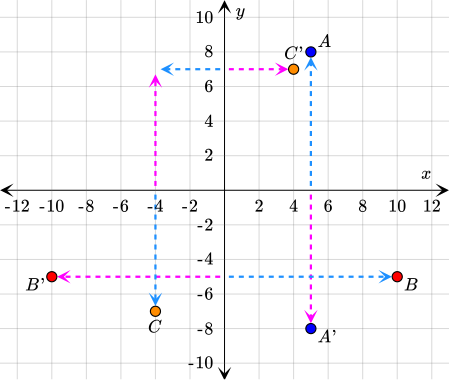
Next, the process for reflecting points across the x-axis, the y-axis, or both, on a coordinate plane will be shown. Consider the points A, B, and C.
| Point | Axis of Reflection | Reflected Point |
|---|---|---|
| A = (5,8) | x | ? |
| B = (10,-5) | y | ? |
| C = (-4,-7) | x and y | ? |
1
Find the Reflected Point
expand_more Keep the same x-coordinate of a point and change the y-coordinate to its opposite to reflect it across the x-axis. With this information, point A can be reflected across the x-axis by changing its y-coordinate 8 to its opposite, -8. A=(5, 8) ⇒ A’=(5, -8) In contrast, change the x-coordinate of a point to its opposite and keep its y-coordinate to reflect it across the y-axis. Point B can be reflected across the y-axis by changing the x-coordinate 10 to its opposite, -10 B=( 10,-5) ⇒ B’=( -10,-5) Finally, change the x-coordinate and the y-coordinate of a point to their opposites to reflect it across both the x-axis and y-axis. Therefore, reflect point C across both axes by changing its x-coordinate from -4 to 4 and its y-coordinate from -15 to 15. C=( -4, -7) ⇒ C’=( 4, 7)
2
Plot the Point and Its Reflection on the Coordinate Plane
expand_more Once each initial point and its reflection across a given axis are found, plot both points on the coordinate plane.
Example
Share
Report error
Improving Basketball Skills With Math
Dominika's team is only one game away from winning the basketball tournament! Dominika is a shooting guard and wants to use her math skills to improve her game. She starts by figuring out the point on the court from where she usually scores using a coordinate plane. This point is (-4,-3).
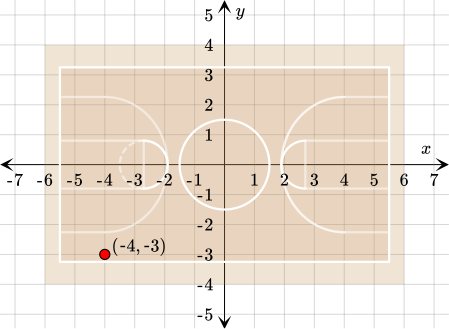
a Dominika knows that if she mirrors that point across the horizontal central line of the court, she can score from there, too. Find this mirror point.
{"type":"text","form":{"type":"point2d","options":{"comparison":"1","nofractofloat":false,"keypad":{"simple":true,"useShortLog":false,"variables":[],"constants":[]},"rendered":false,"decimal":false,"function":false},"text":" "},"formTextBefore":"(x,y)=","formTextAfter":null,"answer":{"text1":"-4","text2":"3"}}
b When Dominika is defending, she needs to be quick on her feet to get the rebounds. To do that, she needs to know the point that is the mirror image of (-4,-3) across the vertical central line of the court. What is this point?
{"type":"text","form":{"type":"point2d","options":{"comparison":"1","nofractofloat":false,"keypad":{"simple":true,"useShortLog":false,"variables":[],"constants":[]},"rendered":false,"decimal":false,"function":false},"text":" "},"formTextBefore":"(x,y)=","formTextAfter":null,"answer":{"text1":"4","text2":"-3"}}
Hint
a Reflect the point across the x-axis. The x-coordinate remains the same and the y-coordinate is changed to its opposite.
b Reflect the point across the y-axis. The y-coordinate remains the same and the x-coordinate is changed to its opposite.
Solution
a Reflect the point across the x-axis to find the mirror point of (-4,-3). Keep the x-coordinate the same and change the y-coordinate to its opposite. The x-coordinate is -4. The opposite of the y-coordinate -3 is 3.
Point&Reflection Acrossx-axis (-4, -3)&(-4, 3) Graph this point on the coordinate plane. Start at the origin and move 4 units to the left and 3 units up.
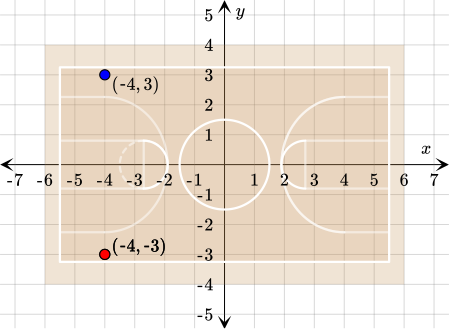
Dominika is interested in the mirror point of (-4, -3) because it is a great shooting position. This point is as far away from the basket as the original point but is oriented in a different direction. This can give her an advantage over her opponents and help her score more points during game!
b Reflect the point (-4,-3) across the y-axis to find the defense point. Keep the y-coordinate and change the x-coordinate to its opposite. In this case, the opposite of -4 is 4.
Point&Reflection Acrossy-axis ( -4,-3)&( 4,-3) Add this point to the graph.
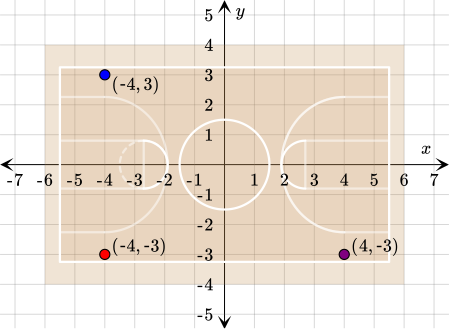
Now that Dominika understands her attack and defense positions better, she can perform much better on the court. Her team is doing great and they keep scoring point after point until before they know it, they win first place in the tournament. They are the champions!
Closure
Share
Report error
Introducing the Three-Dimensional Coordinate System
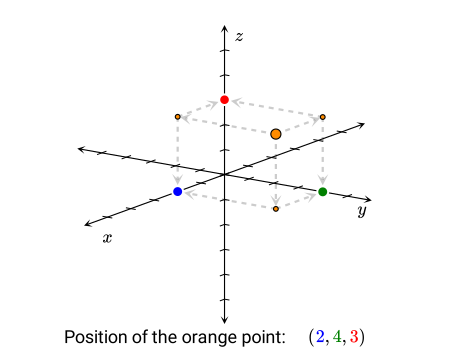
This lesson showed how to locate points with respect to the x- and y-axis on a coordinate plane. A third axis, usually called the z-axis, can be used to provide more information about the position of objects. Think of it like this.
| Description | |
|---|---|
| x-axis | Tells if something is in front of or behind the origin. |
| y-axis | Tells if something is to the left or right of the origin |
| z-axis | Tells if something is above or below the origin. |
These three axes create a 3D coordinate system that is similar to the coordinate plane but with the addition of an extra dimension. This additional dimension means that points are represented as ordered triples (x,y,z) instead of as ordered pairs, as in the coordinate plane.
The Coordinate Plane
Exercise 1.1
Identify the ordered pair that represents each point.
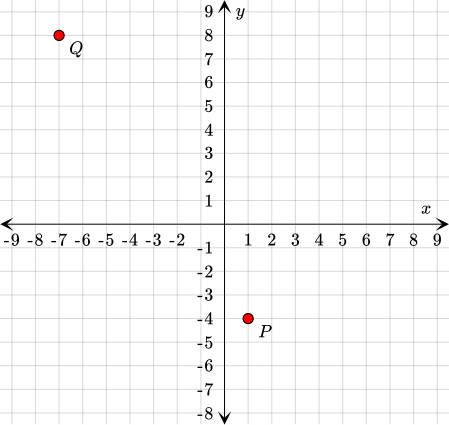
{"type":"text","form":{"type":"point2d","options":{"comparison":"1","nofractofloat":false,"keypad":{"simple":true,"useShortLog":false,"variables":[],"constants":[]},"rendered":false,"decimal":false,"function":false},"text":" "},"formTextBefore":"P","formTextAfter":null,"answer":{"text1":"1","text2":"-4"}}
{"type":"text","form":{"type":"point2d","options":{"comparison":"1","nofractofloat":false,"keypad":{"simple":true,"useShortLog":false,"variables":[],"constants":[]},"rendered":false,"decimal":false,"function":false},"text":" "},"formTextBefore":"Q","formTextAfter":null,"answer":{"text1":"-7","text2":"8"}}
security
report
code
security
report
code
Start by looking at the given graph.
Let's draw a straight line upwards from point P to the x-axis to find its x-coordinate. Then, we will draw another straight line from point P to the y-axis, going horizontally to determine its y-coordinate.
The vertical line intersects the x-axis at 1 and the horizontal line intersects the y-axis at -4. This indicates that the x-coordinate of point P is 1 and the y-coordinate is -4. Now we can express this as an ordered pair. P( 1, -4)
We can use a similar process to determine the coordinates of point Q. Let's start by drawing a vertical line from point Q to the x-axis. We will then draw a horizontal line from point Q to the y-axis.
In this case, the vertical line intersects the x-axis at -7 and the y-axis at 8. This means that the x-coordinate of point Q is -7 and the y-coordinate is 8. Let's write it as an ordered pair! Q( -7, 8)
security
report
code
Consider the given set of ordered pairs. M(2,4), N(-5,0), O(-3,-5), P(7,1) Which of the graphs correctly displays these ordered pairs on the coordinate plane?
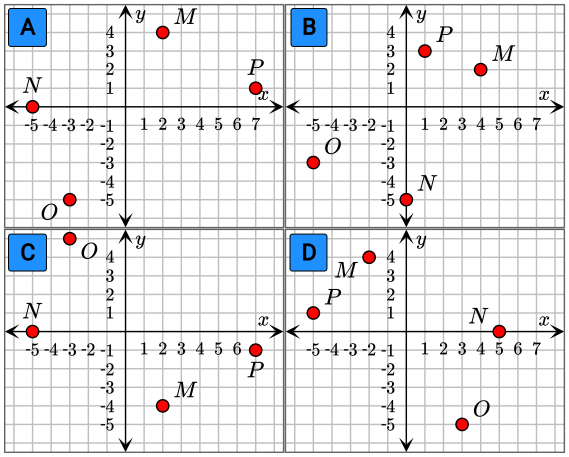
{"type":"choice","form":{"alts":["A","B","C","D"],"noSort":true},"formTextBefore":"","formTextAfter":"","answer":0}
security
report
code
security
report
code
Let's graph each ordered pair on the coordinate plane one by one to determine the correct option. Remember that we graph an ordered pair as a point on a coordinate plane by moving horizontally from the origin the number of units specified by its x-coordinate and vertically the number of units specified by its y-coordinate.
Now, let's take a look at the first given ordered pair. M( 2, 4) Point M has an x-coordinate of 2 and a y-coordinate of 4. We need to move 2 units to the right of the origin and 4 units up to graph this ordered pair.
We can use the same approach to plot the other ordered pairs. Let's start by identifying the x- and y-coordinates for each point. Once we have these coordinates, we can plot them on the graph.
| Ordered Pair | x-coordinate | y-coordinate |
|---|---|---|
| M( 2, 4) | 2 | 4 |
| N( -5, 0) | -5 | 0 |
| O( -3, -5) | -3 | -5 |
| P( 7, 1) | 7 | 1 |
We can add now these points to the graph.
This graph corresponds to option A.
security
report
code
Match each point with its corresponding quadrant.
{"type":"pair","form":{"alts":[[{"id":1,"text":"(-5,14)"},{"id":3,"text":"(14,-11)"},{"id":2,"text":"(-7,-22)"},{"id":0,"text":"(21,19)"}],[{"id":0,"text":"Quadrant II"},{"id":3,"text":"Quadrant IV"},{"id":2,"text":"Quadrant III"},{"id":1,"text":"Quadrant I"}]],"lockLeft":true,"lockRight":false},"formTextBefore":"","formTextAfter":"","answer":[[1,3,2,0],[0,3,2,1]]}
security
report
code
security
report
code
We can check the signs of the x- and y-coordinates to find out where a point is located.
With this information in mind, let's examine the coordinates of the point ( -5, 14). ( -5, 14) ⇓ ( -, +) This point has a negative x-coordinate and a positive y-coordinate. This means that the point ( -5, 14) is located in Quadrant II. We can use a similar reasoning to find the corresponding quadrant of the remaining points.
| Point | Coordinates' Signs | Quadrant |
|---|---|---|
| ( -5, 14) | ( -, +) | Quadrant II |
| ( 14, -11) | ( +, -) | Quadrant IV |
| ( -7, -22) | ( -, -) | Quadrant III |
| ( 21, 19) | ( +, +) | Quadrant I |
We have found the quadrant where each of the given points is located. Let's plot them on a coordinate plane to confirm our matches. For each point, we will move horizontally from the origin according to its x-coordinate and vertically based on its y-coordinate.
security
report
code
Use a coordinate plane to find the reflection of the given point across the indicated axis. Write the answer as an ordered pair.
{"type":"text","form":{"type":"point2d","options":{"comparison":"1","nofractofloat":false,"keypad":{"simple":true,"useShortLog":false,"variables":[],"constants":[]},"rendered":false,"decimal":false,"function":false},"text":" "},"formTextBefore":null,"formTextAfter":null,"answer":{"text1":"-5","text2":"1"}}
{"type":"text","form":{"type":"point2d","options":{"comparison":"1","nofractofloat":false,"keypad":{"simple":true,"useShortLog":false,"variables":[],"constants":[]},"rendered":false,"decimal":false,"function":false},"text":" "},"formTextBefore":null,"formTextAfter":null,"answer":{"text1":"-4","text2":"15"}}
{"type":"text","form":{"type":"point2d","options":{"comparison":"1","nofractofloat":false,"keypad":{"simple":true,"useShortLog":false,"variables":[],"constants":[]},"rendered":false,"decimal":false,"function":false},"text":" "},"formTextBefore":null,"formTextAfter":null,"answer":{"text1":"-2","text2":"9"}}
security
report
code
security
report
code
We are asked to reflect the point ( -5, -1) across the x-axis. This means keeping its x-coordinate the same and changing the y-coordinate to its opposite. The x-coordinate is -5. The opposite of the y-coordinate -1 is 1. Point&Reflection Acrossx-axis ( -5, -1)&( -5, 1) We can plot both points on a coordinate plane to visualize that they are a mirror of each other across the x-axis.
Let's reflect the point ( 4, 15) across the y-axis. In this case, the y-coordinate remains the same and the x-coordinate changes to its opposite. The y-coordinate is 15. The opposite of the x-coordinate 4 is -4. Point&Reflection Acrossy-axis ( 4, 15)&( -4, 15) Again, it is useful to plot these points on a coordinate plane. Let's do it!
Let's reflect the point ( 2, -9) across both the x- and y-axes. To do that, we need to change the x- and y-coordinates both to their opposites. The x-coordinate is 2, so we change it to -2. The y-coordinate is -9, so we change it to 9 to get its reflection. Point&Reflection Across Both Axes ( 2, -9)&( -2, 9) Let's graph both points on a coordinate plane.
security
report
code
Select the statement that best describes the relationship between the given ordered pairs.
{"type":"choice","form":{"alts":["B is a reflection of A over the x-axis.","B is a reflection of A over the y-axis.","B is a reflection of A over both the x- and y-axes.","No relationship."],"noSort":false},"formTextBefore":"","formTextAfter":"","answer":0}
{"type":"choice","form":{"alts":["D is a reflection of C over the x-axis.","D is a reflection of C over the y-axis.","D is a reflection of C over both the x- and y-axes.","No relationship."],"noSort":false},"formTextBefore":"","formTextAfter":"","answer":1}
{"type":"choice","form":{"alts":["F is a reflection of E over the x-axis.","F is a reflection of E over the y-axis.","F is a reflection of E over both the x- and y-axes.","No relationship."],"noSort":false},"formTextBefore":"","formTextAfter":"","answer":2}
security
report
code
security
report
code
Let's review how to reflect a point across each axis.
| Axis of Reflection | Procedure |
|---|---|
| x-axis | Change the y-coordinate to its opposite and keep the x-coordinate the same. |
| y-axis | Change the x-coordinate to its opposite and keep the y-coordinate the same. |
| x- and y-axes | Change the x- and y-coordinates to their opposites. |
Now let's take a look at the points A and B. A( -8, 2), B( -8, -2) They both have an x-coordinate of -8, but their y-coordinates are opposites of each other. This means that B is a reflection of A across the x-axis.
Let's begin by looking at the points C and D.
C( 4, 12), D( -4, 12)
In this case, C and D both have a y-coordinate of 12, but their x-coordinates are opposites. This fits the rule for a reflection across the y-axis, so D is a reflection of C across the y-axis.
Consider the points E and F.
E( -11, 3), F( 11, -3)
Notice that the x-coordinate of E is the opposite of the x-coordinate of F and the y-coordinate of E is also the opposite of the y-coordinate of F. This means that F is the reflection of E across the x- and y-axes, following the rule for reflecting a point across both axes.
security
report
code
Tell if the given statement is always, sometimes, or never true.
|
A point that lies on the y-axis has a y-coordinate of 0. |
{"type":"choice","form":{"alts":["always","sometimes","never"],"noSort":false},"formTextBefore":"","formTextAfter":"","answer":1}
|
Points in Quadrant II have negative x-coordinates. |
{"type":"choice","form":{"alts":["always","sometimes","never"],"noSort":false},"formTextBefore":"","formTextAfter":"","answer":0}
security
report
code
security
report
code
Consider the given statement.
A point that lies on the y-axis has a y-coordinate of 0.
Let's examine some points on the y-axis to find out if the given statement is always, sometimes, or never true.
Point A is 5 units up and 0 units left or right from the origin, so its x-coordinate is 0 and its y-coordinate is 5. A( 0, 5) Points B and D also have an x-coordinate of 0, but their y-coordinates are not 0. B( 0, 2) D( 0, -3) Does this mean that the y-coordinate of a point on the y-axis is never 0? Not necessarily. Point C, which lies on the origin of the coordinate plane, is on the y-axis and has coordinates ( 0, 0). C( 0, 0) We found examples of points on the y-axis whose y-coordinate is not 0 and an example of a point on the y-axis whose y-coordinate is 0. Therefore, the given statement is sometimes true.
Let's look at the given statement.
Points in Quadrant II have negative x-coordinates.
Recall that quadrants of a coordinate plane are numbered counterclockwise, from Quadrant I in the top right to Quadrant IV in the bottom right.
Quadrant II is the top left part of the coordinate plane. Any point in this area is to the left of the y-axis. Since all points to the left of the y-axis have an x-coordinate less than 0, any point in Quadrant II will have a negative x-coordinate. Therefore, this statement is always true.
security
report
code
The Coordinate Plane
Recommended exercises
To get personalized recommended exercises, please login first.
Loading content
≤
>
■2
■▢
e▢
7
8
9
×
÷■1
=
=
√▢
▢√
∫▢▢
4
5
6
+
−
≤
<
log
ln
log▢
1
2
3
()
∣
sin
cos
tan
0
.
π
x
y
Loading content