{{ tocSubheader }}
{{ 'ml-label-loading-course' | message }}
An error ocurred, try again later!
Chapter {{ article.chapter.number }}
{{ article.number }}.
{{ article.displayTitle }}
{{ article.intro.summary }}
Show less Show more expand_more Lesson Settings & Tools
| | {{ 'ml-lesson-number-slides' | message : article.intro.bblockCount }} |
| | {{ 'ml-lesson-number-exercises' | message : article.intro.exerciseCount }} |
| | {{ 'ml-lesson-time-estimation' | message }} |
There are different methods of solving a system of equations. In this lesson, one of the most popular methods, called the Substitution Method, will be presented and practiced.
Catch-Up and Review
Here are a few recommended readings before getting started with this lesson.
Challenge
Finding the Number of Girls and Boys in a Class
There are 23 students in Maya's math class. She does not remember the exact number of boys or girls, but she knows that there are 5 more girls than boys in the class.

{"type":"text","form":{"type":"math","options":{"comparison":"1","nofractofloat":false,"keypad":{"simple":true,"useShortLog":false,"variables":["x"],"constants":["PI"]},"rendered":false},"text":"<span class=\"katex\"><span class=\"katex-html\" aria-hidden=\"true\"><\/span><\/span>"},"formTextBefore":"<span class=\"katex\"><span class=\"katex-html\" aria-hidden=\"true\"><span class=\"base\"><span class=\"strut\" style=\"height:0.96826171875em;vertical-align:-0.2080078125em;\"><\/span><span class=\"mord text\"><span class=\"mord Roboto-Regular\">Number<\/span><span class=\"mord\">\u00a0<\/span><span class=\"mord Roboto-Regular\">of<\/span><span class=\"mord\">\u00a0<\/span><span class=\"mord Roboto-Regular\">girls<\/span><\/span><span class=\"mspace\" style=\"margin-right:0.2777777777777778em;\"><\/span><span class=\"mrel\">=<\/span><\/span><\/span><\/span>","formTextAfter":null,"answer":{"text":["14"]}}
{"type":"text","form":{"type":"math","options":{"comparison":"1","nofractofloat":false,"keypad":{"simple":true,"useShortLog":false,"variables":["x"],"constants":["PI"]},"rendered":false},"text":"<span class=\"katex\"><span class=\"katex-html\" aria-hidden=\"true\"><\/span><\/span>"},"formTextBefore":"<span class=\"katex\"><span class=\"katex-html\" aria-hidden=\"true\"><span class=\"base\"><span class=\"strut\" style=\"height:0.9736328125em;vertical-align:-0.21337890625em;\"><\/span><span class=\"mord text\"><span class=\"mord Roboto-Regular\">Number<\/span><span class=\"mord\">\u00a0<\/span><span class=\"mord Roboto-Regular\">of<\/span><span class=\"mord\">\u00a0<\/span><span class=\"mord Roboto-Regular\">boys<\/span><\/span><span class=\"mspace\" style=\"margin-right:0.2777777777777778em;\"><\/span><span class=\"mrel\">=<\/span><\/span><\/span><\/span>","formTextAfter":null,"answer":{"text":["9"]}}
Discussion
Substitution Method
The Substitution Method is an algebraic method for finding the solutions of a system of equations. It consists of substituting an equivalent expression for a variable in one of the equations of the system. Consider, for example, the following system of linear equations.
If at any step of the method a true statement is obtained, then the lines represented by the equations of the system are coincidental and the system will therefore have infinitely many solutions. Conversely, if at any step a false statement is obtained, then the lines are parallel and the system will have no solution.
{y−4=2x9x+6=3y(I)(II)
To solve the system by using the Substitution Method, there are four steps to follow.
1
Isolate One Variable in Any of the Equations
expand_more The first step is to isolate any variable in any of the equations. For simplicity, in this case, the y-variable will be isolated in Equation (I).
2
Substitute the Expression
expand_more Substitute the new expression for the variable in the equation where the variable was not isolated. In this case, 2x+4 will be substituted for y in Equation (II).
Now Equation (II) only has one variable, which is x.
3
Solve the Equation With One Variable
expand_more Solve the equation that contains only one variable. In this case, Equation (II) will be solved for x.
The value of the x-variable is 2.
{y=2x+49x+6=3(2x+4)(I)(II)
Distr
(II): Distribute 3
{y=2x+49x+6=6x+12
SubEqn
(II): LHS−6=RHS−6
{y=2x+49x=6x+6
SubEqn
(II): LHS−6x=RHS−6x
{y=2x+43x=6
DivEqn
(II): LHS/3=RHS/3
{y=2x+4x=2
4
Substitute the Value of the Variable Into the Other Equation
expand_more Now that the value of one of the variables is known, it can be substituted into the equation that has not been considered yet. Here, x=2 will be substituted into Equation (I).
The value of the y-variable in this system is 8. Therefore, the solution to the system of equations, which is the point of intersection of the lines, is (2,8) or x=2, y=8.
Example
Comparing Methods of Solving a System of Equations
During summer vacation, Maya spent some time in a village with her grandparents. One day she went to the garden to pick some apples and pears.

External credits: @pikisuperstar
{5a+4p=82p=18−a
a Solve the system by graphing.
b Solve the system by substitution.
c Are the obtained solutions the same? Which method of solving is more useful in this case and why?
d Interpret the system of equations in terms of consistency and independence.
Answer
a Graph:
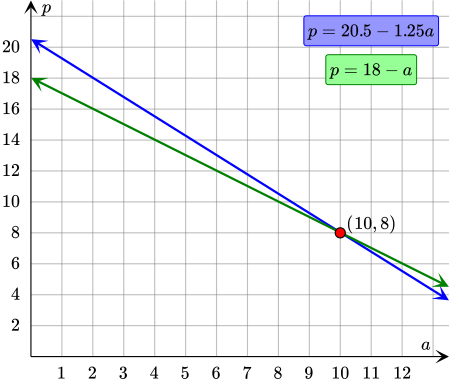
b a=10, p=8
c The solutions are the same. In this case, the Substitution Method is more useful for a number of reasons.
d The system is consistent and independent.
Hint
a Rewrite the equations into slope-intercept form. Then use the slope and y-intercept to graph each equation.
b Substitute 18−a for p in the first equation and solve it for a. Then substitute the found value of a into the second equation and find p.
c Identify which method is shorter. Does either of them require the equations to be in a specific form? Do they both result in finding the exact solutions every time?
d Recall the definitions of consistent and inconsistent systems and independent and dependent systems.
Solution
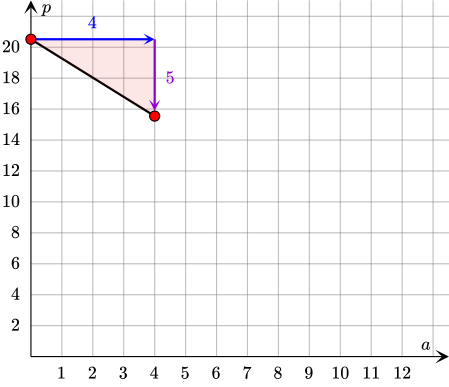
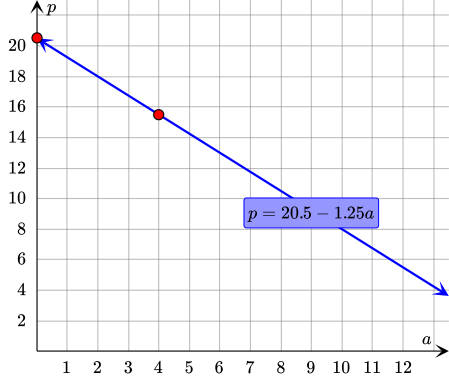
a In order to solve the system of equations by graphing, both equations should be written in slope-intercept form. The second equation is already in the required form, so only the first equation needs to be rewritten.
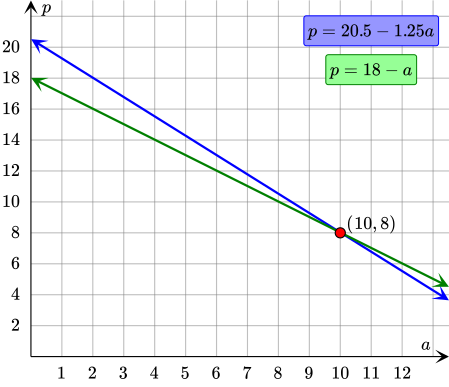
b Now, the system of equations will be solved by using the Substitution Method. The variable p is already isolated in the second equation, so 18−a can be substituted for p in the first equation.
{5a+4p=82p=18−a(I)(II)
Substitute
(I): p=18−a
{5a+4(18−a)=82p=18−a
Distr
(I): Distribute 4
{5a+72−4a=82p=18−a
SubTerm
(I): Subtract term
{a+72=82p=18−a
SubEqn
(I): LHS−72=RHS−72
{a=10p=18−a
Substitute
(II): a=10
{a=10p=18−10
SubTerms
(II): Subtract terms
{a=10p=8
c From the two previous parts, both methods of solving the system of equations gave the same solution. Therefore, both methods of solving are correct.
GraphingMethod↘(10,8)SubstitutionMethod↙
However, in this case, the Substitution Method can be more convenient because it is shorter and gives the exact solution. By comparison, the graphing method requires the equations to be in slope-intercept form and does not always result in finding the exact solution. 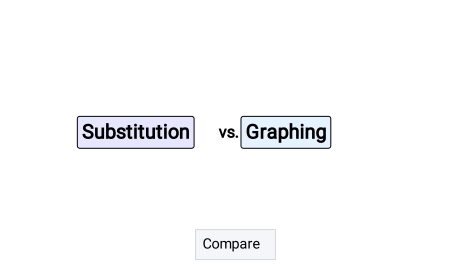
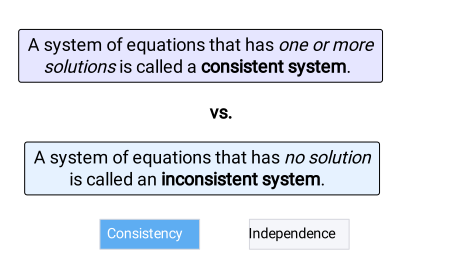
d In order to interpret the system of equations in terms of consistency and independence, start by recalling the definitions of these concepts.
Example
Modeling and Solving a Real-Life Problem with a System of Equations
Maya's grandparents own a small farmyard where they raise sheep and chickens. Maya was curious how many of each her grandparents have, so she asked them about it.

External credits: @brgfx
Her grandfather really likes riddles, so he told her that their sheep and chickens have a total of 102 heads and 252 legs and asked Maya to calculate the number of each animal herself.
a Let s be the number of sheep and c be the number of chickens. Write a system of equations that describes this situation.
b Solve the system using the Substitution Method.
c Check your answer.
d Interpret the system in terms of consistency and independence.
Answer
a {s+c=1022c+4s=252
b s=24, c=78
c See solution.
d Consistent and independent system.
Hint
a How many legs do sheep and chickens have? Use the information about heads to create one equation and the information about legs to write another.
b Start by isolating one variable in one equation and substituting the corresponding expression into the other equation.
c Substitute the found values of s and c into the system of equations and check whether true statements are obtained.
d Use the definitions of consistent and inconsistent, dependent and independent systems.
Solution
a It is given that Maya's grandparents have 102 heads of animals. Each animal has one head, so this number in fact represents the total number of animals. Therefore, the sum of the numbers of sheep s and chickens c is equal to 102. The first equation can now be formed.
s+c=102
To write the second equation, the information about legs will be used. Each chicken has 2 legs, so 2c represents the total number of chicken legs. Sheep have 4 legs, so 4s is the total number of legs that belong to sheep. The sum of these two expressions is said to be 252.
2c+4s=252
Together these two equations form a system of linear equations that describes the given situation. {s+c=1022c+4s=252
b To solve the system of equations by using the Substitution Method, first isolate one variable on one side of an equation. For example, s can be isolated in the first equation. Then, substitute the corresponding expression into the second equation.
{s+c=1022c+4s=252(I)(II)
SubEqn
(I): LHS−c=RHS−c
{s=102−c2c+4s=252
Substitute
(II): s=102−c
{s=102−c2c+4(102−c)=252
{s=102−c2c+4(102−c)=252
{s=102−cc=78
c In order to be sure that the found solution is correct, substitute the found values of s and c into the system of equations. If after simplifying two true statements are obtained, then the solution is correct.
{s+c=1022c+4s=252(I)(II)
(I), (II): s=24, c=78
{24+78=?1022(78)+4(24)=?252
Multiply
(II): Multiply
{24+78=?102156+96=?252
(I), (II): Add terms
{102=102 ✓252=252 ✓
d In order to interpret the system in terms of consistency and independence, recall the definitions of these concepts.
| Concept | Definition |
|---|---|
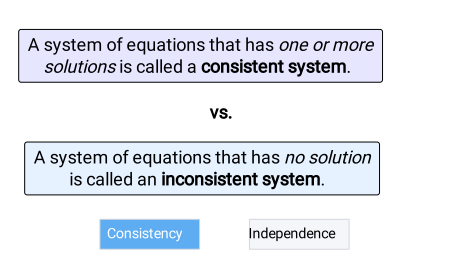
| Consistent System | A system of equations that has one or more solutions. |
| Inconsistent System | A system of equations that has no solution. |
| Dependent System | A system of equations with infinitely many solutions. |
| Independent System | A system of equations with exactly one solution. |
As was found in Part B, the considered system of equations has exactly one solution for each variable. Therefore, the system is consistent and independent.
Pop Quiz
Checking the Solutions of Systems of Equations
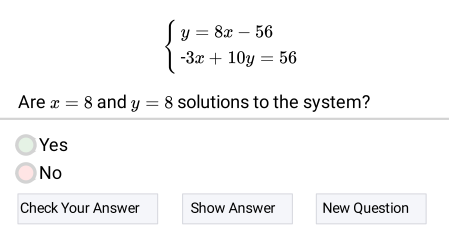
Consider a system of linear equations. Check whether the values of x and y are the solutions to the system.
Example
Determining the Areas Where Potatoes and Carrots Are Grown
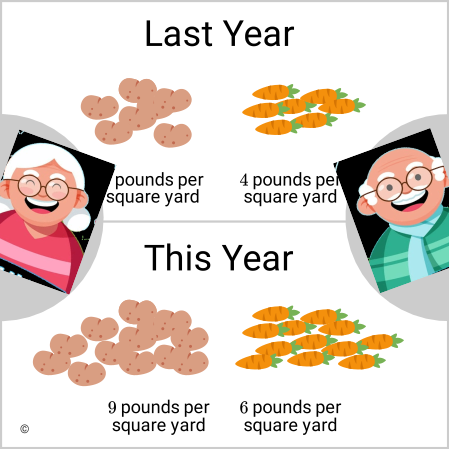
Maya's grandparents also grow some carrots and potatoes. Last year they harvested 6 pounds of potatoes and 4 pounds of carrots per square yard of garden. In total they grew 185 pounds of these vegetables.
External credits: @freepik
To their big surprise, this year they managed to harvest 9 pounds of potatoes and 6 pounds of carrots per square yard of garden, for a total of 277.5 pounds of vegetables.
a Write a system of equations whose solutions are the numbers of square yards of garden where potatoes p and carrots c grow.
b Solve the system using the Substitution Method.
c Interpret the system in terms of consistency and independence.
Answer
a {6p+4c=1859p+6c=277.5
b Infinitely many solutions
c Consistent and dependent system
Hint
a Start by writing the expressions for the total amounts of potatoes and carrots Maya's grandparents grew last year and this year.
b First isolate one variable in one equation. Then, substitute the corresponding expression into the other equation.
c Use the definitions of consistent and inconsistent, dependent and independent systems of equations.
Solution
a First, the equation describing the harvest of the last year will be written. The variables p and c denote the numbers of square yards of garden where potatoes and carrots grow, respectively. Maya's grandparents grew 6 pounds of potatoes per acre, so the product 6p represents the total number of pounds of potatoes.
6p=Total pounds of potatoes
Similarly, 4c represents the total number of pounds of carrots they grew.
4c=Total pounds of carrots
Maya's grandparents grew a total of 185 pounds of vegetables last year. Therefore, the sum of 6p and 4c is equal to 185.
Last Year6p+4c=185
The equation describing the harvest of this year can now be formed by using a similar process. This year the grandparents managed to grow 9 pounds of potatoes per square yard and 6 pounds of carrots per square yard. Therefore, 9p and 6c are the total number of pounds of potatoes and carrots they harvested, respectively.
9p 6c = Total pounds of potatoes= Total pounds of carrots
The sum of these expressions is 277.5, which is the total amount of vegetables that Maya's grandparents grew this year.
This Year9p+6c=277.5
A system of equations can be written using these two linear equations.
{6p+4c=1859p+6c=277.5
b To solve the system of equations using the Substitution Method, isolate one variable in one equation and substitute the corresponding expression into the other equation. For example, c can be isolated on the left-hand side of the first equation.
{6p+4c=1859p+6c=277.5(I)(II)
SubEqn
(I): LHS−6p=RHS−6p
{4c=185−6p9p+6c=277.5
DivEqn
(I): LHS/4=RHS/4
{c=46.25−1.5p9p+6c=277.5
Substitute
(II): c=46.25−1.5p
{c=46.25−1.5p9p+6(46.25−1.5p)=277.5
Distr
(II): Distribute 6
{c=46.25−1.5p9p+277.5−9p=277.5
SubTerm
(II): Subtract term
{c=46.25−1.5p277.5=277.5
c To interpret the system in terms of consistency and independence, first recall the definitions of these concepts.
Example
Determining the Number of Cooks and Waiters in a Restaurant
To keep herself busy and earn some extra cash, Maya found a part time job at a local restaurant. One week she is trained to work in the kitchen and another she works as a waitress. One day, each person working in the kitchen cooked 24 dishes, while each waiter served 120 dishes.
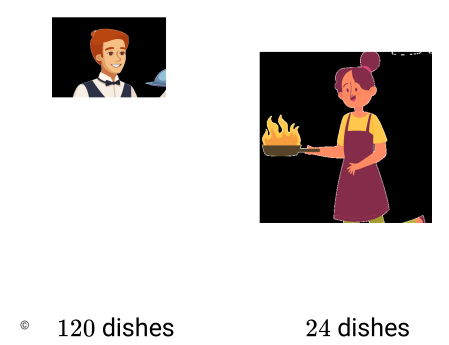
At the end of the day, when the kitchen was closing, Maya noticed that 2 cooked dishes did not get served. The number of people in the kitchen was 4 more than 5 times the number of waiters.
a Write a system of equations whose solutions are the number of people working in the kitchen k and the number of waiters w.
b Solve the system using the Substitution Method.
c Interpret the system in terms of consistency and independence.
Answer
a {24k−120w=2k=5w+4
b No solution
c Inconsistent system
Hint
a What are the expressions for the total numbers of dishes cooked and served? Use the information that the difference between these expressions equals 2.
b Isolate one variable in one equation and substitute the corresponding expression into the other equation.
c Recall the definitions of consistent and inconsistent, dependent and independent systems of equations.
Solution
a Let k denote the number of people working in the kitchen and w denote the number of waiters. Since each person in the kitchen cooked 24 dishes, by multiplying 24 by k, the total number of dishes cooked can be found.
24k = Dishes cooked
Additionally, each waiter served 120 dishes. Therefore, the product of 120 and the number of waiters w equals the total number of dishes served.
120w = Dishes served
Also, it is said that two dishes were cooked but not served at the end of that day. This means that the difference between 24k and 120w equals 2. 24k−120w=2
It is also known that the number of people in the kitchen was 4 more than 5 times the number of waiters. By using this piece of information, the second equation can be written.
k=5w+4
Finally, the system of two linear equations can be formed by combining the two equations.
{24k−120w=2k=5w+4
b To solve the system of equations using the Substitution Method, one variable should be isolated and the corresponding expression should be substituted into the other equation. In the system written in Part A, the variable k is already isolated, so 5w+4 can be substituted for k in the first equation.
{24k−120w=2k=5w+4(I)(II)
Substitute
(I): k=5w+4
{24(5w+4)−120w=2k=5w+4
Distr
(I): Distribute 24
{120w+96−120w=2k=5w+4
SubTerm
(I): Subtract term
{96=2k=5w+4
c In order to interpret the system in terms of consistency and independence, recall the definitions of these concepts.
| Concept | Definition |
|---|---|
| Consistent System | A system of equations that has one or more solutions. |
| Inconsistent System | A system of equations that has no solution. |
| Dependent System | A system of equations with infinitely many solutions. |
| Independent System | A system of equations with exactly one solution. |
The considered system of equations has no solution. Therefore, it is an inconsistent system.
Closure
Calculating the Number of Girls and Boys in a Class
Finally, the challenge presented at the beginning can be solved. It stated that there are 23 students in Maya's math class. She does not remember the exact number of boys and girls, but she knows that there are 5 more girls than boys in the class.  Is it possible to find the number of girls and boys in Maya's math class without graphing? If so, what is the number of girls and boys?
External credits: @vectorpocket
{"type":"text","form":{"type":"math","options":{"comparison":"1","nofractofloat":false,"keypad":{"simple":true,"useShortLog":false,"variables":["x"],"constants":["PI"]},"rendered":false},"text":"<span class=\"katex\"><span class=\"katex-html\" aria-hidden=\"true\"><\/span><\/span>"},"formTextBefore":"<span class=\"katex\"><span class=\"katex-html\" aria-hidden=\"true\"><span class=\"base\"><span class=\"strut\" style=\"height:0.96826171875em;vertical-align:-0.2080078125em;\"><\/span><span class=\"mord text\"><span class=\"mord Roboto-Regular\">Number<\/span><span class=\"mord\">\u00a0<\/span><span class=\"mord Roboto-Regular\">of<\/span><span class=\"mord\">\u00a0<\/span><span class=\"mord Roboto-Regular\">girls<\/span><\/span><span class=\"mspace\" style=\"margin-right:0.2777777777777778em;\"><\/span><span class=\"mrel\">=<\/span><\/span><\/span><\/span>","formTextAfter":null,"answer":{"text":["14"]}}
{"type":"text","form":{"type":"math","options":{"comparison":"1","nofractofloat":false,"keypad":{"simple":true,"useShortLog":false,"variables":["x"],"constants":["PI"]},"rendered":false},"text":"<span class=\"katex\"><span class=\"katex-html\" aria-hidden=\"true\"><\/span><\/span>"},"formTextBefore":"<span class=\"katex\"><span class=\"katex-html\" aria-hidden=\"true\"><span class=\"base\"><span class=\"strut\" style=\"height:0.9736328125em;vertical-align:-0.21337890625em;\"><\/span><span class=\"mord text\"><span class=\"mord Roboto-Regular\">Number<\/span><span class=\"mord\">\u00a0<\/span><span class=\"mord Roboto-Regular\">of<\/span><span class=\"mord\">\u00a0<\/span><span class=\"mord Roboto-Regular\">boys<\/span><\/span><span class=\"mspace\" style=\"margin-right:0.2777777777777778em;\"><\/span><span class=\"mrel\">=<\/span><\/span><\/span><\/span>","formTextAfter":null,"answer":{"text":["9"]}}
Hint
Write two equations that describe the total number of students in the class and the number of girls in the class. Then solve the system of equations by using the Substitution Method.
Solution
Let g be the number of girls and b be the number of boys in Maya's math class. It is given that there are a total of 23 students in the class. Therefore, by adding g and b and setting the sum equal to 23, the first equation can be formed.
It can be concluded that there are 14 girls and 9 boys in Maya's math class.
g+b=23
It is also known that there are 5 more girls than boys in the class. Using this information, the second linear equation can be written.
g=b+5
These two equations form a system of equations.
{g+b=23g=b+5
To solve it, the Substitution Method will be used.
{g+b=23g=b+5(I)(II)
Substitute
(I): g=b+5
{(b+5)+b=23g=b+5
AddTerms
(I): Add terms
{2b+5=23g=b+5
SubEqn
(I): LHS−5=RHS−5
{2b=18g=b+5
DivEqn
(I): LHS/2=RHS/2
{b=9g=b+5
Substitute
(II): b=9
{b=9g=9+5
AddTerms
(II): Add terms
{b=9g=14
Loading content