{{ tocSubheader }}
{{ 'ml-label-loading-course' | message }}
An error ocurred, try again later!
Chapter {{ article.chapter.number }}
{{ article.number }}.
{{ article.displayTitle }}
{{ article.intro.summary }}
Show less Show more expand_more Lesson Settings & Tools
| | {{ 'ml-lesson-number-slides' | message : article.intro.bblockCount }} |
| | {{ 'ml-lesson-number-exercises' | message : article.intro.exerciseCount }} |
| | {{ 'ml-lesson-time-estimation' | message }} |
In this lesson, it will be shown how a graph can help find values of variables that satisfy two linear equations simultaneously.
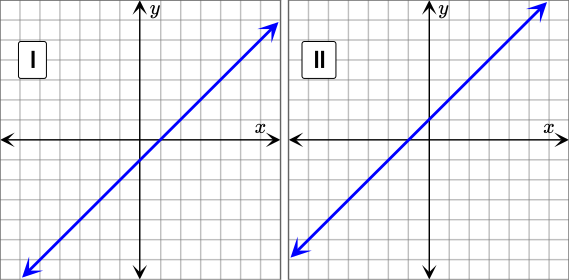
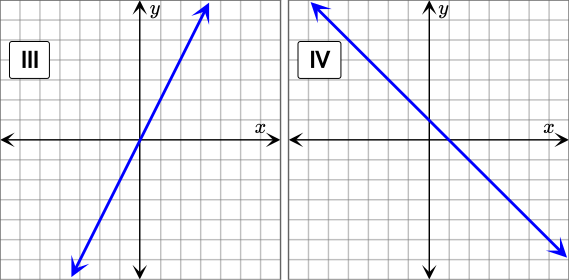 Which graph corresponds to y=x-1?
Catch-Up and Review
Here are a few recommended readings before getting started with this lesson.
- Linear Equation
- Slope-intercept form
- Graphing linear equations in slope-intercept form
- Literal Equations
Here are a few practice exercises before getting started with this lesson.
a Write the equation - 6x+2y=12 in slope-intercept form.
{"type":"text","form":{"type":"math","options":{"comparison":"1","nofractofloat":false,"keypad":{"simple":false,"useShortLog":false,"variables":["x"],"constants":[]},"rendered":false},"text":" "},"formTextBefore":"y=","formTextAfter":null,"answer":{"text":["3x+6"]}}
b Consider the following linear graphs.
{"type":"choice","form":{"alts":["Graph I","Graph II","Graph III","Graph IV"],"noSort":true},"formTextBefore":"","formTextAfter":"","answer":0}
Challenge
Basketball and Soccer
The number of students in the US participating in high school basketball and soccer has steadily increased over the past few years.

The following table shows some information about this.
| High School Sport | Number of Students Participating in 2015 (Thousands) |
Average Rate of Increase (Thousands per Year) |
|---|---|---|
| Basketball | 700 | 20 |
| Soccer | 400 | 40 |
Consider the above table to answer the following questions.
a Write two equations to represent the situation.
b Graph the equations from Part A in the same coordinate plane. Use the graph to predict the approximate year when the number of students participating in these two sports will be the same.
Explore
Lines on the Same Plane
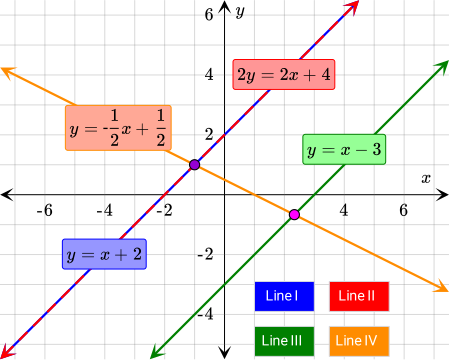
In the graph below, four lines and their corresponding linear equations can be seen on a coordinate plane. Investigate which lines intersect at one point, which lines intersect at infinitely many points, and which lines do not intersect at all.
Discussion
System of Equations
Two important concepts will be discussed here.
Concept
Equation In Two Variables
An equation in two variables is a mathematical relation between two equal quantities that involves two variables.
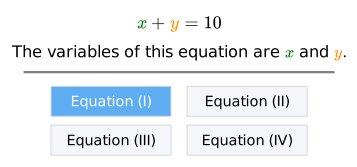 Solving an equation in two variables results in an ordered pair that makes the equation true.
Concept
System of Equations

Systems of equations can be solved graphically or algebraically.
Discussion
Solving a System of Linear Equations Graphically
Solving a system of linear equations graphically means graphing the lines represented by the equations of the system and identifying the point of intersection. Consider an example system of equations.
2y=- 2x+8 x=y-1
To solve the system of equations, three steps must be followed.
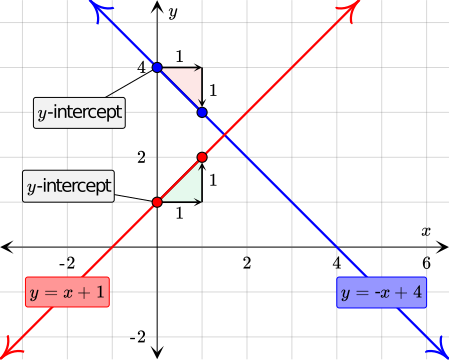
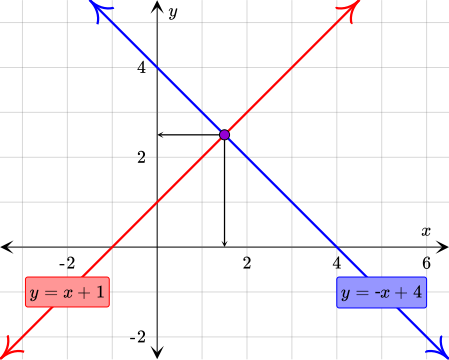 Sometimes the point of intersection of the lines is not a lattice point. In this case, the solution found by solving the system of equations graphically is approximate.
1
Write the Equations in Slope-Intercept Form
expand_more Start by writing the equations in slope-intercept form by isolating the y-variables. For the first linear equation, divide both sides by 2. For the second equation, add 1 to both sides.
2y=- 2x+8 & (I) x=y-1 & (II)
▼
(I): Solve for y
DivEqn
(I): .LHS /2.=.RHS /2.
y= - 2x+82 x=y-1
WriteSumFrac
(I): Write as a sum of fractions
y= - 2x2+ 82 x=y-1
MovePartNumRight
(I): a* b/c=a/c* b
y= - 22x+ 82 x=y-1
MoveNegNumToFrac
(I): Put minus sign in front of fraction
y=- 22x+ 82 x=y-1
CalcQuot
(I): Calculate quotient
y=- 1x+4 x=y-1
IdPropMult
(I): Identity Property of Multiplication
y=- x+4 x=y-1
▼
(II): Solve for y
y=- x+4 y=x+1
2
Graph the Lines
expand_more Now that the equations are both written in slope-intercept form, they can be graphed on the same coordinate plane.
3
Identify the Point of Intersection
expand_more The point where the lines intersect is the solution to the system.
The lines appear to intersect at (1.5,2.5). Therefore, this is the solution to the system — the value of x is 1.5 and the value of y is 2.5.
Example
Modeling With a System of Linear Equations
Tearrik is throwing a party and bought some sodas and chips.

{"type":"text","form":{"type":"math","options":{"comparison":"1","nofractofloat":false,"keypad":{"simple":true,"useShortLog":false,"variables":[],"constants":[]},"rendered":false},"text":" "},"formTextBefore":"Sodas (x):","formTextAfter":null,"answer":{"text":["12"]}}
{"type":"text","form":{"type":"math","options":{"comparison":"1","nofractofloat":false,"keypad":{"simple":true,"useShortLog":false,"variables":[],"constants":[]},"rendered":false},"text":" "},"formTextBefore":"Chips (y):","formTextAfter":null,"answer":{"text":["9"]}}
Hint
Start by writing both linear equations in slope-intercept form.
Solution
To start, each equation in the system will be written in slope-intercept form. This means that the variable y will be isolated in both equations.
Now, the slope and the y-intercept of each line will be used to draw the graphs on the same coordinate plane. Since the number of items cannot be negative, only the first quadrant will be considered for the graph. 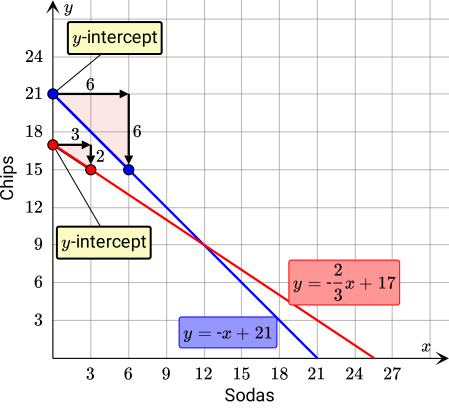
x+y=21 & (I) 2x+3y=51 & (II)
▼
(I), (II): Write in slope-intercept form
SubEqn
(I): LHS-x=RHS-x
y=- x+21 2x+3y=51
SubEqn
(II): LHS-2x=RHS-2x
y=- x+21 3y=- 2x+51
DivEqn
(II): .LHS /3.=.RHS /3.
y=- x+21 y= - 2x+513
WriteSumFrac
(II): Write as a sum of fractions
y=- x+21 y= - 2x3+ 513
MovePartNumRight
(II): a* b/c=a/c* b
y=- x+21 y= - 23x+ 513
MoveNegNumToFrac
(II): Put minus sign in front of fraction
y=- x+21 y=- 23x+ 513
CalcQuot
(II): Calculate quotient
y=- x+21 y=- 23x+17
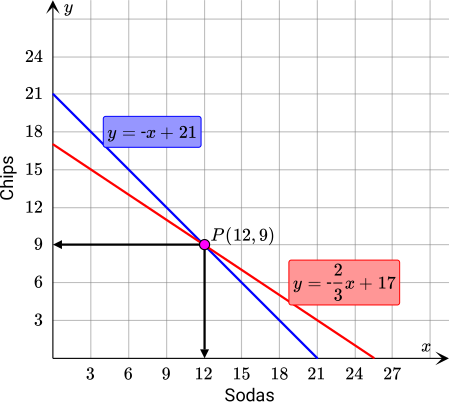
Finally, the point of intersection P can be identified.
The point of intersection of the lines is P(12,9). In the context of the situation, this means that Tearrik bought 12 sodas and 9 bags of chips.
Pop Quiz
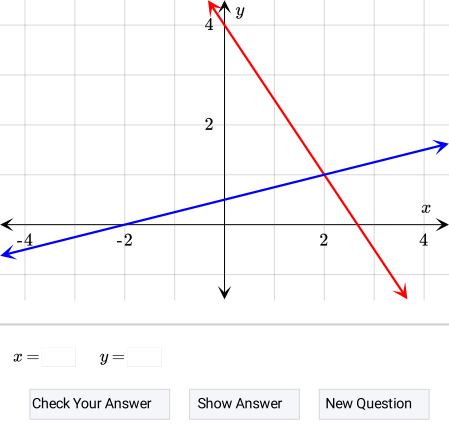
Finding the Solution to a System of Equations by Graphing
Discussion
Consistent and Independent Systems
The system of equations in the previous example had one solution. This leads to two important definitions.
Concept
Consistent System
A system of equations that has one or more solutions is called a consistent system. For example, consider the following linear systems.
ccc
Example System I & & Example System II [0.8em] y=x+1 y=2x-2 & & y=x-1 2y=2x-2
To determine the number of solutions, each system can be graphed on a coordinate plane.
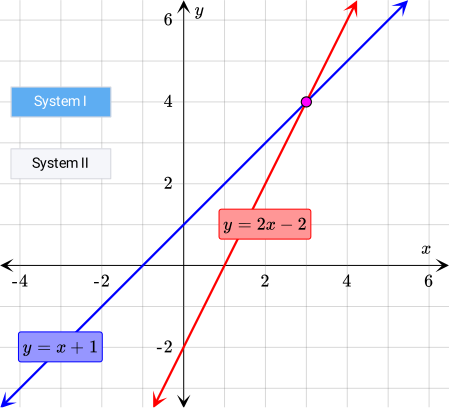 In the graph, it can be seen that the first system has exactly one solution. The second system has infinitely many solutions. Therefore, since both systems have one or more solutions, they are consistent systems.
Concept
Independent System
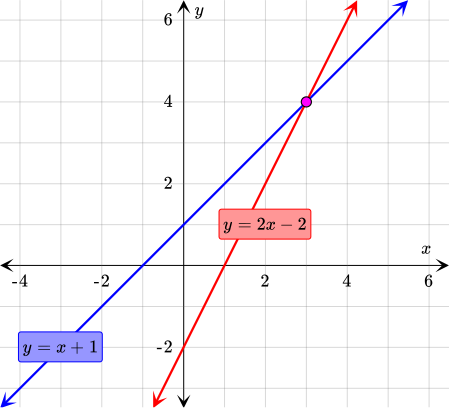
An independent system is a system of equations with exactly one solution. Consider the following linear system. y=x+1 y=2x-2 To state the number of solutions, both lines of the system can be graphed on the same coordinate plane.
Example
Finding the Solution and Classifying a System of Equations
At Tearrik's party, Ignacio found one of Tearrik's homework assignments. He does not want to do Tearrik's homework for him, but Ignacio decides to quiz himself using the assignment.

Help Ignacio determine whether the given systems of equations are consistent systems and whether they are independent systems.
a y=- 2x+6 4x-2y=- 20
{"type":"choice","form":{"alts":["The system is consistent and independent.","The system is neither consistent nor independent.","The system is consistent but not independent.","The system is independent but not consistent."],"noSort":false},"formTextBefore":"","formTextAfter":"","answer":0}
b x+y=3 4x+4y=12
{"type":"choice","form":{"alts":["The system is consistent and independent.","The system is neither consistent nor independent.","The system is consistent but not independent.","The system is independent but not consistent."],"noSort":false},"formTextBefore":"","formTextAfter":"","answer":2}
Hint
a Solve the system by graphing and determine the number of solutions.
b Solve the system by graphing and determine the number of solutions.
Solution
a The system will be solved graphically. To do so, both linear equations must to be expressed in slope-intercept form. In the first equation, the variable y is already isolated. Therefore, only the second equation needs to be rewritten.
y=- 2x+6 & (I) 4x-2y=- 20 & (II)
▼
(II): Write in slope-intercept form
SubEqn
(II): LHS-4x=RHS-4x
y=- 2x+6 - 2y=- 4x-20
DivEqn
(II): .LHS /(- 2).=.RHS /(- 2).
y=- 2x+6 y= - 4x-20- 2
WriteDiffFrac
(II): Write as a difference of fractions
y=- 2x+6 y= - 4x- 2- 20- 2
DivNegNeg
(II): - a/- b=a/b
y=- 2x+6 y= 4x2- 20- 2
MovePartNumRight
(II): a* b/c=a/c* b
y=- 2x+6 y= 42x- 20- 2
MoveNegDenomToFrac
(II): Put minus sign in front of fraction
y=- 2x+6 y= 42x-(- 202)
SubNeg
(II): a-(- b)=a+b
y=- 2x+6 y= 42x+ 202
CalcQuot
(II): Calculate quotient
y=- 2x+6 y=2x+10
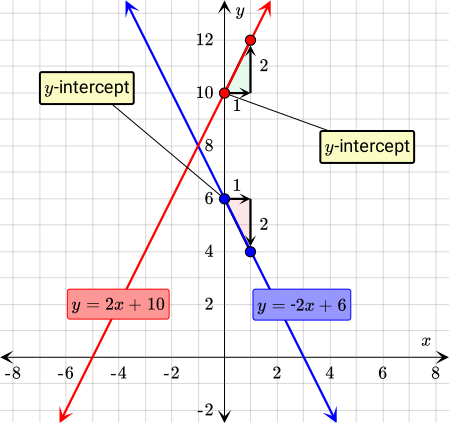
The lines intersect at exactly one point.
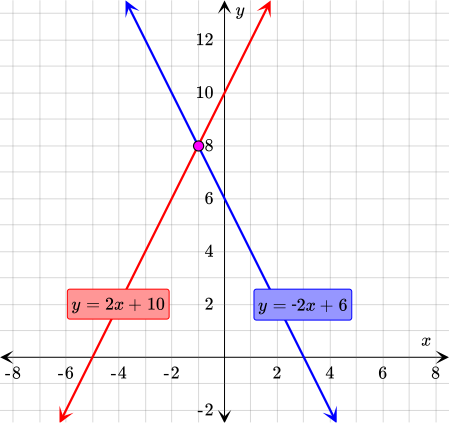
Since the system has one or more solutions, it is a consistent system. Furthermore, since it has exactly one solution, it is also an independent system.
b Again, the system of equations will be solved graphically. To do so, both equations will be rewritten in slope-intercept form.
Note that both equations are simplified to the same equation. It can be graphed by using its slope and its y-intercept. 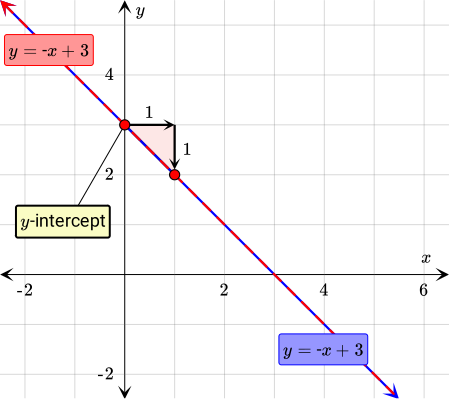 The lines overlap each other. Therefore, they intersect at infinitely many points. Since the system has one or more solutions, it is a consistent system. However, since it does not have exactly one solution, it is not an independent system.
x+y=3 & (I) 4x+4y=12 & (II)
▼
(I), (II): Write in slope-intercept form
SubEqn
(I): LHS-x=RHS-x
y=- x+3 4x+4y=12
SubEqn
(II): LHS-4x=RHS-4x
y=- x+3 4y=- 4x+12
DivEqn
(II): .LHS /4.=.RHS /4.
y=- x+3 y= - 4x+124
WriteSumFrac
(II): Write as a sum of fractions
y=- x+3 y= - 4x4+ 124
MoveNegNumToFrac
(II): Put minus sign in front of fraction
y=- x+3 y=- 4x4+ 124
MovePartNumRight
(II): a* b/c=a/c* b
y=- x+3 y=- 44x+ 124
CalcQuot
(II): Calculate quotient
y=- x+3 y=- 1x+3
IdPropMult
(II): Identity Property of Multiplication
y=- x+3 y=- x+3
Discussion
Dependent and Inconsistent Systems
In the last example, one of the systems had infinitely many solutions. Systems of equations with infinitely many solutions have a special name.
Concept
Dependent System
A dependent system is a system of equations with infinitely many solutions. Consider the following linear system. 2y=4x-4 y=2x-2 To find the number of solutions, both lines of the system can be graphed on the same coordinate plane.
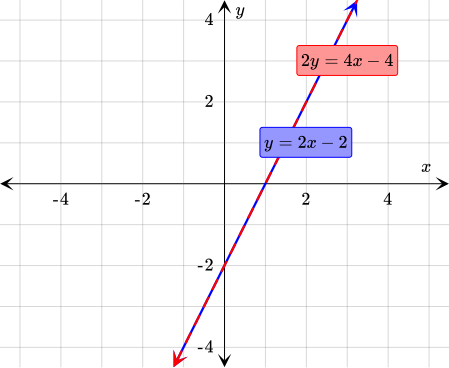
Furthermore, systems with no solutions also have a special name.
Concept
Inconsistent System
A system of equations that has no solutions is called an inconsistent system. For example, consider the following linear system. y=2x-1 y=2x+2 To determine the number of solutions, the system can be graphed on a coordinate plane.
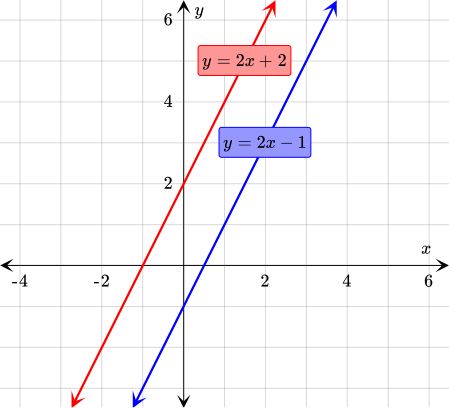
Example
Finding the Solution and Classifying a System of Equations
Mark cannot go to Tearrik's party because he has recently started working with his father at a car dealership. At the dealership, Mark's father sells sedans and trucks.

{"type":"multichoice","form":{"alts":["The system is a consistent system.","The system is an inconsistent system.","The system is a dependent system.","The system is an independent system."],"noSort":false},"formTextBefore":"","formTextAfter":"","answer":[1]}
Hint
Graph both equations on the same coordinate plane.
Solution
To interpret the system in terms of consistency and independence, both linear equations will be drawn on the same coordinate plane. To do so, the slope-intercept form will be used. Since the first equation is already written in this form, the y-variable will be isolated in the second equation.
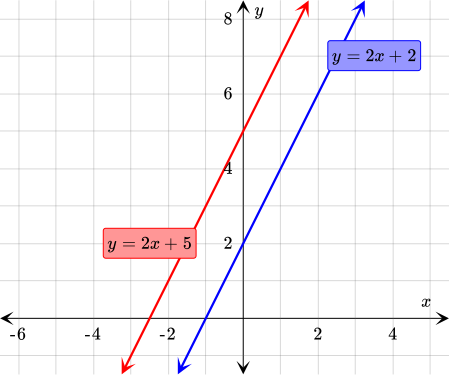
Now that both equations are written in slope-intercept form, their slopes and y-intercepts can be used to draw the lines. 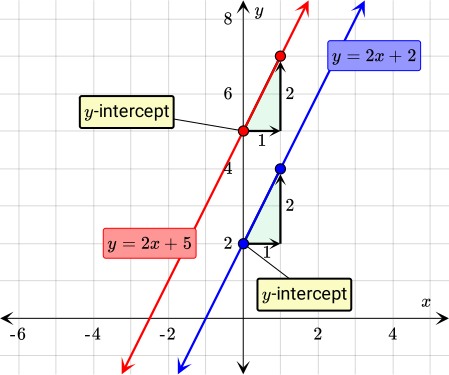
y=2x+2 & (I) 2y-4x=10 & (II)
▼
(II): Write in slope-intercept form
AddEqn
(II): LHS+4x=RHS+4x
y=2x+2 2y=4x+10
DivEqn
(II): .LHS /2.=.RHS /2.
y=2x+2 y= 4x+102
WriteSumFrac
(II): Write as a sum of fractions
y=2x+2 y= 4x2+ 102
MovePartNumRight
(II): a* b/c=a/c* b
y=2x+2 y= 42x+ 102
CalcQuot
(II): Calculate quotient
y=2x+2 y=2x+5
Next, recall the definitions of consistent, inconsistent, dependent, and independent systems.
| Consistent System | A system of equations that has one or more solutions. |
|---|---|
| Independent System | A system of equations with exactly one solution. |
| Dependent System | A system of equations with infinitely many solutions. |
| Inconsistent System | A system of equations that has no solution. |
With this information in mind, the lines will be considered one more time.
Since the lines do not intersect each other, the system has no solution. Therefore, it is an inconsistent system.
Pop Quiz
Classifying Systems
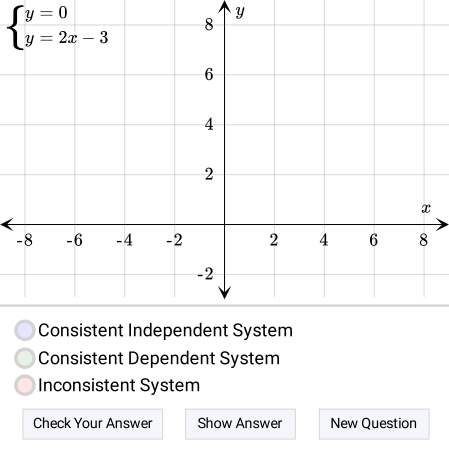
A system of equations can be consistent or inconsistent. In addition, a consistent system can be independent or dependent. Classify the following systems of equations in terms of consistency and independence.
Closure
Basketball and Soccer
With the content learned in this lesson, the challenge presented at the beginning can be solved. It has been said that the number of students in the US participating in high school basketball and soccer has steadily increased over the past few years.

The following table shows some information about this.
| High School Sport | Number of Students Participating in 2015 (Thousands) |
Average Rate of Increase (Thousands per Year) |
|---|---|---|
| Basketball | 700 | 20 |
| Soccer | 400 | 40 |
Consider the above table to answer the following questions.
a Write two equations in slope-intercept form to represent this situation.
{"type":"text","form":{"type":"math","options":{"comparison":"1","nofractofloat":false,"keypad":{"simple":false,"useShortLog":false,"variables":["x","y"],"constants":[]},"rendered":false},"text":" "},"formTextBefore":"Basketball:","formTextAfter":null,"answer":{"text":["y=20x+700"]}}
{"type":"text","form":{"type":"math","options":{"comparison":"1","nofractofloat":false,"keypad":{"simple":false,"useShortLog":false,"variables":["x","y"],"constants":[]},"rendered":false},"text":" "},"formTextBefore":"Soccer:","formTextAfter":null,"answer":{"text":["y=40x+400"]}}
b Graph the equations from Part A in the same coordinate plane. Use the graph to predict the approximate year when the number of students participating in these two sports will be the same.
{"type":"text","form":{"type":"math","options":{"comparison":"1","nofractofloat":false,"keypad":{"simple":true,"useShortLog":false,"variables":[],"constants":[]},"rendered":false},"text":" "},"formTextBefore":"Approximate year:","formTextAfter":null,"answer":{"text":["2030"]}}
Hint
a For both equations, let x be the number of years since 2015.
b Pay close attention to the x-coordinate of the point of intersection of the lines.
Solution
a To start, the equation for the number of students participating in high school basketball will be written. The variables can be defined as follows.
| Variable | Meaning of the Variable |
|---|---|
| x | Number of years since 2015 |
| y | Number of students that participate in high school basketball (thousands) |
From the given table, it is known that in the year 2015, 700 thousands students participated in high school basketball. Also, the yearly average rate of increase is 20 thousand students. With this information, an equation can be written. y= 20x+ 700 Next, the equation for the number of students participating in high school soccer will be written. The variables can be defined in a similar way as before.
| Variable | Meaning of the Variable |
|---|---|
| x | Number of years since 2015 |
| y | Number of students that participate in high school soccer (thousands) |
Again, it is seen in the table that in the year 2015, 400 thousands students participated in high school soccer. Also, the yearly average rate of increase is 40 thousand students. With this information, the second equation can be written. y= 40x+ 400
b The equations found in Part A form a system of equations.
y=20x+700 y=40x+400 Since both lines are already written in slope-intercept form, they can be graphed on the same coordinate plane.
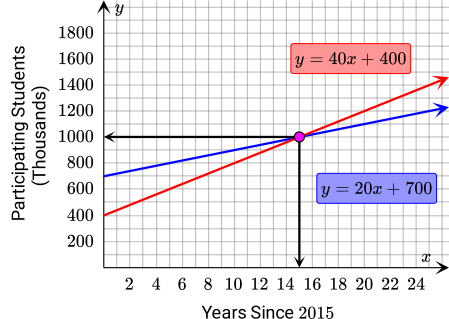
The lines intersect at exactly one point. Therefore, this is a consistent and independent system. The solution is x=15 and y=1000. This means that 15 years after 2015 — the year 2030 — there will be one million high school students participating in both sports.
Loading content