1. Proving the Similarity of All Circles
Sign In
An error ocurred, try again later!
Chapter 5
1.
Proving the Similarity of All Circles
In geometry, circles hold a special place due to their unique properties. One of the most intriguing aspects is the inherent similarity of all circles, regardless of their size. This means that any two circles, when scaled appropriately, will match perfectly. This similarity is not just about size; it extends to all properties and characteristics of circles. Such proofs are fundamental in understanding the deeper concepts of geometry and have practical implications in various fields, from art to engineering. Recognizing the similarity of circles aids in simplifying complex problems and offers a clearer perspective on geometric relationships.
Show less Show more expand_more 


Lesson Settings & Tools
| | 11 Theory slides |
| | 7 Exercises - Grade E - A |
| | Each lesson is meant to take 1-2 classroom sessions |
Proving the Similarity of All Circles
Slide of 11
In this lesson, it will be proven that all circles are similar.
Catch-Up and Review
Here are a few recommended readings before getting started with this lesson.
Try your knowledge on these topics.
a Two similar figures have the same .
{"type":"multichoice","form":{"alts":["Angle measures","Side lengths","Proportions","Orientation"],"noSort":false},"formTextBefore":"","formTextAfter":"","answer":[0,2]}
b Select the name of the transformation shown in each diagram.
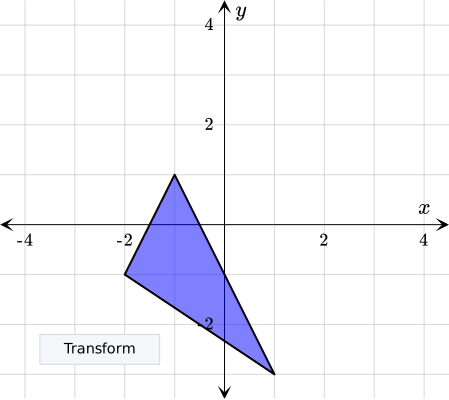
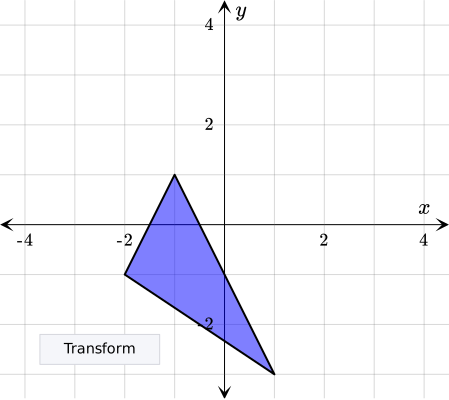
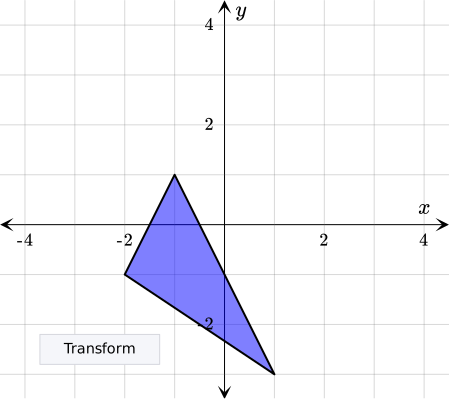
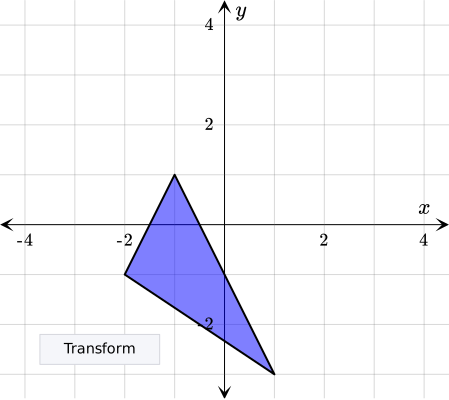
{"type":"choice","form":{"alts":["Translation","Rotation","Reflection","Dilation"],"noSort":false},"formTextBefore":"","formTextAfter":"","answer":0}
{"type":"choice","form":{"alts":["Rotation","Translation","Dilation","Reflection"],"noSort":false},"formTextBefore":"","formTextAfter":"","answer":0}
{"type":"choice","form":{"alts":["Reflection","Rotation","Translation","Dilation"],"noSort":false},"formTextBefore":"","formTextAfter":"","answer":0}
{"type":"choice","form":{"alts":["Reflection","Rotation","Translation","Dilation"],"noSort":false},"formTextBefore":"","formTextAfter":"","answer":3}
Explore
Share
Report error
Circle Transformation
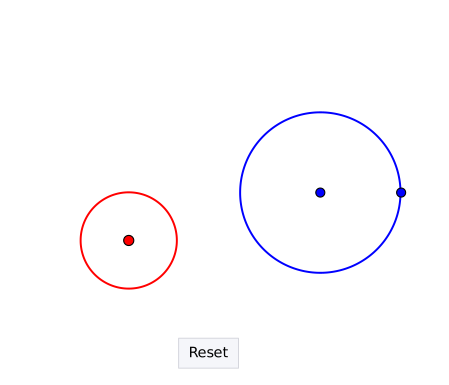
In the diagram below, can the larger circle be mapped onto the smaller circle? What transformations are involved?
Discussion
Share
Report error
Similarity of Concentric Circles
Consider two concentric circles with common center O and radii 4 and 6.
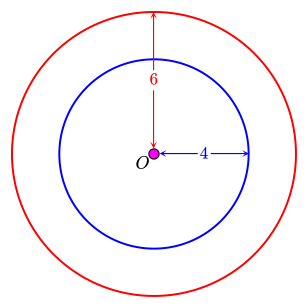
Let A and B be two points on the smaller and larger circles, respectively, collinear with O. Also, consider the ray through A and B, with endpoint O.
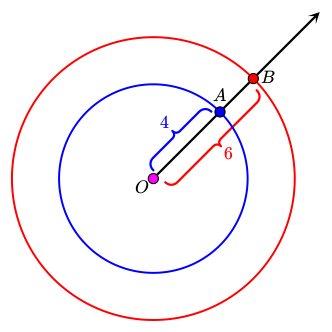
Since 4* 32= 6, point B is the image of point A after a dilation with center O and scale factor 32. Likewise, if any point on the smaller circle is dilated through O by a factor of 32, its image will fall on the larger circle. Hence, the circles are related by a dilation, and so, are similar. The same argument can be used for any two concentric circles. This leads to the following conclusion.
Concentric circles are similar.
Illustration
Share
Report error
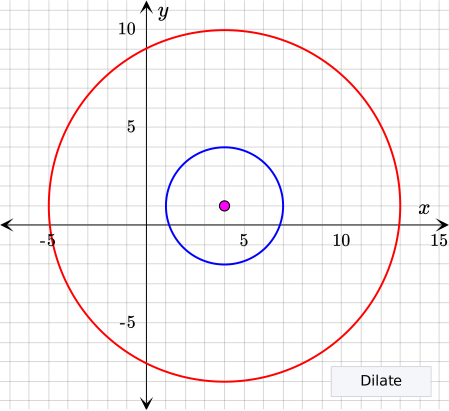
Dilating Concentric Circles
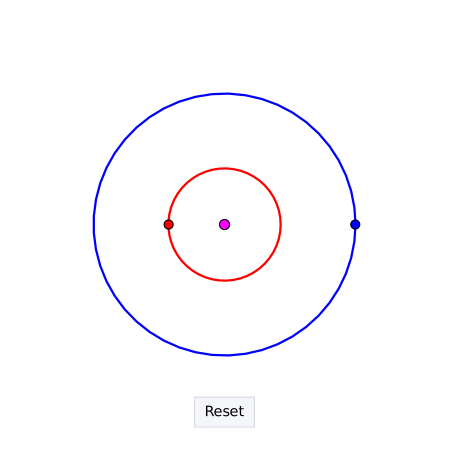
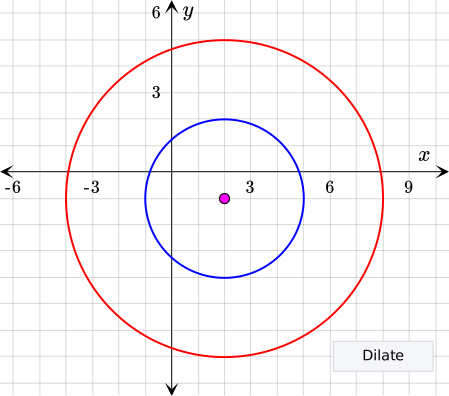
Dilate the concentric circles below so that they map onto each other.
Example
Share
Report error
Dilating a Small Circle to Map Onto a Large Circle
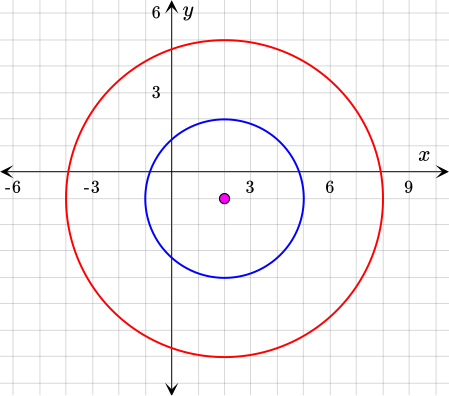
Given two concentric circles on a coordinate plane, Zosia is trying to determine the transformation that maps the smaller circle onto the larger circle.
{"type":"choice","form":{"alts":["Dilation with center (2,- 1) and scale factor 2.","Dilation with center (2,-1) and scale factor 0.5.","Dilation with center (0,0) and scale factor 2.","Translation 2 units up and 2 units to the left."],"noSort":false},"formTextBefore":"","formTextAfter":"","answer":0}
Hint
Consider the fact that the circles have different radii.
Solution
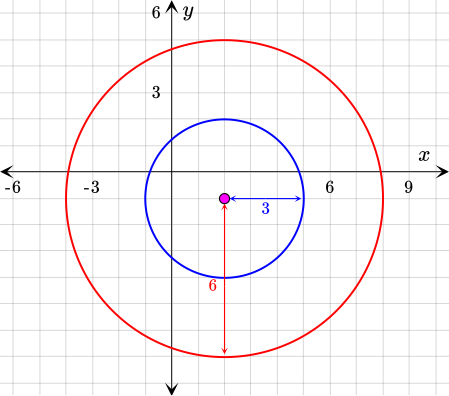
Note that the circles have different radii. The radius of the smaller circle is 3, and the radius of the larger circle is 6.
Example
Share
Report error
Dilating a Large Circle to Map Onto a Small Circle
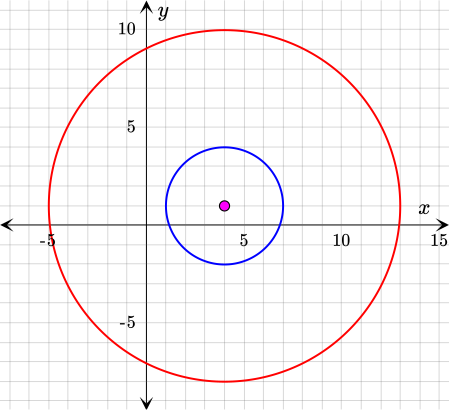
Now, given a different pair of concentric circles, Zosia wants to find the transformation that maps the larger circle onto the smaller circle.
{"type":"choice","form":{"alts":["Dilation with center (4,1) and scale factor 3.","Dilation with center (4,1) and scale factor 13.","Dilation with center (0,0) and scale factor 13.","Translation 6 units up and 3 units right."],"noSort":false},"formTextBefore":"","formTextAfter":"","answer":1}
Hint
Consider the fact that the circles have different radii.
Solution
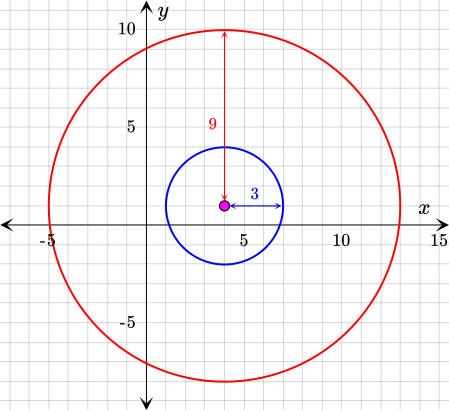
It can be seen in the diagram that the radius of the smaller circle is 3, and the radius of the larger circle is 9.
Discussion
Share
Report error
Similarity of Circles
Now, consider two circles with different centers. One of the circles can be translated so that they become concentric circles.
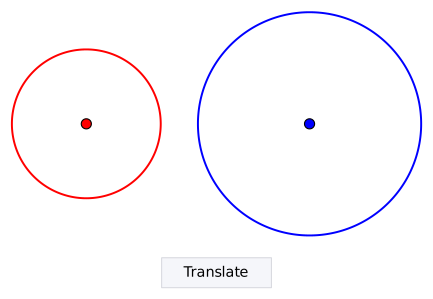 Recall that any two concentric circles are similar through dilation.
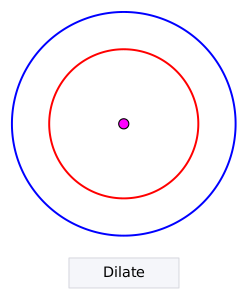 Therefore, any two non-concentric circles can be mapped onto each other. This can be done either by translation or by a combination of a translation and a dilation. Since translations and dilations are similarity transformations, the following statement can be made.
Non-concentric circles are similar.
With this information and knowing that any two concentric circles are also similar, a more general statement can be made.
All circles are similar.
Illustration
Share
Report error
Transforming Non-Concentric Circles
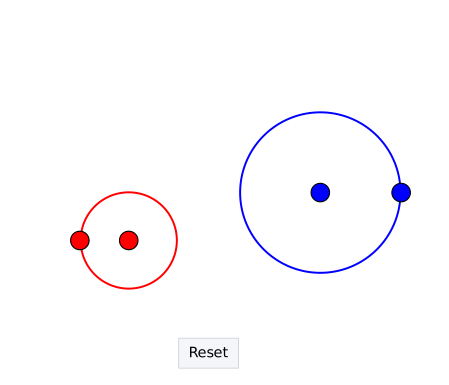
Two non-concentric circles can be mapped onto each other through either a translation or by a combination of a translation and a dilation. Therefore, non-concentric circles are similar. Translate and dilate the non-concentric circles below so that they map onto each other.
Example
Share
Report error
Mapping Congruent Circles Using Transformations
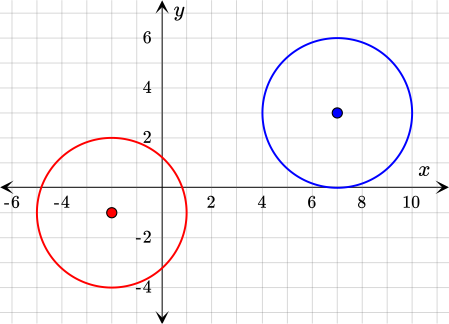
Diego has been asked to identify the transformation that maps the circle on the left onto the circle on the right.
{"type":"choice","form":{"alts":["Translation 9 units to the left and 4 units down.","Translation 9 units to the right and 4 units up.","Dilation with center (0,0) and scale factor 2.","Translation 9 units to the right and 4 units down."],"noSort":false},"formTextBefore":"","formTextAfter":"","answer":1}
Hint
Consider the fact that the circles have the same radius.
Solution
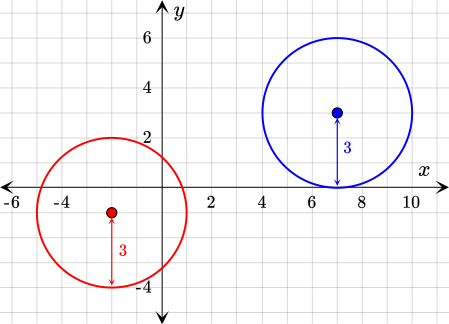
It can be seen in the diagram that the radius of both circles is 3.
Example
Share
Report error
Mapping Similar Circles Using Transformations
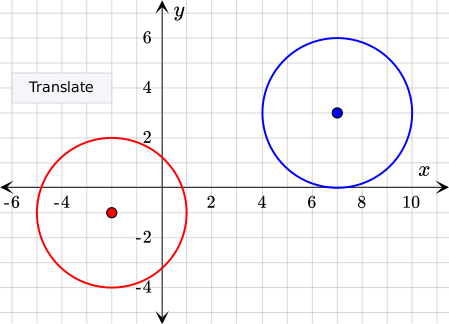
Finally, Diego wants to identify the combination of transformations that maps the smaller circle onto the larger circle.
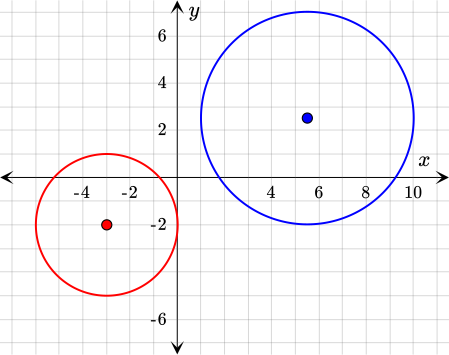
{"type":"choice","form":{"alts":["Translation 8.5 units to the right and 4.5 units up, and dilation by a scale factor of 1.5.","Translation 8.5 units to the right and 4.5 units up, and dilation by a scale factor of 2.","Translation 8 units to the right and 4.5 units up, and dilation by a scale factor of 1.5.","Translation 8.5 units to the right and 4 units up, and dilation by a scale factor of 1.5."],"noSort":false},"formTextBefore":"","formTextAfter":"","answer":0}
Hint
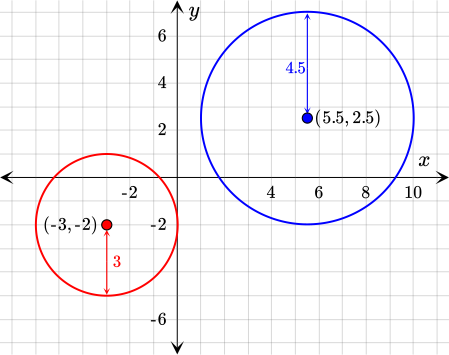
The radius of the smaller circle is 3, and the radius of the larger circle is 4.5. By which number does 3 need to be multiplied to obtain 4.5?
Solution
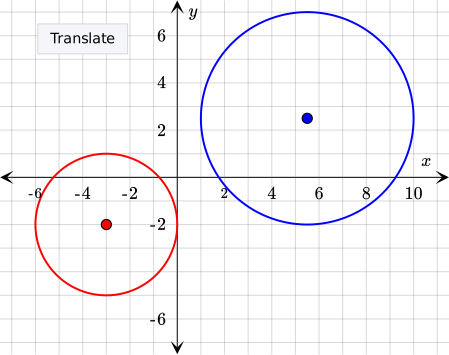
It can be seen in the diagram that the smaller circle has a radius of 3 and its center at the point (- 3,- 2). Furthermore the larger circle is centered at (5.5,2.5) and its radius is 4.5
Closure
Share
Report error
Extending to Theorems About Circles
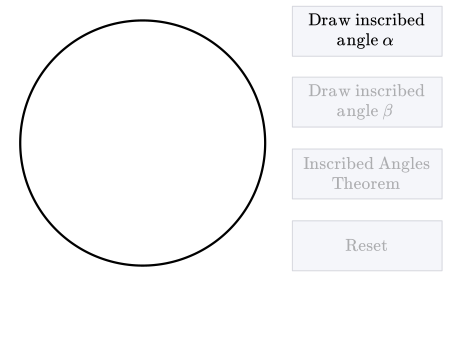
In this lesson, it has been proven that all circles are similar by using similarity transformations. Therefore, any theorem that is valid for one circle, is also valid for all circles. This can be exemplified by the following theorem.
|
If two inscribed angles of a circle intercept the same arc, then they are congruent. |
Proving the Similarity of All Circles
Exercise 1.1
Which of the following circles are similar to iv?
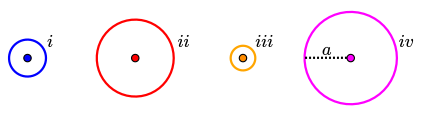
{"type":"multichoice","form":{"alts":["i","ii","iii","None"],"noSort":true},"formTextBefore":"","formTextAfter":"","answer":[0,1,2]}
security
report
code
security
report
code
Similarity means that two figures have the same shape. Basically what this tells us is that its only their size that differs. For that to be the case, the ratio of each figure's corresponding sides must be the same. Below we see an example.
However, in circles there is only one dimension that decides the size — the radius. Therefore, we will always be able to map any two circles onto each other by dilating the radius of one of them. It is formalized by the Similar Circles Theorem that all circles are similar.
security
report
code
Is there enough information to claim that ⊙ A ~ ⊙ B. Explain your reasoning.
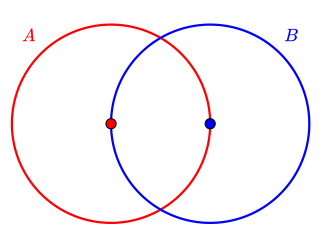
{"type":"choice","form":{"alts":["Yes","No"],"noSort":true},"formTextBefore":"","formTextAfter":"","answer":0}
security
report
code
security
report
code
The symbol ~ means similarity. Therefore, the statement is telling us that circle A is similar to circle B. A ~ B ⇓ A is similar to B By the Similar Circles Theorem, we know that all circles are, in fact, similar. We can prove this by transforming one of the circles until it maps onto the other. In this case, the circles have the same radius. Therefore, all we need to do is translate one circle until the centers overlap.
security
report
code
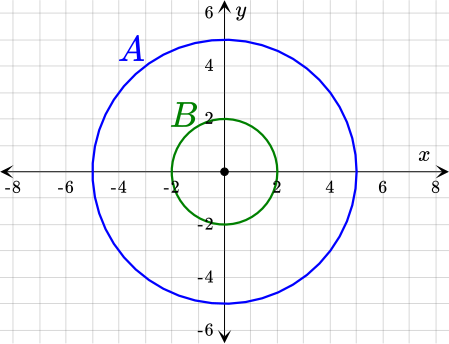
Consider ⊙ A and ⊙ B.
{"type":"text","form":{"type":"math","options":{"comparison":"1","nofractofloat":false,"keypad":{"simple":true,"useShortLog":false,"variables":["x"],"constants":["PI"]},"rendered":false},"text":" "},"formTextBefore":null,"formTextAfter":null,"answer":{"text":["\\dfrac{2}{5}"]}}
{"type":"text","form":{"type":"math","options":{"comparison":"1","nofractofloat":false,"keypad":{"simple":true,"useShortLog":false,"variables":["x"],"constants":["PI"]},"rendered":false},"text":" "},"formTextBefore":null,"formTextAfter":null,"answer":{"text":["\\dfrac{5}{2}"]}}
security
report
code
security
report
code
The scale factor needs to dilate ⊙ A such that it maps onto ⊙ B is the ratio of the radius of A to the radius of B. Therefore, let's first measure the radii of the two circles.
As we can see, ⊙ A and ⊙ B has a radius of 5 and 2 units respectively. Therefore, to dilate A so that it maps onto ⊙ B, we have to multiply its radius by a scale factor of 25.
This time, we want to dilate ⊙ B until it maps onto ⊙ A. From Part A, we know the radii of both circles. Since we want B to map onto A, we must multiply the radius of B by a scale factor of 52.
security
report
code
Proving the Similarity of All Circles
Recommended exercises
To get personalized recommended exercises, please login first.
Loading content
≤
>
■2
■▢
e▢
7
8
9
×
÷■1
=
=
√▢
▢√
∫▢▢
4
5
6
+
−
≤
<
log
ln
log▢
1
2
3
()
∣
sin
cos
tan
0
.
π
x
y
Loading content