16. Polygons Inscribed in a Circle
Sign In
An error ocurred, try again later!
Chapter 1
16.
Polygons Inscribed in a Circle
Understand the geometric properties of polygons inscribed within circles. One of the highlights is the construction of a pentagon using just a compass and a straightedge. This process involves drawing intersecting circles and connecting specific points to form the desired shape. The lesson further delves into the construction of other polygons, like equilateral triangles and hexagons, using foundational techniques. Such constructions have practical applications, like in security setups where equidistant points on a circle determine camera placements. Overall, the study provides a comprehensive insight into the world of inscribed polygons and their real-world implications.
Show less Show more expand_more 


Lesson Settings & Tools
| | 8 Theory slides |
| | 8 Exercises - Grade E - A |
| | Each lesson is meant to take 1-2 classroom sessions |
Polygons Inscribed in a Circle
Slide of 8
Some basic constructions such as bisecting an angle and drawing a perpendicular bisector were made using several tools and methods. With those constructions as a foundation, this lesson will expand into more complex constructions such as constructing an equilateral triangle and a regular pentagon using a straightedge and a compass.
Catch-Up and Review
Here are a few recommended readings before getting started with this lesson.
Challenge
Share
Report error
Positioning Three Cameras in a Circular Room
Jordan is the head of security at a famous casino hotel named The Compazu in Las Vegas. She decided to have a safe room constructed after a heist took place. About its design, the safe room will be circular, and three security cameras will monitor it. One of the cameras will be opposite the entrance door.
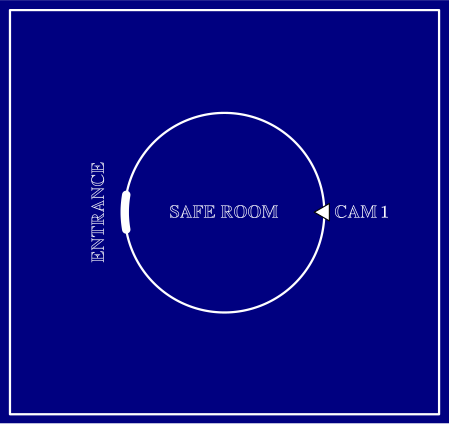
Discussion
Share
Report error
Constructing an Equilateral Triangle With a Compass
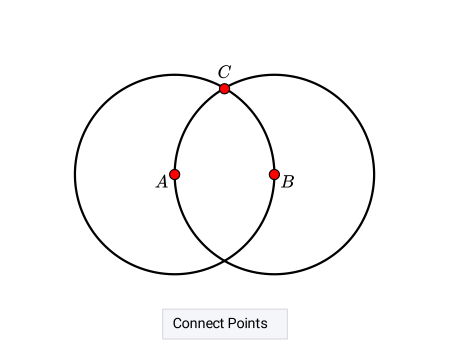
An equilateral triangle can be constructed in several ways. One method is to use two intersecting circles.
An equilateral triangle is a triangle with three congruent sides.
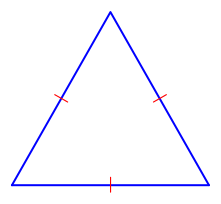
It can be constructed using a compass and a straightedge.
1
Draw a Circle
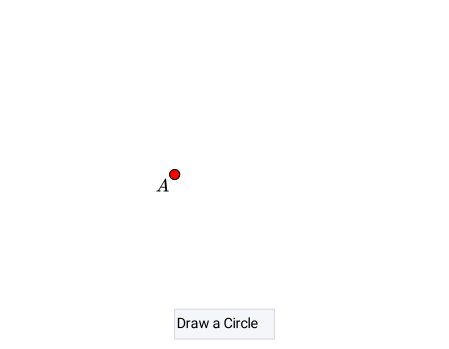
expand_more Begin by drawing a circle centered at point A. Then identify an arbitrary point B on the circumference.
2
Draw Another Circle
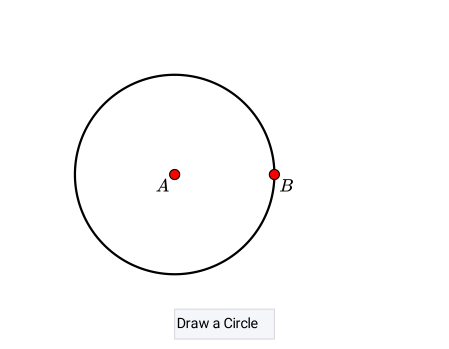
expand_more Place the compass at point B and draw another circle passing through point A. Then identify one of the intersection points of the circles as point C.
3
Connect the Points
expand_more
Connect the points using a straightedge.
Why
Note that point A and point B are the centers of ⊙ A and ⊙ B, respectively. Since ⊙ A passes through point B and ⊙ B passes through point A, the radii of the circles are equal. Therefore, AB, BC, and AC are equal. Consequently, △ ABC is an equilateral triangle.
Explore
Share
Report error
Investigating an Inscribed Square in a Circle
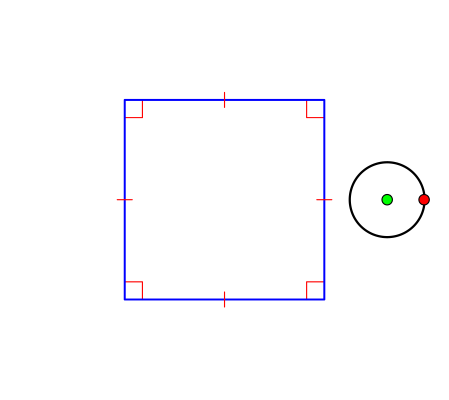
Given a square and a circle, use the applet to place the circle such that the square is inscribed in the circle. Then draw the diagonals of the square.
Discussion
Share
Report error
Inscribing a Square in a Circle
Considering the previous exploration, when given a circle, the construction of a square can be done using a compass and a straightedge.
A square that is inscribed in a circle can be constructed in a few of steps.
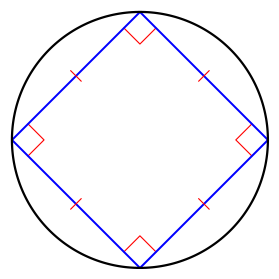
Given a circle, these three steps can be followed to construct a square inscribed in the circle.
1
Draw a Diameter
expand_more
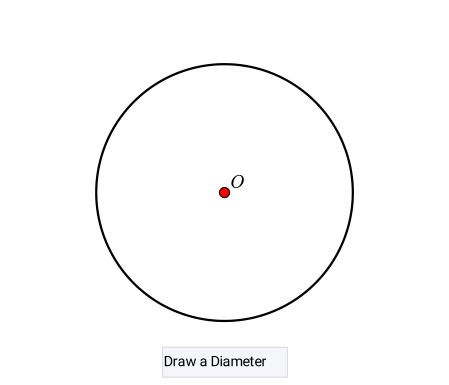
Begin by drawing an arbitrary diameter of ⊙ O using a straightedge. Identify the endpoints as A and C.
2
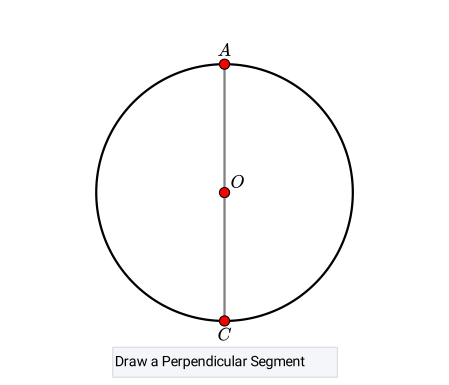
Draw the Perpendicular Bisector of the Diameter
expand_more
Next, draw a segment perpendicular to AC at point O. This will be another diameter of ⊙ O. Identify its endpoints as B and D.
3
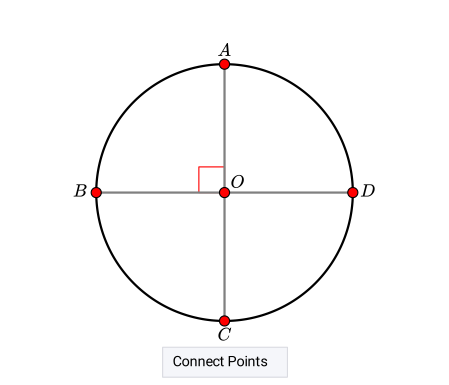
Connect the Points
expand_more
Finally, by connecting the endpoints of the diameters, an inscribed square can be drawn.
Why
Note that diagonals of a square are congruent and they are the perpendicular bisectors of each other. Since AC and BD are congruent and they are perpendicular bisectors of each other, polygon ABCD is a square.
Discussion
Share
Report error
Inscribing a Regular Pentagon in a Circle
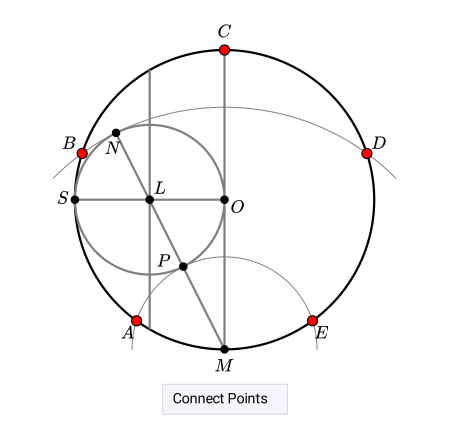
A regular pentagon can be inscribed in a circle using a compass and straightedge.
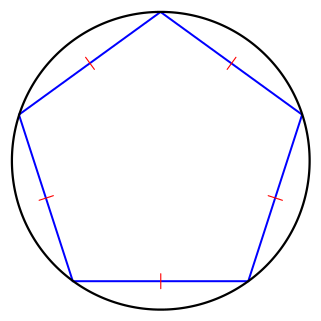
The following steps can be followed to construct a regular pentagon.
1
Draw a Diameter
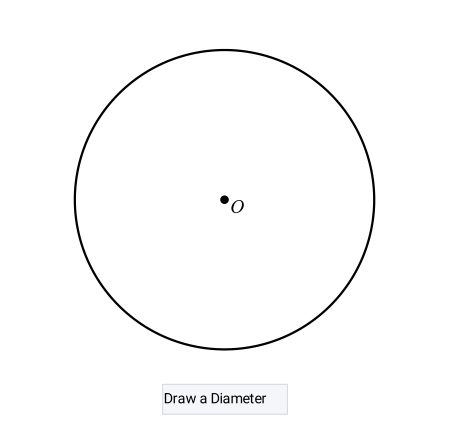
expand_more Given a circle, begin by drawing an arbitrary diameter. Then identify the endpoints of the diameter as C and M.
2
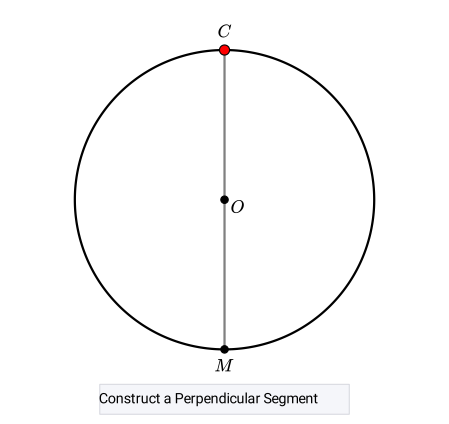
Construct a Perpendicular Segment
expand_more Construct a perpendicular segment to CM at point O. After that identify the point of intersection of the circle and the perpendicular segment as S.
3
Construct the Perpendicular Bisector
expand_more 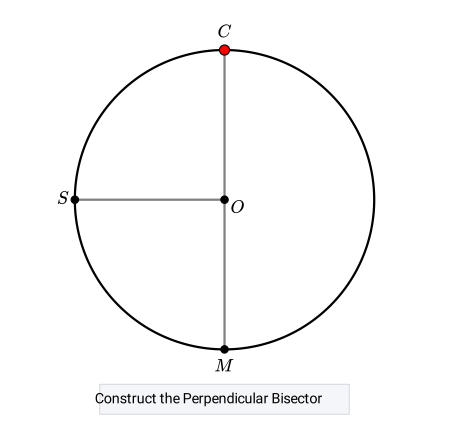
4
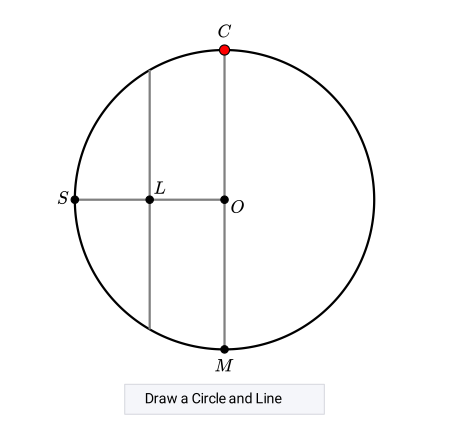
Draw a Circle and Line
expand_more Next, draw a circle centered at point L with a radius of SL. Then draw a line passing through point M and point L intersecting ⊙ L. From here, identify the intersection points of ⊙ L and the segment as N and P.
5
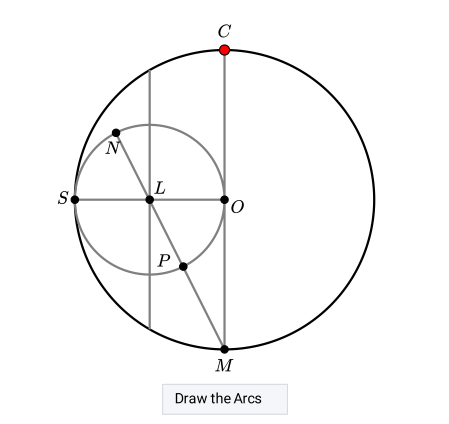
Draw the Arcs
expand_more Now, two arcs centered at point M will be drawn. Both arcs will intersect ⊙ O. One of them will pass through point P and the other one will pass through point N. Label the intersection points of the arcs and ⊙ O as A, E, B, and D.
6
Connect the Points
expand_more Finally, connect points A, B, C, D, and E.
Discussion
Share
Report error
Inscribing a Regular Hexagon in a Circle
None of the previous constructions will help Jordan. Finally, by using a compass and a straightedge, a regular hexagon will be constructed hoping that it will help Jordan. Otherwise, she may lose her job.
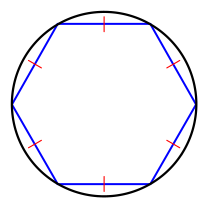
These three steps can be followed to construct a regular hexagon inscribed in a circle.
1
Draw a Circle
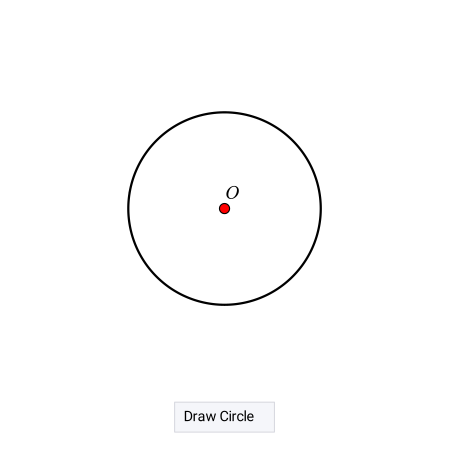
expand_more Given ⊙ O, place the compass on an arbitrary point on the circumference of the circle. Then draw a circle passing through the center of ⊙ O and identify one of the intersection points as B.
2
Repeat the Process to Obtain Six Intercepted Points on the Circle
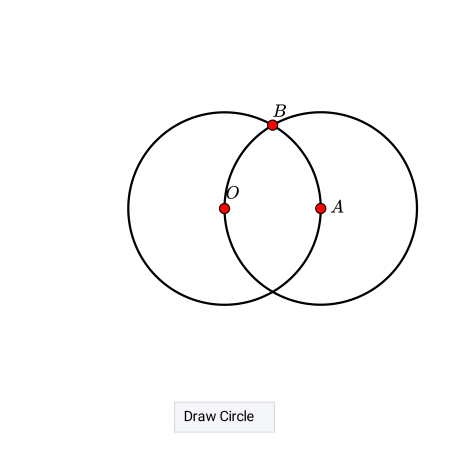
expand_more Next, place the compass at point B and draw another circle passing through the center of ⊙ O. Repeat the process until ⊙ O is intercepted six times and label the intersection points as C, D, E, and F.
3
Connect the Points
expand_more
Finally, connect the points using a straightedge.
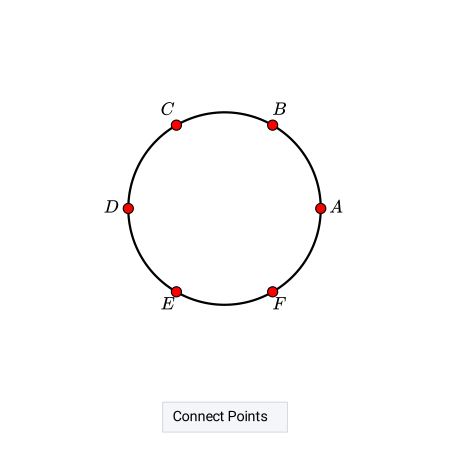
Therefore, a regular hexagon ABCDEF has been constructed.
Why
Notice that a regular hexagon consists of six equilateral triangles that are congruent.
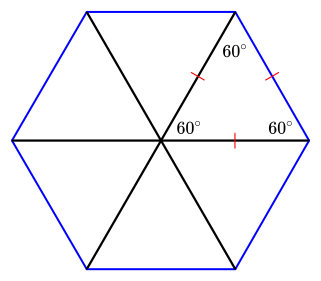
By repeating the process of constructing an equilateral triangle several times, the vertices of the polygon has been found. Therefore, the resulting polygon is a regular hexagon.
Closure
Share
Report error
Solving the Problem of the Three Cameras
Among all of the constructions covered in this lesson, there is one in particular that will help Jordan place the cameras correctly — slowing any attempted heist! Recall that Jordan wants to determine the positions of the three cameras, given that one of the cameras will be opposite the entrance door.
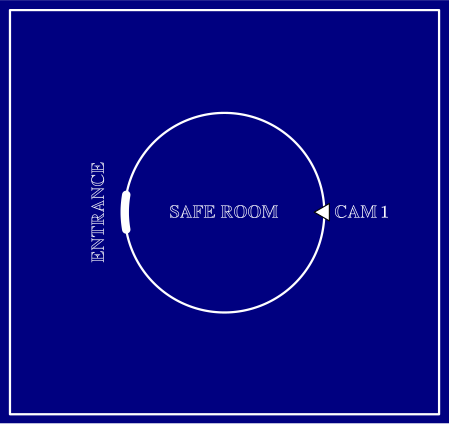
She came ready with a compass, a straightedge, and the blueprint of the room. Show how she can determine the positions of the other two cameras.
Answer
See solution.
Hint
Follow the process of inscribing a regular hexagon in a circle.
Solution
Following the process of inscribing a regular hexagon in a circle, first determine six points on the circle. The starting point will be the position of the first security camera.
According to the construction, each point on the circle is equidistant from each other. Therefore, it can be concluded that the distances between every other point are also equal.
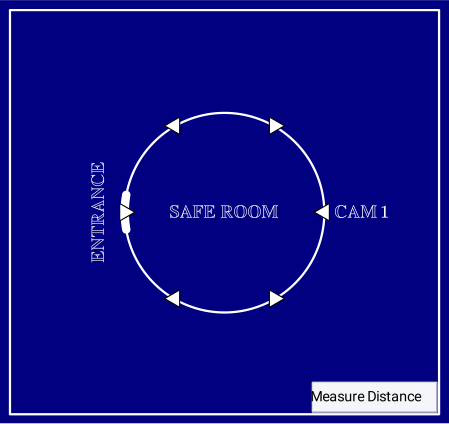
Therefore, Jordan can determine the position of the cameras by choosing every other point starting from the position of the first point — Camera 1.
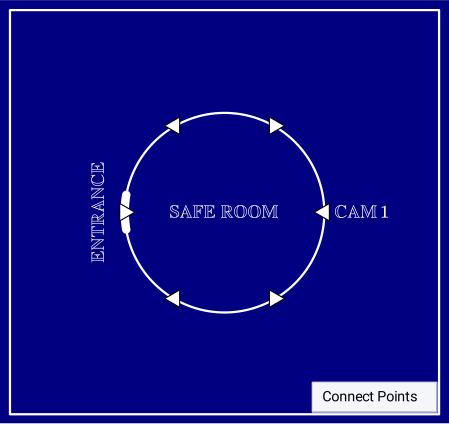
With this camera setup, Jordan can have three security cameras equidistant from each other, adequately monitoring The Compazu's safe room.
Polygons Inscribed in a Circle
Exercises
The steps for constructing an equilateral triangle using a compass and straightedge are given.
Order these steps to have an equilateral triangle.
{"type":"sort","form":{"alts":[{"id":0,"text":"Mark point A on your paper."},{"id":1,"text":"Construct a circle with center at A."},{"id":2,"text":"Mark point B somewhere on ⊙ A."},{"id":3,"text":"Set compass width to AB."},{"id":4,"text":"Construct a circle with center at point B."},{"id":5,"text":"Mark point C on either of the intersection points of ⊙ A and ⊙ B."},{"id":6,"text":"Connect the points using a straightedge."}]},"formTextBefore":"","formTextAfter":"","answer":[0,1,2,3,4,5,6]}
security
report
code
security
report
code
Let's will construct an equilateral triangle considering the given steps by ourselves. We need a circle to start our construction. We should first mark the center of the circle. Since point B is somewhere on ⊙ A, our first step will be marking point A on our paper.
Now we can construct a circle with center at A using a compass.
We need another circle. Let's mark point B somewhere on ⊙ A.
We need to determine the radius of the circle to construct it. To do so, we will set compass width to AB.
Now that the we determined the radius of the circle, we can construct it centered at point B.
We are almost there! We have two points but we need three points to construct a triangle. We will mark point C on either of the intersection points of ⊙ A and ⊙ B.
Finally, we will connect these points with a straightedge.
We can order the steps as follows based on our construction.
- Mark point A on your paper.
- Construct a circle with center at A.
- Mark point B somewhere on ⊙ A.
- Set compass width to AB.
- Construct a circle with center at point B.
- Mark point C on either of the intersection points of ⊙ A and ⊙ B.
- Connect the points using a straightedge.
security
report
code
Emily creates an equilateral triangle using a compass and straightedge.
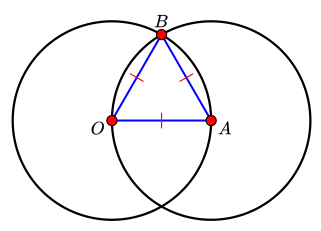
{"type":"sort","form":{"alts":[{"id":0,"text":"Set the compass width to AO."},{"id":1,"text":"Put the compass point on B and draw another circle."},{"id":2,"text":"Mark the new intersection points of ⊙ O and ⊙ B."},{"id":3,"text":"Repeat the process to have six intersection points by keep the compass setting the same."},{"id":4,"text":"Connect the points using a straightedge."}]},"formTextBefore":"","formTextAfter":"","answer":[0,1,2,3,4]}
security
report
code
security
report
code
We have been given a construction of an equilateral triangle. We want to construct a hexagon by completing this construction. Note that we will need six vertices. We should first set the compass width to AO based on the given steps.
Now we will put the compass point on B and draw another circle.
Next, we will mark the new intersection point C and repeat the process until we have six vertices.
In our last step, we will connect these points using a straightedge.
Based on our construction, the steps can be followed in the following order.
- Set the compass width to AO.
- Put the compass point on B and draw another circle.
- Mark the new intersection points of ⊙ O and ⊙ B.
- Repeat the process to have six intersection points by keep the compass setting the same.
- Connect the points using a straightedge.
security
report
code
Zosia wants to construct an isosceles trapezoid inscribed in a circle using a compass and a straightedge.
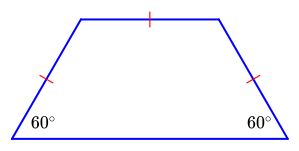
{"type":"sort","form":{"alts":[{"id":0,"text":"Mark point O on your paper."},{"id":1,"text":"Construct a circle with center at O."},{"id":2,"text":"Draw a diameter using a straightedge and mark the endpoints as A and B."},{"id":3,"text":"Set compass width to AO or BO."},{"id":4,"text":"Put the compass point on point A keeping the compass setting the same."},{"id":5,"text":"Draw an arc intersecting ⊙ O on one side of the diameter and mark the intersection point."},{"id":6,"text":"Repeat the process for point B and draw another arc on the same side of the diameter."},{"id":7,"text":"Connect the four points using a straightedge."}]},"formTextBefore":"","formTextAfter":"","answer":[0,1,2,3,4,5,6,7]}
security
report
code
security
report
code
We need a circle to construct an isosceles trapezoid inscribed in a circle. Therefore, we should first construct a circle. Let's mark point O on our paper.
Now we can construct a circle with center at O using a compass.
Next we will draw a diameter by using a straightedge to have the bottom side of the trapezoid.
We will next set compass width to BO.
Let's draw two arcs with this compass setting. We will first put the compass point on point A and draw an arc intersecting ⊙ O.
We can follow the same process for point B.
Finally, we can connect these points using a straightedge.
Based on our construction, we can order the steps.
- Mark point O on your paper.
- Construct a circle with center at O.
- Draw a diameter using a straightedge and mark the endpoints as A and B.
- Set compass width to AO or BO.
- Put the compass point on point A keeping the compass setting the same.
- Draw an arc intersecting ⊙ O on one side of the diameter and mark the intersection point.
- Repeat the process for point B and draw another arc on the same side of the diameter.
- Connect the four points using a straightedge.
security
report
code
Which of the following polygons can be constructed out of a construction of a hexagon inscribed in a circle?
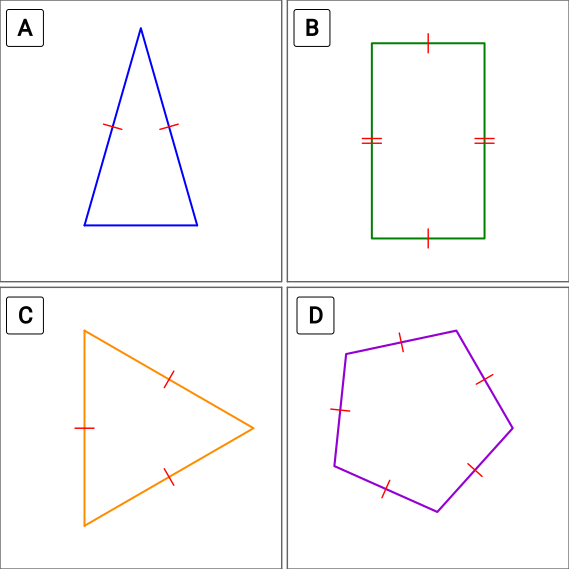
{"type":"multichoice","form":{"alts":["A","B","C","D"],"noSort":true},"formTextBefore":"","formTextAfter":"","answer":[1,2]}
security
report
code
security
report
code
Let's consider a hexagon inscribed in a circle.
If we overlap this construction with given polygons one by one, there are only two polygons that would fit it. Let's connect the points B, C, E, and F.
We can construct the given rectangle. Next, we will connect the points A, C, and E.
We can also construct the equilateral triangle. However, there is no way to construct the isosceles triangle and the pentagon out of the construction of a hexagon. Therefore, the possible options are B and C.
security
report
code
Polygons Inscribed in a Circle
Recommended exercises
To get personalized recommended exercises, please login first.
Loading content
≤
>
■2
■▢
e▢
7
8
9
×
÷■1
=
=
√▢
▢√
∫▢▢
4
5
6
+
−
≤
<
log
ln
log▢
1
2
3
()
∣
sin
cos
tan
0
.
π
x
y
Loading content