4. Point-Slope Form of a Line
Sign In
An error ocurred, try again later!
Chapter 7
4.
Point-Slope Form of a Line
The point-slope form is a useful tool for working with linear equations and their graphs. This lesson explains how to write linear equations in point-slope form and use them to represent relationships between variables. It also explores the process of graphing linear equations using this form, enabling students to visualize and interpret linear relationships effectively. These skills are essential for solving problems in algebra and understanding how linear models apply to real-world scenarios, such as predicting trends and analyzing data.
Show less Show more expand_more 


Lesson Settings & Tools
| | 13 Theory slides |
| | 10 Exercises - Grade E - A |
| | Each lesson is meant to take 1-2 classroom sessions |
Point-Slope Form of a Line
Slide of 13
There are different forms in which equations of lines can be written. This lesson will focus on one of those ways called the Point-Slope Form. How this form is created, its characteristics, and ways to convert between this and other forms of equations will be explored.
Catch-Up and Review
Here are a few recommended readings before getting started with this lesson.
Explore
Share
Report error
Exploring the Information Given by the Slope and a Point on the Line
The following applet shows the graph of a line and its slope. By clicking anywhere on the line, a point together with its coordinates will appear.
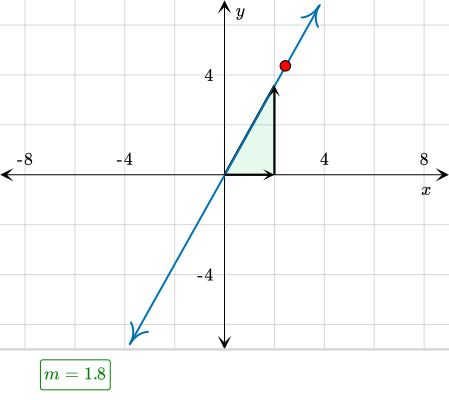 Think about the following questions.
- Is it possible to write an equation for the line using the slope and a point on the line?
- What happens if this information is substituted into the Slope Formula?
Discussion
Share
Report error
Introducing Point-Slope Form of a Line
There is a way of writing an equation of a line when only its slope and one point that lies on the line are known. This form of an equation gets its name from two pieces of information about the line — a point and a slope.
Concept
Share
Report error
Point-Slope Form
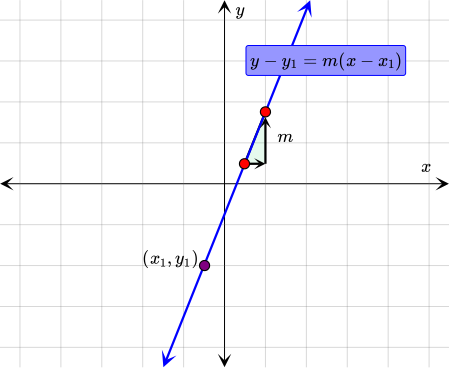
A linear equation with slope m through the point (x_1,y_1) is written in the point-slope form if it has the following form.
y-y_1 = m(x-x_1)
In this point-slope equation, (x_1,y_1) represents a specific point on the line, and (x,y) represents any point also on the line. Graphically, this means that the line passes through the point (x_1,y_1).
Pop Quiz
Share
Report error
Identifying the Point-Slope Form of a Linear Equation
The applet shows linear equations showing a relationship between the variables x and y. Determine whether each equation is written in point-slope form.

Pop Quiz
Share
Report error
Identifying the Essential Parts of Equations in Point-Slope Form
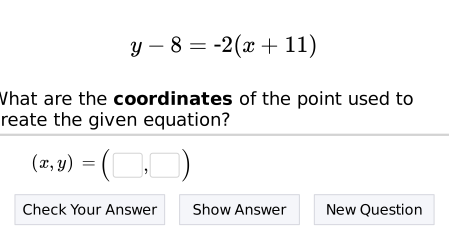
To get familiar with the point-slope form, it is essential to identify the parts of its composition. In this applet, identify the slope or point used to create the given equation in point-slope form, depending on what is asked.
Discussion
Share
Report error
Graphing a Linear Equation in Point-Slope Form
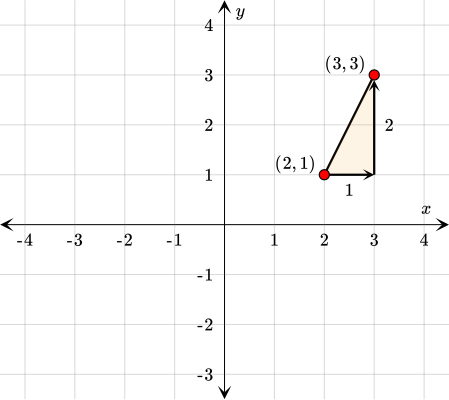
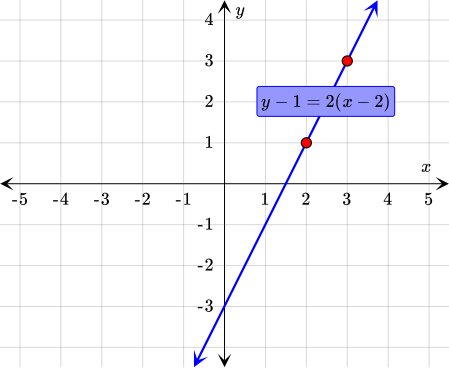
When working with a linear equation in point-slope form, the graph’s line is described by the equation. The known point and slope of the line to is used to find another point. A line is then drawn through the points to create its graph. Consider the following equation. y-1=2(x-2)
There are three steps to graph an equation written in point-slope form. 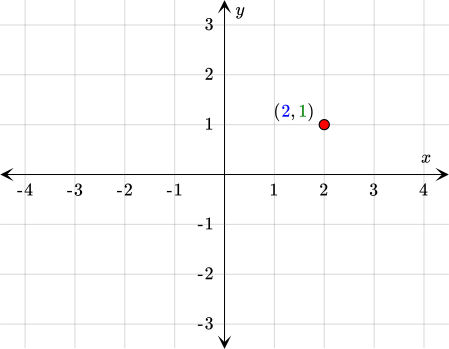
1
Plot the Point Given by the Equation
expand_more The point-slope form gives a point through which the line passes. This point needs to be identified first in order to graph it on the coordinate plane. Consider the given equation and compare it with the general equation in point-slope form. y- y_1&=m(x- x_1) y- 1&=2(x- 2) The point used to write the given equation is ( 2, 1). This point will be drawn on the coordinate plane.
2
Use the Slope to Find a Second Point
expand_more Next, a second point on the line can be found by using the slope. y-y_1&= m(x-x_1) y-1&= 2(x-2) In this case, the given equation has a slope of 2, which can be written as 21. Therefore, a second point can be plotted by going 1 unit to the right and 2 units up.
3
Draw a Line Through the Two Points
expand_more Finally, the line described by the equation in the point-slope form will be found by drawing a line through the two plotted points.
Example
Share
Report error
Graphing Equations in Point-Slope Form
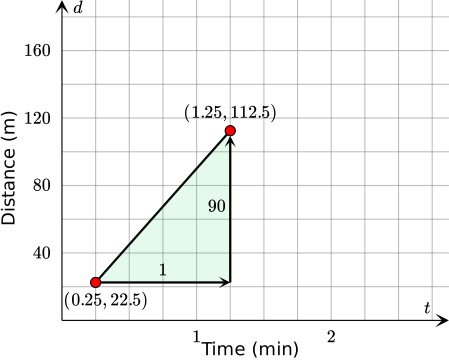
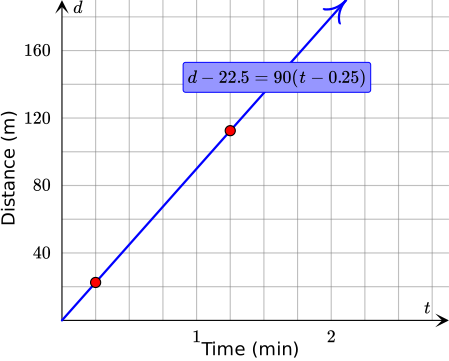
Izabella is leaving her hometown behind for the city of Mathville. Her passion awaits her in Mathville. She is traveling by train at the speed of 90 kilometers per hour.  The distance d traveled by the train from Izabella's hometown is given by the following equation.
d-22.5=90(t-0.25)
In this equation, t is the time in hours since the train departed from Izabella's hometown. Graph the equation on a coordinate plane.
The distance d traveled by the train from Izabella's hometown is given by the following equation.
d-22.5=90(t-0.25)
In this equation, t is the time in hours since the train departed from Izabella's hometown. Graph the equation on a coordinate plane. 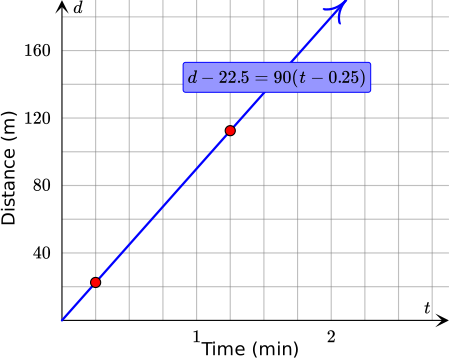
Answer
Hint
Begin by identifying the point used to write the equation. Then, use the method for graphing a linear equation in point-slope form.
Solution
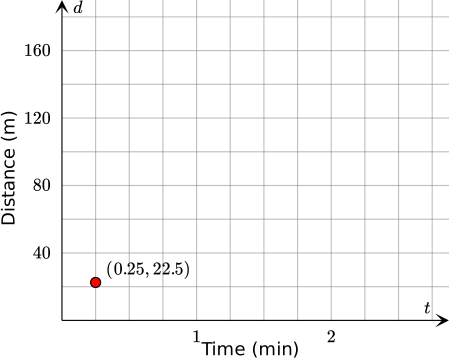
To graph the equation, first identify the point used to write the equation. Then, apply the method for graphing an equation in point-slope form. A linear equation in point-slope form is written in the following way. y-y_1=m(x-x_1) In this equation, (x_1,y_1) is a specific point on the line, (x,y) represents any point on the line, and m is the slope of the line. Using this information, find the specific point and the slope of the given equation. d- 22.5= 90(t- 0.25) The slope is m= 90 and the given point is ( 0.25, 22.5). Since both time and distance must be non-negative, the graph of the equation must be in the first quadrant. The x-axis will represent the time and the y-axis the distance. Plot the point ( 0.25, 22.5) on the coordinate plane.
Next, find a second point on the line by using the slope. Because the given equation has a slope of 90, plot a second point by moving 1 unit to the right and 90 units up.
Finally, draw a line through the points to find the line described by the given equation.
Discussion
Share
Report error
Writing a Linear Equation in Point-Slope Form
The slope and a point on a certain line are needed to write an equation in point-slope form. The slope can be found using two points on the line. That means this process begins by assuming that two points are given. After the slope is calculated, either point can be used to determine the equation. This method is illustrated using the following points that lie on a line. (-1,5) and (1,1)
Three steps are needed to find the equation in point-slope form.
Note that, unlike the slope-intercept form, an infinite number of equations written in point-slope form can represent the same line. In other words, when written in point-slope form, any line does not have only one unique equation.
1
Calculate the Slope
expand_more First, the slope of the line can be calculated by substituting the given points into the Slope Formula. Note that if the slope is given, this step is not needed. If only the line is provided, select two points on the line whose coordinates are easy to identify.
In this case, the slope of the line that passes through the given points is - 2.
m = y_2-y_1/x_2-x_1
SubstitutePoints
Substitute ( -1,5) & ( 1,1)
m=1- 5/1-( -1)
▼
Evaluate right-hand side
m=-2
2
Select One Point on the Line
expand_more Next, one point on the line needs to be selected. Ideally, one of the points used in the previous step is chosen, but it can be any other point on the line whose coordinates are known. Out the given points, (1,1) will be used.
3
Substitute Values
expand_more Finally, once the slope and a point on the line are known, the equation can be written by substituting these values into the general equation in point-slope form. Here, m= -2 and (x_1,y_1)=( 1, 1). y-y_1&=m(x-x_1) &⇓ y- 1&= -2(x- 1)
Example
Share
Report error
Population of Mathville
As Izabella pulled into Mathville, a sign greeted her stating that population of the town is 7892. That number was recorded in the year 2012.

a The population of the town increases by around 140 citizens every year. Write the equation in point-slope form where x is the year and y is the population. Explain the answer.
{"type":"text","form":{"type":"math","options":{"comparison":"1","nofractofloat":false,"keypad":{"simple":false,"useShortLog":false,"variables":["x","y"],"constants":[]},"rendered":false},"text":" "},"formTextBefore":null,"formTextAfter":null,"answer":{"text":["y-7892=140(x-2012)"]}}
b The population of the nearest town also grew linearly since the year 2012. After five years, the population was 3420, and in the year 2023, the population became 4170. Use the two points to write an equation for the population in point-slope form.
{"type":"text","form":{"type":"math","options":{"comparison":"1","nofractofloat":false,"keypad":{"simple":false,"useShortLog":false,"variables":["x","y"],"constants":[]},"rendered":false},"text":" "},"formTextBefore":null,"formTextAfter":null,"answer":{"text":["y-3420=125(x-2017)","y-4170=125(x-2023)"]}}
Hint
a Recall the general equation of the point-slope form of a line.
b Use the known data to form two points and substitute them into the Slope Formula. Then, use the slope and either of the points to write the equation in point-slope form.
Solution
a Start by recalling the point-slope form of an equation.
y-y_1=m(x-x_1) Here, m is the slope and (x_1,y_1) are the coordinates of the point. The population of the town in 2012 was 7892 people. This data gives the point ( 2012, 7892). It is also given that the population of the town increases by 140 citizens, which means that the slope is 140. y- 7892= 140(x- 2012) This way, the equation in point-slope form for the given equation was written.
b It is known that 5 years after 2012 the population of the nearest town to Mathville was 3420. This can be represented by the point (2017,3420). The other known point is (2023,4170). These two points can be substituted into the Slope Formula to determine the slope.
m=y_2-y_1/x_2-x_1
SubstitutePoints
Substitute ( 2017,3420) & ( 2023,4170)
m=4170- 3420/2023- 2017
SubTerm
Subtract term
m=750/6
CalcQuot
Calculate quotient
m= 125
Example
Share
Report error
Using Point-Slope Form to Find Missing Information
In Mathville, Izabella can kindle her spirit by getting to ride the horse of her dreams — this is her passion. The given graph describes the distance Izaballa is from the city center, in meters, as she rides the horse over a certain time, in minutes.
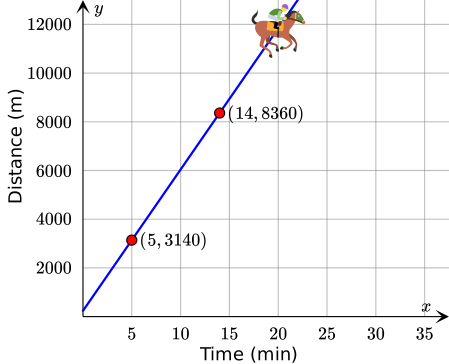
Use the given graph to find the following information.
a Find the equation of the line in point-slope form.
{"type":"text","form":{"type":"math","options":{"comparison":"1","nofractofloat":false,"keypad":{"simple":false,"useShortLog":false,"variables":["x","y"],"constants":[]},"rendered":false},"text":" "},"formTextBefore":null,"formTextAfter":null,"answer":{"text":["y-3140=580(x-5)","y-8360=580(x-14)"]}}
b What was Izabella's initial distance from the city center?
{"type":"text","form":{"type":"math","options":{"comparison":"1","nofractofloat":false,"keypad":{"simple":true,"useShortLog":false,"variables":[],"constants":[]},"rendered":false},"text":" "},"formTextBefore":null,"formTextAfter":"meters","answer":{"text":["240"]}}
c How long does it take for Izabella to be 10 000 meters from the city center? Round to the nearest minute.
{"type":"text","form":{"type":"math","options":{"comparison":"1","nofractofloat":false,"keypad":{"simple":true,"useShortLog":false,"variables":[],"constants":[]},"rendered":false},"text":" "},"formTextBefore":"Around","formTextAfter":"minutes","answer":{"text":["17"]}}
Solution
a The equation of a line that passes through the point (x_1,y_1) and has a slope of m can be written in point-slope form.
b Izabella's initial distance from the city center is at the point where x=0. It means that the initial distance can be found by solving the equation found in Part A for y when x= 0.
c To find how long it took Izabella to reach the distance of 10 000 meters, the equation needs to be solved for x when y= 10 000.
y-3140=580(x-5)
Substitute
y= 10 000
10 000-3140=580(x-5)
▼
Solve for x
SubTerm
Subtract term
6860=580(x-5)
RearrangeEqn
Rearrange equation
580(x-5)=6860
DivEqn
.LHS /580.=.RHS /580.
x-5=11.827586...
AddEqn
LHS+5=RHS+5
x=16.827586...
RoundInt
Round to nearest integer
x=17
Example
Share
Report error
Translating Between Slope-Intercept and Point-Slope Forms
Izabella is taking a break from all that horseback riding and she visits a local museum called 
The Incredible World Inside of Horses.She found a screen allowing her to scroll side to side to see illustrations of horse organs. She would then read some amazing facts about them.
a The way a horse heart pumps out blood can be represented by the following equation.
B=22t-160
Transform this equation from slope-intercept form to point-slope form. b The amount of air that a horse breaths out, on average, can be modeled by the following equation.
A-129=56(t-33)
Transform from point-slope form to slope-intercept form.Answer
a Example solution: B+116=22(t-2)
b A=56t-1719
Solution
a The equation that represents how a horse heart pumps out blood is given in slope-intercept form.
B=22t-160
Rewrite
Rewrite 160 as 44+116
B=22t-(44+116)
Distr
Distribute - 1
B=22t-44-116
SplitIntoFactors
Split into factors
B=22t-22* 2-116
FactorOut
Factor out 22
B=22(t-2)-116
AddEqn
LHS+116=RHS+116
B+116=22(t-2)
b The following equation in point-slope form is given.
Example
Share
Report error
Translating Between General and Point-Slope Forms
Later in the museum there was a section explaining some common gestures made by horseback riders. For example, how many muscles are activated when riders wave or high-five fellow riders. 
a When waving, the number of muscles m activated is given by the following equation.
5m-9t=35
Transform this equation from standard form to point-slope form where m depends on t. b When giving a high-five, the number of muscles activated is given by the following equation.
m+9=6(t-11)
Transform from point-slope form to standard form.Answer
a Example solution: m+0.2=1.8(t+4)
b Example solution: m-6t=- 75
Solution
a The equation that describes the relationship between the number of muscles m activated when waving is given in standard form.
5m-9t=35
AddEqn
LHS+9t=RHS+9t
5m=9t+35
DivEqn
.LHS /5.=.RHS /5.
m=1.8t+7
Rewrite
Rewrite 7 as 7.2-0.2
m=1.8t+7.2-0.2
FactorOut
Factor out 1.8
m=1.8(t+4)-0.2
AddEqn
LHS+0.2=RHS+0.2
m+0.2=1.8(t+4)
b The following equation in point-slope form is given.
Closure
Share
Report error
Infinite Equations in the Point-Slope Form
In this lesson, the point-slope form of linear equations was explored. As its name suggests, this form communicates the slope and a point on the line described by the equation. Point-Slope Form y-y_1=m(x-x_1)
Since a line has infinite points, any of these points can be used to find its equation. Therefore, a line has infinite equivalent equations in point-slope form. This can be visualized in the following applet. Select any point on the line to see how the equation varies depending on the point selected. 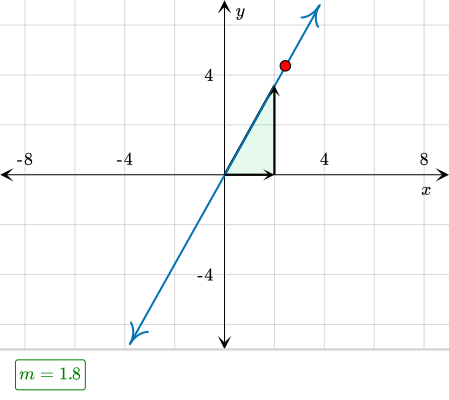 Moreover, transforming between point-slope and slope-intercept forms can be addressed by the following procedure.
- If the equation is in slope-intercept form, evaluate the equation for some x-value to find a point on the line. Then, use this point to find its equivalent equation in point-slope form.
- If the equation is in point-slope form, isolate the y-variable and simplify to find its equivalent equation in slope-intercept form.
Point-Slope Form of a Line
Exercise 2.1
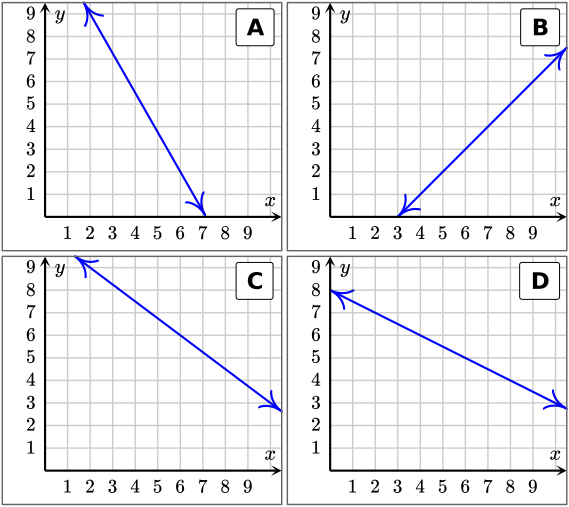
The amount of water left in the pool after x minutes of draining the water is given by the following equation. y-9=- 0.75(x-2) Graph the equation and determine the graph that corresponds to the given situation.
{"type":"choice","form":{"alts":["A","B","C","D"],"noSort":true},"formTextBefore":"","formTextAfter":"","answer":2}
security
report
code
security
report
code
We are asked to graph the following equation. y-9=- 0.75(x-2) To do so, we need to identify the point on the line and then apply the method for graphing an equation in point-slope form. A linear equation in point-slope form is written in the following way. y-y_1=m(x-x_1) In this equation, (x_1,y_1) is a specific point on the line, (x,y) represents any point on the line, and m is the slope of the line. Using this information, we can find the specific point and the slope of the given equation. y- 9= - 0.75(x- 2) As we can see, the slope is m= - 0.75 and the given point is ( 2, 9). Let's start making the graph by plotting the point ( 2, 9) on the coordinate plane.
Next, we can plot a second point on the line by using the slope. Because the given equation has a slope of - 0.75, we can plot a second point by going 1 unit to the right and 0.75 units down or 2 units right and 2* 0.75=1.5 units down.
Finally, we can draw a line through the points to graph the given equation.
This corresponds to option C.
security
report
code
The population of the city Geometropolis was 28 162 in the year 2022. Its population increases by about 450 citizens every year.

External credits: @rocketpixel
{"type":"text","form":{"type":"math","options":{"comparison":"1","nofractofloat":false,"keypad":{"simple":false,"useShortLog":false,"variables":["x","y"],"constants":[]},"rendered":false},"text":" "},"formTextBefore":null,"formTextAfter":null,"answer":{"text":["y-28162=450(x-2022)"]}}
security
report
code
security
report
code
Let's start by recalling the point-slope form of an equation. y-y_1=m(x-x_1) Here, m is the slope and (x_1,y_1) are the coordinates of the point. The population of the city in 2022 is 28 162 people. Using this information we get a point ( 2021, 28 162). We also know that the population of the town increases by about 450 citizens, which means that the slope is 450. y- 28 162= 450(x- 2022) This way we have written the equation in point-slope form for the given equation.
security
report
code
A snowboarder is sliding down a mountain.

{"type":"text","form":{"type":"math","options":{"comparison":"1","nofractofloat":false,"keypad":{"simple":false,"useShortLog":false,"variables":["x","y"],"constants":[]},"rendered":false},"text":" "},"formTextBefore":null,"formTextAfter":null,"answer":{"text":["y-2053=20.8(x-37)","y-1845=20.8(x-47)"]}}
security
report
code
security
report
code
We are told that after 37 minutes of sliding down, the snowboarder was at 2053 meters above the seal level and after 47 minutes, they were at 1845 meters. We can use this information to write two points. (37,2053) and (47,1845) Let's substitute these two points into the Slope Formula to determine the slope.
Therefore, the slope is 20.8. Now, we can substitute either of the known points along with the slope into the formula for the point-slope form of an equation. For example, we will use the point ( 37, 2053). y- 2053= 20.8(x- 37)
security
report
code
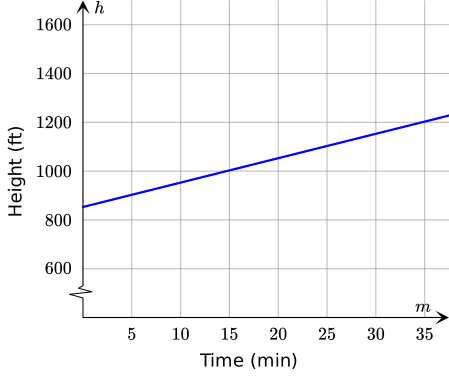
Ignacio went hiking on one sunny Saturday morning. The following graph describes his height during the hike.
{"type":"text","form":{"type":"math","options":{"comparison":"1","nofractofloat":false,"keypad":{"simple":true,"useShortLog":false,"variables":[],"constants":[]},"rendered":false},"text":" "},"formTextBefore":null,"formTextAfter":"minutes","answer":{"text":["82"]}}
security
report
code
security
report
code
Let's start by recalling the point-slope form of an equation. y-y_1=m(x-x_1) We are given the graph describing the situation. Let's identify two points on the graph using the coordinate plane.
Let's substitute the coordinates of these points into the Slope Formula and find the slope of the line.
Now that we know the slope, we can substitute it into the general equation of point-slope form. In addition, we can use either of the found points. Let's choose to use ( 15, 1000). y-y_1&=m(x-x_1) &⇓ h- 1000&= 60(m- 15) Finally, we can use this equation to find how long it will take for Ignacio to be at the height of 5020 feet from the ground. Let's substitute 5020 into the equation for h and solve it for m.
We found that it will take 82 minutes for Ignacio to reach the height of 5020 feet above the ground.
security
report
code
Point-Slope Form of a Line
Recommended exercises
To get personalized recommended exercises, please login first.
Loading content
≤
>
■2
■▢
e▢
7
8
9
×
÷■1
=
=
√▢
▢√
∫▢▢
4
5
6
+
−
≤
<
log
ln
log▢
1
2
3
()
∣
sin
cos
tan
0
.
π
x
y
Loading content