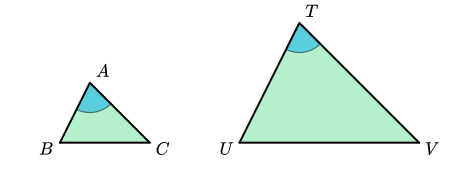
△ ABC ~ △ TUV
We are asked to determine whether the measures of ∠ A and ∠ T are the same.
m∠ A ? = m∠ T
Recall that, in similar triangles, the measures of corresponding angles are equal.
Since the angles are corresponding, they must be congruent.
∠ A ≅ ∠ T
This means that, yes, they have the same measurement.
∠ A ≅ ∠ T
⇕
m∠ A = m∠ T
b We have two similar triangles.
△ ABC ~ △ TUV
We are asked to determine whether the measures of the perimeters of both triangles are the same. In similar figures, all the corresponding sides keep the same proportions. For our triangle, this gives us the following ratios.
AB/TU = BC/UV = CA/VT
Let's assume that x is the value of the ratios, then we have the following scale of our ratio of the sides.
Side in △ ABC
Corresponding Side in △ TUV
Proportion
AB
TU
AB= TUx
BC
UV
BC= UVx
CA
VT
CA= VTx
The perimeter of the first triangle will be found by adding all three side lengths together.
P_1 = AB + BC + CA
Let's use the relation of the sides of the first triangle to rewrite the sides of the second triangle. We can see that the perimeter of the first triangle, when written in terms of the side lengths of the second triangle, is as follows.
The perimeter of the second triangle will be unchanged when this scale factor is introduced.
P_2 = TU + UV + VT
Now, we will check if the perimeters are equal.
But, this is not true in general. Having any other scale factor would make the perimeter of the first triangle greater or lesser than the perimeter of the second triangle by a factor of x times.
P_1 = P_2 &if x=1
P_1 ≠ P_2 &if x ≠ 1
c We have two similar triangles.
△ ABC ~ △ TUV
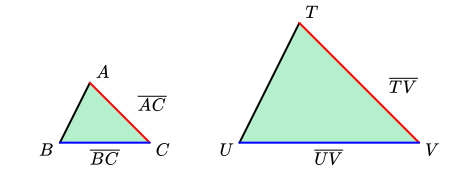
We are asked to determine whether the measures of the given ratios are the same.
BC/UV and AC/TV,
Recall that in similar figures all the corresponding side lengths keep the same proportions. Notice that BC and UV, as well as AC and TV, are corresponding sides.
Therefore, yes, both quotients will have the same proportion and will measure the same.