What is an equation? What is an identity? When does an equation have no solution?
Not necessarily, see solution.
Practice makes perfect
The exercise asks us to think about a situation where we are solving an equation and the variable gets eliminated. Let's start by recalling what an equation is, when it is an identity, and when it has no solutions.
Equation
We have an equation whenever we have two algebraic expressions set equal to one another. Let's take a look at the example.
2x + 1 = x + 3
Notice that this equality will only hold for a specific value of x. We can isolate x by combining the variable terms and using inverse operations.
The value x=2 is the special value that will make this equality hold true.
Identity
An identity is an equality relation that holds true for every value we use. Let's construct one. To do this let's wirte an expression.
2(x + 1)
Next, we can simplify it by distributing 2 to terms in the parentheses.
2(x + 1) = 2x + 2
Notice that the equality we have must be true for any value. After all, it contains the same information, just written differently. Then if we try to solve for x, the following happens.
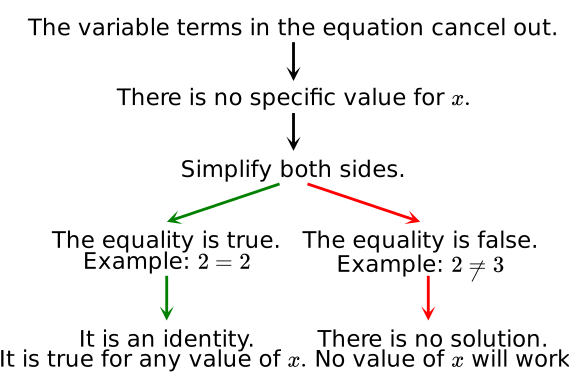
The variable terms cancel out and we are left with an identity. This is because there is no special value for the equality to hold true. Instead, it will hold for any value of x. However, this may not always be the case when the variable terms cancel out.
Equation With No Solution
Now let's analyze the following equation.
x + 2 = x + 3
We can start solving for x by combining like terms. In fact, let's give that a try.
Notice that the variable terms canceled out. However we are left with two numerical expressions which are clearly not equal. We can see then that this is not an identity. In cases like this there is no solution. There is no value we can use for x so that the equality holds true.
Putting It Together
We saw that the variable terms can cancel out in two different situations. We may need to simplify both sides of an equation before we can tell if it is an identity or an equation with no solution. This information can be summarized as shown below.