Sign In
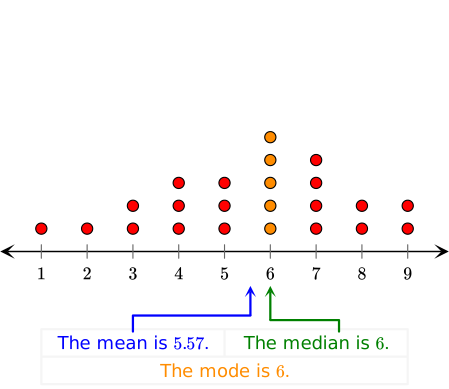
A measure of center, or a measure of central tendency, is a statistic that summarizes a data set by finding a central value. The most common measures of center are the mean, median, and mode. Measures of center are often used together with a measure of spread to give an idea of both what a typical value is and how much the data can be expected to deviate from it.
The mean, or the average, of a numerical data set is one of the measures of center. It is defined as the sum of all of the data values in a set divided by the number of values in the set.
Mean=Sum of Values/Number of Values
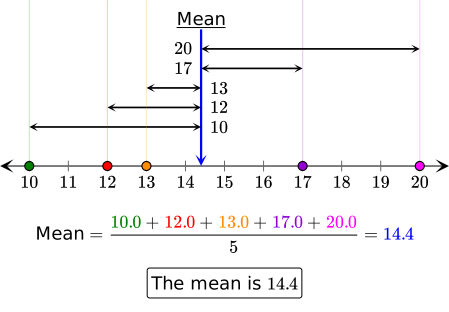
The following applet calculates the mean of the data set on the number line. Points can be moved to change the data values.
x=x_1+x_2+⋯+x_n/n
There are several types of the mean in statistics, such as population mean and geometric mean. The exact name of this mean is the arithmetic mean, but it is often shortened to the mean for simplicity.
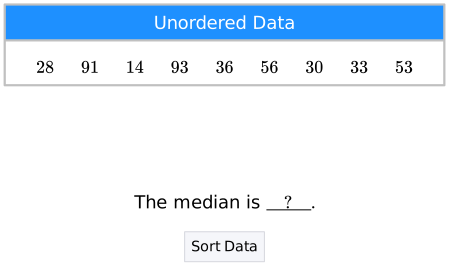
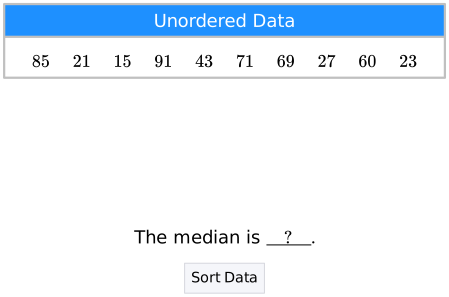
The median is a measure of center that lies in the middle of a numerical data set when the data set is written in numerical order. When the the data set has an odd number of data points, the median is the value in the middle.
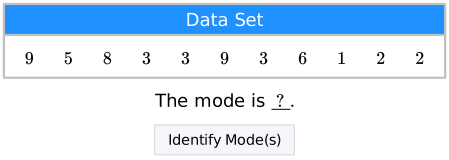
The mode is a measure of center that shows the most common value in a data set. Modes can be used for both numerical and categorical data.