6. Exponential Growth and Decay
Sign In
An error ocurred, try again later!
Chapter 6
6.
Exponential Growth and Decay
This lesson explores the mathematical concepts of exponential growth and decay, emphasizing their real-world applications, particularly in finance and biology. For example, understanding exponential growth can help you appreciate how compound interest works in a savings account, allowing your money to grow over time. On the flip side, exponential decay is crucial in calculating the depreciation of assets like cars. These concepts are not just theoretical; they are tools that can help you make informed decisions in various aspects of life, from managing your finances to understanding biological phenomena like bacterial growth.
Show less Show more expand_more 


Lesson Settings & Tools
| | 12 Theory slides |
| | 10 Exercises - Grade E - A |
| | Each lesson is meant to take 1-2 classroom sessions |
Exponential Growth and Decay
Slide of 12
Exponential functions are useful for modeling a wide variety of real-life scenarios. This lesson will introduce the concepts of exponential growth and exponential decay. How they are used to model real-life situations will also be understood.
Catch-Up and Review
Here are a few recommended readings before getting started with this lesson.
Challenge
Share
Report error
Carbon-14 Decay and Archaeology
While watching a documentary about ancient civilizations, Ali wondered how scientists could determine the age of an object belonging to such ancient civilizations.

Ali recalled that his uncle, Mr. Jones, is an archaeologist! Ali called and asked him how are the ages of ancient objects determined.

Carbon-14 is a substance present in organisms that, once they expire, begin to be released from an object's body at a slow rate. To date an object this way consists of measuring the amount of carbon-14 in a sample and comparing it to known values of different ages.

Explore
Share
Report error
Exploring Exponential Functions
Consider the following exponential function.
y=2 * b^x
How does its graph change when the value of b changes? To visualize its effect, move the slider in the following applet.
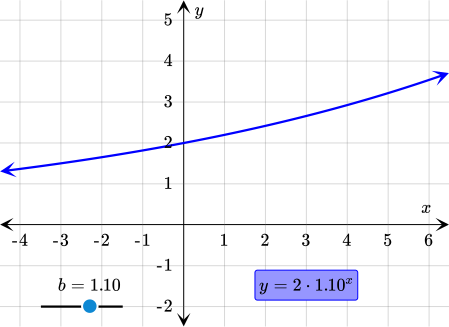 Think about these two questions.
- What is the behavior of the function when b>1?
- What is the behavior of the function when b<1?
Discussion
Share
Report error
Exponential Growth
For an exponential function y=a(b)^x, where a>0 and b>1, the y-values increases as the x-values increases. Therefore, it can be classified as an increasing function. y = ab^x ⇓ Increasing when a>0 and b >1 Such exponential functions are called exponential growth functions.
When a quantity increases by the same factor over equal intervals of time, it is said that such a quantity is in exponential growth. Exponential growth is modeled using exponential functions where a >0 and b>1. y = a(b)^t
In this form, a is the initial amount, the base b is the growth factor, and t usually represents time. Like any other exponential function, a also represents the y-intercept. 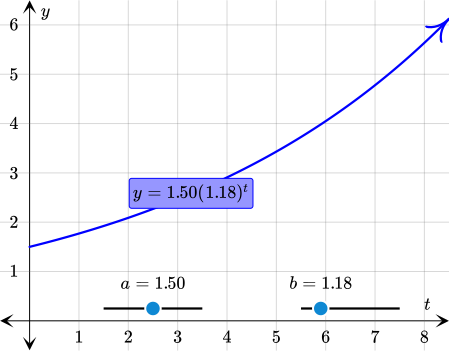 As shown, the greater the base b, the faster the exponential function grows. Since the base b is greater than 1, it can be written as the sum of 1 and some positive number r. This constant r can then be interpreted as the rate of growth, in decimal form.
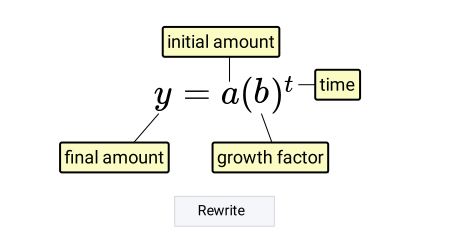 For example, r=0.06 means that the quantity increases by 6 % over every unit of time.
Example
Share
Report error
Studying Bacterial Growth
Magdalena, excited for biology lab, is exploring about bacterial growth.

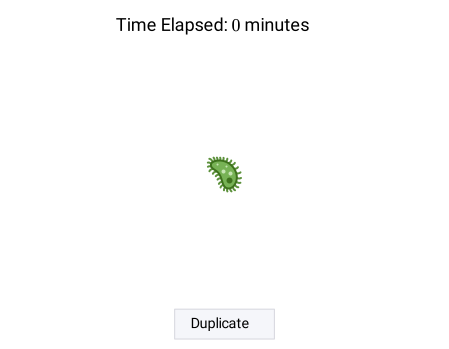
a Write an equation that models this exponential growth in terms of the time elapsed since the start of the experiment, in minutes.
{"type":"text","form":{"type":"math","options":{"comparison":"1","nofractofloat":false,"keypad":{"simple":false,"useShortLog":false,"variables":["t"],"constants":[]},"rendered":false},"text":" "},"formTextBefore":"y=","formTextAfter":null,"answer":{"text":["2^{t\/20}"]}}
b How much bacteria will there be after two hours?
{"type":"text","form":{"type":"math","options":{"comparison":"1","nofractofloat":false,"keypad":{"simple":true,"useShortLog":false,"variables":[],"constants":[]},"rendered":false},"text":" "},"formTextBefore":null,"formTextAfter":"bacteria","answer":{"text":["64"]}}
Hint
a The initial amount of bacteria is 1 and they duplicate each 20 minutes.
b Write 2 hours as minutes. Then substitute that into the equation obtained in Part A.
Solution
a Exponential growths are modeled using exponential functions of the following form.
y=a* b^t In the above equation, a represents the initial number of bacteria. Since the experiment starts with 1 bacteria, a equals 1. The bacteria duplicate themselves every 20 minutes. That means the base should be equal to 2. y= 1( 2)^t ⇒ y=2^t Notice that this function does not represent the situation exactly. The reason being that, for example, substituting 1 for t doubles the number of the bacteria. That is, the bacteria doubles itself every minute. For the equation to give the number of bacteria duplicating every 20 minutes, t must be divided by 20. y =2^t ⇒ y=2^(t 20) Therefore, y=2^(t20) correctly models the situation for E. coli. Comparing the number of bacteria on the applet and the y-values found by the equation, it can be checked if the equation is correct or not.
| Time Elapsed, t | y=2^(t20) | Number of Bacteria, y |
|---|---|---|
| 0 | 2^(020)=1 | 1 |
| 20 | 2^(2020)=2^1 | 2 |
| 40 | 2^(4020)=2^2 | 4 |
| 60 | 2^(6020)=2^3 | 8 |
| 80 | 2^(8020)=2^4 | 16 |
b Since the exponential growth function is a function of time in minutes, 2 hours must expressed in minutes as well. That can be done using a conversion factor.
Discussion
Share
Report error
Compound Interest
Applications of exponential growth can also be encountered in the world of finance. Some people use the power of compound interest to grow their wealth exponentially.
Compound interest is the interest earned depending on both the initial investment and previously earned interest. To find the balance A of an account that earns compound interest, an exponential growth function can be used.
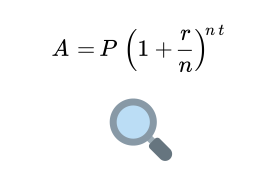 In this function, P stands for the principal, or the initial amount of money, r is the interest rate in decimal form, and n is the number of times the interest is compounded per year. For an account with the principal $100 and an annual interest of 18 % compounded twice a year, the balance in the account after t years is shown in the graph.
 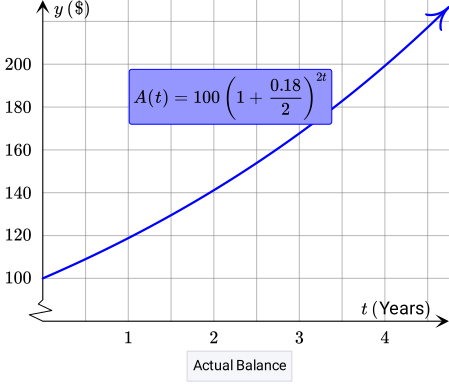 Notice that the function grows continuously, whereas, in reality, the account balance only increases at the times of compound. When calculating compound interest, the number of compounding periods n creates a difference. That is, the higher the number of compounding periods, the greater the amount of compound interest.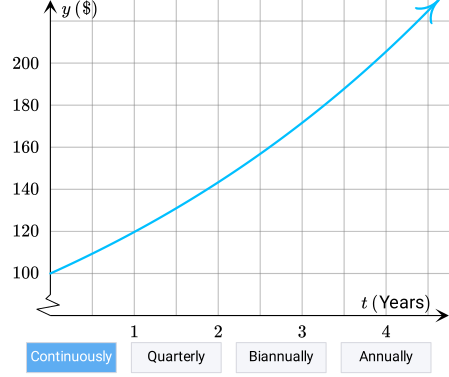
Example
Share
Report error
Investing Into a Savings Account
Kriz, determined and focused, won an online video game competition. The first place prize was $1000!

Kriz decides to not spend the prize money. Instead, their parent suggests placing all of it into a Certificate of Deposit. This is a type of savings account with compound interest. The catch is that the money cannot be taken out for a certain period of time. Ngân Hàng, a local bank, offers a Certificate of Deposit with the interest rate at 3 % compounded monthly.
a Write an equation that models the local bank's compound interest.
{"type":"text","form":{"type":"math","options":{"comparison":"1","nofractofloat":false,"keypad":{"simple":false,"useShortLog":false,"variables":["t"],"constants":[]},"rendered":false},"text":" "},"formTextBefore":"A=","formTextAfter":null,"answer":{"text":["1000*1.0025^{12*t}"]}}
b How much money will Kriz have 2 years after opening the account? Round the amount to 2 decimal places.
{"type":"text","form":{"type":"math","options":{"comparison":"1","nofractofloat":false,"keypad":{"simple":true,"useShortLog":false,"variables":[],"constants":[]},"rendered":false},"text":" "},"formTextBefore":"$","formTextAfter":null,"answer":{"text":["1061.76"]}}
Hint
a The meaning of
compounded monthlyis that the interest is compounded each month of the year — meaning twelve times per year.
b Substitute 2 for t in the equation obtained in Part A.
Solution
a The local bank offers Kriz an interest rate of 3 % that is compounded monthly. Using the exponential growth function that models compound interest, first write the percentage as a decimal.
b In order to find how much money Kriz would have in their savings account after 2 years, 2 will be substituted for t into the equation solved for in Part A.
Discussion
Share
Report error
Exponential Decay
When the base of an exponential function is a number greater than 0 and less than 1, the function is said to be decreasing. In such cases, the function represents what is known as exponential decay.
When a quantity decreases by the same factor over equal intervals of time it is said that such quantity is in exponential decay. Exponential decay is modeled using exponential functions with a>0 and a base b that is between 0 and 1. y = a(b)^t
In this form, a is the initial amount, the base b is the decay factor, and t usually represents time. Like any other exponential function, a also represents the y-intercept.
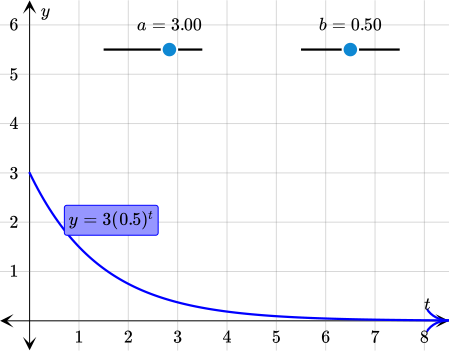 As seen, the closer the base gets to 0, the faster the exponential function decays. Since the base b is less than 1, it can be written as 1 minus a positive number r between 0 and 1. This constant r can be interpreted as the rate of decay, in decimal form.
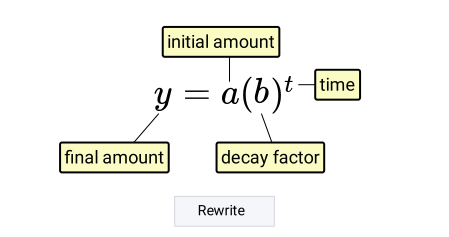 A value of 0.12, for instance, would mean that the quantity decreases by 12 % over every unit of time.
Example
Share
Report error
Calculating the Devaluation of a Car
Diego has saved for the past few years dreaming of buying a car with a drop top so he can cruise the streets looking fly. Diego runs to the nearest car dealer and is met by Mr. Peterson, a car salesmen. They come to an agreement where Diego trades in his old car to help pay for the new car.

Diego bought his car five years ago at the same dealer for $20 000. Mr. Peterson states that the car depreciates at a rate of 15 % annually.

{"type":"text","form":{"type":"math","options":{"comparison":"1","nofractofloat":false,"keypad":{"simple":true,"useShortLog":false,"variables":[],"constants":[]},"rendered":false},"text":" "},"formTextBefore":"$","formTextAfter":null,"answer":{"text":["8874.11"]}}
Hint
Since the value of the car depreciates, the situation can be modeled using an exponential decay function.
Solution
Previously, Diego bought a car with a value that has depreciated since the time of purchase. Therefore, this scenario can be modeled using an exponential decay function. The car was bought for $ 20 000, which is the initial amount.
y=a(1-r)^t ⇓ y= 20 000(1-r)^t
The car depreciates at a rate of 15 % annually. That value needs to be written as a decimal.
15 % ⇒ 0.15
There is now enough information to write an equation for the value of the old car.
It has been five years since Diego bought his car. Therefore, to find the current value of the car, 5 should be substituted for t into the function.
Considering the depreciation rate of 15 %, Mr.Peterson offers $8874.11 for Diego's 5-year-old car. If Diego accepts the offer, he will have a capital of $8874.11 to put toward the purchase of a new car from the dealership.
y=20 000(0.85)^t
Substitute
t= 5
y=20 000(0.85)^5
UseCalc
Use a calculator
y=8874.10625
RoundDec
Round to 2 decimal place(s)
y=8874.11
Pop Quiz
Share
Report error
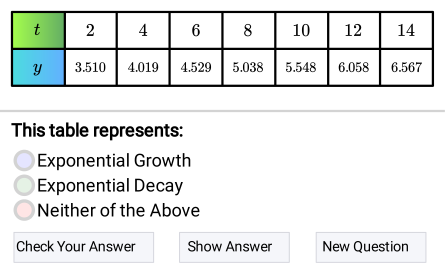
Identifying Exponential Growth or Decay From a Table
Select the option that best describes the table of values given below.
Pop Quiz
Share
Report error
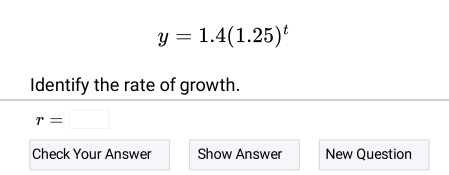
Identifying the Rate of Growth or Decay
Exponential functions y=ab^t can model exponential decay as well as exponential growth. Identify the rate of decay or growth r for the indicated function. Write the corresponding rate in decimal form.
Closure
Share
Report error
Modeling Carbon-14 Decay
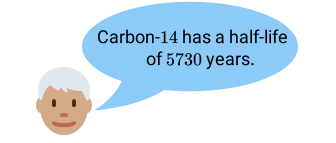
This lesson introduced the interesting concepts of compound interest, exponential growth, and exponential decay. Using the knowledge gained from this lesson, the introductory challenge can be modeled using an exponential decay function. Recall what the archaeologist had to say.
{"type":"text","form":{"type":"math","options":{"comparison":"1","nofractofloat":false,"keypad":{"simple":false,"useShortLog":false,"variables":["A","t"],"constants":[]},"rendered":false},"text":" "},"formTextBefore":"y=","formTextAfter":null,"answer":{"text":["A*0.5^{\\dfrac{t}{5730}}","\\dfrac{A}{2}^{\\dfrac{t}{5730}}"]}}
Hint
Find the decay factor of this situation.
Solution
Exponential decay is modeled using exponential functions with a base b that is between 0 and 1. y=a(b)^t Since the given information is about the half-life of carbon-14, the base is 12, or 0.5. It is also given that the initial amount of carbon is represented by A. y=a(b)^t ⇓ y= A( 0.5)^t The half-life of carbon-14 is 5730 years, which means that after 5730 years, only half of the initial amount will remain. Therefore, t should be divided by 5730 so that for every 5730 years half the previous amount remains. y=A(0.5)^(t 5730) Wow! That is a great amount of time that carbon-14 takes in order to decay. That fact makes for a good reason to use it when determining the age of a fossil.
Exponential Growth and Decay
Exercise 3.1
Polonium-210 is a material that has been used as a heat source to power thermoelectric cells in artificial satellites. It has a half-life of about 138 days.
{"type":"text","form":{"type":"math","options":{"comparison":"1","nofractofloat":false,"keypad":{"simple":false,"useShortLog":false,"variables":["A","t"],"constants":[]},"rendered":false},"text":" "},"formTextBefore":"y=","formTextAfter":null,"answer":{"text":["A(0.5)^{t\/138}"]}}
{"type":"text","form":{"type":"math","options":{"comparison":"1","nofractofloat":false,"keypad":{"simple":true,"useShortLog":false,"variables":[],"constants":[]},"rendered":false},"text":" "},"formTextBefore":"r \u2248","formTextAfter":null,"answer":{"text":["0.005"]}}
security
report
code
security
report
code
We can model exponential decay by using exponential functions with a base b that is between 0 and 1. y=a(b)^t Since the given information is about the half-life of polonium-210, the base is 12, or 0.5. It is also given that the initial amount of polonium is represented by A. y=a(b)^t ⇓ y= A( 0.5)^t The half-life of polonium-210 is 138 days, which means that after 138 days, only half of the initial amount will remain. Therefore, t should be divided by 138 so that for every 138 days half the previous amount remains. y=A(0.5)^(t 138)
To find the daily percent decrease, we will use the Properties of Exponents.
Since the decay factor b is equal to 1-r, where r is the rate of decay, we can write an equation for r and solve it. Let's do it!
The daily rate of decay of polonium-210 is about 0.005.
security
report
code
Exponential Growth and Decay
Recommended exercises
To get personalized recommended exercises, please login first.
Loading content
≤
>
■2
■▢
e▢
7
8
9
×
÷■1
=
=
√▢
▢√
∫▢▢
4
5
6
+
−
≤
<
log
ln
log▢
1
2
3
()
∣
sin
cos
tan
0
.
π
x
y
Loading content