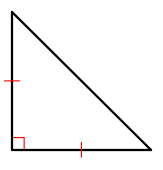
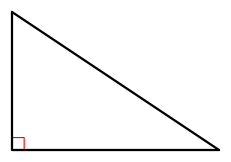
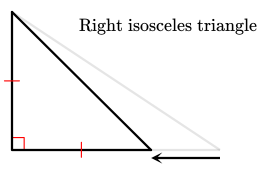
An isosceles triangle is a triangle with two sides of equal length. Can we resize our right triangle so that this is the case and it's still a right triangle? Yes we can! Either we shorten the horizontal side or lengthen the vertical side.
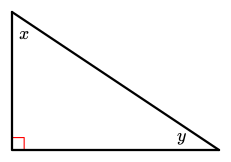
b Again, we start by drawing an arbitrary right triangle, labeling the unkown angles x and y.
In an obtuse triangle, one angle is greater than 90^(∘) but less than 180^(∘). Since the angles of a triangle sum to 180^(∘), if one angle is obtuse, for example 91^(∘), then the sum of the remaining angles has to be less than 90^(∘).
x+y+91^(∘)=180^(∘) ⇔ x+y=89^(∘)
That means we cannot have a right angle anymore, which means we no longer have a right triangle. This means we cannot draw a right obtuse triangle.
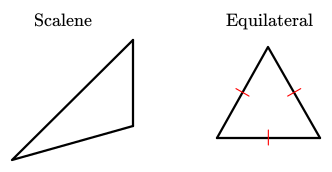
c A scalene triangle is a triangle where none of the sides have equal lengths. On the other hand, an equilateral triangle is a triangle where all sides have the same length.
These concepts are contradictory which means you cannot draw this kind of a triangle.
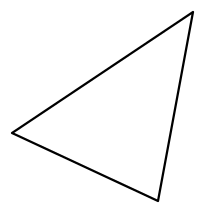
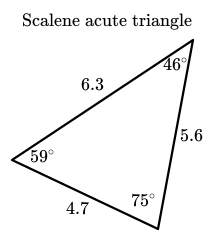
d An acute triangle is a triangle where all angles are less than 90^(∘). Additionally, as we explained in Part C, a scalene triangle is a triangle where none of the sides have equal lengths. Let's draw such a triangle.