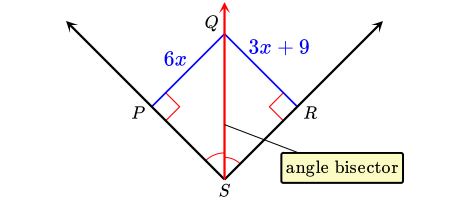
Examining the given diagram, we can see that ∠PSQ and ∠QSR are adjacentcongruent angles. Therefore, SQ forms a bisector of ∠PSR. Moreover, the segments connecting Q with the sides of ∠PSR are both perpendicular to the sides. This means that their length is the distance from each side to Q.
According to the Angle Bisector Theorem, if a point lies on the bisector of an angle, then it is equidistant from the two sides of the angle. In our case, since Q lies on SQ, we know that it is equidistant from the sides of ∠PSR. Therefore, QP and QR have equal lengths.
QP=QR
This allows us to equate the given expressions for their lengths to solve for x.
Mathleaks uses cookies for an enhanced user experience. By using our website, you agree to the usage of cookies as described in our policy for cookies.