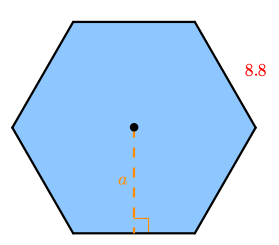
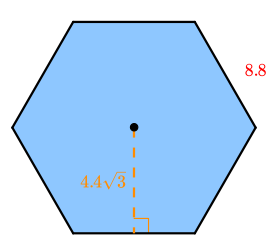
We will first need to find the perimeter and the apothem of the polygon. Then we will use the formula A= 12ap to find the area.
Finding the Perimeter
Since we have a regular hexagon whose side length is 8.8, we can find the perimeter by multiplying 6 by 8.8.
6* 8.8= 52.8
The perimeter of the given polygon is 52.8.
Finding the Apothem
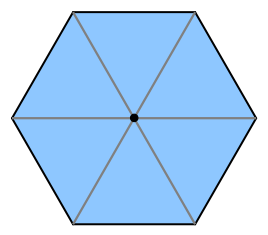
Let's now find the apothem. To do so, we will start by drawing the radii of the hexagon. Be aware that the radii divide a regular hexagon into six congruent isosceles triangles.
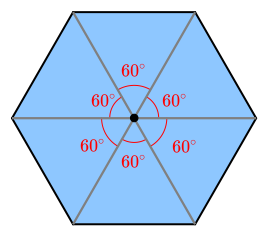
Since corresponding angles of congruent figures are congruent, the vertex angles of the isosceles triangles formed by the radii are congruent. Moreover, since a full turn measures 360^(∘), we can divide 360 by 6 to obtain their measures.
360/6=60
The vertex angles of the isosceles triangles measure 60^(∘) each.
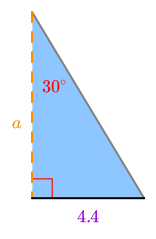
The apothem bisects both the vertex angle of the isosceles triangle and the opposite side of the vertex, which is a side of the hexagon. As a result, a 30^(∘)-60^(∘)-90^(∘) triangle is created. The length of its shorter leg is 8.8 ÷ 2=4.4.
In this type of special triangle the length of the longer leg, which is the apothem, is sqrt(3) times the length of the shorter leg.
Longer Leg: sqrt(3)* 4.4=4.4sqrt(3)
Therefore, the length of the apothem is 4.4sqrt(3).
Finding the Area
To find the area of the given regular polygon, we will substitute a=4.4sqrt(3) and p= 52.8 in the formula A= 12ap.