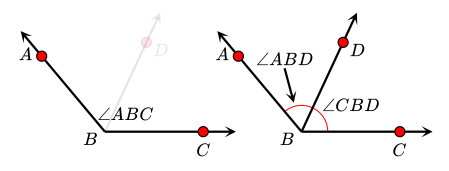
If BD bisects ∠ ABC, we can equate the expressions for the two smaller angles.
m∠ ABD=65^(∘)
m∠ CBD=65^(∘)
m∠ ABC=130^(∘)
Practice makes perfect
We are asked to find three angle measurements: m∠ ABC, m∠ ABD, and m∠ CBD. We have been told that BD bisects ∠ ABC which means that it cuts the angle exactly in half. We have marked these relationships in the diagram below. Let's consider them.
Since BD bisects angle ∠ ABC, angles ∠ ABD and ∠ DBC have the same measure. This means that m∠ ABD=m∠ DBC. Therefore, we can form an equation and substitute the given expressions for the measures to solve for x.
Having solved the equation, we can calculate the measures of individual angles by substituting x= - 8 into the given expressions.
m∠ ABD:& - 4( -8)+33 =65^(∘)
m∠ CBD:& 2 ( - 8)+81 =65^(∘)
Having found m∠ ABD and m∠ CBD, we can find m∠ ABC. Since this angle is bisected by BD, its measure can be calculated by doubling either of the smaller angles.
m∠ ABC: 65* 2 = 130^(∘)