{{ tocSubheader }}
{{ 'ml-label-loading-course' | message }}
An error ocurred, try again later!
Chapter {{ article.chapter.number }}
{{ article.number }}.
{{ article.displayTitle }}
{{ article.intro.summary }}
Show less Show more expand_more Lesson Settings & Tools
| | {{ 'ml-lesson-number-slides' | message : article.intro.bblockCount }} |
| | {{ 'ml-lesson-number-exercises' | message : article.intro.exerciseCount }} |
| | {{ 'ml-lesson-time-estimation' | message }} |
Two or more geometric shapes can make up a plane figure. There are no standard procedures for finding the area or perimeter of the figure in these cases. However, breaking down the figure into known geometric shapes helps reveal that information. This lesson will use real-life problems to discuss calculating the area and perimeter of figures with different shapes.
Catch-Up and Review
Here are a few recommended readings before getting started with this lesson.
Challenge
Finding the Area of a Pool
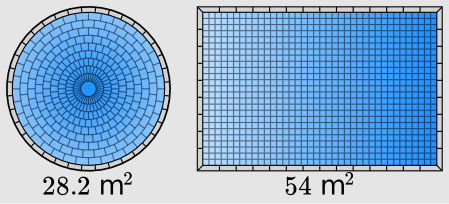
Tearrik began training at a newly opened gym in his neighborhood called Little Muscles. In the swimming area there are three pools. One is a circular pool with an area of 28.2 square meters. Another is a rectangular pool with an area of 54 square meters.
The shape of the third pool surprised Tearrik a little. It looks like the combination of half the circular pool with the rectangular pool.
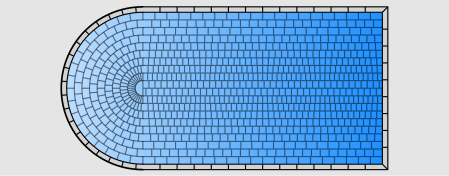
What is the area of the third pool?
{"type":"text","form":{"type":"math","options":{"comparison":"1","nofractofloat":false,"keypad":{"simple":true,"useShortLog":false,"variables":[],"constants":[]},"rendered":false},"text":"<span class=\"katex\"><span class=\"katex-html\" aria-hidden=\"true\"><\/span><\/span>"},"formTextBefore":"<span class=\"katex\"><span class=\"katex-html\" aria-hidden=\"true\"><span class=\"base\"><span class=\"strut\" style=\"height:0.68333em;vertical-align:0em;\"><\/span><span class=\"mord mathdefault\">A<\/span><span class=\"mspace\" style=\"margin-right:0.2777777777777778em;\"><\/span><span class=\"mrel\">=<\/span><\/span><\/span><\/span>","formTextAfter":"<span class=\"katex\"><span class=\"katex-html\" aria-hidden=\"true\"><span class=\"base\"><span class=\"strut\" style=\"height:0.8141079999999999em;vertical-align:0em;\"><\/span><span class=\"mord\"><span class=\"mord text\"><span class=\"mord Roboto-Regular\">m<\/span><\/span><span class=\"msupsub\"><span class=\"vlist-t\"><span class=\"vlist-r\"><span class=\"vlist\" style=\"height:0.8141079999999999em;\"><span style=\"top:-3.063em;margin-right:0.05em;\"><span class=\"pstrut\" style=\"height:2.7em;\"><\/span><span class=\"sizing reset-size6 size3 mtight\"><span class=\"mord mtight\">2<\/span><\/span><\/span><\/span><\/span><\/span><\/span><\/span><\/span><\/span><\/span>","answer":{"text":["68.1"]}}
Discussion
Composite Figures
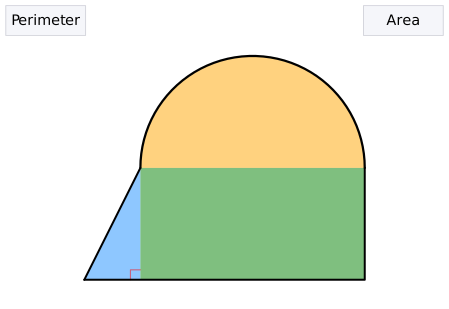
A composite figure is a plane figure made of two or more two-dimensional figures combined in a way that creates a new figure. For example, the following figure is made of a rectangle, a triangle, and a semicircle.
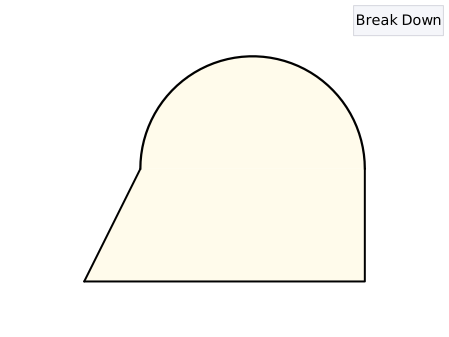 The perimeter of such a figure is the total distance around it, just remember not to count the same side twice. Additionally, the area of a compound figure is found by combining up the areas of all the basic figures that make up it.
 From the definition, composite figures can also have holes inside. For instance, consider a figure that is a combination of a square and a circle, where the circle is removed from the inside of the square, creating a hole.
 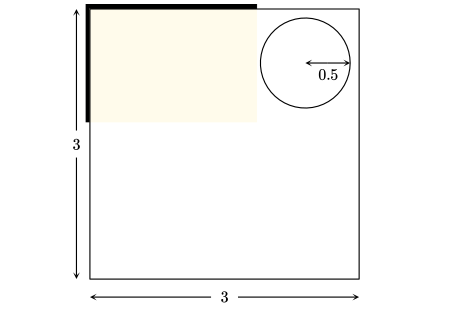 In this case, the area of the composite figure is the difference between the area of the square and the area of the circle. The perimeter coincides with the perimeter of the square.
Example
Area and Perimeter of the Gym's Logo
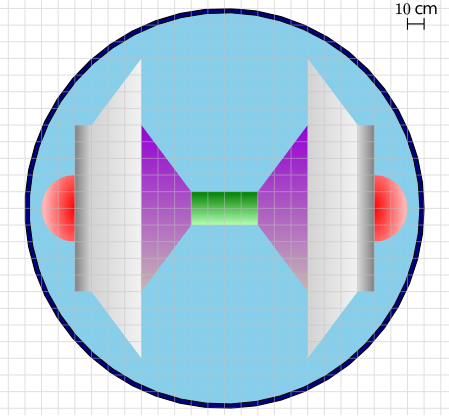
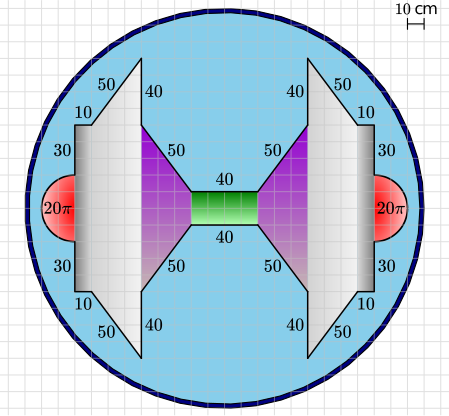
The wrestling room of the gym where Tearrik works out has a circular carpet with the gym's logo inside.
{"type":"text","form":{"type":"math","options":{"comparison":"1","nofractofloat":false,"keypad":{"simple":true,"useShortLog":false,"variables":[],"constants":[]},"rendered":false},"text":"<span class=\"katex\"><span class=\"katex-html\" aria-hidden=\"true\"><\/span><\/span>"},"formTextBefore":"<span class=\"katex\"><span class=\"katex-html\" aria-hidden=\"true\"><span class=\"base\"><span class=\"strut\" style=\"height:0.68333em;vertical-align:0em;\"><\/span><span class=\"mord mathdefault\">A<\/span><span class=\"mspace\" style=\"margin-right:0.2777777777777778em;\"><\/span><span class=\"mrel\">\u2248<\/span><\/span><\/span><\/span>","formTextAfter":"<span class=\"katex\"><span class=\"katex-html\" aria-hidden=\"true\"><span class=\"base\"><span class=\"strut\" style=\"height:0.8141079999999999em;vertical-align:0em;\"><\/span><span class=\"mord\"><span class=\"mord text\"><span class=\"mord Roboto-Regular\">m<\/span><\/span><span class=\"msupsub\"><span class=\"vlist-t\"><span class=\"vlist-r\"><span class=\"vlist\" style=\"height:0.8141079999999999em;\"><span style=\"top:-3.063em;margin-right:0.05em;\"><span class=\"pstrut\" style=\"height:2.7em;\"><\/span><span class=\"sizing reset-size6 size3 mtight\"><span class=\"mord mtight\">2<\/span><\/span><\/span><\/span><\/span><\/span><\/span><\/span><\/span><\/span><\/span>","answer":{"text":["1.6"]}}
{"type":"text","form":{"type":"math","options":{"comparison":"1","nofractofloat":false,"keypad":{"simple":true,"useShortLog":false,"variables":[],"constants":[]},"rendered":false},"text":"<span class=\"katex\"><span class=\"katex-html\" aria-hidden=\"true\"><\/span><\/span>"},"formTextBefore":"<span class=\"katex\"><span class=\"katex-html\" aria-hidden=\"true\"><span class=\"base\"><span class=\"strut\" style=\"height:0.68333em;vertical-align:0em;\"><\/span><span class=\"mord mathdefault\" style=\"margin-right:0.13889em;\">P<\/span><span class=\"mspace\" style=\"margin-right:0.2777777777777778em;\"><\/span><span class=\"mrel\">\u2248<\/span><\/span><\/span><\/span>","formTextAfter":"cm","answer":{"text":["926"]}}
Hint
a Decompose the logo into familiar geometric shapes such as triangles, rectangles, trapezoids, and semicircles. Find the area of the involved figures and add them up.
b Use the Pythagorean Theorem to find the lengths of the slant sides. Notice that all these sides have the same length. The circumference of a semicircle is π times the radius.
Solution
a The gym's logo is a dumbbell formed by different geometric figures — a green rectangle, two purple trapezoids, two gray trapezoids, two gray rectangles, and two red semicircles. Thus, it is a composite figure.
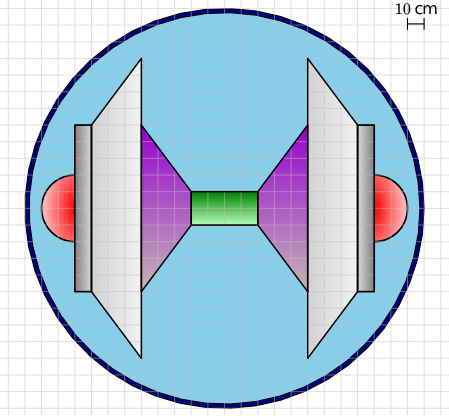
The area of the logo is the sum of the areas of the involved figures. Then, start by recalling the formulas for finding the area of the corresponding figures.
| Figure | Area's Formula |
|---|---|
| Rectangle | A=ℓ⋅w |
| Trapezoid | A=2(b1+b2)h |
| Semicircle | A=2πr2 |
Next, find the area of each of the pieces that make up the logo.
| Figure | Dimensions (cm) | Area (cm2) |
|---|---|---|
| Green rectangle | ℓ=40 w=20 |
A1=40⋅20=800 |
| Purple trapezoid | b1=100 b2=20 h=30 |
A2=2(100+20)30=1800 |
| Gray trapezoid | b1=180 b2=100 h=30 |
A3=2(180+100)30=4200 |
| Gray rectangle | ℓ=100 w=10 |
A4=100⋅10=1000 |
| Red semicircle | r=20 | A5=2π(20)2≈628.32 |
A=A1+2⋅A2+2⋅A3+2⋅A4+2⋅A5
SubstituteValues
Substitute values
A=800+2⋅1800+2⋅4200+2⋅1000+2⋅628.32
Multiply
Multiply
A=800+3600+8400+2000+1256.64
AddTerms
Add terms
A=16056.64
16056.64 cm2⋅10000 cm21 m2
▼
Evaluate
MoveLeftFacToNum
a⋅cb=ca⋅b
10000 cm216056.64 cm2⋅1 m2
Cross out common units
10000 cm216056.64 cm2⋅1 m2
Cancel out common units
1000016056.64⋅1 m2
MultByOne
a⋅1=a
1000016056.64 m2
CalcQuot
Calculate quotient
1.605664 m2
RoundDec
Round to 1 decimal place(s)
1.6 m2
b The perimeter of the gym's logo, which is a composite figure, is the distance around the logo. From the given diagram, almost all side lengths can be clearly identified.
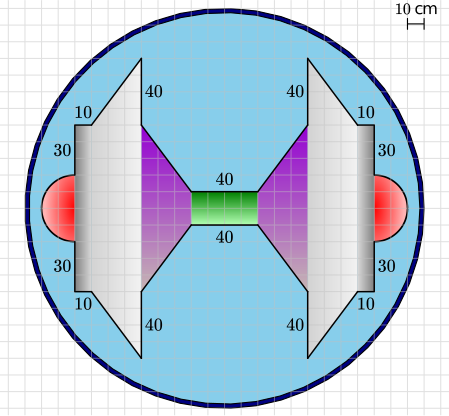
a2+b2=c2
SubstituteValues
Substitute values
402+302=c2
▼
Solve for c
CalcPow
Calculate power
1600+900=c2
AddTerms
Add terms
2500=c2
SqrtEqn
LHS=RHS
2500=c2
SqrtPowToNumber
a2=a
2500=c
CalcRoot
Calculate root
50=c
RearrangeEqn
Rearrange equation
c=50
Example
Carpeting the Training Rooms
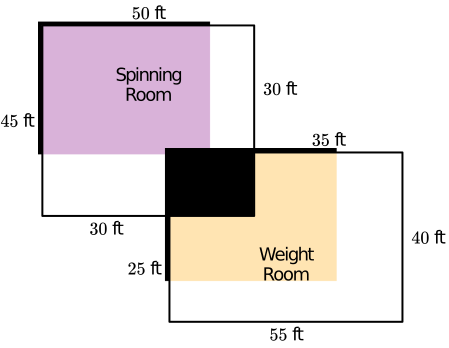
On the first floor of the gym, the weight room and the spinning room are connected by the locker room. The gym owner received many complaints about the current floor quality. The entire first floor, instead, will be covered using recycled yoga mats.
{"type":"text","form":{"type":"math","options":{"comparison":"1","nofractofloat":false,"keypad":{"simple":true,"useShortLog":false,"variables":[],"constants":[]},"rendered":false},"text":"<span class=\"katex\"><span class=\"katex-html\" aria-hidden=\"true\"><\/span><\/span>"},"formTextBefore":null,"formTextAfter":"<span class=\"katex\"><span class=\"katex-html\" aria-hidden=\"true\"><span class=\"base\"><span class=\"strut\" style=\"height:0.97402753125em;vertical-align:-0.009765625em;\"><\/span><span class=\"mord\"><span class=\"mord text\"><span class=\"mord Roboto-Regular\">ft<\/span><\/span><span class=\"msupsub\"><span class=\"vlist-t\"><span class=\"vlist-r\"><span class=\"vlist\" style=\"height:0.96426190625em;\"><span style=\"top:-3.21315390625em;margin-right:0.05em;\"><span class=\"pstrut\" style=\"height:2.7em;\"><\/span><span class=\"sizing reset-size6 size3 mtight\"><span class=\"mord mtight\">2<\/span><\/span><\/span><\/span><\/span><\/span><\/span><\/span><\/span><\/span><\/span>","answer":{"text":["4150"]}}
Hint
Add the areas of the two big rectangles and subtract the area of the locker room.
Solution
Notice that the three rooms together form a composite figure that is shaped as two overlapping rectangles.
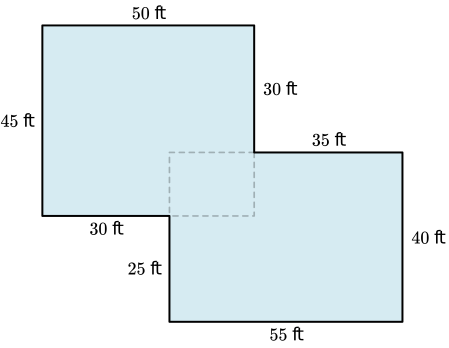
The area of the entire floor is then the sum of the areas of the big rectangles minus the area of the locker room. The area of the locker room must be subtracted because it is common for both rectangles.
| Room | Figure | Dimensions (ft) | Area (ft2) |
|---|---|---|---|
| Spinning | Upper Rectangle | ℓ=50 w=45 |
A1=50⋅45=2250
|
| Weight | Lower Rectangle | ℓ=55 w=40 |
A2=55⋅40=2200
|
| Locker | Small Rectangle | ℓ=55−35=20 w=40−25=15 |
A3=20⋅15=300
|
A=A1+A2−A3
SubstituteValues
Substitute values
A=2250+2200−300
AddSubTerms
Add and subtract terms
A=4150
Example
Kettlebells
It is leg day and Tearrik wants to try a new exercise he discovered on social media — the single-kettlebell swing. Instead of the usual spherical shape, the kettleballs at this gym are polyhedrons.
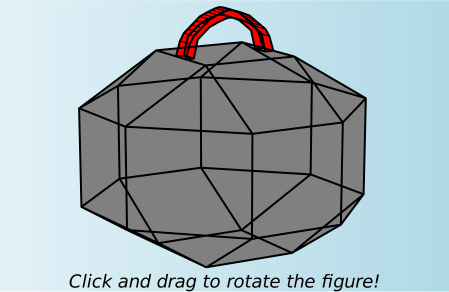 The front view of the gym's kettlebells are regular octagons with a circular handle.
 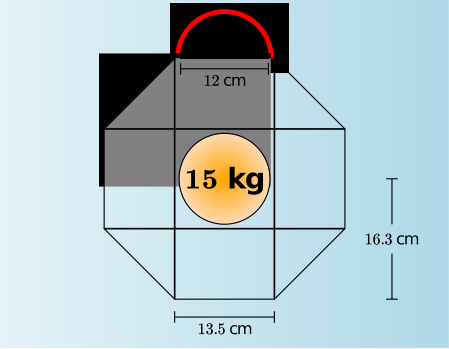 What is the area of the front view of the kettlebell? Round to the nearest integer.
{"type":"text","form":{"type":"math","options":{"comparison":"1","nofractofloat":false,"keypad":{"simple":true,"useShortLog":false,"variables":[],"constants":[]},"rendered":false},"text":"<span class=\"katex\"><span class=\"katex-html\" aria-hidden=\"true\"><\/span><\/span>"},"formTextBefore":"<span class=\"katex\"><span class=\"katex-html\" aria-hidden=\"true\"><span class=\"base\"><span class=\"strut\" style=\"height:0.68333em;vertical-align:0em;\"><\/span><span class=\"mord mathdefault\">A<\/span><span class=\"mspace\" style=\"margin-right:0.2777777777777778em;\"><\/span><span class=\"mrel\">\u2248<\/span><\/span><\/span><\/span>","formTextAfter":"<span class=\"katex\"><span class=\"katex-html\" aria-hidden=\"true\"><span class=\"base\"><span class=\"strut\" style=\"height:0.8238736249999999em;vertical-align:-0.009765625em;\"><\/span><span class=\"mord\"><span class=\"mord text\"><span class=\"mord Roboto-Regular\">cm<\/span><\/span><span class=\"msupsub\"><span class=\"vlist-t\"><span class=\"vlist-r\"><span class=\"vlist\" style=\"height:0.8141079999999999em;\"><span style=\"top:-3.063em;margin-right:0.05em;\"><span class=\"pstrut\" style=\"height:2.7em;\"><\/span><span class=\"sizing reset-size6 size3 mtight\"><span class=\"mord mtight\">2<\/span><\/span><\/span><\/span><\/span><\/span><\/span><\/span><\/span><\/span><\/span>","answer":{"text":["895"]}}
Hint
The area of a regular polygon is half the perimeter times the apothem. The apothem is the distance from the center of the polygon to any of its sides. The handle is what is left when a small semicircle is removed from a large semicircle.
Solution
The front view of the kettlebell can be separated into two parts — the body and the handle. The body is a regular octagon and the handle looks like half a ring. The kettlebell's front view is then a composite figure whose area is the sum of these two areas.
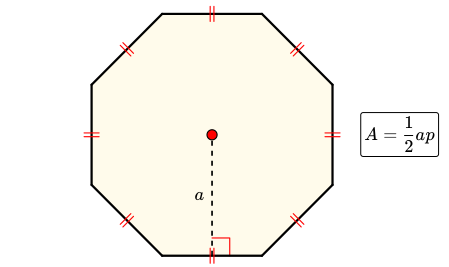 The perimeter of a regular polygon is equal to the side length times the number of sides. In this case, the number of sides is 8 and all of them have a length of 13.5 centimeters.
The area of the regular octagon is 880.2 square centimeters.
The perimeter of a regular polygon is equal to the side length times the number of sides. In this case, the number of sides is 8 and all of them have a length of 13.5 centimeters.
The area of the regular octagon is 880.2 square centimeters. 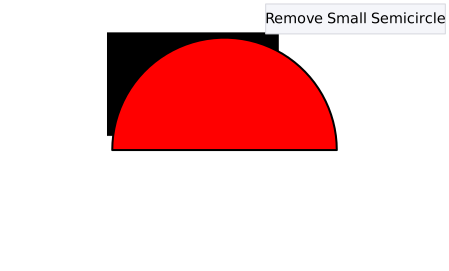 The inner semicircle has a diameter of 12 centimeters so its radius is r1=6 centimeters. The outer semicircle has a diameter of 13.5 centimeters so its radius is r2=6.75 centimeters. The area of a semicircle is half the product of π and the radius squared.
The area of the handle is the difference between the area of the outer semicircle and the area of the inner semicircle.
The area of the front view of the handle is 15.02 square centimeters.
A=Aoctagon+Ahandle
Area of the Octagon
The area of a regular polygon is half the perimeter times the apothem.
p=8⋅13.5⇒p=108 cm
The apothem of a regular polygon is the distance from the center of the polygon to any of its sides. From the given diagram, the apothem of the kettlebell's front view is 16.3 centimeters.
Aoctagon=21pa
SubstituteII
p=108, a=16.3
Aoctagon=21⋅108⋅16.3
▼
Simplify
Multiply
Multiply
Aoctagon=21⋅1760.4
MoveLeftFacToNumOne
a⋅b1=ba
Aoctagon=21760.4
CalcQuot
Calculate quotient
Aoctagon=880.2
Area of the Handle
The handle has the shape of half a ring which is what is left when a small semicircle is removed from a large semicircle.Asemicircle=21πr2
Use this formula to find the area of the semicircles. | Semicircle | Radius (cm) | A=21πr2 | Area (cm2) |
|---|---|---|---|
| Outer | 6.75 | A1=21π(6.75)2 | A1=71.57 |
| Inner | 6 | A2=21π(6)2 | A2=56.55 |
Area of the Kettlebell's Front View
Finally, add the areas of the regular octagon and the area of the handle.A=880.2+15.02⇓A=895.22
The area of the front view of the kettlebell is about 895 square centimeters.
Example
New Training Zone
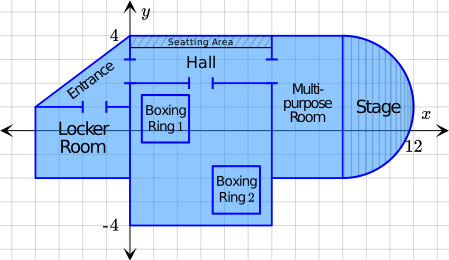
Tearrik noticed a poster on the wall saying that the gym would soon open its second floor with a boxing room and a multipurpose room. The blueprint for the second floor is shown next.
{"type":"text","form":{"type":"math","options":{"comparison":"1","nofractofloat":false,"keypad":{"simple":true,"useShortLog":false,"variables":[],"constants":[]},"rendered":false},"text":"<span class=\"katex\"><span class=\"katex-html\" aria-hidden=\"true\"><\/span><\/span>"},"formTextBefore":"<span class=\"katex\"><span class=\"katex-html\" aria-hidden=\"true\"><span class=\"base\"><span class=\"strut\" style=\"height:0.68333em;vertical-align:0em;\"><\/span><span class=\"mord mathdefault\" style=\"margin-right:0.13889em;\">P<\/span><span class=\"mspace\" style=\"margin-right:0.2777777777777778em;\"><\/span><span class=\"mrel\">\u2248<\/span><\/span><\/span><\/span>","formTextAfter":"m","answer":{"text":["174"]}}
{"type":"text","form":{"type":"math","options":{"comparison":"1","nofractofloat":false,"keypad":{"simple":true,"useShortLog":false,"variables":[],"constants":[]},"rendered":false},"text":"<span class=\"katex\"><span class=\"katex-html\" aria-hidden=\"true\"><\/span><\/span>"},"formTextBefore":"<span class=\"katex\"><span class=\"katex-html\" aria-hidden=\"true\"><span class=\"base\"><span class=\"strut\" style=\"height:0.68333em;vertical-align:0em;\"><\/span><span class=\"mord mathdefault\">A<\/span><span class=\"mspace\" style=\"margin-right:0.2777777777777778em;\"><\/span><span class=\"mrel\">\u2248<\/span><\/span><\/span><\/span>","formTextAfter":"<span class=\"katex\"><span class=\"katex-html\" aria-hidden=\"true\"><span class=\"base\"><span class=\"strut\" style=\"height:0.8141079999999999em;vertical-align:0em;\"><\/span><span class=\"mord\"><span class=\"mord text\"><span class=\"mord Roboto-Regular\">m<\/span><\/span><span class=\"msupsub\"><span class=\"vlist-t\"><span class=\"vlist-r\"><span class=\"vlist\" style=\"height:0.8141079999999999em;\"><span style=\"top:-3.063em;margin-right:0.05em;\"><span class=\"pstrut\" style=\"height:2.7em;\"><\/span><span class=\"sizing reset-size6 size3 mtight\"><span class=\"mord mtight\">2<\/span><\/span><\/span><\/span><\/span><\/span><\/span><\/span><\/span><\/span><\/span>","answer":{"text":["1570"]}}
Hint
Use the coordinate plane to find the side lengths of the composite figure. The perimeter is the sum of the lengths of the exterior sides. Break down the figure into known figures and find the sum of their areas.
Solution
The first step involves finding the perimeter of the entire floor. After that, the area of the floor will be calculated.
Perimeter of The Floor
Start by identifying the coordinates of the vertices of the blueprint and the lengths of the horizontal and vertical sides. Let m be the length of the slant side of the entrance.
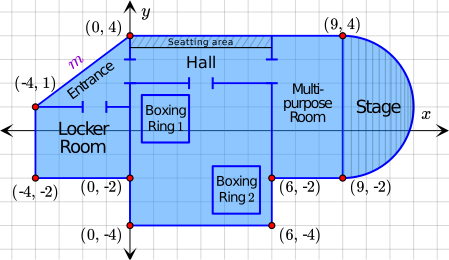
C=π⋅3⇒C≈9.42
The wall at the back of the stage is about 9.42 units long. By adding the lengths of the exterior sides of the blueprint, the perimeter of the entire floor can be calculated.
P=5+9+9.42+3+2+6+2+4+3⇓P=43.42
The perimeter of the entire floor in the blueprint is 43.42 units. Convert this to meters by using the fact that every unit in the blueprint is the same as 4 meters.
43.42 units⋅1 unit4 m=173.68 m
The entire floor has a perimeter of about 174 meters. Area of The Floor
Notice that the entire floor can be broken down into some known figures.
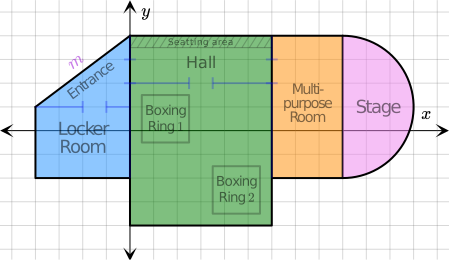
The area of the floor is the sum of the areas of the involved figures.
| Place | Figure | Dimensions | Area |
|---|---|---|---|
| Entrance and locker room | Trapezoid | b1=6 b2=3 h=4 |
A1=2(6+3)4=18 |
| Seating area, hall, and boxing room | Rectangle | ℓ=8 w=6 |
A2=8⋅6=48 |
| Multipurpose room without the stage | Rectangle | ℓ=6 w=3 |
A3=6⋅3=18 |
| Stage | Semicircle | r=3 | A4=21π(3)2≈14.14 |
A=18+48+18+14.14⇓A=98.14
The area of the entire floor in the blueprint is about 98.14 square units. Finally, convert this to square meters.
98.14 units⋅(1 unit4 m)2=1570.24 m2
The entire floor has an area of about 1570 square meters.
Example
Composite Figures in Real Life
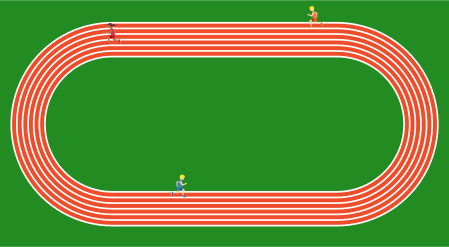
Composite figures are everywhere, it is a matter of looking closely. For instance, a running track combines rectangles and semicircles.
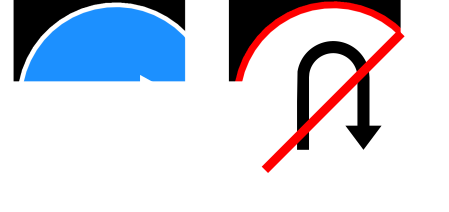
Many traffic signs can also be decomposed into known figures. The traffic sign indicating the direction of a street is formed by a rectangle and a triangle. The traffic sign corresponding to no U-turn
combines two rectangles, a semicircle, and a triangle.
Loading content