5. Translations of Figures in a Plane
Sign In
An error ocurred, try again later!
Chapter 1
5.
Translations of Figures in a Plane
This lesson focuses on the concept of translation in geometry, which involves moving geometric figures in a plane without altering their shape, size, or orientation. This is particularly useful in fields like engineering, architecture, and design where precise movement of shapes is required. For instance, in architecture, you might need to move a window design from one wall to another while maintaining its dimensions and orientation. The lesson provides exercises and examples to help you understand how to perform these translations effectively.
Show less Show more expand_more 


Lesson Settings & Tools
| | 12 Theory slides |
| | 10 Exercises - Grade E - A |
| | Each lesson is meant to take 1-2 classroom sessions |
Translations of Figures in a Plane
Slide of 12
Besides rotations, another common type of transformation is translations. As the name suggests, the effect a translation has on an object is a slide across a plane. In this lesson, the formal definition and properties of a translation will be developed.
Catch-Up and Review
Here is some recommended reading before getting started with this lesson.
Explore
Share
Report error
Translations Using Vectors
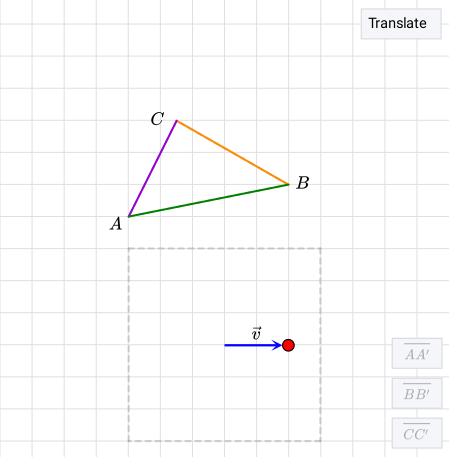
Discussion
Share
Report error
Properties of Translations
From the exploration, the following conclusions can be drawn.
To perform a translation, a vector is required. This implies that the direction of the translation plays an important role. To illustrate this statement, consider the following diagram.
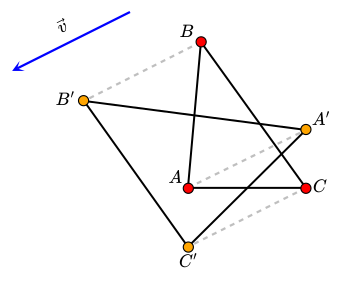
It can be seen that the lengths of AA', BB', and CC' are equal to the magnitude of v. Also, AA', BB', and CC' are parallel to v. Therefore, the same two conclusions written above apply to this diagram. AA'=|v| BB'=|v| CC'=|v| and AA' ∥ v BB' ∥ v CC' ∥ v However, △ A'B'C' is not a translation of △ ABC. This is because, although vectors BB' and CC' have the same direction as v, the vector A A' does not have the same direction as v.
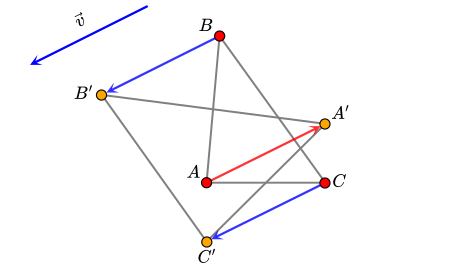
Consequently, and referring to what can be inferred from the exploration applet, a third conclusion can be drawn.
The vectors AA', BB', and CC' have the same direction as v.
Discussion
Share
Report error
Definition of Translations
Be aware that the three conclusions written before do not depend on the preimage. They hold true even when the preimage is a single point, a segment, a polygon, or any other figure. Then, these properties can be used to define a translation properly.
Concept
Share
Report error
Translation of Geometric Objects
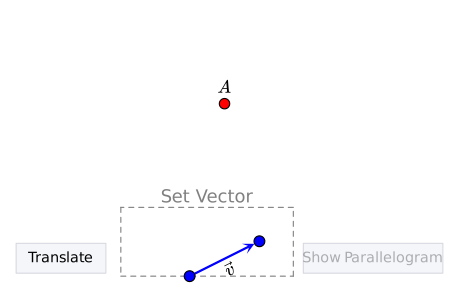
A translation is a transformation that moves every point of a figure the same distance in the same direction. More precisely, a translation along a vector v maps every point A in the plane onto its image A' such that the following statements hold true.
- The length of AA' and the magnitude of v are equal.
- Segment AA' and v are parallel.
- Vectors AA' and v have the same direction.
Explore
Share
Report error
Translating a Figure
By definition of translation, there is a relationship between the vector v that defines this transformation and the segment connecting a point with its image. Below it will be explored whether there is a relationship between a figure and its image after a translation. In the applet, the measure of ∠ ABC and the length of its sides can be set. Also, the magnitude and direction of v can be defined. Once done, ∠ ABC can be translated along v.
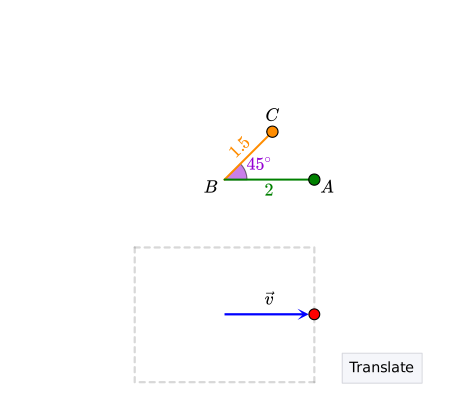 After performing the translation, consider the following questions.
- What do the preimage and the image have in common?
- Apart from the dimensions, is there any other relationship between AB and A'B'?
- Do BC and B'C' have the same relationship as AB and A'B'?
Example
Share
Report error
Identifying Translations
As the previous exploration shows, translations preserve side lengths and angle measures. That confirms translations are rigid motions. Additionally, take note that translations map segments onto parallel segments. Consider the polygon P shown in the middle of the diagram below. The other polygons are images of P after different transformations.
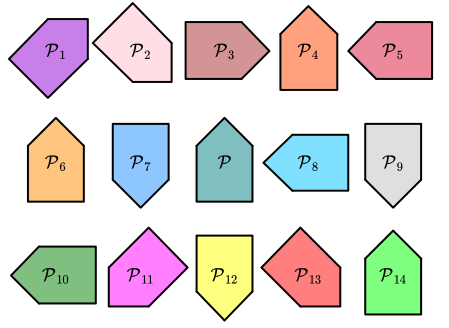
What polygons are the image of P after a translation?
Answer
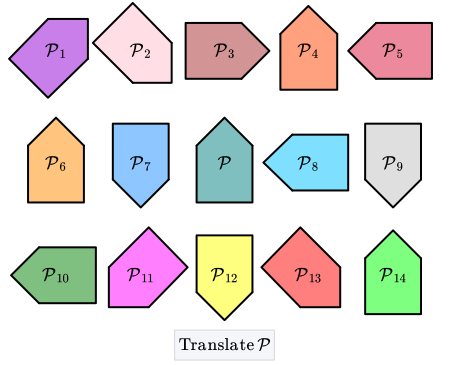
Only polygons P_4, P_6, and P_(14) are the image of P after a translation.
Hint
Remember that translations map segments onto parallel segments. Since P looks like an arrow pointing up, the images of P after a translation will also look like an arrow pointing up.
Solution
Since translations map segments onto parallel segments, the sides of P are parallel to the sides of its image after any translation. Notice that P looks like an arrow pointing up.

Example
Share
Report error
Translations and Polygon's Vertices
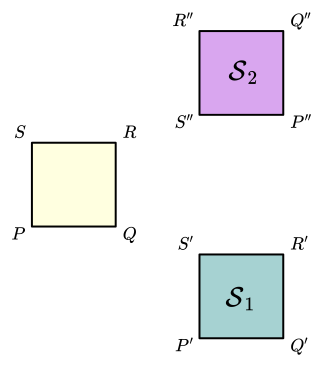
In the previous example, only the shape of polygon P was used to determine which polygons were the image of P after a translation. When the vertices are labeled, keep an eye on them. Consider the following three squares.
{"type":"choice","form":{"alts":["S_1","S_2","Both","None"],"noSort":false},"formTextBefore":"","formTextAfter":"","answer":0}
Solution
At first glance, it seems like both squares S_1 and S_2 are the image of PQRS after a translation. In fact, if the vertices were not labeled, that would be the case.
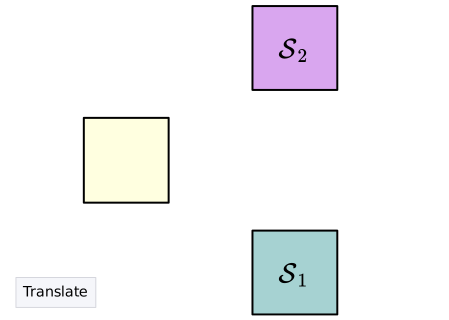 However, because the vertices are labeled, closer attention needs to be paid. By definition of translation, for every preimage A and its image A', the following relations hold true.
 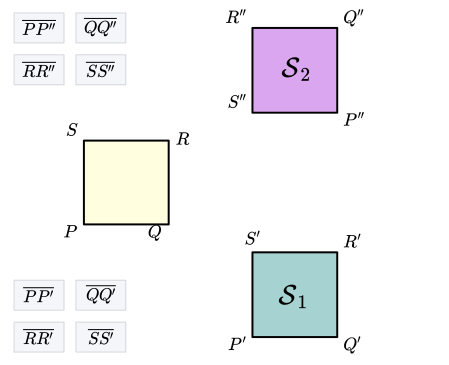 Considering only the squares PQRS and S_2, the following observations about the segments that connect the vertices and their corresponding images can be made.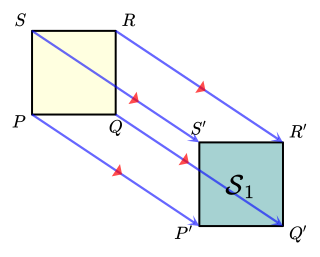
- The segment whose endpoints are A and A', AA', has the same length as the magnitude of the vector that defines the translation. This means all the segments connecting a point to its image have the same length.
- The segment whose endpoints are A and A', AA', is parallel to the vector that defines the translation. This means that all the segments connecting a point to its image are parallel to each other.
- These segment have different lengths.
- These segments are not parallel.
Therefore, S_2 is not the image of PQRS after a translation. Conversely, S_1 satisfies the two conditions previously written. Even more, since every vector that connects a vertex to its image have the same direction, it can be concluded that S_1 is a translation of PQRS.
Discussion
Share
Report error
Translations Performed by Hand
Translations can be performed by hand with the help of a straightedge and a compass.
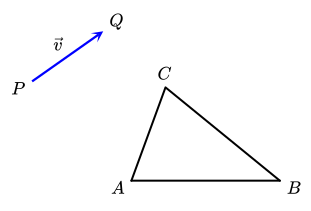
To translate △ ABC along v follow the four steps below.
1
Draw the Line l Containing v
expand_more 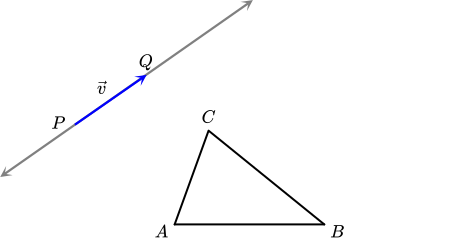
2
Draw Parallel Lines to l Through Each Vertex
expand_more Draw parallel lines to l through each vertex.
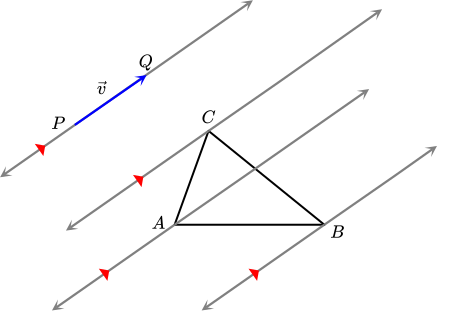
3
Copy v Over the Lines Drawn
expand_more Over the three lines drawn in the previous step, using a compass copy vector v in such way that each vertex of △ ABC is the tail of the new vector.
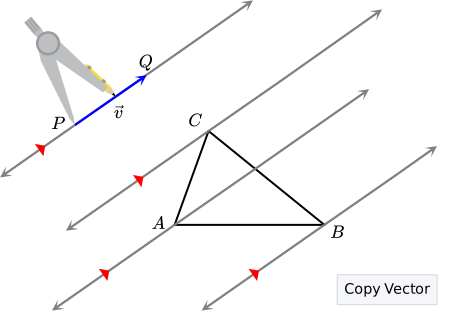 The tip of each vector is the image of each vertex.
4
Draw the Image
expand_more Draw the triangle formed by the image points A', B', and C'.
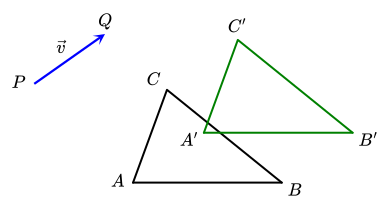
Extra
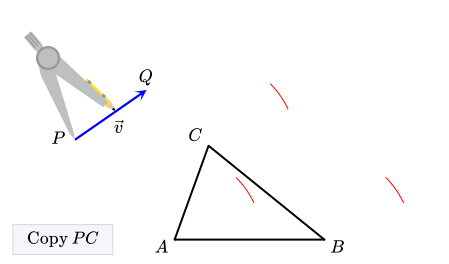
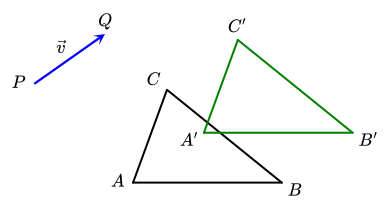
Alternative MethodBy definition of translation, vectors AA' and v are parallel and have the same magnitude and direction. This makes PAA'Q a parallelogram. With this in mind, the translation of △ ABC can be performed as follows.
- Copy the length of v: open the compass to the length of v. Then, with this setting, place the compass tip on each vertex of △ ABC and draw an arc.
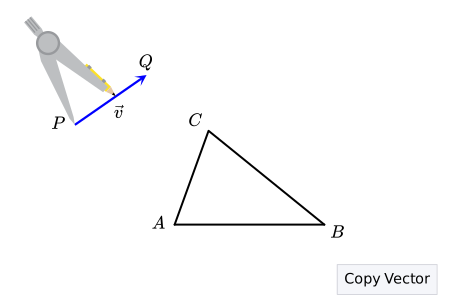
- Copy the length from P to each vertex: place the compass tip on P and open the compass to C. Then, with this setting, place the compass tip on Q and make an arc that intersects the arc centered at C. The point of intersection is C'.Here, PCC'Q is a parallelogram. Repeating the same process, the image of the rest of the vertices can be found.
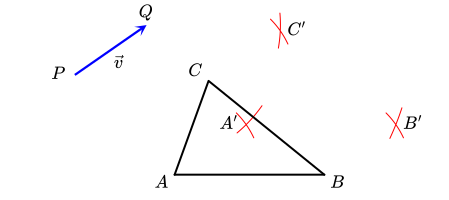
- Draw the Image: Draw the triangle formed by the image points A', B', and C'.
Discussion
Share
Report error
Translations in the Coordinate Plane
In the coordinate plane, the component form of the translation vector v is closely related to the coordinates of the image of a point P(a,b). Investigate this relationship by using the following applet.
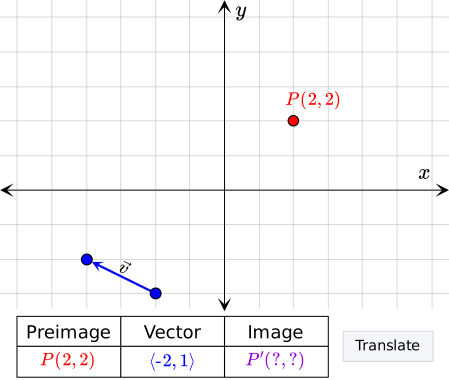 As it can be seen in the applet, the image of P(a,b) after a translation along the vector v = ⟨ v_1,v_2 ⟩ is the point P'(a+v_1,b+v_2). In other words, to find the image of P(a,b), add v_1 to the x-coordinate and v_2 to the y-coordinate. When a figure and its image after a particular translation are given, it is possible to find the translation vector. In fact, the translation vector is any vector connecting a preimage with its image. That is, any vector of the form AA'.
Pop Quiz
Share
Report error
Practice Translations
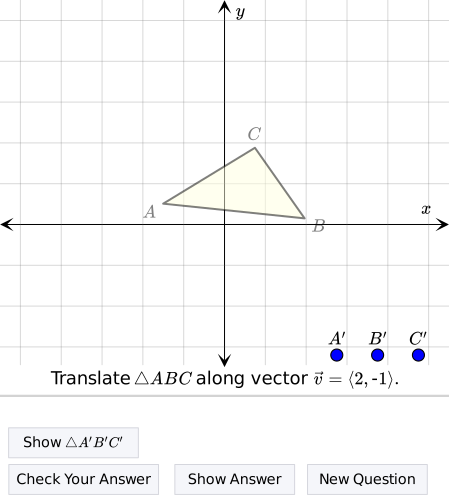
In the following applet, one of the following tasks may be required.
- Translate △ ABC along the given vector v.
- Write the component form of the translation vector that maps △ ABC onto △ A'B'C'.
To translate △ ABC, place points A', B', and C' where they should be after the translation is applied.
Example
Share
Report error
Composition of Translations
When learning about rotations, it was said that the composition of two rotations could be a translation. Now, the composition of two translations will be examined.
Consider the following pair of quadrilaterals P_1 and P_2. Also, consider a pair of different translations. One translation along vector u = ⟨ 5,1⟩ and the other along v = ⟨ -2,-4⟩.
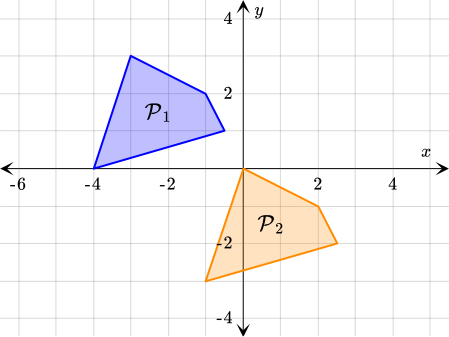
a In which order must the translations be applied to P_1 so that it is mapped onto P_2? Only one option is correct.
{"type":"choice","form":{"alts":["Along u first","Along v first","The order is insignificant"],"noSort":false},"formTextBefore":"","formTextAfter":"","answer":2}
b Is there a single translation that maps P_1 onto P_2?
{"type":"choice","form":{"alts":["Yes","No"],"noSort":true},"formTextBefore":"","formTextAfter":"","answer":0}
If so, write the component form of the translation vector.
To determine the correct order, both compositions should be tried. First, perform the translation along u followed by the translation along v.
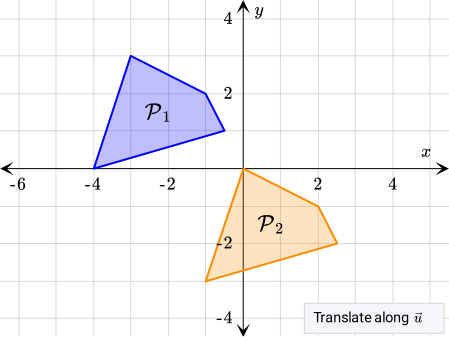 As it can be seen, the above composition maps P_1 onto P_2. Next, perform the translation along v followed by the translation along u.
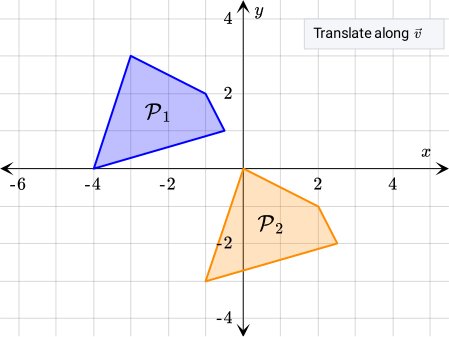 The last composition also mapped P_1 onto P_2. Consequently, the order in which the translations are applied is insignificant. This implies that the composition of translations is commutative.
{"type":"text","form":{"type":"point2d","options":{"comparison":"1","nofractofloat":false,"keypad":{"simple":true,"useShortLog":false,"variables":[],"constants":[]},"rendered":false,"decimal":false,"function":false},"text":" "},"formTextBefore":null,"formTextAfter":null,"answer":{"text1":"3","text2":"-3"}}
Hint
a Translating along u is the same as translating 5 units to the right and 1 unit up. Translating along v is the same as translating 2 units to the left and 4 unit down. Perform both compositions and compare the resulting images.
Solution
a Translating P_1 along u = ⟨ 5,1⟩ is equivalent to translating it 5 units to the right and 1 unit up. Similarly, translating P_1 along v = ⟨ -2,-4⟩ is equivalent to translating it 2 units to the left and 1 unit down.
| Translating Along | Is Equivalent To |
|---|---|
| u=⟨ 5,1⟩ | Translating 5 units to the right and 1 unit up. |
| v=⟨ -2,-4⟩ | Translating 2 units to the left and 4 unit down. |
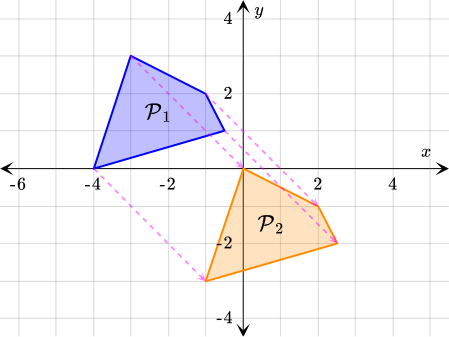
b The fact that the corresponding sides of both polygons are parallel suggests that P_2 can be the image of P_1 under a single translation. To confirm this, draw the vectors connecting corresponding vertices.
All the vectors drawn seem to be parallel and with the same magnitude. Even more, they all have the same direction. This could be checked by finding the component form of each vector.
| Vertex | Image | Vector | Component Form |
|---|---|---|---|
| ( -4, 0) | ( -1, -3) | ⟨ -1-( -4), -3- 0 ⟩ | ⟨ 3, -3 ⟩ |
| ( -1, 1) | ( 2, -2) | ⟨ 2-( -1), -2- 1 ⟩ | ⟨ 3, -3 ⟩ |
| ( -1, 2) | ( 2, -1) | ⟨ 2-( -1), -1- 2 ⟩ | ⟨ 3, -3 ⟩ |
| ( -3, 3) | ( 0, 0) | ⟨ 0-( -3), 0- 3 ⟩ | ⟨ 3, -3 ⟩ |
As the table shows, all the vectors connecting a preimage with its image have the same component form. This confirms that the vectors are parallel and have the same magnitude and direction. Consequently, a translation along ⟨ 3, -3 ⟩ maps P_1 onto P_2.
Closure
Share
Report error
Translations in the Real World
The two conclusions obtained in the previous example are not a coincidence. In fact, these are general results when performing a composition of translations.
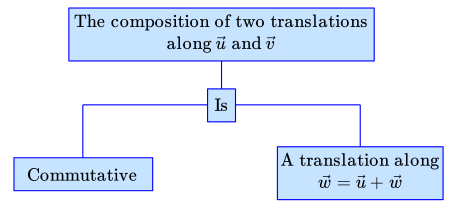
Be aware that a composition of transformations might involve translations and rotations. This combination can produce interesting images.
In interior design, it is pretty common to see designs consisting of a single preimage and its images under different transformations such as translations and rotations. Below, two different kitchen tile designs are made using just four right triangles.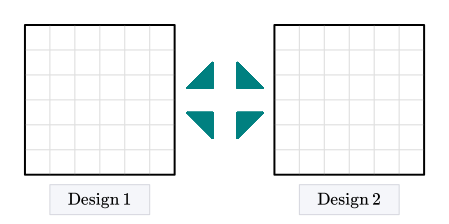
Translations of Figures in a Plane
Exercise 3.1
{"type":"choice","form":{"alts":["Yes","No"],"noSort":true},"formTextBefore":"","formTextAfter":"","answer":1}
{"type":"choice","form":{"alts":["Yes","No"],"noSort":true},"formTextBefore":"","formTextAfter":"","answer":1}
security
report
code
security
report
code
A translation is a rigid motion. This means that a translation preserves a polygon's shape and size. Let's investigate an example translation of a triangle.
From the given information, we know that AP, BQ, and CR are parallel and congruent. In the diagram we can see that the given information supports the notion that one triangle is a translation of the other. However, notice that segments do not have directionality.
We have not been given information about the direction of the segments. Let's see if we can create a situation that is not a translation but still get parallel and congruent results for AP, BQ, and CR.
As we can see, △ PQR fulfills the given conditions of AP, BQ, and CR being parallel and congruent but is not a translation of △ ABC.
This time, we know that AP, BQ, and CR are parallel and have the same direction. Here we have not been told that the vectors are congruent. The following example fulfills the given conditions without describing a translation.
The vectors have the same direction and are parallel. Since they are not the same size, however, △ PQR is not a translation of △ ABC.
security
report
code
Translations of Figures in a Plane
Recommended exercises
To get personalized recommended exercises, please login first.
Loading content
≤
>
■2
■▢
e▢
7
8
9
×
÷■1
=
=
√▢
▢√
∫▢▢
4
5
6
+
−
≤
<
log
ln
log▢
1
2
3
()
∣
sin
cos
tan
0
.
π
x
y
Loading content