1. Translations and Reflections
Sign In
An error ocurred, try again later!
Chapter 11
1.
Translations and Reflections
Transformations like translations and reflections are essential for understanding the behavior of geometric objects in different contexts. These concepts reveal how figures can be moved or flipped while retaining their shape and size, making them crucial for analyzing symmetry, congruence, and spatial relationships. Translations help to explore the movement of objects in a plane, while reflections focus on understanding symmetry and mirroring across a line. These transformations have practical applications in design, navigation, and various problem-solving scenarios. Mastering these ideas supports the development of spatial reasoning and enhances comprehension of geometric principles, which are fundamental in mathematics and its real-world applications.
Show less Show more expand_more 


Lesson Settings & Tools
| | 15 Theory slides |
| | 15 Exercises - Grade E - A |
| | Each lesson is meant to take 1-2 classroom sessions |
Translations and Reflections
Slide of 15
There are lots of things that can be done to a given a geometric figure to obtain a new one. Since a figure is transformed into a new one, these are called transformations. 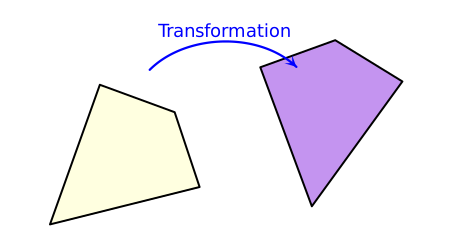
Transformations are useful to describe the relationship between two figures. This lesson will discuss two particular types of transformations: translations and reflections.
Catch-Up and Review
Here are a few recommended readings before getting started with this lesson.
Explore
Share
Report error
Moving a Triangle
In the following applet, arrow v dictates how △ ABC will move to get △ A'B'C'. Try changing the direction and length of the arrow to see different types of movements.
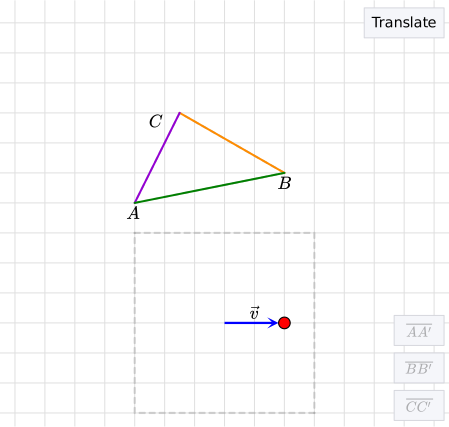 Notice how △ ABC and △ A'B'C' are congruent and how the orientation of △ A'B'C' matches the orientation of △ ABC. Furthermore, the segments AA', BB', and CC' are all parallel to arrow v, and all four segments have the same length.
Discussion
Share
Report error
Transformations of Geometric Objects
A transformation is a function that changes a figure in a particular way — it can change the position, size, or orientation of a figure. The original figure is called the preimage and the figure produced is called the image of the transformation. A prime symbol is often added to the label of a transformed point to denote that it is an image.
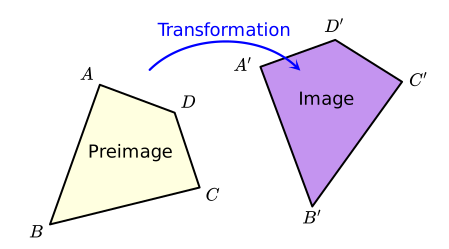
Discussion
Share
Report error
Translations of Geometric Objects
A translation is a transformation that moves every point of a figure the same distance in the same direction. To find the coordinates of a geometric object after a translation, a value a is added to the x-coordinate of every point of the preimage and a value b is added to the y-coordinate of every point of the preimage. (x,y) → (x+a,y+b)
Positive a values indicate a translation to the right and positive b values correspond to a translation up.
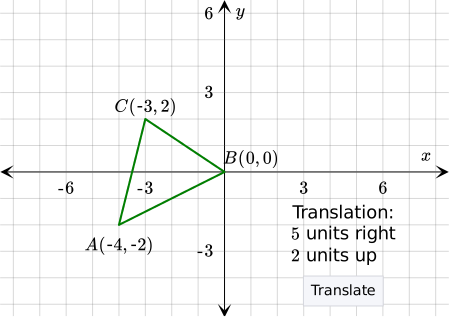 Conversely, negative a values indicate a translation to the left and negative b values correspond to a translation down.
 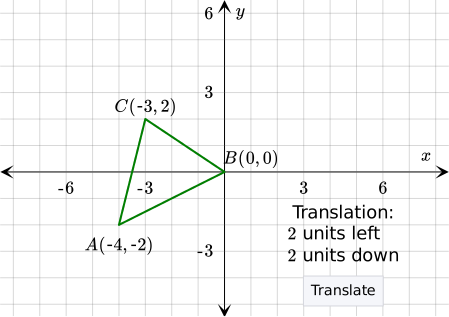 Translations preserve the side lengths and angle measures of the involved geometric objects.
Example
Share
Report error
Placing a Pool in the Backyard
Zain's parents want to renovate their backyard. The lot is pretty wide and, once the weeds are taken care of, it could be used for plenty of things. The first thing that comes to Zain's mind is to put in a pool, so they make a sketch of the backyard to show their idea to their parents. They use the letter P to represent the pool.
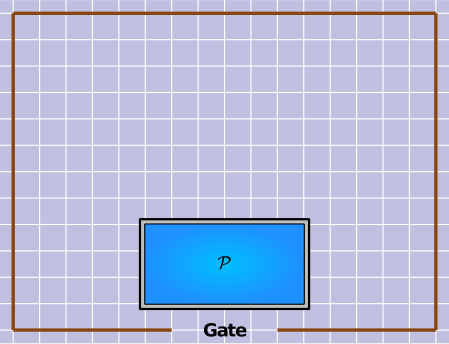
Zain's dad says that the pool should not be right against the gate to the backyard, so he suggests two possible alternatives, P_1 and P_2.
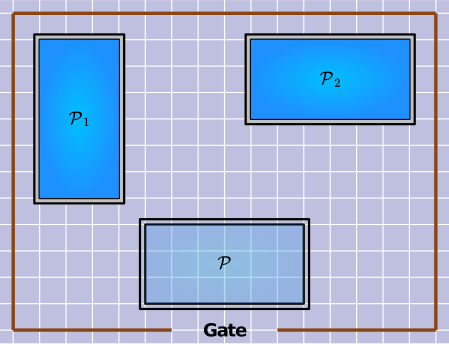
a Let P be the preimage of the pool before a transformation. Which figure represents the image of P after a pure translation?
{"type":"choice","form":{"alts":["P_1","P_2"],"noSort":true},"formTextBefore":"","formTextAfter":"","answer":1}
b The translation can be written as (x,y) → (x+a,y+b). Use the grid on the sketch to find the a and b values of the translation of the pool.
{"type":"text","form":{"type":"math","options":{"comparison":"1","nofractofloat":false,"keypad":{"simple":true,"useShortLog":false,"variables":[],"constants":[]},"rendered":false},"text":" "},"formTextBefore":"a=","formTextAfter":null,"answer":{"text":["4"]}}
{"type":"text","form":{"type":"math","options":{"comparison":"1","nofractofloat":false,"keypad":{"simple":true,"useShortLog":false,"variables":[],"constants":[]},"rendered":false},"text":" "},"formTextBefore":"b=","formTextAfter":null,"answer":{"text":["7"]}}
Hint
a A translation maps figures into congruent figures that have the same orientation.
b Focus on any corner of the pool. Count how many squares it is moved vertically and horizontally.
Solution
a Consider the pool location suggestions made by Zain's dad.
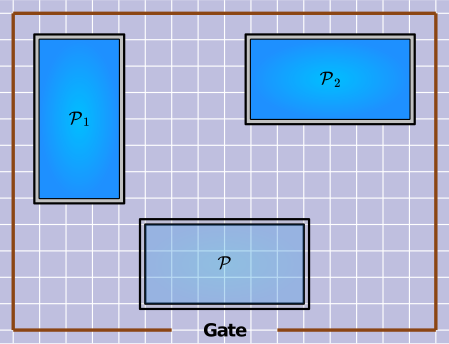
A pure translation takes a preimage P and makes it into an image that is congruent and has the same orientation as P. In the sketch, both P_1 and P_2 are congruent to P, so all that remains is to determine which image has the same orientation as P. Notice that the longest side of P is horizontal in the sketch.
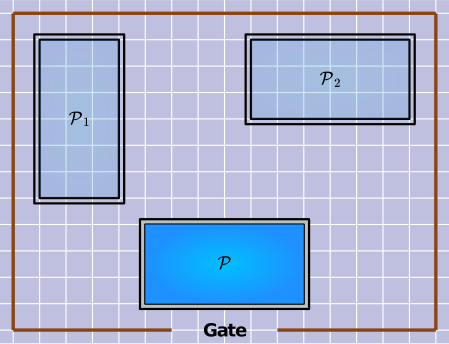
This preimage will now be compared to images P_1 and P_2. The longest side of image P_1 is vertical in the sketch, so it does not have the same orientation as P. This means that P_1 is not a pure translation of P. On the other hand, P_2 matches P exactly.
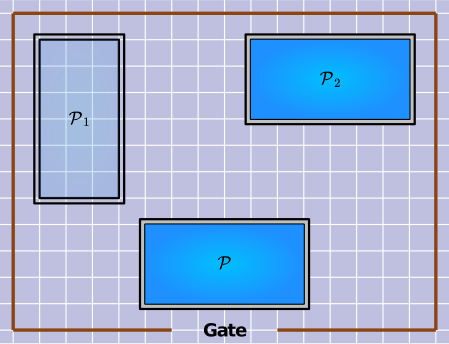
Since P_2 is congruent to P and has the same orientation, it is a pure translation of P.
b Given the coordinates (x,y) of each point in a preimage, a translation of the point can be written in the following form.
(x,y) → (x+a,y+b) In this case, it is not necessary to know the coordinates (x,y), only the values a and b that are relevant to the translation. It was found in Part A that P_2 is the image of Zain's pool after a translation, so the focus will be in this image.
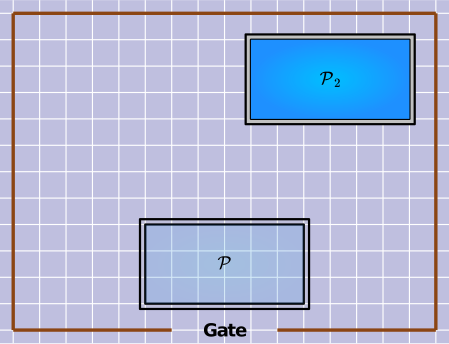
The a value of the translation corresponds to the horizontal displacement of the translation, while the b value is the vertical displacement. Since every point of the preimage is translated in the same way, any particular corner of the pool can be used along with the grid to find a and b. Just keep in mind that they have to be matching corners!
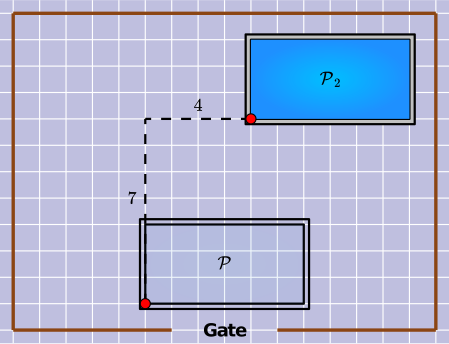
The horizontal displacement is 4 units to the right, so a=4. Likewise, the vertical displacement is 7 units up, so b=7.
Pop Quiz
Share
Report error
Identifying Translations
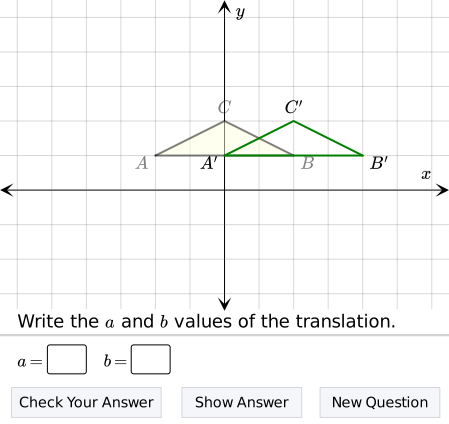
In the following applet, △ ABC is translated to map onto △ A'B'C'. Write the a and b values of the translation.
Example
Share
Report error
Replacing the Planter
The renovations are now taking place, so there is a lot going on in the backyard. During the morning, Zain's mom goes out to water some plants that were on a planter pot when she noticed that they are in the wrong place.
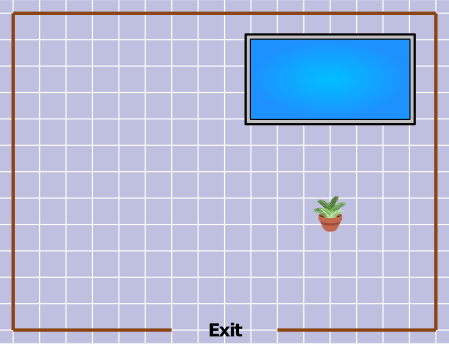
The planter was probably in the way when the builders were working on the pool. However, the plants need to be in the correct spot to get just the right amount of sunlight, so she kindly requests the workers to put them back where they belong when they are finished for the day. To find the original position of the pots, Zain placed a coordinate plane on the backyard plans.
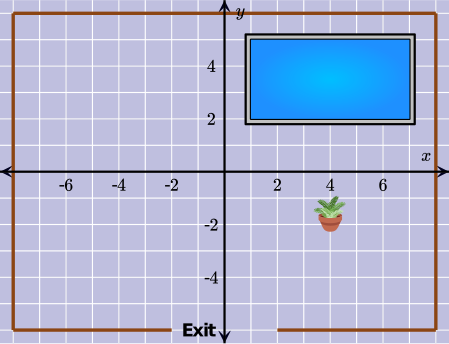
{"type":"text","form":{"type":"point2d","options":{"comparison":"1","nofractofloat":false,"keypad":{"simple":true,"useShortLog":false,"variables":[],"constants":[]},"rendered":false,"decimal":false,"function":false},"text":" "},"formTextBefore":null,"formTextAfter":null,"answer":{"text1":"-3","text2":"-1"}}
Hint
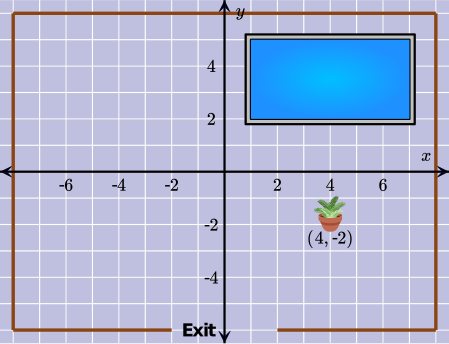
Find the initial coordinates of the pot. To translate it 7 units to the left and 1 unit up, subtract 7 from the x-coordinate and add 1 to the y-coordinate.
Solution
Zain's mom wants the builders to return the planter pot back to where it was, which they can do by translating it 7 units to the left and 1 unit up. Begin by finding the current coordinates of the pot.
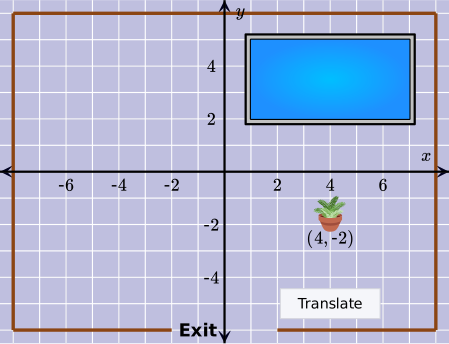
Explore
Share
Report error
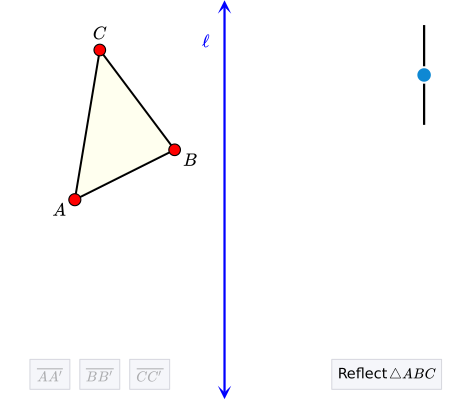
Reflecting a Triangle
Discussion
Share
Report error
Reflections of Geometric Objects
A reflection is a transformation in which every point of a figure is reflected across a line. The line across the points are reflected in what is called the line of reflection. This acts like a mirror.
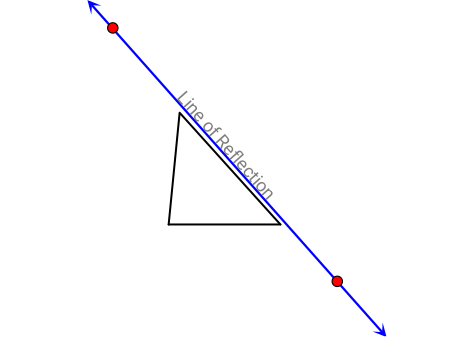 In more precise terms, a reflection across a line l maps every point A in the plane onto its image A' such that one of the following statements is satisfied.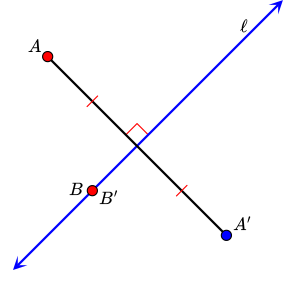
- If A is on the line l, then A and A' are the same point.
- If A is not on the line l, then l is the perpendicular bisector of AA'.
Example
Share
Report error
Reflections In the Pool Tiles
Once the pool was installed, Zain went to take a look at it. They noticed a unique pattern printed in the pool tiles.
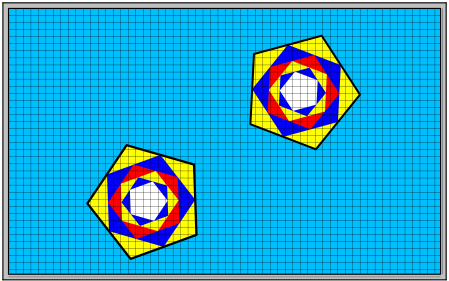
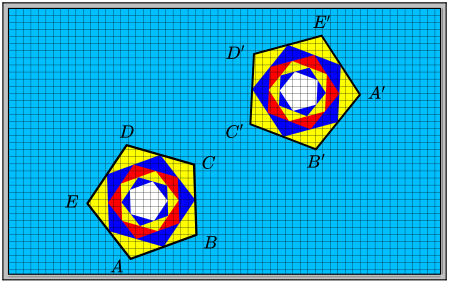
Zain thinks of this as a transformation and writes the following labels for the vertices of both figures.
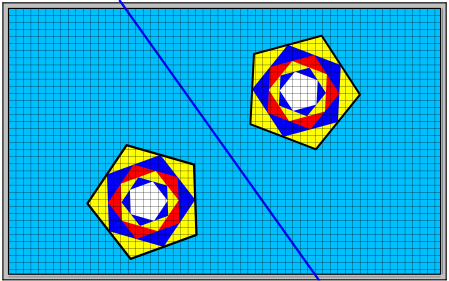
Answer
Hint
Draw segments that connect every point of the preimage with its corresponding point in the image — for example, CC'. The line of reflection is the perpendicular bisector of any segment connecting a point to its image.
Solution
When a point is reflected across a line, its image is such that the line of reflection is the perpendicular bisector of the segment that connects the point to its image. To find the line of reflection of the pool tiles, start by drawing a segment that connects a vertex and its image. For instance, draw CC'.
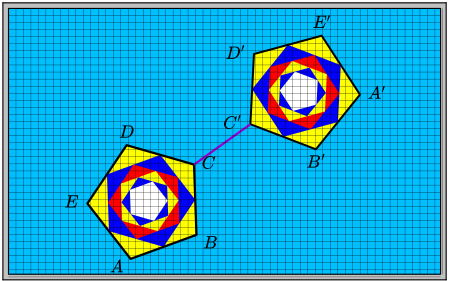
Next, construct the perpendicular bisector of CC'. This will represent the line of reflection used to make the pattern in the pool tiles.
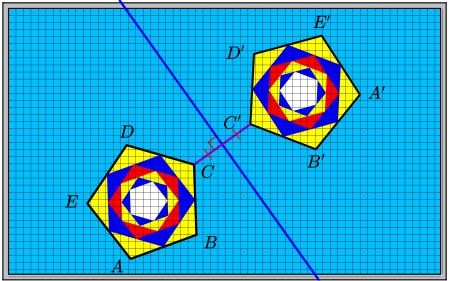
With this, the line of reflection can be finally drawn.
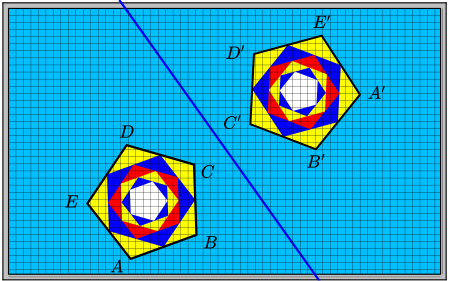
Pop Quiz
Share
Report error
Drawing Lines of Reflection
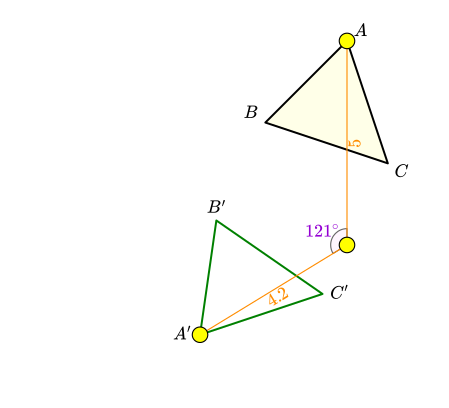
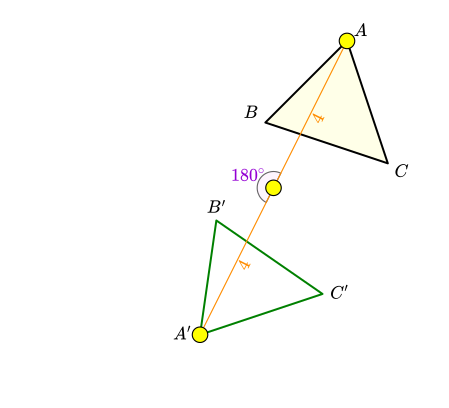
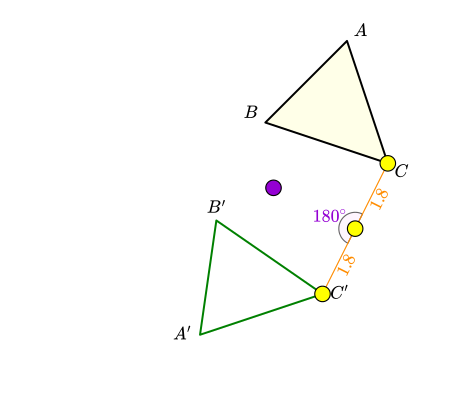
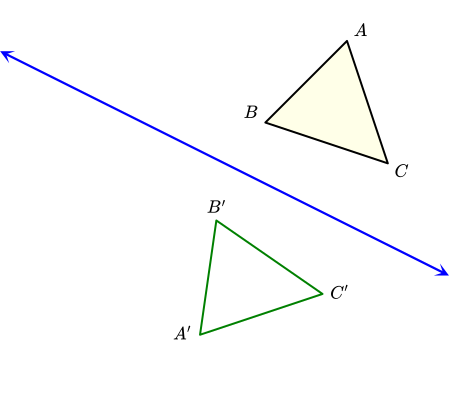
Drag the points in the following applet to draw the line of reflection used to map △ ABC onto △ A'B'C'. To do so, place the two points so they lie on the line of reflection. The measuring tool can be used to find the midpoint between corresponding vertices of the image and preimage, and they can also be used to find right angles.
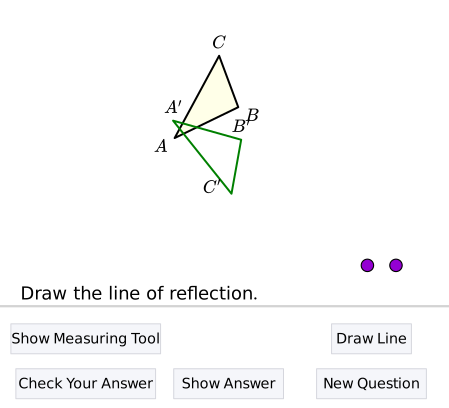
Extra
How to Use the Measuring ToolThe measuring tool is useful for finding the midpoint between a point and its image. Place the ends of the measuring tool on a point and its corresponding image.
Next, move the middle point so that the angle of the measuring tool is 180^(∘) and the length of both segments is equal. This will make sure the middle point lies on the line of reflection.
Repeat this process on another pair of corresponding vertices to find a second point that lies on the line of reflection.
Now that two points that lie on the line of reflection have been identified, that line can be drawn.
Pop Quiz
Share
Report error
Reflecting Triangles
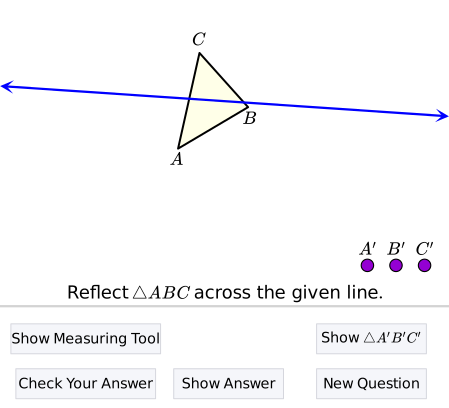
Place points A', B', and C' where they should be to reflect △ ABC across the given line. The measuring tool can be used to find segments perpendicular to the line of reflection.
Discussion
Share
Report error
Reflections in the Coordinate Plane
In the coordinate plane, there is a particular relationship between the coordinates of a point and those of its image after a reflection across the coordinate axes. Investigate each relationship by using the following applet.
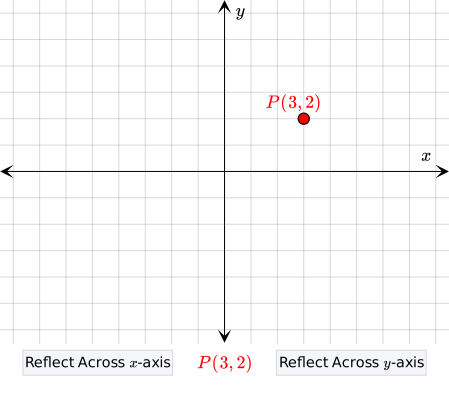 Drawn from diagram, the following relations can be determined.
- The image of (a,b) after a reflection across the x-axis is (a,- b).
- The image of (a,b) after a reflection across the y-axis is (- a,b).
Example
Share
Report error
Placing Chairs in the Backyard
It is always a good idea to have a picnic table close to the pool for snacks and drinks and to hang out while drying off, so Zain added this to the sketch, along with two chairs.
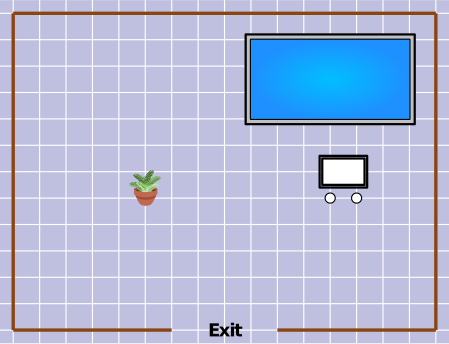
Zain noted that the table is placed along the x-axis they drew when trying to figure out where to return the planter pot.
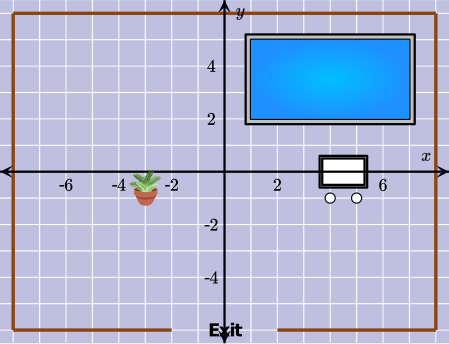
{"type":"text","form":{"type":"point2d","options":{"comparison":"1","nofractofloat":false,"keypad":{"simple":true,"useShortLog":false,"variables":[],"constants":[]},"rendered":false,"decimal":false,"function":false},"text":" "},"formTextBefore":null,"formTextAfter":null,"answer":{"text1":"4","text2":"1"}}
Solution
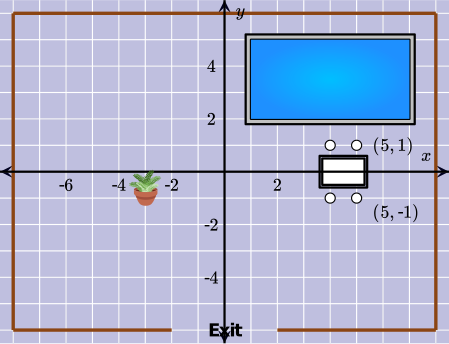
Two more chairs are to be placed so that they are reflections across the x-axis of the currently shown chairs.
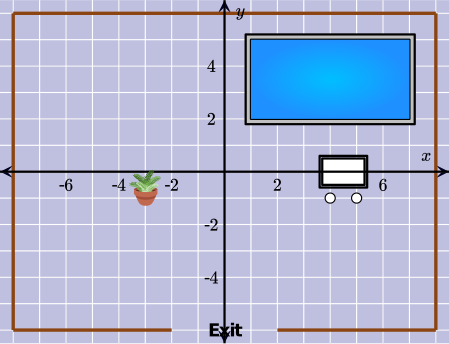
Start by finding the coordinates of the left chair.
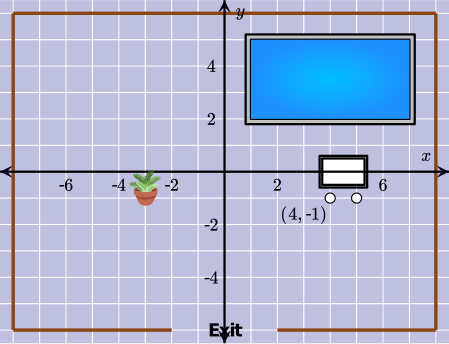
To find the reflection of an object across the x-axis, just change the sign of its y-coordinate. (4, -1) → (4, 1) Now that the coordinates of the image have been identified, Zain can place the chairs!
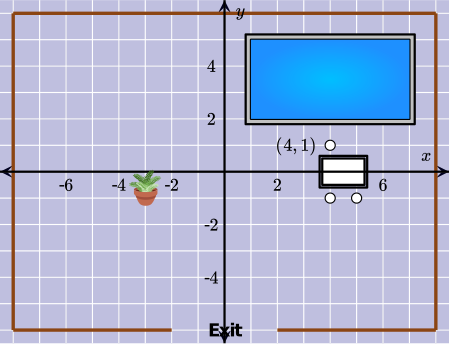
The right chair can also be reflected by following the same procedure.
Closure
Share
Report error
A Brief Talk About Glide Reflections
This lesson introduced two types of transformations of geometric objects. Translations move every point of the preimage the same distance in the same direction.
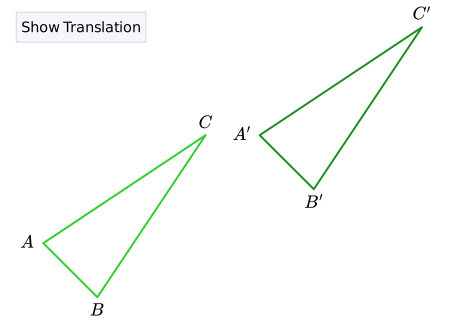 Reflections move every point in the preimage over to the line of reflection, which acts like a mirror.
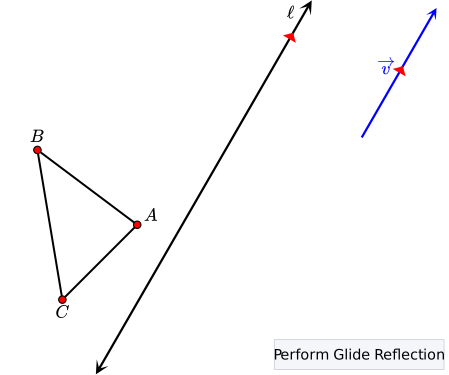
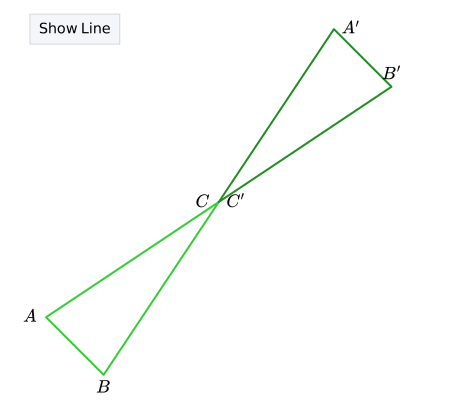 These transformations can be combined to make a new transformation. When the figure is translated in a direction parallel to the line of reflection this is called a glide reflection. In the following applet, △ ABC is translated in the direction and length of arrow v, and then is reflected across the line l.
 A glide reflection can also be done by performing the reflection before the translation.
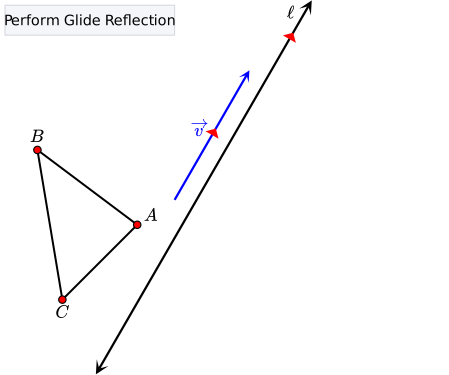 Note that the image is the same in both cases, which means that, in the case of a glide reflection, the image does not depend on the order of the transformations.
Translations and Reflections
Exercise 2.1
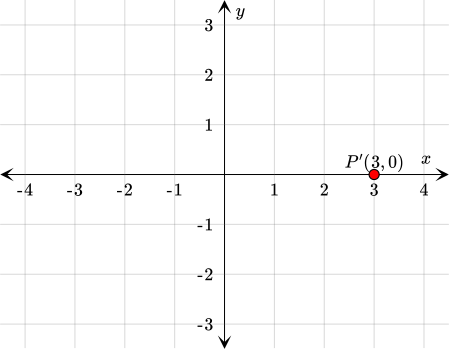
The following graph shows the image of a point P after a translation.
{"type":"text","form":{"type":"point2d","options":{"comparison":"1","nofractofloat":false,"keypad":{"simple":true,"useShortLog":false,"variables":[],"constants":[]},"rendered":false,"decimal":false,"function":false},"text":" "},"formTextBefore":"P","formTextAfter":null,"answer":{"text1":"-2","text2":"2"}}
security
report
code
security
report
code
Let's take a look at the given point.
We are told that this point P' is the image of a point P after a translation 5 units right and 2 units down. We do not know the coordinates of P, so we will let them be (x,y). We can write the translation using translation notation. (x,y) → (x + 5,y - 2) We know that the image of P after the translation is P'(3,0). (x+5,y-2) = (3,0) This lets us write and solve an equation for each coordinate. Let's write and solve the equation for the x-coordinate first.
Let's find the y-coordinate of the preimage next.
This means that the coordinates of the preimage P before the translation are P(-2,2).
Another way of finding the preimage is by reversing the translation. Point P' is the image of point P after a translation 5 units right and 2 units down. To reverse the translation, we just reverse the directions of the translation while keeping the number of units. 5 units right &→ 5 units left 2 units down &→ 2 units up Let's see how the translation would look!
security
report
code
The following diagram shows the image △ A'B'C' after it was translated 3 units left and 1 unit up.

{"type":"text","form":{"type":"point2d","options":{"comparison":"1","nofractofloat":false,"keypad":{"simple":true,"useShortLog":false,"variables":["x"],"constants":["PI"]},"rendered":false,"decimal":false,"function":false},"text":" "},"formTextBefore":"C","formTextAfter":null,"answer":{"text1":"2","text2":"-2"}}
security
report
code
security
report
code
Consider the given triangle.
We are told that this triangle is the image of a triangle ABC after a translation 3 units left and 1 unit up. We want to determine the coordinates of the vertex C of the preimage before the translation. Let's focus on vertex C'.
Since we do not know the coordinates of point C, we will write them as (x,y). Let's write this translation using translation notation. (x,y) → (x - 3,y + 1) We know that the image of C after the translation is C'(-1,-1). (x-3,y+1) = (-1,-1) This lets us write and solve an equation for each coordinate. Let's write and solve the equation for the x-coordinate first.
Let's find the y-coordinate of the preimage next.
We found that x=2 and y=-2. This means that point C of the preimage before the translation is C(2,-2).
Another way of finding the preimage is by reversing the translation. Point P' is the image of point P after a translation 5 units right and 2 units down. To reverse the translation, we just reverse the directions of the translation while keeping the number of units. 3 units left &→ 3 units right 1 unit up &→ 1 unit down Let's see how the translation would look!
security
report
code
Consider the given triangle.

{"type":"choice","form":{"alts":["A'(1,2), B'(1,-2), and C'(-1,0)","A'(-1,-2), B'(-1,2), and C'(1,0)","A'(-2,-1), B'(2,-1), and C'(1,0)","A'(2,1), B'(-2,1), and C'(-1,0)"],"noSort":false},"formTextBefore":"","formTextAfter":"","answer":0}
security
report
code
security
report
code
Let's begin by identifying the coordinates of the vertices of the given triangle.
To reflect a figure over the y-axis, we can simply change the sign of the x-coordinates of the figure.
| Vertices of △ ABC | Vertices of △ A'B'C' |
|---|---|
| A(-1,2) | A'(1,2) |
| B(-1,-2) | B'(1,-2) |
| C(1,0) | C'(-1,0) |
This means that the coordinates of the image after the reflection over the y-axis are A'(1,2), B'(1,-2), and C'(-1,0). Let's finish by drawing the image!
security
report
code
Consider the given triangle.

{"type":"choice","form":{"alts":["A'(-3,-2), B'(1,-1), and C'(0,1)","A'(3,2), B'(-1,1), and C'(0,-1)","A'(-3,2), B'(1,1), and C'(0,-1)","A'(3,-2), B'(-1,-1), and C'(0,1)"],"noSort":false},"formTextBefore":"","formTextAfter":"","answer":0}
security
report
code
security
report
code
Let's begin by labeling the coordinates of the vertices of the given triangle.
We can reflect a figure over the x-axis by simply changing the sign of the y-coordinates of the figure.
| Vertices of △ ABC | Vertices of △ A'B'C' |
|---|---|
| A(-3,2) | A'(-3,-2) |
| B(1,1) | B'(1,-1) |
| C(0,-1) | C'(0,1) |
We found that the coordinates of the image after the reflection over the x-axis are A'(-3,-2), B'(1,-1), and C'(0,1). Finally, let's draw the image after the reflection.
security
report
code
Translations and Reflections
Recommended exercises
To get personalized recommended exercises, please login first.
Loading content
≤
>
■2
■▢
e▢
7
8
9
×
÷■1
=
=
√▢
▢√
∫▢▢
4
5
6
+
−
≤
<
log
ln
log▢
1
2
3
()
∣
sin
cos
tan
0
.
π
x
y
Loading content