{{ tocSubheader }}
{{ 'ml-label-loading-course' | message }}
An error ocurred, try again later!
Chapter {{ article.chapter.number }}
{{ article.number }}.
{{ article.displayTitle }}
{{ article.intro.summary }}
Show less Show more expand_more Lesson Settings & Tools
| | {{ 'ml-lesson-number-slides' | message : article.intro.bblockCount }} |
| | {{ 'ml-lesson-number-exercises' | message : article.intro.exerciseCount }} |
| | {{ 'ml-lesson-time-estimation' | message }} |
Trigonometric ratios are useful in solving right triangles. Furthermore, the Law of Sines is a fairly used law when solving non-right triangles. However, there are cases in which this law is not applicable. This lesson will explore those cases, where the relationship between the side lengths and an angle measure of different triangles. 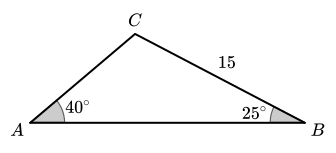
Catch-Up and Review
Here is a bundle of recommended readings before getting started with this lesson.
Try your knowledge on these topics.
Consider the triangle with vertices A, B, and C.
a Find the measure of the missing angle.
{"type":"text","form":{"type":"math","options":{"comparison":"1","nofractofloat":false,"keypad":{"simple":true,"useShortLog":false,"variables":["x"],"constants":["PI"]},"rendered":false},"text":"<span class=\"katex\"><span class=\"katex-html\" aria-hidden=\"true\"><\/span><\/span>"},"formTextBefore":"<span class=\"katex\"><span class=\"katex-html\" aria-hidden=\"true\"><span class=\"base\"><span class=\"strut\" style=\"height:0.69224em;vertical-align:0em;\"><\/span><span class=\"mord mathdefault\">m<\/span><span class=\"mord\">\u2220<\/span><span class=\"mord mathdefault\" style=\"margin-right:0.05017em;\">B<\/span><span class=\"mord mathdefault\" style=\"margin-right:0.07153em;\">C<\/span><span class=\"mord mathdefault\">A<\/span><span class=\"mspace\" style=\"margin-right:0.2777777777777778em;\"><\/span><span class=\"mrel\">=<\/span><\/span><\/span><\/span>","formTextAfter":"<span class=\"katex\"><span class=\"katex-html\" aria-hidden=\"true\"><span class=\"base\"><span class=\"strut\" style=\"height:0.674115em;vertical-align:0em;\"><\/span><span class=\"mord\"><span><\/span><span class=\"msupsub\"><span class=\"vlist-t\"><span class=\"vlist-r\"><span class=\"vlist\" style=\"height:0.674115em;\"><span style=\"top:-3.063em;margin-right:0.05em;\"><span class=\"pstrut\" style=\"height:2.7em;\"><\/span><span class=\"sizing reset-size6 size3 mtight\"><span class=\"mbin mtight\">\u2218<\/span><\/span><\/span><\/span><\/span><\/span><\/span><\/span><\/span><\/span><\/span>","answer":{"text":["115"]}}
b Find the length of the longest side. If necessary, round the answer to the nearest integer.
{"type":"text","form":{"type":"math","options":{"comparison":"1","nofractofloat":false,"keypad":{"simple":true,"useShortLog":false,"variables":["x"],"constants":["PI"]},"rendered":false},"text":"<span class=\"katex\"><span class=\"katex-html\" aria-hidden=\"true\"><\/span><\/span>"},"formTextBefore":null,"formTextAfter":null,"answer":{"text":["21"]}}
c If the altitude of the triangle is 6, find AD and DB. If necessary, round the answer to the nearest integer. 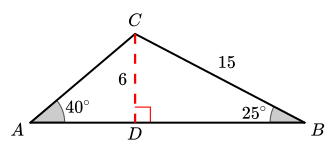
{"type":"text","form":{"type":"math","options":{"comparison":"1","nofractofloat":false,"keypad":{"simple":true,"useShortLog":false,"variables":["x"],"constants":["PI"]},"rendered":false},"text":"<span class=\"katex\"><span class=\"katex-html\" aria-hidden=\"true\"><\/span><\/span>"},"formTextBefore":"<span class=\"katex\"><span class=\"katex-html\" aria-hidden=\"true\"><span class=\"base\"><span class=\"strut\" style=\"height:0.68333em;vertical-align:0em;\"><\/span><span class=\"mord mathdefault\">A<\/span><span class=\"mord mathdefault\" style=\"margin-right:0.02778em;\">D<\/span><span class=\"mspace\" style=\"margin-right:0.2777777777777778em;\"><\/span><span class=\"mrel\">=<\/span><\/span><\/span><\/span>","formTextAfter":null,"answer":{"text":["7"]}}
{"type":"text","form":{"type":"math","options":{"comparison":"1","nofractofloat":false,"keypad":{"simple":true,"useShortLog":false,"variables":["x"],"constants":["PI"]},"rendered":false},"text":"<span class=\"katex\"><span class=\"katex-html\" aria-hidden=\"true\"><\/span><\/span>"},"formTextBefore":"<span class=\"katex\"><span class=\"katex-html\" aria-hidden=\"true\"><span class=\"base\"><span class=\"strut\" style=\"height:0.68333em;vertical-align:0em;\"><\/span><span class=\"mord mathdefault\" style=\"margin-right:0.02778em;\">D<\/span><span class=\"mord mathdefault\" style=\"margin-right:0.05017em;\">B<\/span><span class=\"mspace\" style=\"margin-right:0.2777777777777778em;\"><\/span><span class=\"mrel\">=<\/span><\/span><\/span><\/span>","formTextAfter":null,"answer":{"text":["14"]}}
Challenge
Investigate Distances in Space Using Trigonometry
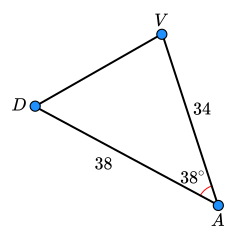
On a June night, Zosia observes an astronomical asterism, which is called the Summer Triangle. 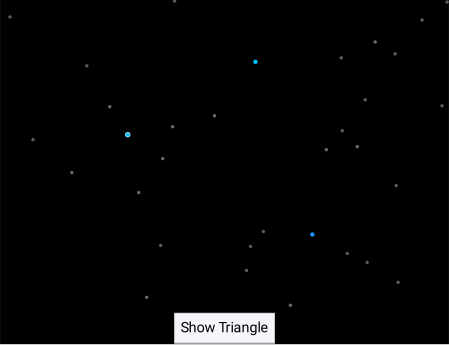 From an observer's point of view, the apparent distances of celestial objects in the sky are measured in angular distance. The apparent distance from Altair to Deneb is 38 angular units and 34 angular units from Altair to Vega. Furthermore, the angle measure between these sides is 38∘. Help Zosia find the apparent distance between Deneb and Vega.
Explore
Limitations of the Law of Sines
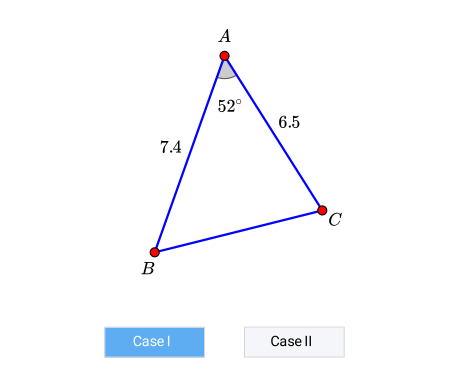
The applet below shows two different cases for a triangle with vertices A, B, and C. Case I shows the lengths of two sides and the measure of their included angle. Case II shows the lengths of all three sides.
Discussion
Law of Cosines
When the Law of Sines cannot be used to solve triangles, the Law of Cosines may be applied.
Consider △ABC with sides of length a, b, and c, which are respectively opposite the angles with measures A, B, and C.
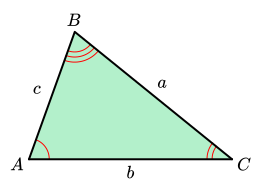
The following equations hold true with regard to △ABC.
a2=b2+c2−2bccos(A)
b2=a2+c2−2accos(B)
c2=a2+b2−2abcos(C)
Proof
For Acute AnglesThe first equation will be proven. The other two equations can be proven by following the same procedure.
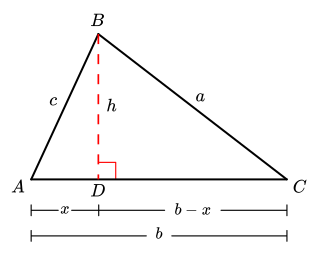 By the definition of an altitude, both △ADB and △CDB are right triangles. By applying the Pythagorean Theorem to △CDB and △ADB, two equations can be obtained.
Now, the x-term in this equation can be written using the cosine ratio.
By the definition of an altitude, both △ADB and △CDB are right triangles. By applying the Pythagorean Theorem to △CDB and △ADB, two equations can be obtained.
Now, the x-term in this equation can be written using the cosine ratio. 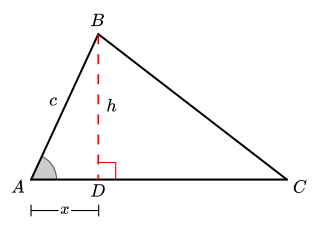 In △ADB, the cosine of A is the ratio of x to c.
a2=b2+c2−2bccosA
Begin by drawing the altitude from B to its opposite side AC. Equation I: Equation II: a2=(b−x)2+h2 c2=x2+h2
The binomial in Equation I can be expanded.
Notice that Equation II says that x2+h2 is equal to c2. Therefore, the expanded form of Equation I can be rewritten by using the Substitution Property of Equality.
a2=b2−2bx+x2+h2
Substitute
x2+h2=c2
a2=b2−2bx+c2
CommutativePropAdd
Commutative Property of Addition
a2=b2+c2−2bx
cosA=cx⇔x=ccosA
Finally, ccosA can be substituted for x into a2=b2+c2−2bx. By doing so, the formula for the Law of Cosines is obtained.
a2a2=b2+c2−2bx=b2+c2−2bccosA
Proof
For Obtuse AnglesThe first equation will be proven for obtuse angles. The remaining equations can be proven similarly. 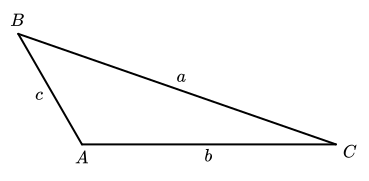
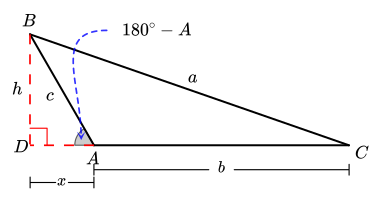 From the definition of an altitude, it follows that △BDA and △BDC are right triangles. Two equations can be obtained by applying the Pythagorean Theorem to both triangles.
From Equation II, h2+x2 is equal to c2. Therefore, the expanded form of Equation I can be rewritten by using the Substitution Property of Equality.
Note that A and 180∘−A are supplementary angles. Using the cosine ratio of 180∘−A then gives an expression for the x-term.
From the definition of an altitude, it follows that △BDA and △BDC are right triangles. Two equations can be obtained by applying the Pythagorean Theorem to both triangles.
From Equation II, h2+x2 is equal to c2. Therefore, the expanded form of Equation I can be rewritten by using the Substitution Property of Equality.
Note that A and 180∘−A are supplementary angles. Using the cosine ratio of 180∘−A then gives an expression for the x-term. 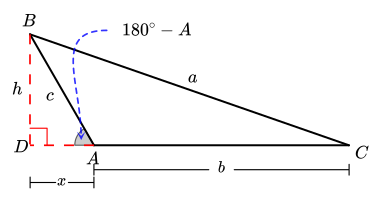 In △BDA, the cosine of 180∘−A is the ratio of x to c.
a2=b2+c2−2bccosA
Consider △ABC with side lengths of a, b, and c, respectively opposite the angles with measures A, B, and C, such that m∠A is greater than 90∘. The altitude of the triangle is the perpendicular segment from B to the extension of the base AC. Let D be the endpoint of this segment and x be the distance from D to A.
Equation I: Equation II: a2=h2+(b+x)2 c2=h2+x2
Expand the binomial in Equation I.
a2=h2+(b+x)2
ExpandPosPerfectSquare
(a+b)2=a2+2ab+b2
a2=h2+b2+2bx+x2
CommutativePropAdd
Commutative Property of Addition
a2=h2+x2+b2+2bx
cos(180∘−A)=cx⇕x=ccos(180∘−A)
By the Sine and Cosine of Supplementary Values Angles, cos(180∘−A) and cosA have opposite values.
x=ccos(180∘−A)⇕x=-ccosA
Finally, by substituting -ccosA for x into a2=b2+c2+2bx, the Law of Cosines is obtained.
Example
Knowing Two Sides and the Included Angle of a Triangle
In a triangle, when the lengths of two sides and the measure of their included angle are known, the missing side length can be found by applying the Law of Cosines.
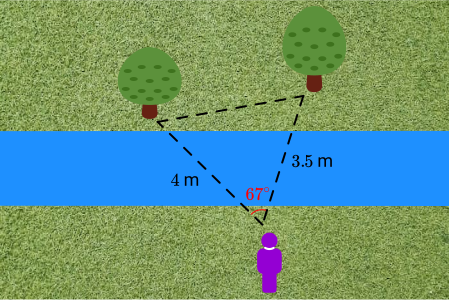
Kriz wants to determine the distance between two trees on the other side of the river. Kriz uses a tool that measures the distances to objects. The tool is able to find the distances to each tree as 4 meters and 3.5 meters.
External credits: @kdekiara
The angle between these sides, from where the Kriz stands with the measuring tool, measures 67∘. Find the distance between the trees, and round the answer to the nearest tenth of a meter.
{"type":"text","form":{"type":"math","options":{"comparison":"1","nofractofloat":false,"keypad":{"simple":true,"useShortLog":false,"variables":["x"],"constants":["PI"]},"rendered":false},"text":"<span class=\"katex\"><span class=\"katex-html\" aria-hidden=\"true\"><\/span><\/span>"},"formTextBefore":null,"formTextAfter":"m","answer":{"text":["4.2"]}}
Hint
Start by naming the vertices and sides of the triangle.
Solution
For simplicity, the vertices and sides of the triangle will be named.
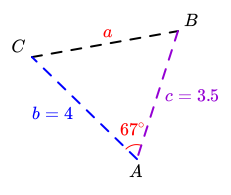
a2=b2+c2−2bccosA
The next step is to substitute b=4, c=3.5, and A=67∘ into the equation. Then, solve for a.
Note that only the principal root was considered because a side length cannot be negative. Therefore, the distance between the trees is about 4.2 meters. Example
Knowing Three Sides of a Triangle
When all the three side lengths of a triangle are known, the Law of Cosines can be used to find the measure of the angles.
Ramsha lives near a lighthouse. As she likes to observe the landscape, she notices that the light rays coming out of the lighthouse create an angle. She decides to ask the lighthouse keeper, but he insists on not telling her the measure of the angle. She sees a blueprint on the desk behind him, and quickly writes the lengths shown in the diagram before the grumpy keeper blocks her view!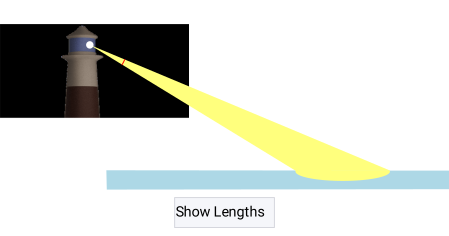
{"type":"text","form":{"type":"math","options":{"comparison":"1","nofractofloat":false,"keypad":{"simple":true,"useShortLog":false,"variables":["x"],"constants":["PI"]},"rendered":false},"text":"<span class=\"katex\"><span class=\"katex-html\" aria-hidden=\"true\"><\/span><\/span>"},"formTextBefore":"<span class=\"katex\"><span class=\"katex-html\" aria-hidden=\"true\"><span class=\"base\"><span class=\"strut\" style=\"height:0.69224em;vertical-align:0em;\"><\/span><span class=\"mord mathdefault\">m<\/span><span class=\"mord\">\u2220<\/span><span class=\"mord mathdefault\">L<\/span><\/span><\/span><\/span>","formTextAfter":"<span class=\"katex\"><span class=\"katex-html\" aria-hidden=\"true\"><span class=\"base\"><span class=\"strut\" style=\"height:0.674115em;vertical-align:0em;\"><\/span><span class=\"mord\"><span><\/span><span class=\"msupsub\"><span class=\"vlist-t\"><span class=\"vlist-r\"><span class=\"vlist\" style=\"height:0.674115em;\"><span style=\"top:-3.063em;margin-right:0.05em;\"><span class=\"pstrut\" style=\"height:2.7em;\"><\/span><span class=\"sizing reset-size6 size3 mtight\"><span class=\"mbin mtight\">\u2218<\/span><\/span><\/span><\/span><\/span><\/span><\/span><\/span><\/span><\/span><\/span>","answer":{"text":["12"]}}
{"type":"text","form":{"type":"math","options":{"comparison":"1","nofractofloat":false,"keypad":{"simple":true,"useShortLog":false,"variables":["x"],"constants":["PI"]},"rendered":false},"text":"<span class=\"katex\"><span class=\"katex-html\" aria-hidden=\"true\"><\/span><\/span>"},"formTextBefore":"<span class=\"katex\"><span class=\"katex-html\" aria-hidden=\"true\"><span class=\"base\"><span class=\"strut\" style=\"height:0.69224em;vertical-align:0em;\"><\/span><span class=\"mord mathdefault\">m<\/span><span class=\"mord\">\u2220<\/span><span class=\"mord mathdefault\" style=\"margin-right:0.10903em;\">M<\/span><\/span><\/span><\/span>","formTextAfter":"<span class=\"katex\"><span class=\"katex-html\" aria-hidden=\"true\"><span class=\"base\"><span class=\"strut\" style=\"height:0.674115em;vertical-align:0em;\"><\/span><span class=\"mord\"><span><\/span><span class=\"msupsub\"><span class=\"vlist-t\"><span class=\"vlist-r\"><span class=\"vlist\" style=\"height:0.674115em;\"><span style=\"top:-3.063em;margin-right:0.05em;\"><span class=\"pstrut\" style=\"height:2.7em;\"><\/span><span class=\"sizing reset-size6 size3 mtight\"><span class=\"mbin mtight\">\u2218<\/span><\/span><\/span><\/span><\/span><\/span><\/span><\/span><\/span><\/span><\/span>","answer":{"text":["39"]}}
{"type":"text","form":{"type":"math","options":{"comparison":"1","nofractofloat":false,"keypad":{"simple":true,"useShortLog":false,"variables":["x"],"constants":["PI"]},"rendered":false},"text":"<span class=\"katex\"><span class=\"katex-html\" aria-hidden=\"true\"><\/span><\/span>"},"formTextBefore":"<span class=\"katex\"><span class=\"katex-html\" aria-hidden=\"true\"><span class=\"base\"><span class=\"strut\" style=\"height:0.69224em;vertical-align:0em;\"><\/span><span class=\"mord mathdefault\">m<\/span><span class=\"mord\">\u2220<\/span><span class=\"mord mathdefault\" style=\"margin-right:0.07153em;\">K<\/span><\/span><\/span><\/span>","formTextAfter":"<span class=\"katex\"><span class=\"katex-html\" aria-hidden=\"true\"><span class=\"base\"><span class=\"strut\" style=\"height:0.674115em;vertical-align:0em;\"><\/span><span class=\"mord\"><span><\/span><span class=\"msupsub\"><span class=\"vlist-t\"><span class=\"vlist-r\"><span class=\"vlist\" style=\"height:0.674115em;\"><span style=\"top:-3.063em;margin-right:0.05em;\"><span class=\"pstrut\" style=\"height:2.7em;\"><\/span><span class=\"sizing reset-size6 size3 mtight\"><span class=\"mbin mtight\">\u2218<\/span><\/span><\/span><\/span><\/span><\/span><\/span><\/span><\/span><\/span><\/span>","answer":{"text":["129"]}}
Hint
To find m∠L, use the Law of Cosines. Then, the measures of other two angles can be found by using either the Law of Cosines or the Law of Sines.
Solution
As the diagram indicates, the light rays form a triangle. In this triangle, the three side lengths are known.
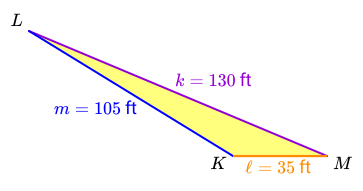
The measure of the three angles will be found one at a time.
Finding m∠L
To find the measure of ∠L, the Law of Cosines can be used.ℓ2=m2+k2−2mkcosL
Substitute 35 for ℓ, 105 for m, and 130 for k into the equation. ℓ2=k2+m2−2kmcosL
SubstituteValues
Substitute values
352=1052+1302−2(105)(130)cosL
▼
Solve for cosL
CalcPow
Calculate power
1225=11025+16900−2(105)(130)cosL
Multiply
Multiply
1225=11025+16900−27300cosL
AddTerms
Add terms
1225=27925−27300cosL
SubEqn
LHS−27925=RHS−27925
-26700=-27300cosL
DivEqn
LHS/(-27300)=RHS/(-27300)
-27300-26700=cosL
DivNegNeg
-b-a=ba
2730026700=cosL
RearrangeEqn
Rearrange equation
cosL=2730026700
ReduceFrac
ba=b/300a/300
cosL=9189
cosL=9189
cos-1(LHS)=cos-1(RHS)
L=cos-1(9189)
L≈12∘
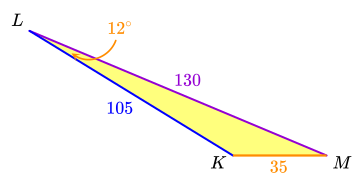
Finding m∠M
Since the ratio of the sine of an angle to the length of its opposite side is constant, the following proportion can be written.ℓsinL=msinM⇒35sin12∘=105sinM
The equation can be solved for M.
35sin12∘=105sinM
▼
Solve for M
MultEqn
LHS⋅105=RHS⋅105
105⋅35sin12∘=sinM
RearrangeEqn
Rearrange equation
sinM=105⋅35sin12∘
sin-1(LHS)=sin-1(RHS)
M=sin-1(105⋅35sin12∘)
UseCalc
Use a calculator
M=38.589405…∘
RoundInt
Round to nearest integer
M≈39∘
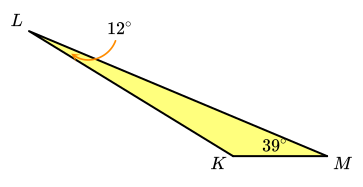
Finding m∠K
By the Triangle Angle Sum Theorem, the sum of the interior angles of a triangle is 180∘.m∠K+12∘+39∘=180∘m∠K=129∘
Therefore, all measures of △KLM were found. 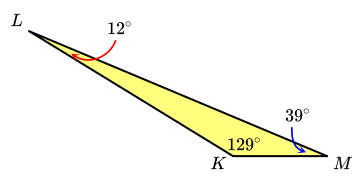
Explore
Investigating the Cosine Ratio of Obtuse Angles
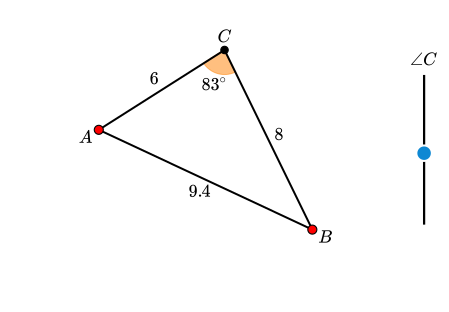
In △ABC, all three side lengths and the measure of the angle at C are given. Examine how the length of AB changes as the measure of ∠C varies.
Discussion
Relationship Between the Angles of a Triangle
Consider △ABC, in which all three sides lengths and the measure of the angle at C are known. Let a, b, and c be the lengths of the sides opposite A, B, and C, respectively. In the following applet, the values of a2+b2 and c2 are shown. Move the slider to change the measure of ∠C.
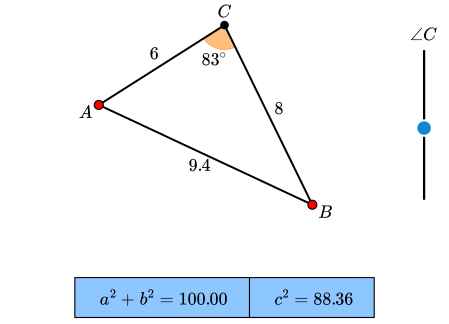 The table below shows the equation for the Law of Cosines when ∠ACB is an acute, right, and obtuse angle. In the table it is also shown the relationship between a2+b2 and c2 for these values, and conclusions are made.
Note that a calculator can be used to verify that the cosine of an acute angle is greater than 0, that the cosine of a right angle is equal to 0, and that the cosine of an obtuse angle is less than 0.
| m∠C | c2=a2+b2−2abcosC | Relationship between a2+b2 and c2 | Conclusion |
|---|---|---|---|
| m∠C<90∘ | c2=a2+b2−2ab>0cosC | c2<a2+b2 | If ∠C is acute, not too many conclusions can be made. The opposite side to ∠C can be the largest side, the shortest side, or none. |
| m∠C=90∘ | c2=a2+b2−2ab=0cos90∘ | c2=a2+b2 | The cosine of 90∘ is 0. In this case, the Law of Cosines becomes the Pythagorean Theorem. This means that the opposite side to ∠C is the largest side of the triangle. |
| 90∘<m∠C<180∘ | c2=a2+b2−2ab<0cosC | c2>a2+b2 | If ∠C is obtuse, its measure is greater than the measures of ∠A and ∠C. Therefore, its opposite side is the largest side of the triangle. |
Example
Solving Problems Using the Law of Cosines
Once Diego completed a grueling month-long shift as a lighthouse keeper, he decided to fly from San Juan to New York. After flying for 3 hours on a straight path, he felt that the pilot made a course correction, then continued to fly for about 2 more hours on a path still toward New York. On Diego's return flight, the pilot flew on a straight path, without any change in direction, from New York to San Juan.
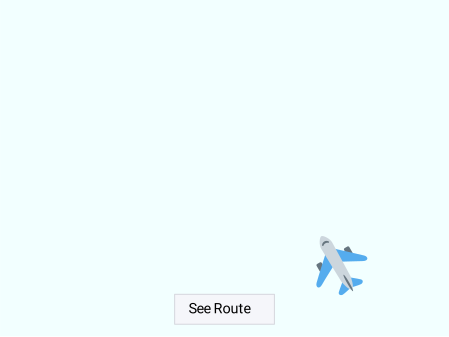 If the plane is deflected 10∘ and its average speed is 330 miles per hour, what is the distance from San Juan to New York? Round the answer to the nearest hundred miles.
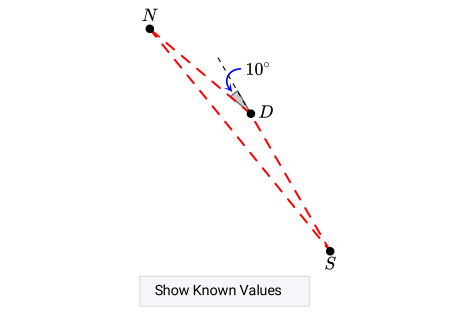 Now, in △SDN, the lengths of two sides and the measure of their included angle are known. Therefore, the Law of Cosines can be used. Let d, s, and n be the lengths of the sides opposite D, S, and N, respectively.
{"type":"text","form":{"type":"math","options":{"comparison":"1","nofractofloat":false,"keypad":{"simple":true,"useShortLog":false,"variables":["x"],"constants":["PI"]},"rendered":false},"text":"<span class=\"katex\"><span class=\"katex-html\" aria-hidden=\"true\"><\/span><\/span>"},"formTextBefore":null,"formTextAfter":"miles","answer":{"text":["1600"]}}
Hint
Use the speed formula to calculate the distance traveled before the change in direction SD, and the distance traveled after the change DN.
Solution
First, SD and DN will be found. Then, the Law of Cosines will be used to find NS, the distance between New York and San Juan.
Finding SD and DN
The average speed is the distance traveled divided by the amount of time spent traveling.Speed=TimeDistance
The flight from S to D takes 3 hours and the speed of the plane is 330 miles per hour. Substitute these values into the formula and solve for SD.
The distance covered in the first 3 hours of the flight is 990 miles. Similarly, the distance covered in the next 2 hours can be calculated. | Speed=TimeDistance | ||
|---|---|---|
| Length | SD | DN |
| Substitution | 330=3SD | 330=2DN |
| Calculation | SD=990mi | DN=660mi |
Finding SD
Since the plane was deflected 10∘ from the first route, the measure of the angle SDN is 170∘.d2=s2+n2−2sncosD
Substitute 660 for s, 990 for n, and 170∘ for D.
Since a length cannot be negative, only the principal root is considered here. Therefore, the distance from San Juan to New York is about 1600 miles.
Closure
Calculating Distances in Space Using Trigonometry
In this course, the use of the Law of Cosines in solving any type of triangle has been studied. By using this law, the challenge presented at the beginning can be solved.
Zosia knows the lengths of two sides of a triangle and the measure of their included angle. Let A, V, and D denote the vertices of the Summer Triangle.
{"type":"text","form":{"type":"math","options":{"comparison":"1","nofractofloat":false,"keypad":{"simple":true,"useShortLog":false,"variables":[],"constants":[]},"rendered":false},"text":"<span class=\"katex\"><span class=\"katex-html\" aria-hidden=\"true\"><\/span><\/span>"},"formTextBefore":null,"formTextAfter":null,"answer":{"text":["24"]}}
Hint
The Law of Cosines states the relationship between the side lengths of a triangle and the cosine of one of the angles.
Answer
Let a, v, and d be the lengths of the sides opposite A, V, and D, respectively. By the Law of Cosines, the following equations holds true for △AVD. 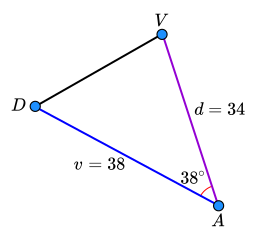 Substitute these values and solve for a.
The angular distance between Deneb and Vega is about 24 angular units.
Substitute these values and solve for a.
The angular distance between Deneb and Vega is about 24 angular units.
a2v2d2=v2+d2−2vdcosA=d2+a2−2dacosV=a2+v2−2avcosD
Since the values of v, d, and A are given, the first equation will give the length of the third side.
Loading content