{{ tocSubheader }}
{{ 'ml-label-loading-course' | message }}
An error ocurred, try again later!
Chapter {{ article.chapter.number }}
{{ article.number }}.
{{ article.displayTitle }}
{{ article.intro.summary }}
Show less Show more expand_more Lesson Settings & Tools
| | {{ 'ml-lesson-number-slides' | message : article.intro.bblockCount }} |
| | {{ 'ml-lesson-number-exercises' | message : article.intro.exerciseCount }} |
| | {{ 'ml-lesson-time-estimation' | message }} |
Every individual benefits from the efficient use of their resources such as time and money. To use such resources effectively, several inequalities might need to be solved simultaneously. Together, these inequalities form a system. This lesson will teach how to write systems of inequalities and how to solve them using graphs.
Catch-Up and Review
Here are a few recommended readings before getting started with this lesson.
Challenge
Matching Graphs With Inequalities
Each of the following graphs represents the solution set of a certain inequality.
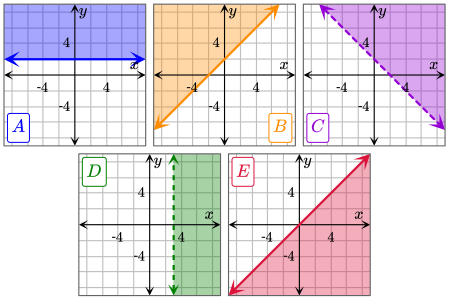
Pair each graph with its corresponding inequality.
{"type":"pair","form":{"alts":[[{"id":0,"text":"<span class=\"katex\"><span class=\"katex-html\" aria-hidden=\"true\"><span class=\"base\"><span class=\"strut\" style=\"height:0.8304100000000001em;vertical-align:-0.19444em;\"><\/span><span class=\"mord mathdefault\" style=\"margin-right:0.03588em;\">y<\/span><span class=\"mspace\" style=\"margin-right:0.2777777777777778em;\"><\/span><span class=\"mrel\">\u2265<\/span><span class=\"mspace\" style=\"margin-right:0.2777777777777778em;\"><\/span><\/span><span class=\"base\"><span class=\"strut\" style=\"height:0.64444em;vertical-align:0em;\"><\/span><span class=\"mord\">2<\/span><\/span><\/span><\/span>"},{"id":1,"text":"<span class=\"katex\"><span class=\"katex-html\" aria-hidden=\"true\"><span class=\"base\"><span class=\"strut\" style=\"height:0.5782em;vertical-align:-0.0391em;\"><\/span><span class=\"mord mathdefault\">x<\/span><span class=\"mspace\" style=\"margin-right:0.2777777777777778em;\"><\/span><span class=\"mrel\">><\/span><span class=\"mspace\" style=\"margin-right:0.2777777777777778em;\"><\/span><\/span><span class=\"base\"><span class=\"strut\" style=\"height:0.64444em;vertical-align:0em;\"><\/span><span class=\"mord\">3<\/span><\/span><\/span><\/span>"},{"id":2,"text":"<span class=\"katex\"><span class=\"katex-html\" aria-hidden=\"true\"><span class=\"base\"><span class=\"strut\" style=\"height:0.8304100000000001em;vertical-align:-0.19444em;\"><\/span><span class=\"mord mathdefault\" style=\"margin-right:0.03588em;\">y<\/span><span class=\"mspace\" style=\"margin-right:0.2777777777777778em;\"><\/span><span class=\"mrel\">\u2265<\/span><span class=\"mspace\" style=\"margin-right:0.2777777777777778em;\"><\/span><\/span><span class=\"base\"><span class=\"strut\" style=\"height:0.66666em;vertical-align:-0.08333em;\"><\/span><span class=\"mord mathdefault\">x<\/span><span class=\"mspace\" style=\"margin-right:0.2222222222222222em;\"><\/span><span class=\"mbin\">+<\/span><span class=\"mspace\" style=\"margin-right:0.2222222222222222em;\"><\/span><\/span><span class=\"base\"><span class=\"strut\" style=\"height:0.64444em;vertical-align:0em;\"><\/span><span class=\"mord\">2<\/span><\/span><\/span><\/span>"},{"id":3,"text":"<span class=\"katex\"><span class=\"katex-html\" aria-hidden=\"true\"><span class=\"base\"><span class=\"strut\" style=\"height:0.7335400000000001em;vertical-align:-0.19444em;\"><\/span><span class=\"mord mathdefault\" style=\"margin-right:0.03588em;\">y<\/span><span class=\"mspace\" style=\"margin-right:0.2777777777777778em;\"><\/span><span class=\"mrel\">><\/span><span class=\"mspace\" style=\"margin-right:0.2777777777777778em;\"><\/span><\/span><span class=\"base\"><span class=\"strut\" style=\"height:0.66666em;vertical-align:-0.08333em;\"><\/span><span class=\"mord text\"><span class=\"mord\">-<\/span><\/span><span class=\"mord mathdefault\">x<\/span><span class=\"mspace\" style=\"margin-right:0.2222222222222222em;\"><\/span><span class=\"mbin\">+<\/span><span class=\"mspace\" style=\"margin-right:0.2222222222222222em;\"><\/span><\/span><span class=\"base\"><span class=\"strut\" style=\"height:0.64444em;vertical-align:0em;\"><\/span><span class=\"mord\">2<\/span><\/span><\/span><\/span>"},{"id":4,"text":"<span class=\"katex\"><span class=\"katex-html\" aria-hidden=\"true\"><span class=\"base\"><span class=\"strut\" style=\"height:0.8304100000000001em;vertical-align:-0.19444em;\"><\/span><span class=\"mord mathdefault\" style=\"margin-right:0.03588em;\">y<\/span><span class=\"mspace\" style=\"margin-right:0.2777777777777778em;\"><\/span><span class=\"mrel\">\u2264<\/span><span class=\"mspace\" style=\"margin-right:0.2777777777777778em;\"><\/span><\/span><span class=\"base\"><span class=\"strut\" style=\"height:0.43056em;vertical-align:0em;\"><\/span><span class=\"mord mathdefault\">x<\/span><\/span><\/span><\/span>"}],[{"id":0,"text":"Graph <span class=\"katex\"><span class=\"katex-html\" aria-hidden=\"true\"><span class=\"base\"><span class=\"strut\" style=\"height:0.68333em;vertical-align:0em;\"><\/span><span class=\"mord mathdefault\">A<\/span><\/span><\/span><\/span>"},{"id":3,"text":"Graph <span class=\"katex\"><span class=\"katex-html\" aria-hidden=\"true\"><span class=\"base\"><span class=\"strut\" style=\"height:0.68333em;vertical-align:0em;\"><\/span><span class=\"mord mathdefault\" style=\"margin-right:0.02778em;\">D<\/span><\/span><\/span><\/span>"},{"id":1,"text":"Graph <span class=\"katex\"><span class=\"katex-html\" aria-hidden=\"true\"><span class=\"base\"><span class=\"strut\" style=\"height:0.68333em;vertical-align:0em;\"><\/span><span class=\"mord mathdefault\" style=\"margin-right:0.05017em;\">B<\/span><\/span><\/span><\/span>"},{"id":2,"text":"Graph <span class=\"katex\"><span class=\"katex-html\" aria-hidden=\"true\"><span class=\"base\"><span class=\"strut\" style=\"height:0.68333em;vertical-align:0em;\"><\/span><span class=\"mord mathdefault\" style=\"margin-right:0.07153em;\">C<\/span><\/span><\/span><\/span>"},{"id":4,"text":"Graph <span class=\"katex\"><span class=\"katex-html\" aria-hidden=\"true\"><span class=\"base\"><span class=\"strut\" style=\"height:0.68333em;vertical-align:0em;\"><\/span><span class=\"mord mathdefault\" style=\"margin-right:0.05764em;\">E<\/span><\/span><\/span><\/span>"}]],"lockLeft":false,"lockRight":false},"formTextBefore":"","formTextAfter":"","answer":[[0,1,2,3,4],[0,3,1,2,4]]}
Explore
Analyzing Plane Regions Formed by Two Inequalities
In the following applet, each of the solution sets of the inequalities presented previously can be viewed on the same coordinate plane. Plane regions are formed once two inequalities are drawn. Only two can be drawn at a time.
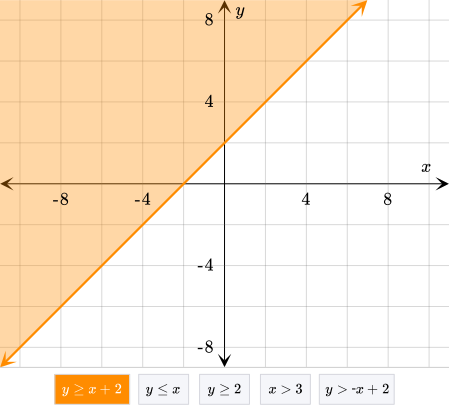 Think about what each of these regions — overlapping, shaded, and unshaded — represent.
Discussion
System of Linear Inequalities
As seen earlier, when two or more inequalities are graphed on the same coordinate plane, their solution sets may overlap. In these cases, the set of all inequalities being solved simultaneously forms a system of inequalities.
Concept
System of Inequalities
A system of inequalities is a set of two or more inequalities involving the same variables. For example, the set formed by the following two inequalities is a system.
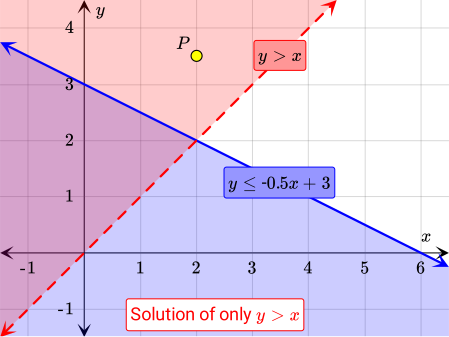 Of the regions formed, the overlapping region represents the solution set of the system.
{y≤-0.5x+3y>x
The solution set of a system of inequalities is the set of all ordered pairs that satisfy all the inequalities in the system simultaneously. The ordered pair (0,1), for example, is a solution to the above system.
{1≤-0.5(0)+31>0✓✓
Usually, systems of inequalities are solved by graphing each inequality on the same coordinate plane. When the inequalities in a system are graphed, the coordinate plane is divided into different regions. These regions provide an insight into the determination of the solution set. To see what these regions represent for the aforementioned system, move point P.
Method
Solving a System of Linear Inequalities Graphically
A system of linear inequalities can be solved by graphing all inequalities on the same coordinate plane and then finding the region of intersection, if any. For example, consider the following system.
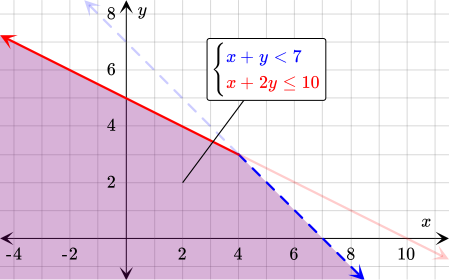 Keep in mind that if there is no overlapping region, the system has no solution.
{x+y<7x+2y≤10(I)(II)
To solve the system graphically, these three steps can be followed.
1
Write the Inequalities in Slope-Intercept Form
expand_more To simplify the process of graphing the inequalities, start by writing them in slope-intercept form.
2
Graph the Inequalities
expand_more To graph the inequalities, begin with writing the corresponding boundary lines. The boundary line of the first inequality is y=-x+7. 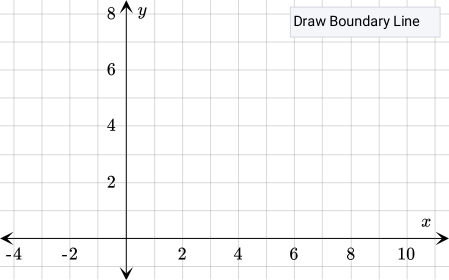 Similarly, the boundary line of the second inequality is y=-0.5x+5.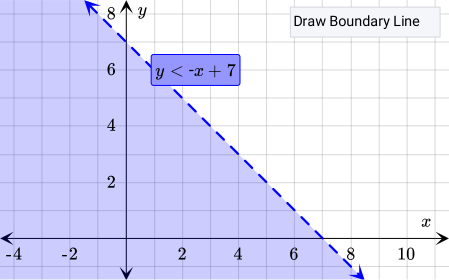
Inequality I:Boundary Line I:y<-x+7y=-x+7
Since the inequality is strict, the boundary line should be dashed and, in this case, the shaded region is the one below the line.
Inequality II:Boundary Line II:y<-0.5x+5y=-0.5x+5
Since the inequality is non-strict, its boundary line is solid. In addition, the region to be shaded is the one below the line. This inequality will be graphed on the same coordinate plane.
3
Find the Overlapping Region
expand_more Notice that there is a region where the solution sets of the inequalities overlap. All the points in this region satisfy both inequalities simultaneously. Therefore, the overlapping region is the solution set of the system. In the next graph, only the common region is shaded.
Since the boundary lines in their entirety are not part of the solution set, they can be cropped to show only the edges of the overlapping region, or the exceeding parts can be drawn with lower opacity.
Example
Buying Gifts Without Going Over Budget
Jordan, feeling jolly, is thinking about giving gifts to her teammates — there are 30 players. Shopping at a stationery store, she decides it is best to buy some fancy ballpoint and fountain pens. She wants to spend less than $240 and is now unsure whether to give all or only some of her teammates a gift.

Let x and y be the number of ballpoint and fountain pens Jordan will buy, respectively.
a Help Jordan and write a system of inequalities that represents this situation.
b Graph the solution set of the system.
c If Jordan wants to buy the maximum number of fountain pens she can under her budget, what is the maximum number of teammates that could get a gift? How many of them will get a ballpoint pen?
Answer
a {x+y≤306x+12y<240
b Graph:
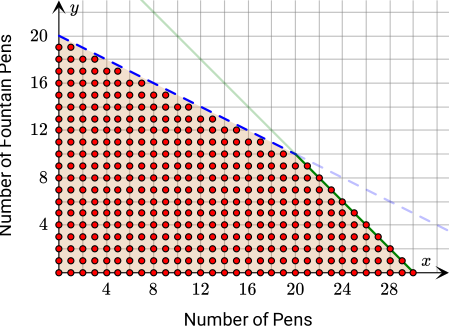
c A maximum of 20 teammates could get a gift. Of that number, only one would get a ballpoint pen.
Hint
a Recall that Jordan can buy at most 30 gifts and that the total cost has to be less than $240.
b To graph the solution set of the system of inequalities, start by writing the inequalities in slope-intercept form. Note that only points with non-negative and integer coordinates are meaningful.
c Of the points in the solution set, which one has the greatest y-coordinate?
Solution
a Since Jordan has 30 teammates, she can buy at most 30 gifts. In other words, the sum of the number of ballpoint pens x and the number of fountain pens y can be at most 30. This leads to writing the first inequality.
x+y≤30
Jordan does not want to go over budget and wants to spend less than $240. Therefore, the total cost of the pens has to be less than 240.
Total Cost<240
The total cost equals the number of ballpoint pens bought multiplied by its price plus the number of fountain pens bought multiplied by its price. Using the fact that each ballpoint pen costs $6.00 and each fountain pen costs $12.00, a second inequality can be set.
6x+12y<240
In consequence, the following system of inequalities models Jordan's situation.
{x+y≤306x+12y<240(I)(II)
b To solve the system written in Part A graphically, both inequalities will be graphed on the same coordinate plane.
{x+y≤306x+12y<240(I)(II)
Start by rewriting each inequality in slope-intercept form. To do so, isolate the y-variable in the left-hand side of each inequality.
{x+y≤306x+12y<240(I)(II)
{y≤-x+30y<-21x+20
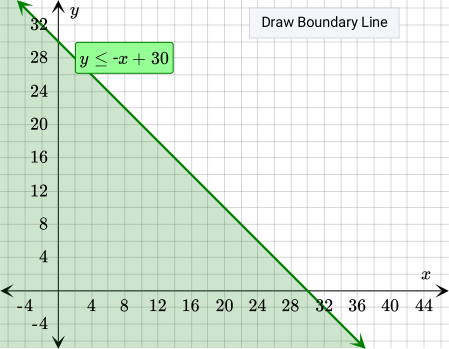
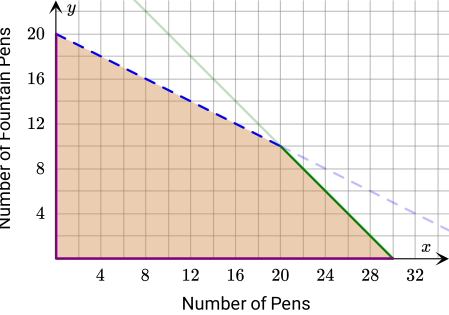
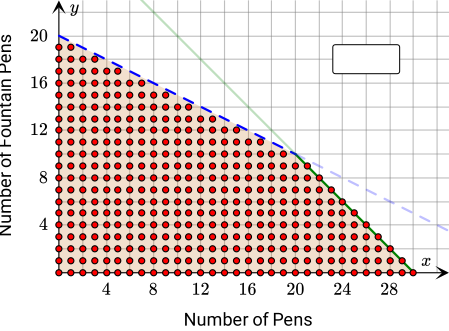
c Since y represents the number of fountain pens that Jordan will buy, in the solution of the system found in Part B, look for the points with the greatest y-coordinate.
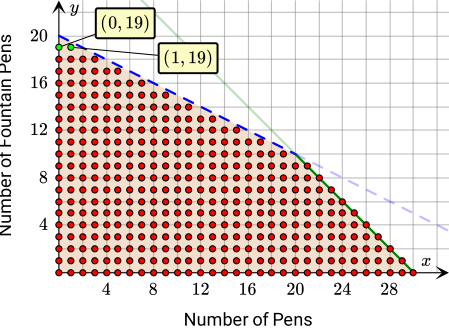
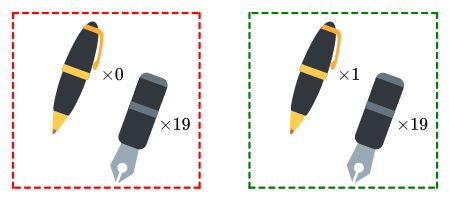
With the first option, 19 teammates will receive a gift, while 20 teammates will get a gift with the second option. Therefore, if Jordan buys the maximum number of fountain pens she can, the maximum number of teammates that could get a gift is 20. Of those 20 teammates, only one would get a ballpoint pen.
Example
Working Two Jobs Without Being Overworked
Jordan enjoyed being able to buy gifts for her friends. Now she wants to save up to buy a family members car. To achieve this goal, she dares to work two jobs this summer — one in a mechanic shop and another in a bakery. She can make $9 per hour in the mechanic shop and $8 per hour in the bakery.
 Jordan plans to work every day for at least 4 more hours in the bakery than in the mechanic shop. However, since she does not want to overwork, she does not plan to earn more than $108 per day.
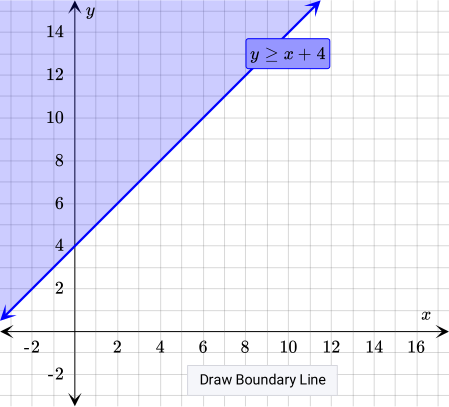
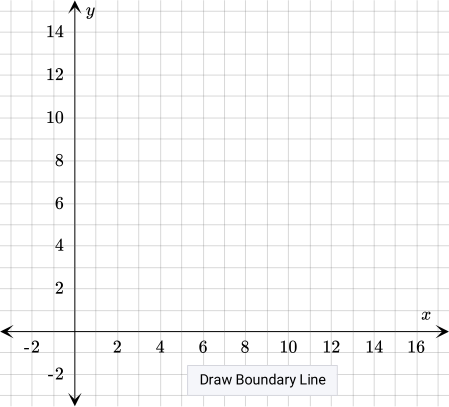 Next, inequality (II) will be graphed on the same coordinate plane. To do so, draw the boundary line, whose equation is y=-1.125x+13.5. Since the inequality is non-strict, this line will also be solid. In this case, the region to be shaded is the one below the line.
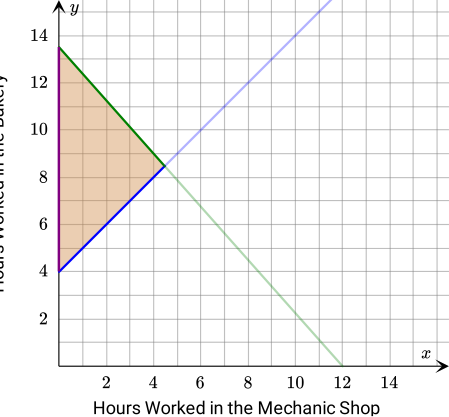
 The solution to the system of inequalities is the overlapping region. Notice that negative values do not make sense in this context. Therefore, the shaded region will include but also be limited by the y-axis. Consequently, the system's solution looks as follows.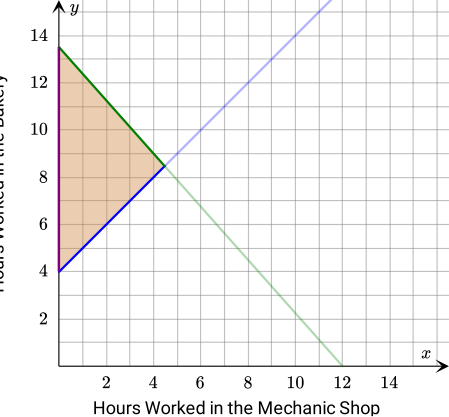
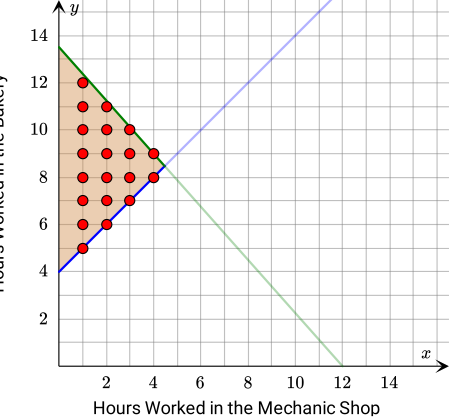 Because the second line drawn represents Jordan's maximum possible daily income, the further a point is from this line, the lower the income that the point represents. Of the points, the one that is farthest from the line is (1,5) which represents the case when Jordan worked 1 hour in the mechanic shop and 5 hours in the bakery.
Consequently, the minimum amount of money that Jordan could have earned last Friday is $49.
Because the second line drawn represents Jordan's maximum possible daily income, the further a point is from this line, the lower the income that the point represents. Of the points, the one that is farthest from the line is (1,5) which represents the case when Jordan worked 1 hour in the mechanic shop and 5 hours in the bakery.
Consequently, the minimum amount of money that Jordan could have earned last Friday is $49.
a Let x and y be the number of hours that Jordan will work in the mechanic shop and in the bakery every day, respectively. Write a system of inequalities that models Jordan's situation.
b Solve the system graphically.
c Last Friday, Jordan worked whole number of hours in both places. What is the minimum amount of money she could have earned last Friday?
Answer
a {y≥x+49x+8y≤108
b Graph:
c $49
Hint
a Note that y must be greater than or equal to x+4. Also, be aware that Jordan plans to earn at most $108 per day.
b Both boundary lines have to be drawn solid, and negative values do not make sense.
c Look for the points with integer coordinates inside the region drawn in Part B. Which of these points is farthest from the line representing the maximum daily earnings? Use the coordinates of that point to determine the amount of money earned.
Solution
a Since Jordan wants to work in the bakery at least 4 more hours than in the mechanic shop, y must be greater than or equal to x plus 4.
Bakeryy↑≥↓x+4≥Mechanic Shop
On the other hand, it is said that Jordan plans to earn no more than $108. That is, her daily income is at most $108.
Daily Income≤108
The daily income equals the hourly rate multiplied by the number of hours worked. Since Jordan has two jobs, her daily income equals 9 multiplied by the number of hours worked in the mechanic shop added to 8 multiplied by the number of hours worked in the bakery.
9x+8y≤108
Consequently, the following system of inequalities models Jordan's situation.
{y≥x+49x+8y≤108(I)(II)
b To solve the system written in Part A graphically, both inequalities will be graphed on the same coordinate plane.
{y≥x+49x+8y≤108(I)(II)
The first inequality is already in slope-intercept form. However, the other inequality needs to be written in slope-intercept form.
{y≥x+49x+8y≤108(I)(II)
{y≥x+4y≤-1.125x+13.5
c It is given that Jordan worked an integer number of hours in both jobs last Friday. Then, look for the points with integer coordinates inside the shaded region drawn in Part B. Since the points on the y-axis represent the case where Jordan did not work in the mechanic shop, these points should not be considered.
(1,5)⇒{👨🏼🔧×1hour👨🏼🍳×5hour
With this combination of worked hours, the minimum income that Jordan could have earned last Friday can be found. To do so, substitute x=1 and y=5 into the expression representing the daily income.
Daily Income=9x+8y
▼
Substitute coordinates and evaluate
Daily Income=49
Example
A Cinema's Expected Attendance and Revenue
Jordan now has a bit of extra cash to spend. She is excited for a new movie release. Ticket prices vary depending on the customer's age — $6 for children and $9 for adults. The cinema expects more than 250 people to attend the premiere but they do not expect a revenue of more than $2700.
 Jordan finds herself wanting to solve this problem during her break time at the bakery. Let x and y be the number of children and adults who attended the movie premiere, respectively.
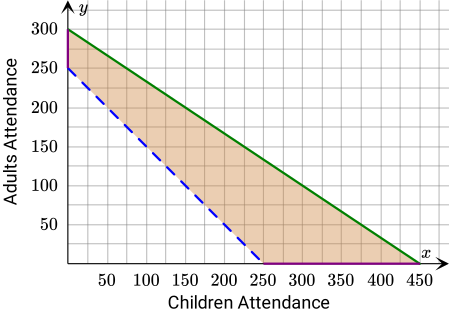
 Next, graph inequality (II) on the same coordinate plane. To do so, draw the boundary line whose equation is y=-32x+300. Since the inequality is not strict, this line will be drawn solid. In this case, the region to be shaded is the one below the line.
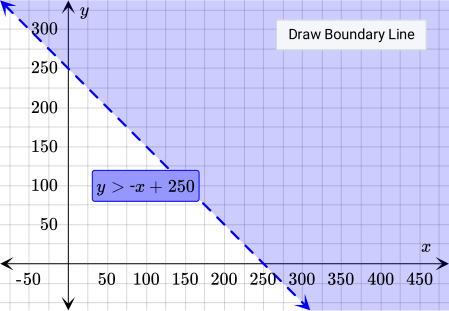 The solution to the system of inequalities is the overlapping region. However, because of the context, only non-negative and integer values make sense. Therefore, the region where both inequalities overlap will also be limited by the axes, including them.
 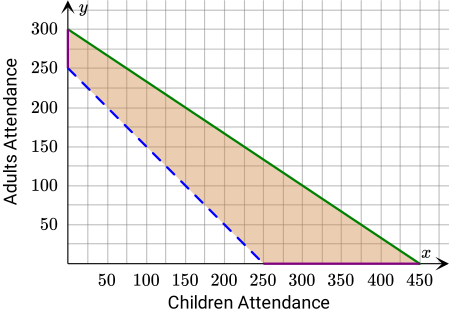 Instead of showing each point separately on the graph, because it is difficult to do so, the region where these points lie is shown. However, remember that only the points with integer coordinates are meaningful.
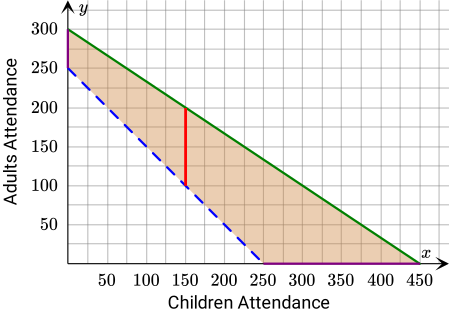 The number of adults who could have attended the premiere can be any point whose x-coordinate is 150 and lie inside the shaded region. Of those points, (150,200) has the the maximum integer y-coordinate and (150,101) has the minimum y-coordinate.
a Write a system of inequalities that models the given situation.
b Solve the system graphically.
c If the cinema's expectations were met and 150 children attended the premiere, what is the maximum and minimum possible number of adults who could have attended the premiere?
Answer
a {x+y>2506x+9y≤2700
b Graph:
c Maximum: 200
Minimum: 101
Hint
a The number of attendees is greater than 250. The cinema's revenue is less than or equal to 2700.
b The line representing the attendance is dashed while the other line is solid. In this context, only non-negative and integer values for x and y make sense.
c Look for the points whose x-coordinate is 150 and lie inside the shaded region drawn in Part B. Of those points, what is the maximum integer y-coordinate?
Solution
a Since the cinema expects an attendance of more than 250 people, the number of children plus the number of adults must be greater than 250.
x+y>250
Also, it is said that the estimated revenue will be no more than $2700. Therefore, the revenue is less than or equal to 2700.
Revenue≤2700
The cinema's revenue equals the number of children who attended the premiere multiplied by 6 added to the number of adults who attended the premiere multiplied by 9.
6x+9y≤2700
Consequently, the following system of inequalities models the described situation.
{x+y>2506x+9y≤2700
b To solve the system written in Part A graphically, both inequalities will be graphed on the same coordinate plane.
{x+y>2506x+9y≤2700(I)(II)
First, rewrite each inequality in slope-intercept form.
{x+y>2506x+9y≤2700(I)(II)
{y>-x+250y≤-32x+300
c It is known that the expected conditions have occurred.
- More than 250 people attended the premiere.
- Less than $2700 was earned.
{x+y>2506x+9y≤2700
The solution set of the system shows all the possible cases satisfying both conditions. Now, knowing that there were 150 children in the premiere eliminates most of the possible cases.
(150,200)←Maximum y-coordinate(150,101)←Minimum y-coordinate
Therefore, the number of adults who could have attended the premiere is any number between 101 and 200, inclusive.
Example
Analyzing a Road Trip Plan
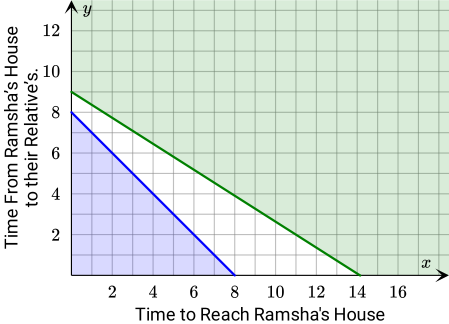
Finally, Jordan was able to save enough money to buy a used car! She now plans to take a mini-road trip to visit a relative across-state. First, she will pick up her sister Ramsha, who lives in a different city. The travel distance depends on the path she chooses, but the entire route is no less than 990 kilometers. Jordan would like to drive for a maximum of 8 hours.
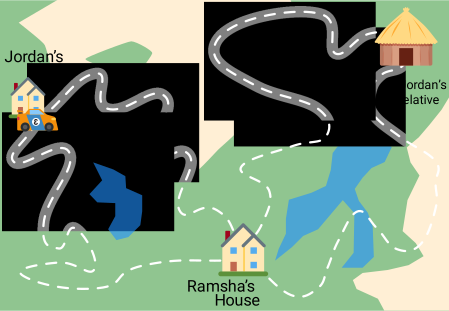
Jordan plans to drive at 70 kilometers per hour from her house to Ramsha's, and from there, she plans to increase the speed to 110 kilometers per hour until reaching her relative's house.
a Let x be the time it takes Jordan to drive from her house to Ramsha, and let y be the time it takes to drive from Ramsha's house to her relative's house. Write a system of inequalities that models Jordan's travel plan.
b Solve the system graphically.
Answer
a {x+y≤870x+110y≥990
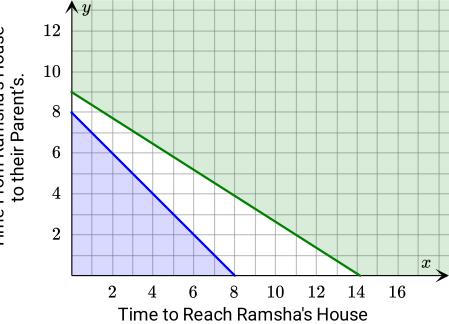
b The system has no realistic solution — the regions do not intersect in the first quadrant.
Hint
a The sum of the traveling times cannot be greater than 8. When speed is multiplied by time, the distance traveled is obtained. That is, d=r⋅t. Note that the sum of the distances is greater than or equal to 990 kilometers.
b Both boundary lines have to be drawn solid. Note that negative values do not make sense.
Solution
a Since Jodran wants to drive at most for 8 hours, the sum of the times, x and y, should be at most 8. With this, the first inequality can be written.
x+y≤8
On the other hand, it is said that the entire route is no less than 990 kilometers, which means that the distance to drive is greater than or equal to 990 kilometers.
Distance to Drive≥990
This distance can be written in terms of x and y by using the speed formula d=r⋅t. According to Jordan's plan, she will drive to Ramsha's house at a rate of 70 kilometers per hour. Multiplying this rate by the time elapsed to arrive at Ramsha's house gives the distance traveled from her house to Ramsha's.
Distance from Jordan’shouse to Ramsha’s⇓70x
Similarly, multiplying the second rate, 110 kilometers per hour, by the time it takes for the rest of the route, the distance from Ramsha's house to their relative's will be obtained.
Distance from Ramsha’shouse to their relative’s⇓110y
The sum of these distances equals the distance needed to drive. Thus, a second inequality can be set.
70x+110y≥990
These two inequalities need to be satisfied simultaneously. Therefore, the two inequalities together form a system of inequalities that models Jordan's travel plan.
{x+y≤870x+110y≥990
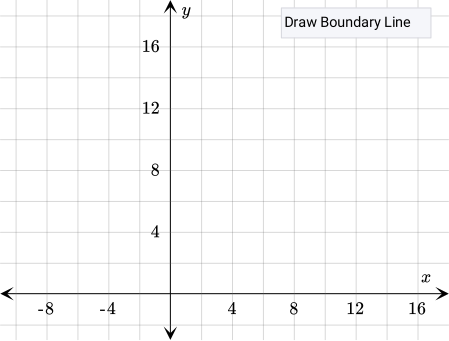
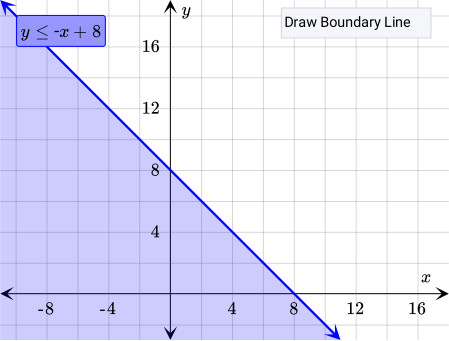
b To solve the system written in Part A graphically, both inequalities will be graphed on the same coordinate plane.
{x+y≤870x+110y≥990(I)(II)
First, rewrite the inequalities in slope-intercept form.
{x+y≤870x+110y≥990(I)(II)
{y≤-x+8y≥-117x+9
Pop Quiz
Solving Systems of Linear Inequalities Graphically
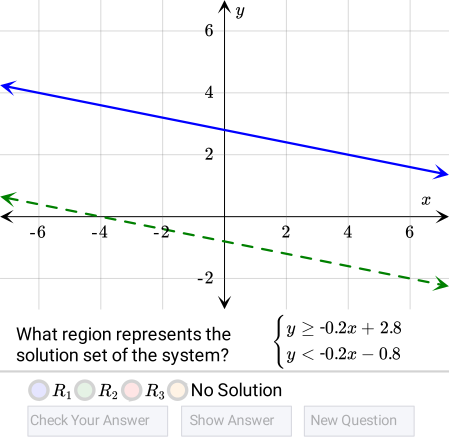
For each given system of linear inequalities, select the region corresponding to its solution set, if any.
Closure
Systems With More Than Two Inequalities
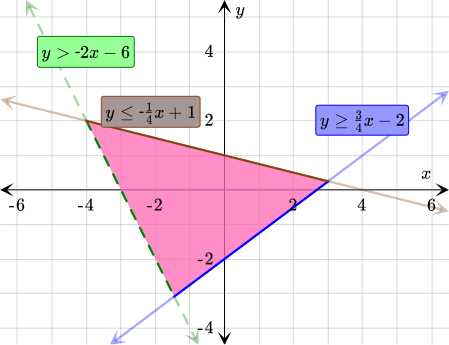
When working with a system of inequalities, there is no upper limit to the number of inequalities that can be analyzed. Consider, for example, the following system with three inequalities.
 As can be seen, there is a portion of the plane where the three regions overlap — the triangle in the middle. Any point in that triangle is in the solution set of the system.
 Note that in the examples considered throughout this lesson, even though only two inequalities were mentioned, the fact that the x- and y-values could not be negative is equivalent to considering the inequalities x≥0 and y≥0. That is, in those examples, four inequalities were considered together.
⎩⎪⎪⎨⎪⎪⎧-3x+4y≥-82x+y>-6x+4y≤4(I)(II)(III)
The steps to solve this system are the same as those used to solve a system with only two inequalities. - Write the inequalities in slope-intercept form.
- Graph each inequality in the system.
- Find the region where all the graphs overlap.
⎩⎪⎪⎨⎪⎪⎧y≥43x−2y>-2x−6y≤-41x+1(I)(II)(III)
The second step can be performed with the help of the applet.
Loading content