5. Solving System of Equations Graphically
Sign In
An error ocurred, try again later!
Chapter 7
5.
Solving System of Equations Graphically
This lesson explains how to solve systems of linear equations by graphing. It shows how the intersection of two lines on a graph represents the solution to the system, whether it is one unique solution, no solution, or infinitely many solutions. This method is helpful for visualizing relationships between equations and understanding their solutions.
Show less Show more expand_more 


Lesson Settings & Tools
| | 12 Theory slides |
| | 10 Exercises - Grade E - A |
| | Each lesson is meant to take 1-2 classroom sessions |
Solving System of Equations Graphically
Slide of 12
Some real-life situations can be modeled with more than one equation that can be joined into a system of equations. There are different methods of solving systems of equations. This lesson will focus on one of them, which involves graphing the equations.
Catch-Up and Review
Here are a few recommended readings before getting started with this lesson.
Explore
Share
Report error
Lines on the Same Plane
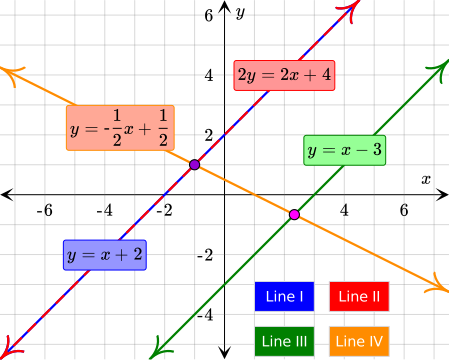
In the graph below, four lines and their corresponding linear equations can be seen on a coordinate plane. Determine which lines intersect at one point, which lines intersect at infinitely many points, and which lines do not intersect at all.
Discussion
Share
Report error
Introducing Systems of Equations
Consider the definition of equations in two variables.
Concept
Share
Report error
Equation In Two Variables
An equation in two variables is a mathematical relation between two equal quantities that involves two variables.
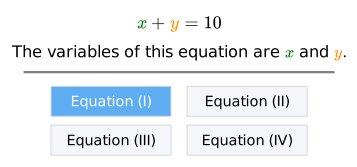 Solving an equation in two variables results in an ordered pair that makes the equation true.
Discussion
Share
Report error
Systems of Equations
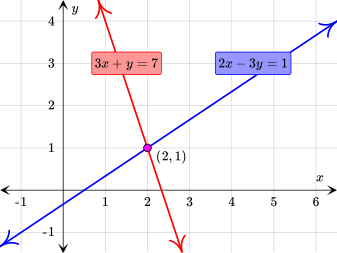
A system of equations is a set of two or more equations involving the same variables. The solutions to a system of equations are values for these variables that satisfy all the equations simultaneously. A system of equations is usually written as a vertical list with a curly bracket on the left-hand side. 2x-3y=1 3x+y=7 Graphically, solutions to systems of equations are the points where the graphs of the equations intersect. For this reason, these solutions are usually expressed as coordinates.
Discussion
Share
Report error
Solving a System of Linear Equations Graphically
Solving a system of linear equations graphically means graphing the lines represented by the equations of the system and identifying the point of intersection. Consider an example system of equations.
2y=- 2x+8 x=y-1
To solve the system of equations, three steps must be followed.
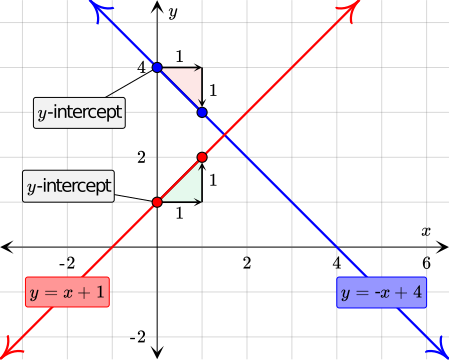
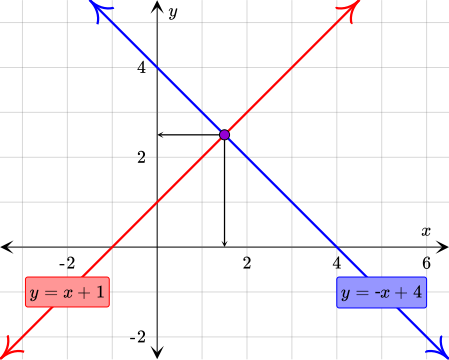 Sometimes the point of intersection of the lines is not a lattice point. In this case, the solution found by solving the system of equations graphically is approximate.
1
Write the Equations in Slope-Intercept Form
expand_more Start by writing the equations in slope-intercept form by isolating the y-variables. For the first linear equation, divide both sides by 2. For the second equation, add 1 to both sides.
2y=- 2x+8 & (I) x=y-1 & (II)
▼
(I): Solve for y
DivEqn
(I): .LHS /2.=.RHS /2.
y= - 2x+82 x=y-1
WriteSumFrac
(I): Write as a sum of fractions
y= - 2x2+ 82 x=y-1
MovePartNumRight
(I): a* b/c=a/c* b
y= - 22x+ 82 x=y-1
MoveNegNumToFrac
(I): Put minus sign in front of fraction
y=- 22x+ 82 x=y-1
CalcQuot
(I): Calculate quotient
y=- 1x+4 x=y-1
IdPropMult
(I): Identity Property of Multiplication
y=- x+4 x=y-1
▼
(II): Solve for y
y=- x+4 y=x+1
2
Graph the Lines
expand_more Now that the equations are both written in slope-intercept form, they can be graphed on the same coordinate plane.
3
Identify the Point of Intersection
expand_more The point where the lines intersect is the solution to the system.
The lines appear to intersect at (1.5,2.5). Therefore, this is the solution to the system — the value of x is 1.5 and the value of y is 2.5.
Example
Share
Report error
Modeling With a System of Linear Equations
Mark is throwing a party, so he bought some donuts and lollipops for his friends.

{"type":"text","form":{"type":"math","options":{"comparison":"1","nofractofloat":false,"keypad":{"simple":true,"useShortLog":false,"variables":[],"constants":[]},"rendered":false},"text":" "},"formTextBefore":"Donuts (x):","formTextAfter":null,"answer":{"text":["12"]}}
{"type":"text","form":{"type":"math","options":{"comparison":"1","nofractofloat":false,"keypad":{"simple":true,"useShortLog":false,"variables":[],"constants":[]},"rendered":false},"text":" "},"formTextBefore":"Lollipops (y):","formTextAfter":null,"answer":{"text":["8"]}}
Hint
Start by writing both linear equations in slope-intercept form.
Solution
To start, each equation in the system will be rewritten in slope-intercept form. This means that the y-variable will be isolated in both equations.
Now, the slope and the y-intercept of each line will be used to draw the graphs on the same coordinate plane. The y-intercept of the first equation is 20, so the first point is (0,20). The slope is - 1, so the second point can be plotted by 1 step to the right and 1 step down on the graph. Since this graph uses a different scale, try moving 4 steps right and 4 steps down instead. 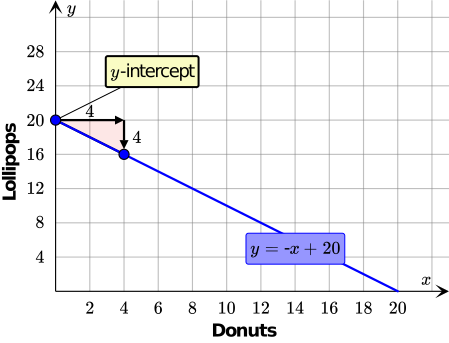
x+y=20 & (I) 3x+2y=52 & (II)
▼
(I), (II): Write in slope-intercept form
SubEqn
(I): LHS-x=RHS-x
y=- x+20 3x+2y=52
SubEqn
(II): LHS-3x=RHS-3x
y=- x+20 2y=- 3x+52
DivEqn
(II): .LHS /2.=.RHS /2.
y=- x+20 y= - 3x+522
WriteSumFrac
(II): Write as a sum of fractions
y=- x+20 y= - 3x2+ 522
MovePartNumRight
(II): a* b/c=a/c* b
y=- x+20 y= - 32x+ 522
MoveNegNumToFrac
(II): Put minus sign in front of fraction
y=- x+20 y=- 32x+ 522
CalcQuot
(II): Calculate quotient
y=- x+20 y=- 1.5x+26
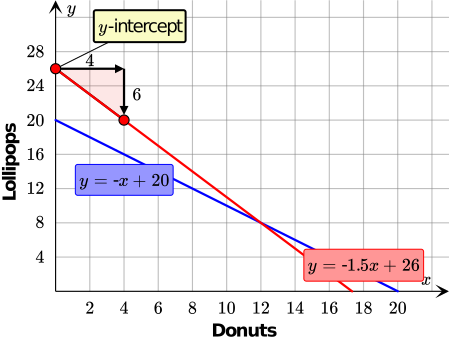
Since the number of items cannot be negative, only the first quadrant will be considered for the graph. The y-intercept of the second equation is 26, so the first point on that line is (0,26). The slope is - 1.5. To better match the scale of this graph, the second point can be plotted by going 4 steps to the right and 4* 1.5=6 steps down.
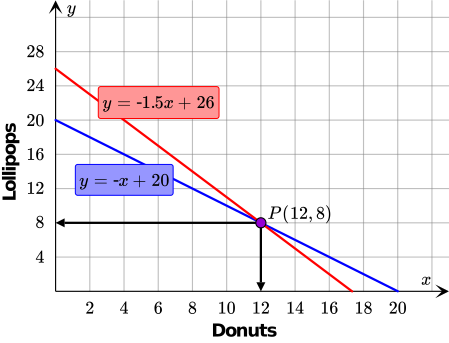
Finally, the point of intersection P can be identified.
The point of intersection of the lines is P(12,8). In the context of the situation, this means that Mark bought x=12 donuts and y=8 lollipops.
Pop Quiz
Share
Report error
Finding the Solution to a System of Equations
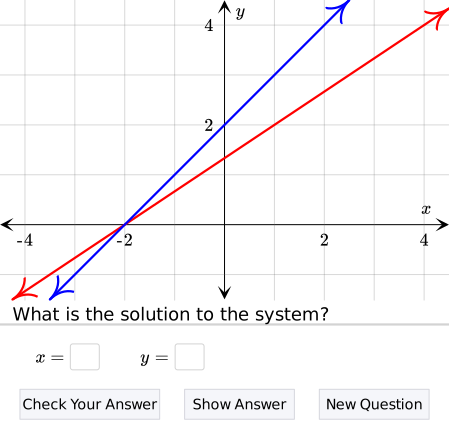
Consider the graph of a system of equations consisting of two lines. What is the solution to the system?
Discussion
Share
Report error
Number of Solutions to a System of Linear Equations
When a system of linear equations has two equations and two variables, the system can have zero, one, or infinitely many solutions.
No Solution
If a system has no solution, its graph might look similar to this one.
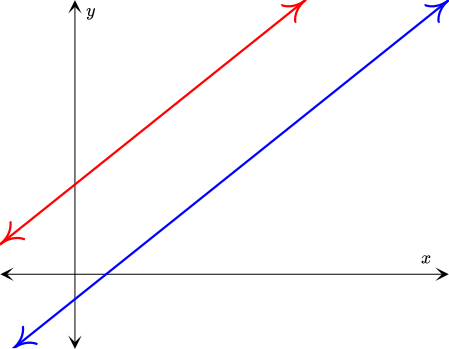
Recall that the solution to a system is the point where the lines intersect. If a system has no solution, then the lines never intersect. In fact, the lines must be parallel, meaning that they have the same slope and different y-intercepts. Here is an example of one such system. y=3x+2 y=3x-5
One Solution
If a system of equations has one solution, its graph consists of two lines that intersect exactly once. The point of intersection is the solution to the system.
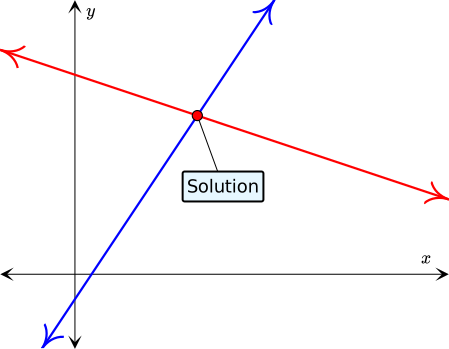
In contrast to parallel lines, lines that intersect once must have different slopes. For example, the following system must have exactly one solution because the two lines have different slopes. y=- x+5 y=3x-2
Infinite Number of Solutions
If a system of equations has infinitely many solutions, the lines intersect at infinitely many points. This means the lines lie on top of each other or coincide with each other.
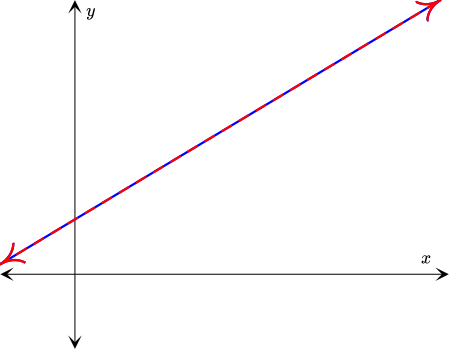
These lines are said to be coincidental, and since they have the same slope and y-intercept, they are different versions of the same line. Here is one example of a system that has an infinite number of solutions.
y=3x+1 2y=6x+2Example
Share
Report error
Determining the Numbers of Tasks and Questions in Balloons
To start the party, Mark suggested they play a fun game. He invited everyone to a room full of balloons. Each balloon had a note with a task to complete or a question to answer.
 The number of tasks t and questions q can be determined by the following system of equations.
5t+8q=116 12.5t=290-20q
Solve the system of equations by graphing.
The number of tasks t and questions q can be determined by the following system of equations.
5t+8q=116 12.5t=290-20q
Solve the system of equations by graphing.
{"type":"text","form":{"type":"equation","options":{"comparison":"1","nofractofloat":false,"keypad":{"simple":true,"useShortLog":false,"variables":[],"constants":[]},"rendered":false},"text":"","description":[{"id":0,"text":"t"},{"id":1,"text":"q"}]},"formTextBefore":null,"formTextAfter":null,"answer":{"text":[{"id":0,"text":""},{"id":1,"text":""}],"noSolution":false,"infiniteSolution":true}}
Hint
First, rewrite the equations into slope-intercept form. Then, graph the equations and find the point of intersection of the lines.
Solution
To solve the system of equations graphically, both equations should be rewritten in slope-intercept form first. Let q be the independent variable and t be the dependent variable.
Notice that both equations simplify to the same equation. This equation can be graphed by using its slope and its y-intercept. 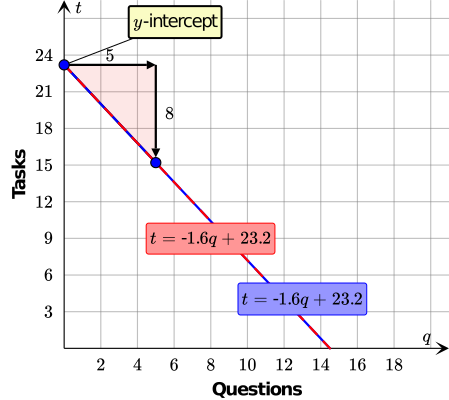
5t+8q=116 & (I) 12.5t=290-20q & (II)
▼
(I), (II): Write in slope-intercept form
SubEqn
(I): LHS-8q=RHS-8q
5t=- 8q+116 12.5t=290-20q
DivEqn
(I): .LHS /5.=.RHS /5.
t= - 8q5+ 1165 12.5t=290-20q
CommutativePropAdd
(II): Commutative Property of Addition
t= - 8q5+ 1165 12.5t=- 20q+290
DivEqn
(II): .LHS /12.5.=.RHS /12.5.
t= - 8q5+ 1165 t= - 20q12.5+ 29012.5
(I), (II): Put minus sign in front of fraction
t=- 8q5+ 1165 t=- 20q12.5+ 29012.5
(I), (II): a* b/c=a/c* b
t=- 85q+ 1165 t=- 2012.5q+ 29012.5
(I), (II): Calculate quotient
t=- 1.6q+23.2 t=- 1.6q+23.2
The lines overlap each other. They intersect at infinitely many points, which means that the system of equations has infinitely many solutions. This indicates that the system of equations was not set up properly. Maybe the same information was written in two different ways, which resulted in two equations that represent the same line.
Example
Share
Report error
Scavenger Hunt
Later in the evening, Mark suggested doing a scavenger hunt. All the hunters were split into two teams. The team that found the most items would win.
 Team 1, the Adventure Seekers, found a items. Team 2, the Mystery Solvers, found m items. Mark’s parents tallied up the scores and, to make it more of a challenge, decided to give the scores as a system of equations. Whoever solves the system will get an extra gift! 9a+4m=54 2m=34-4.5a Solve the system using the graphing method to find how many items each team found.
External credits: @upklyak
{"type":"text","form":{"type":"equation","options":{"comparison":"1","nofractofloat":false,"keypad":{"simple":true,"useShortLog":false,"variables":[],"constants":[]},"rendered":false},"text":"","description":[{"id":0,"text":"a"},{"id":1,"text":"m"}]},"formTextBefore":null,"formTextAfter":null,"answer":{"text":[{"id":0,"text":""},{"id":1,"text":""}],"noSolution":true,"infiniteSolution":false}}
Hint
Begin by rewriting the equations into slope-intercept form. Then, graph both equations on the same coordinate plane using their slopes and y-intercepts.
Solution
The given system of equations needs to be solved graphically.
9a+4m=54 2m=34-4.5a To do so, both equations should be rewritten in slope-intercept form first. Let a be the independent variable and m be the dependent variable.
Notice that the equations have the same slope of - 2.25 but different y-intercepts. This means that the lines are parallel. Graph them using the slope and the y-intercepts.
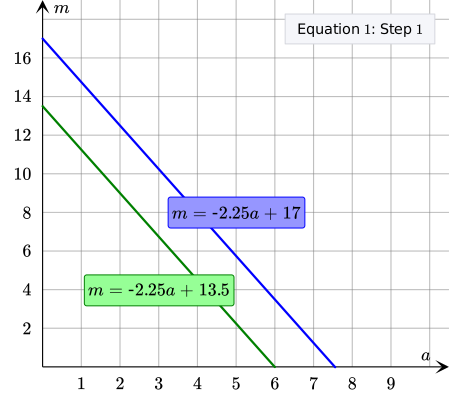 Recall the the solution to the system of equations is the point of intersection of the lines. However, since the lines are parallel, they never intersect. Therefore, there is no solution to the system of equations. Since Mark's parents are not mathematicians, they probably made a mistake, so their system did not work.
9a+4m=54 & (I) 2m=34-4.5a & (II)
▼
(I), (II): Write in slope-intercept form
SubEqn
(I): LHS-9a=RHS-9a
4m=- 9a+54 2m=34-4.5a
CommutativePropAdd
(II): Commutative Property of Addition
4m=- 9a+54 2m=- 4.5a+34
DivEqn
(I): .LHS /4.=.RHS /4.
m= - 9a+544 2m=- 4.5a+34
DivEqn
(II): .LHS /2.=.RHS /2.
m= - 9a+544 m= - 4.5a+342
(I), (II): Write as a sum
m= - 9a4+ 544 m= - 4.5a2+ 342
(I), (II): Put minus sign in front of fraction
m=- 9a4+ 544 m=- 4.5a2+ 342
(I), (II): Calculate quotient
m=- 2.25a+13.5 m=- 2.25a+17
Pop Quiz
Share
Report error
Determining the Number of Solutions to a System of Equations
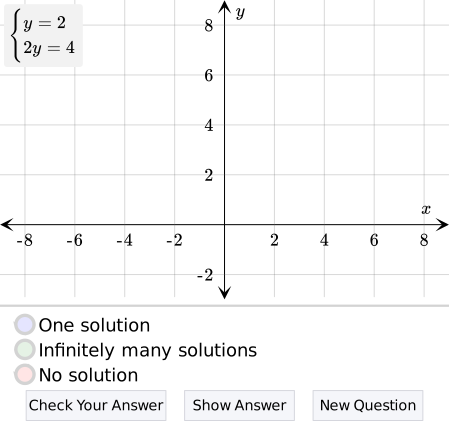
Consider the given system of equations. Does it have zero, one, or infinitely many solutions?
Closure
Share
Report error
Identifying the Number of Solutions From Slope-Intercept Form
This lesson focused on solving systems of linear equations by graphing. When equations in the system are written in standard or point-slope form, it is unclear how many solutions the system has. However, the situation is different when it comes to slope-intercept form. Slope-Intercept Form y=mx+b If both equations of the system of equations are in slope-intercept form, there is no need to graph them in order to find the number of solutions. It can be found by analyzing the slopes and y-intercepts of the equations.
| Characteristics | Number of Solutions |
|---|---|
| Same slope and same y-intercept | Infinitely many solutions |
| Same slope and different y-intercepts | No solution |
| Different slopes | One solution |
Solving System of Equations Graphically
Exercise 3.1
One equation in a system is y= 56x-7.
Write a second equation so that the system has one solution, then graph the system.
Write a second equation so that the system has no solutions, then graph the system.
Write a second equation so that the system has infinitely many solutions, then graph the system.
security
report
code
security
report
code
We are asked to write a second equation to form a system with one solution. Let's begin by analyzing the given equation. y=5/6x-7 Recall that lines that have different slopes will always have one point of intersection. This means that if we keep the same y-intercept and change the slope, the only point of intersection will be the shared y-intercept. While we could use a different slope and y-intercept, at minimum, we just need to choose a different slope. Let's use - 2 for our equation. y=- 2x-7 Together the equations form the following system of equations. y= 56x-7 y=- 2x-7 Let's graph the system on a coordinate plane to make sure the lines have only one solution, represented by only one point of intersection.
Keep in mind that the second equation is an example equation, so answers may vary.
We are asked to write a second equation to form a system with no solutions. This means that the two lines must be parallel — in other words, they should have the same slope and cannot share an y-intercept. Let's recall the slope and the y-intercept of the given equation. Slope: & 5/6 [0.5em] y-intercept: & - 7 We need to keep the same slope and choose another y-intercept. Let's use - 4 for our example. y=5/6x-4 This way we get the following system of equations. y= 56x-7 y= 56x-4 Let's now graph both equations.
Keep in mind that the second equation is an example equation, so answers may vary.
We need to write a second equation so that there are infinitely many solutions. This means that the lines must intersect at each and every point on both of the lines. For this to be true, the two lines must be coincidental, or the same line. They should have the same equation or be different forms of the same equation. y=5/6x-7 We can create a different form of this equation by multiplying both sides of the equation by any non-zero number — for example, 6. y * 6=(5/6x-7) * 6 ⇓ 6y=5x-42 This equation and the given one form the following system of equations. y= 56x-7 6y=5x-42 Let's graph this final system of equations to make sure that they are indeed the same line and have infinitely many solutions.
Keep in mind that the second equation is an example equation, so answers may vary.
security
report
code
Solving System of Equations Graphically
Recommended exercises
To get personalized recommended exercises, please login first.
Loading content
≤
>
■2
■▢
e▢
7
8
9
×
÷■1
=
=
√▢
▢√
∫▢▢
4
5
6
+
−
≤
<
log
ln
log▢
1
2
3
()
∣
sin
cos
tan
0
.
π
x
y
Loading content